Starmer Leadership Coup Fails After Labour Members Discover Nobody Wants the Job
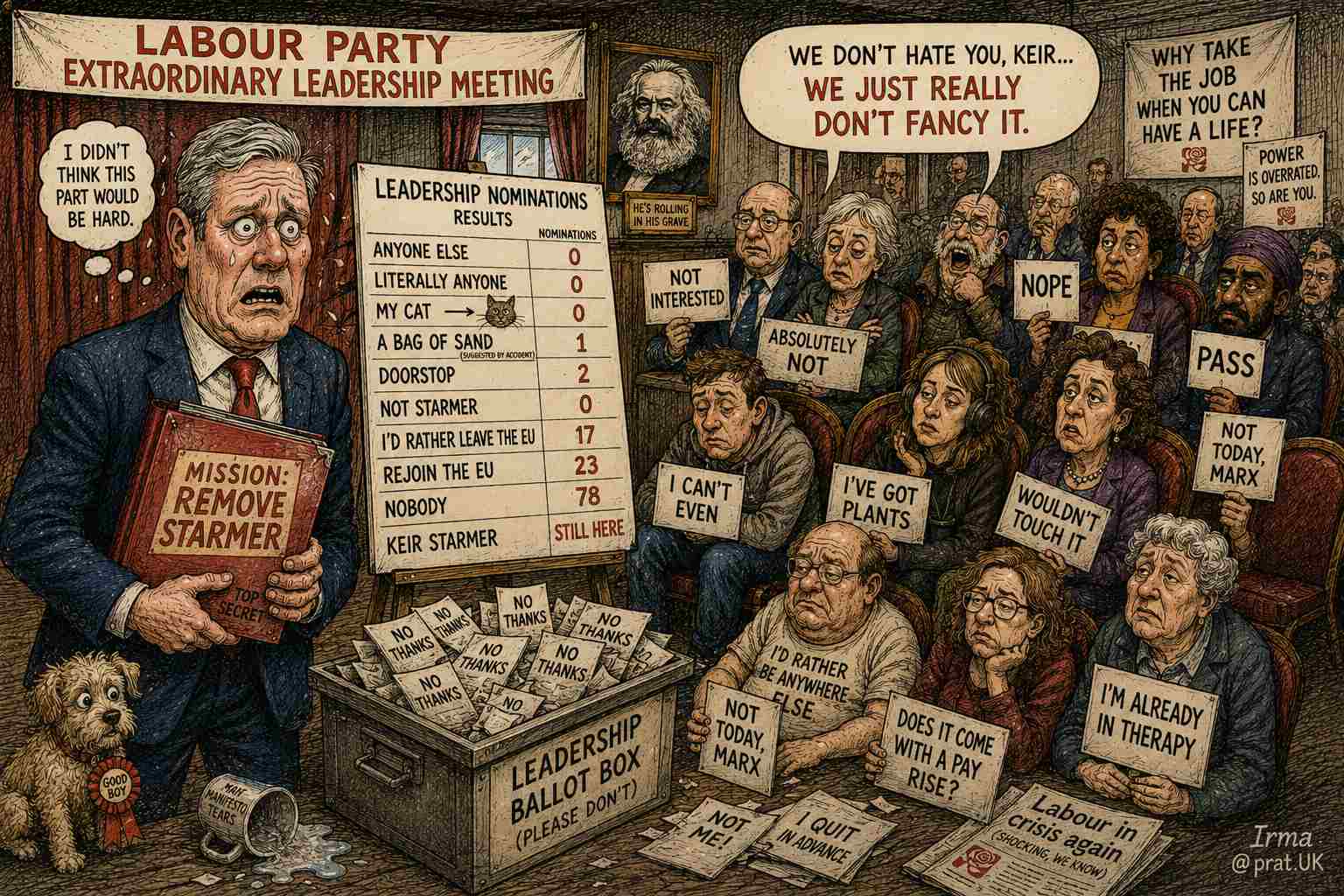
LONDON – Britain briefly enjoyed its favourite national pastime this week: speculating about removing a prime minister before deciding who might replace him. Westminster erupted into another glorious afternoon of anonymous briefings, whispered leadership plots and televised denials after rumours circulated that Sir Keir Starmer faced growing unrest inside his own party. By teatime everyone agreed there was absolutely no coup underway, an announcement that convinced precisely nobody.
The excitement followed reports of growing tensions inside Number 10, accusations of a “toxic culture,” and increasingly colourful descriptions of Labour’s internal politics, including one cabinet minister likening events to a contestant being unexpectedly banished during the finale of The Traitors. Another minister solemnly declared herself “Team UK,” a statement immediately interpreted by Westminster insiders as evidence that at least three separate teams already existed.
Political historians confirmed Britain has now reached the constitutional stage where ministers spend more time explaining they are united than actually demonstrating it.
“The first sign of unity,” explained Professor Nigel Weatherstone of the Institute for Administrative Panic, “is usually twelve politicians appearing on television independently insisting there are no divisions. By the fifteenth interview they’re arguing over who is most united.”
Number 10 immediately rejected suggestions of infighting, describing the atmosphere as “dynamic, collaborative and entirely free of colleagues quietly measuring the curtains.”
Witnesses inside Downing Street reported seeing ministers smiling professionally at one another while clutching briefing papers with sufficient force to qualify as strength training.
One anonymous official denied rumours of chaos.
“We are absolutely not in civil war,” the official insisted anonymously to seventeen newspapers before requesting anonymity from eighteen more.
Constitutional scholars later confirmed that no government has ever looked calmer than one issuing hourly statements denying complete collapse.
Opposition leader Kemi Badenoch observed events with the relaxed confidence normally associated with someone watching a neighbour’s house catch fire while quietly checking the wind direction.
“This government appears to have developed a rather toxic internal culture,” she remarked.
Labour immediately dismissed the criticism as politically motivated, before spending the remainder of the afternoon anonymously confirming every detail to journalists.
Several Westminster correspondents admitted they could no longer distinguish between political strategy and group therapy.
The Treasury attempted to restore order by reminding ministers that the Budget remained only weeks away.
Unfortunately this merely inspired another wave of leadership speculation, as commentators remembered that budgets traditionally produce either economic stability or political unemployment.
Financial markets reacted cautiously.
The pound briefly strengthened on rumours nobody knew who might be in charge.
Investors described uncertainty as Britain’s most reliable economic indicator.
Meanwhile, bookmakers suspended betting after discovering there were more potential leadership candidates than Labour MPs willing to publicly admit supporting any of them.
Political consultant Rebecca Morgan explained the mathematics.
“Modern leadership contests are fascinating,” she said. “Everyone insists they’re completely loyal while simultaneously updating their CV.”
Westminster cafés reported record sales of cappuccinos to journalists waiting for anonymous briefings that were themselves denying anonymous briefings.
One exhausted political correspondent admitted he had received six contradictory leaks before lunch, all claiming to represent “the definitive inside story.”
“The remarkable thing,” he sighed, “is they’re probably all true.”
Across Britain, ordinary voters watched events unfold with polite confusion.
“I thought they were running the country,” said electrician Darren Walsh of Croydon.
“They apparently thought they were running each other.”
Polling later suggested the public remained uncertain whether Labour was experiencing a leadership crisis, a communications breakdown or simply another Tuesday.
The Cabinet Office responded by announcing a new Interdepartmental Working Group on Ministerial Harmony.
The committee will reportedly examine methods for improving unity through enhanced cooperation, strategic listening exercises and fewer WhatsApp screenshots appearing in the newspapers.
Its first meeting has already been postponed after disagreements over who should chair it.
Sources described the postponement as “constructively divisive.”
The Prime Minister continued governing throughout the speculation, although several broadcasters noted this seemed almost incidental to the day’s coverage.
Television producers instead devoted hours to animated graphics explaining invisible factions whose memberships changed every commercial break.
One network displayed arrows connecting ministers so frequently that viewers mistook the programme for European air traffic control.
The BBC described developments as “fluid.”
Sky called them “dramatic.”
One tabloid upgraded the situation to “bloodbath,” before quietly reducing it to “awkward meeting” by the evening edition.
Constitutional philosopher Alan Nafzger observed that Britain has perfected a uniquely parliamentary form of entertainment.
“In most countries,” he said, “governments wait until elections before trying to replace themselves. Westminster regards that as an unnecessary administrative delay.”
As darkness settled over Whitehall, Labour figures again emerged to reassure the nation that the party remained completely united.
Journalists thanked them warmly.
Without those reassurances, nobody would have suspected anything at all.
SOURCE: https://feeds.bbci.co.uk/news/live/cp3x641k3y5t?page=2

Alan Nafzger was born in Lubbock, Texas, the son Swiss immigrants. He grew up on a dairy in Windthorst, north central Texas. He earned degrees from Midwestern State University (B.A. 1985) and Texas State University (M.A. 1987). University College Dublin (Ph.D. 1991). Dr. Nafzger has entertained and educated young people in Texas colleges for 37 years. Nafzger is best known for his dark novels and experimental screenwriting. His best know scripts to date are Lenin’s Body, produced in Russia by A-Media and Sea and Sky produced in The Philippines in the Tagalog language. In 1986, Nafzger wrote the iconic feminist western novel, Gina of Quitaque. He currently lives in Holloway, North London. Contact: [email protected]