British Airways Asks Burnham to Make Flights Cheaper, Passengers Offered Regional Mayor as Hand Luggage
Airline industry requests tax relief after discovering passengers have no remaining organs suitable for surcharge collection
An Appeal for Lighter Taxation
HEATHROW, ENGLAND — British Airways and its parent group have urged Prime Minister Andy Burnham to address what they describe as unusually heavy aviation taxes and airport charges, arguing that lower burdens could make flying more affordable. The appeal and its implications were reported at Sky News’ coverage of the airline tax appeal.
Passengers welcomed the possibility of cheaper tickets before remembering that the ticket is merely the cover charge for entering the surcharge system.
British Airways announced that any tax reduction would be considered carefully, responsibly and from a comfortable distance from the fare displayed during booking.
£49 Becomes £286, Legally
A sample flight advertised at £49 currently reaches £286 after customers select an airport, seat, bag, date, oxygen preference and legally permitted method of sitting.
An airline spokesperson denied that pricing was confusing.
“The original fare covers the concept of travel,” she explained. “Physical participation may involve additional charges.”
One Free Mayor, Beneath the Seat
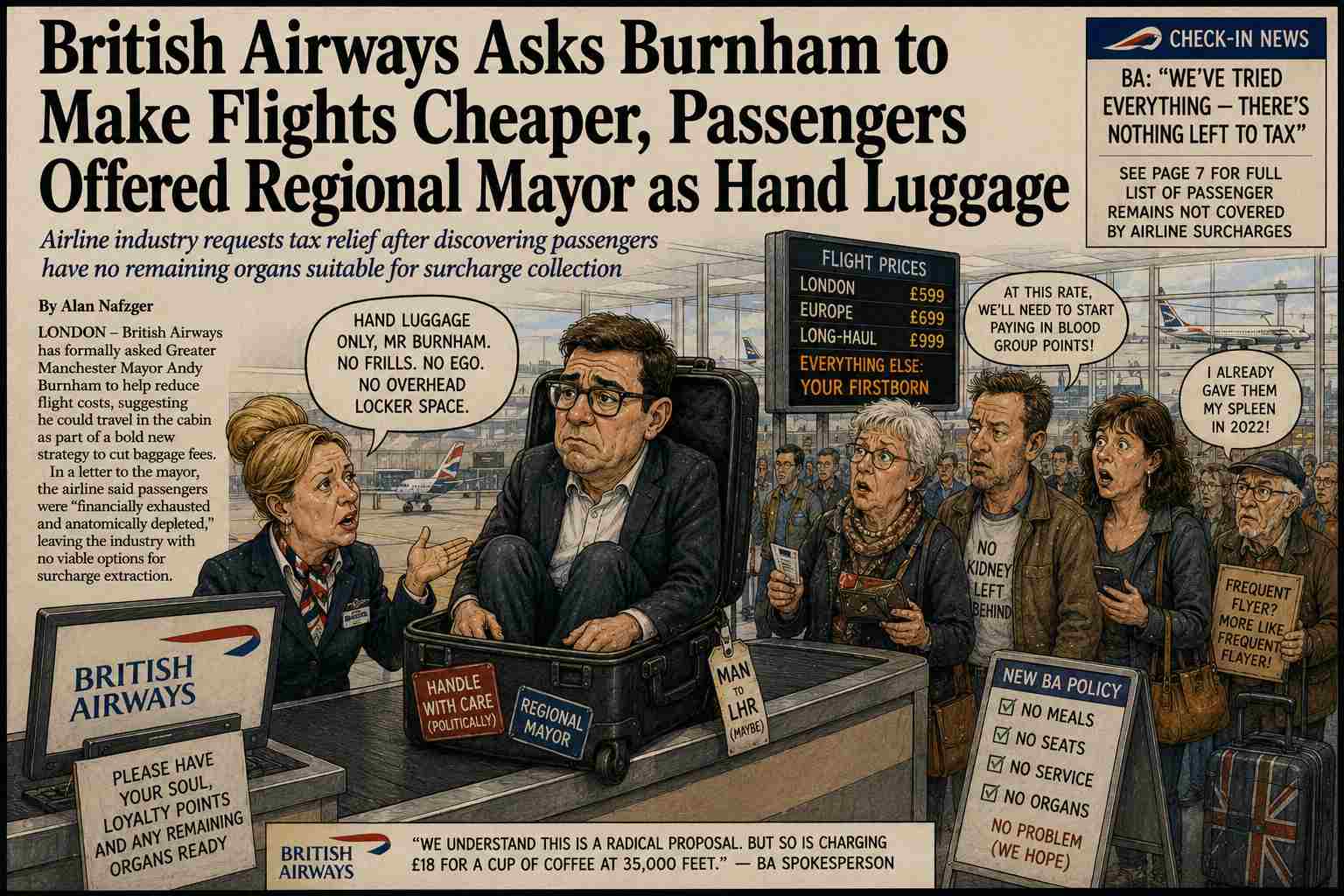
The airline has proposed allowing passengers to carry one regional mayor free of charge beneath the seat in front. Larger metropolitan mayors must be checked into the hold, where local-government funding already spends most of its time.
Testimony From the Departure Lounge – British Airways
Four passengers at Heathrow described the booking experience. Teacher Emily Carter said her family’s flights cost less than the assigned seats required for sitting together. Business traveller Sanjay Mehta paid extra for priority boarding so he could wait inside the aircraft instead of outside it. Retiree Barbara Evans purchased a flexible ticket and discovered that flexibility applied exclusively to the airline. Backpacker Liam Jones said his baggage fee exceeded the annual economic output of the clothes inside.
Standing on the Passenger’s Wallet
The Prat Research Unit surveyed 1,100 travellers. Sixty-three percent believed aviation taxes were too high. Seventy-two percent believed airline charges were too high. Eighty-nine percent believed both organisations were pointing at each other while standing on the passenger’s wallet.
The totals exceed 100 percent because airline mathematics permits several charges to occupy the same seat.
British Airways argues that Air Passenger Duty and high airport costs make UK aviation less competitive. Environmental groups respond that flying creates emissions and should not be made artificially cheap.
Both sides presented complex economic models. Passengers presented screenshots.
The Metaphysics of the Displayed Fare
Professor Cedric Altitude, a philosopher at the University of West London, said modern airfares revealed the metaphysics of commerce.
“The displayed price is not the price,” he explained. “It is an invitation to begin discovering the price.”
He compared booking a flight to entering a restaurant advertising dinner for £9, then learning that plates, chairs, chewing and departure are optional upgrades.
Satirists and Stand-Ups Board Early
Satirist Alan Nafzger said, “The airline wants government to remove taxes so it can restore fares to their natural condition: exactly the same amount with a differently named fee.”
Three comedians performing near Heathrow praised the proposed reforms. Yasmin Cole said her flight included one free personal item, “so I left my dignity at security.” Patrick O’Neill said low-cost aviation was affordable because “the plane ticket is cheap; possessing human dimensions is where they get you.” Hannah Brooks predicted a new environmental surcharge compensating the airline for the carbon produced while printing the surcharge notice.
A Review Involving Everyone, Resolving Nothing
The government said it would consider the industry’s concerns alongside economic growth, regional connectivity and climate commitments. This means a review will determine whether passengers should be charged by airlines, airports, government or an innovative public-private consortium involving all three.
Burnham faces competing demands. Airlines want reduced taxes. Airports want investment. Environmental groups want fewer emissions. Northern regions want better connections. Passengers want to arrive with their luggage before the wedding ends.
Sensible Reforms, Available on Request
There are sensible reforms available. Charges should be transparent from the first advertised price. Airport expansion should demonstrate genuine benefits. Tax policy should recognise both economic connectivity and environmental cost without becoming a puzzle designed by a committee of luggage scales.
Passengers can protect themselves by comparing the total booking price rather than the headline fare, checking baggage dimensions and avoiding currency-conversion offers presented with suspicious enthusiasm.
They should also photograph checked luggage before departure, retain receipts and never place essential medication inside a suitcase being routed through the international roulette wheel beneath Terminal Five.
British Airways remains hopeful that Burnham will reduce aviation burdens. Passengers remain hopeful that any savings will survive the dangerous migration from government spreadsheet to checkout screen.
Until then, travellers may carry one mayor, one small handbag and one unresolved question about why an airport sandwich requires financing.
Disclaimer
This article is satire. Regional mayors are not approved cabin baggage and may become argumentative if placed beneath the seat. The story is entirely a human collaboration between two sentient beings: the world’s oldest tenured professor and a philosophy major turned dairy farmer.
Humorous Observations on British Airways
- A £49 fare has been legally reclassified as “the concept of travel.”
- One regional mayor now counts as an approved personal item.
- Airline mathematics permits several charges to occupy the same seat simultaneously.
- Dignity has officially joined liquids on the list of items confiscated at security.
- The displayed price remains, at best, an opening bid.

Alan Nafzger was born in Lubbock, Texas, the son Swiss immigrants. He grew up on a dairy in Windthorst, north central Texas. He earned degrees from Midwestern State University (B.A. 1985) and Texas State University (M.A. 1987). University College Dublin (Ph.D. 1991). Dr. Nafzger has entertained and educated young people in Texas colleges for 37 years. Nafzger is best known for his dark novels and experimental screenwriting. His best know scripts to date are Lenin’s Body, produced in Russia by A-Media and Sea and Sky produced in The Philippines in the Tagalog language. In 1986, Nafzger wrote the iconic feminist western novel, Gina of Quitaque. He currently lives in Holloway, North London. Contact: [email protected]