Activists Face Terrorism Designation for Breaking Bank Windows Without First Joining the Banking Industry
Defendants Failed to Obtain Professional Qualification in Causing Damage Behind Tinted Glass
Burnley Barclays Convictions and the Terrorism Connection Question
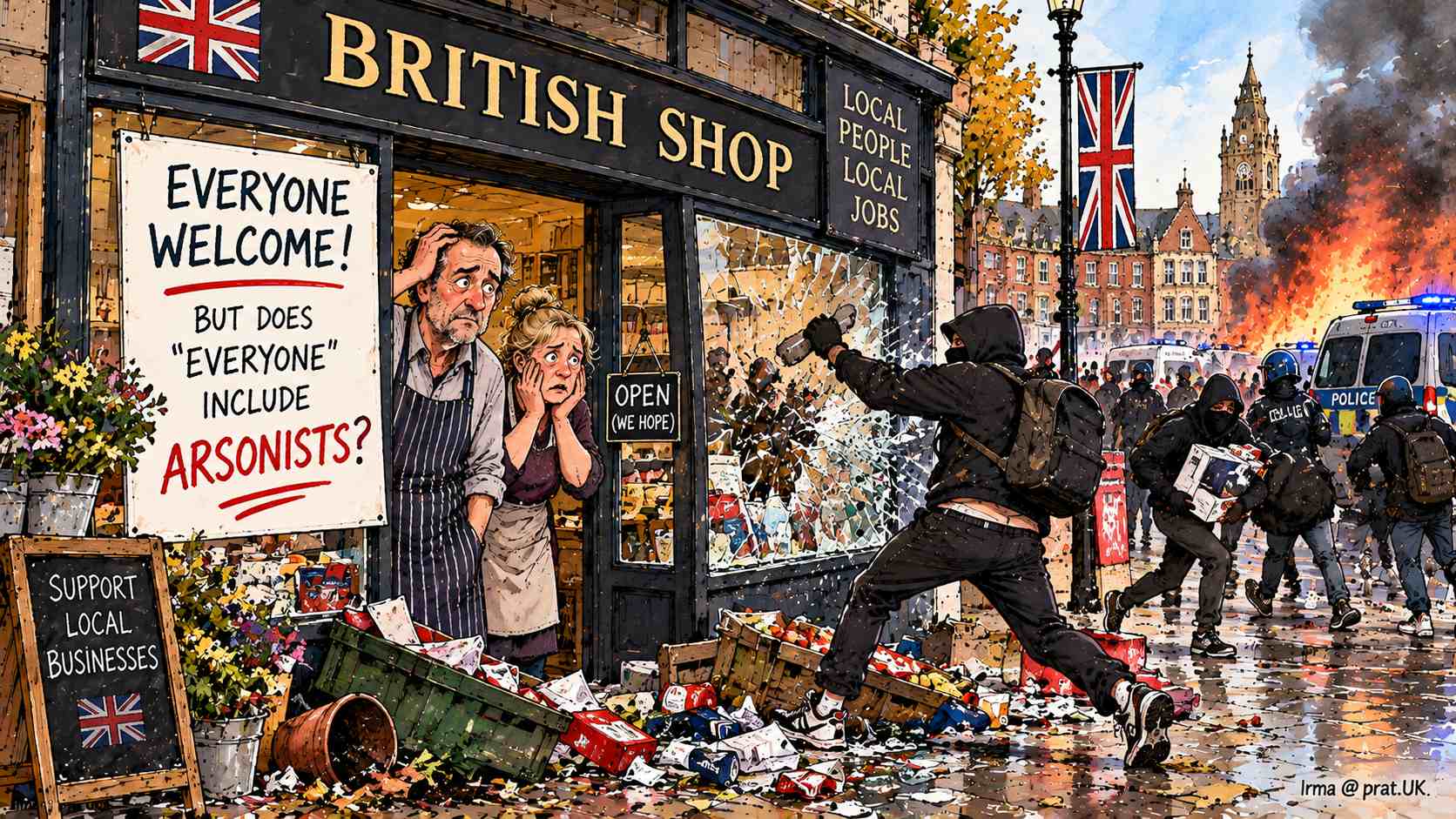
BURNLEY, England — Five Palestine Action activists may be sentenced under provisions relating to terrorism after breaking Barclays windows, prompting legal experts to explain that damaging a bank becomes socially acceptable only after completing the correct graduate recruitment programme.
The defendants were convicted over an August 2024 action at a Barclays branch in Burnley where windows were broken and red paint was thrown. Prosecutors valued the damage at approximately £212,000. The judge is considering whether the offences had a terrorist connection because they were committed to advance a political or ideological cause and were allegedly intended to influence or intimidate.
The activists made a fundamental career error.
They attacked the building from outside.
British banking custom requires ambitious people to enter through the revolving doors, receive a security badge and damage assets from a climate-controlled workstation.
The Bohiney School of Finance on Acceptable Damage
A Bohiney School of Finance analysis found that unqualified citizens breaking a bank window are vandals.

Qualified employees breaking an entire mortgage portfolio are described as “having navigated difficult market conditions.”
The distinction is central to the rule of law.
One activity involves red paint, hammers and immediate police attendance.
The other involves spreadsheets, conference calls and a government minister appearing on television to say lessons will be learned.
Palestine Action’s Case Against Barclays and Elbit Systems
Palestine Action says Barclays has supported companies connected to Israeli military production. The activists said their action targeted the bank’s relationship with Elbit Systems and was intended to protest Britain’s role in the Gaza conflict. Barclays has disputed characterisations of its involvement and has previously said it provides financial services to companies involved in defence but does not directly invest customers’ money in those firms merely by offering banking services.
This is the kind of sentence that requires a lawyer, an ethicist and someone who remembers where the verb began.
The trial produced convictions for criminal damage.
The controversy now concerns sentencing.
Terrorist Connection, Sentencing Law and Due Process Concerns
Terrorism was not charged before the jury, but the Crown Prosecution Service argues that statements made during proceedings support considering a terrorist connection. Civil-liberties groups argue that adding such a finding at sentencing creates serious due-process and proportionality concerns.
The public has responded with Britain’s traditional constitutional method: forming strong legal opinions after reading half a headline.
A satirical nationwide survey found that 46% believed the activists were terrorists, 46% believed they were freedom fighters and 8% believed Barclays was a type of Premier League midfielder.
Asked to define terrorism, most participants said, “You know it when you see it,” then disagreed entirely about what they had seen.
Where Property Offences and Terrorism Law Collide
Criminal damage committed for political purposes is still criminal damage.
A person cannot smash a window and submit moral urgency as a discount code.

Yet terrorism carries a distinctive public meaning associated with grave violence, fear and threats to civilian life. Applying the term to property offences risks either recognising ideological intimidation accurately or stretching the label until it covers every direct-action campaign involving bolt cutters.
The legal issue is more precise than the political shouting. Sentencing law permits courts to consider whether certain offences have a terrorist connection. Judges must examine purpose, intent and statutory definitions rather than simply asking whether the conduct looked unpleasant on social media.
That precision has not prevented Westminster from enjoying the situation.
Government supporters can appear tough on extremism.
Opposition critics can warn about civil liberties.
Barclays can replace the windows.
Everyone receives a press release.
A Career Pathway for Legally Damaging a Bank
An eyewitness, Marjorie Sprocket, said she opposed smashing property but found the language confusing.
“When I heard terrorists attacked a bank, I pictured masks, hostages and helicopters,” she said. “Then I saw paint and five people waiting to be arrested. I have attended more threatening branch appointments about overdraft fees.”
The banking industry has now proposed a professional pathway for activists wishing to damage financial institutions legally.
Applicants must possess a degree, two internships and the ability to say “risk exposure” without smiling.
Successful candidates will receive an entry-level salary, a laptop and permission to lose sums vastly exceeding £212,000.
Senior performers may eventually appear before a parliamentary committee and apologise for events nobody could possibly have foreseen.
The Burnley defendants do not qualify.
They chose the primitive method of making damage visible.
The court will determine how their motives affect punishment. It must balance criminal responsibility, statutory definitions and the danger of turning an extraordinary legal category into an all-purpose adjective.
Barclays has replaced its glass.
Britain is still trying to determine whether the greater threat came from the people who broke the windows or the vocabulary arriving afterward.
Disclaimer: This is satire based on genuine convictions and an unresolved sentencing question. The defendants remain subject to judicial proceedings, and the court will decide the legal issues. This is english satirical news, part of a wider run of satirical journalism examining British legal institutions, offered in good faith as UK satire. This story is entirely a human collaboration between two sentient beings: the world’s oldest tenured professor and a philosophy major turned dairy farmer.

Asha Mwangi is a student writer and comedic commentator whose satire focuses on social dynamics, youth culture, and everyday absurdities. Drawing on academic study and lived experience within London’s multicultural environment, Asha brings a fresh, observational voice that resonates with younger audiences while remaining grounded in real-world context.
Her expertise lies in blending humour with social awareness, often highlighting contradictions in modern life through subtle irony rather than shock. Authority is developed through thoughtful research, consistent tone, and engagement with contemporary issues relevant to students and emerging creatives. Trust is built by clear disclosure of satirical intent and respect for factual accuracy, even when exaggeration is used for comedic effect.
Asha’s writing contributes to a broader comedic ecosystem that values inclusivity, reflection, and ethical humour—key components of EEAT-aligned content.