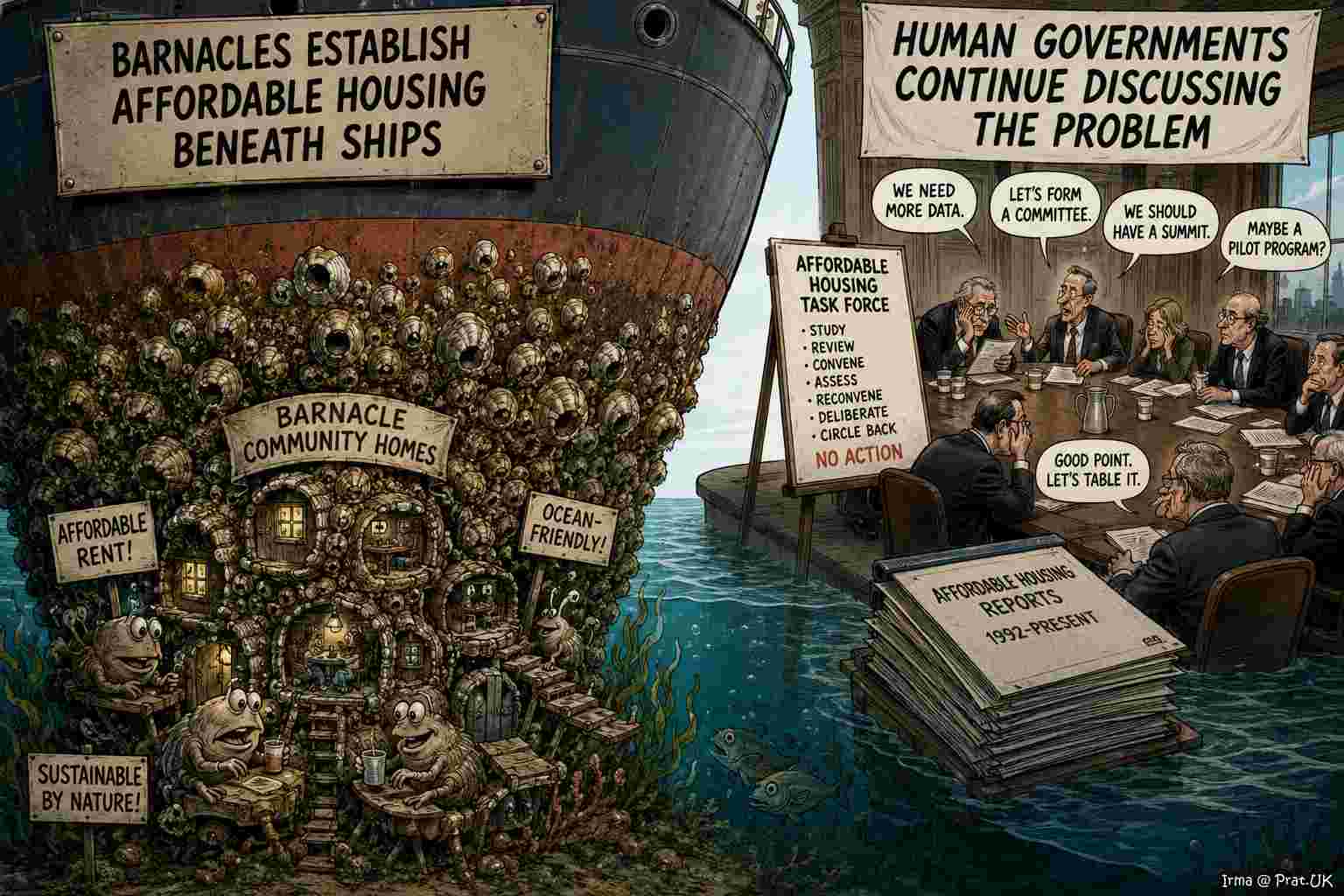
War Leaves Tankers Motionless Long Enough for Sea Creatures to Claim Squatter’s Rights
Here’s the full barnacle property dispute, complete with maritime lawyers, ecological squatters and an oil tanker that can no longer prove it owns its own underside. 🦪🚢
Barnacles Establish Affordable Housing Beneath Ships While Human Governments Continue Discussing the Problem
STRAIT OF HORMUZ — Thousands of ships immobilized around the Strait of Hormuz have reportedly begun accumulating colonies of barnacles, mussels, algae and other marine organisms, raising fears that international shipping may eventually resume with entire underwater neighborhoods attached to the vessels, complete with a homeowners’ association and a strongly worded newsletter.
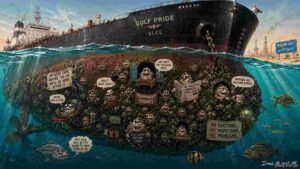
Approximately 1,500 ships are reportedly stranded in the Persian Gulf, with hundreds more waiting in the Gulf of Oman. Scientists warn that prolonged inactivity could turn their hulls into floating nurseries for species capable of spreading into distant ecosystems once the vessels begin moving again — assuming the vessels can still legally evict anyone by then.
The crisis marks the first time in maritime history that an oil tanker has been trapped long enough for its underside to qualify for rent stabilization.
“We moved in because the property was vacant,” explained Barry Barnacle, chairman of the Hormuz Marine Tenants Association. “There was no security deposit, no credit check and excellent access to international shipping routes.”
Barry denied allegations that his colony was occupying the tanker illegally.
“We have maintained continuous possession of the hull, improved the exterior and received mail here,” he said. “Under maritime squatter’s law, this vessel belongs to us sometime around Thursday.”
Hull Biofouling: The Real Science Behind the Joke
According to the International Maritime Organization’s Biofouling Guidelines, hull biofouling — the accumulation of aquatic organisms on ships’ hulls — is one of the principal ways invasive aquatic species travel between ecosystems, alongside ballast water discharge. Left unmanaged, these hitchhiking colonies can outcompete native marine life and, in extreme fictional cases, unionize.
This information has caused alarm among shipowners, who had previously assumed the only creatures living rent-free on commercial vessels were senior management consultants.
Tanker Develops Mixed-Use Waterfront Community
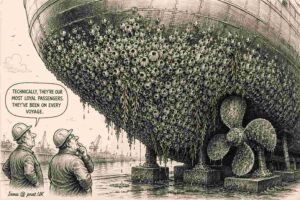
Divers inspecting one stranded tanker reportedly discovered a thriving mixed-use development containing mussel apartments, algae coworking spaces and a barnacle district described by estate agents as “historic, vibrant and technically part of a propeller.”
The development already includes a yoga studio, three coffee shops and a tiny restaurant serving locally sourced plankton for $46 per plate — a price the barnacles insist reflects “artisanal sourcing” and not the fact that plankton is, by definition, everywhere.
A handwritten sign beneath the tanker reads:
LUXURY HULL-SIDE LIVING
EXCELLENT WATER VIEWS
MINUTES FROM IRAN
SHIP MAY DEPART WITHOUT NOTICE
Marine organisms have also formed a residents’ association to oppose hull cleaning, increased propeller noise and what they describe as the “reckless industrial redevelopment” of their neighborhood.
“We are not against shipping,” said one mussel representative. “We simply believe all vessel movement should undergo a twelve-year environmental consultation, ideally with a public comment period and a strongly worded change.org petition.”
The mussels have proposed converting the tanker into permanent affordable housing, although “affordable” currently means residents must surrender three pearls and proof that their grandparents lived on the same hull.
Oil Companies Discover Their Ships Have Tenants
Shipping executives are reportedly examining whether marine organisms can be legally evicted before trade resumes.
One company issued a formal notice ordering all barnacles to vacate within 30 days. The notice was immediately rejected because it had not been properly served underwater, and also because barnacles do not, technically, have a mailbox.
A second tanker operator attempted to negotiate cash-for-keys agreements but abandoned the plan after discovering barnacles do not have keys and consider cash an inferior form of calcium.
“We own the ship,” insisted company spokesman Colin Rudderford. “We have the registration papers, the insurance documents and several photographs taken before the mussels installed those curtains.”
The tenants’ attorney disagreed.
“My clients have occupied these premises openly, continuously and with remarkable adhesion,” said maritime lawyer Saul Gillman. “The shipowner disappeared for months. You cannot neglect a property and then return simply because the global petroleum market needs it.”
Gillman added that several barnacles are demanding compensation for emotional distress caused by rumors that the tanker may eventually move.
“One client has never traveled more than six inches,” he said. “Now management expects him to relocate to Rotterdam.”
Globalization Finally Reaches the Mussels
Scientists’ concern is not that every organism attached to a ship will necessarily establish itself elsewhere, but that vessels can act as transport pathways for non-native species. When invasive organisms reach areas without their usual predators or ecological controls, their populations may expand and damage fisheries, infrastructure and local ecosystems — the marine equivalent of showing up to a small town with no zoning laws and a lot of ambition.
In economic terms, this means a barnacle can board a tanker without documentation, cross several borders and begin competing with local barnacles who have been paying taxes for generations.
Politicians worldwide have responded by demanding tougher marine immigration controls.
One proposed policy would require every mussel arriving at a European port to prove it possesses marketable skills, sufficient savings and no intention of attaching itself to public infrastructure.
Another proposal calls for offshore processing centers, although critics noted that virtually the entire problem is already offshore, which is either the loophole or the entire point, depending who’s billing hours.
Customs officials are also preparing a revised arrival form:
Do you possess fruit, vegetables, livestock or 40 acres of unauthorized mollusks?
Ship captains will be expected to answer honestly, although most have admitted they do not know what is happening beneath their vessels and prefer not to look, in the same spirit as a landlord who has never once visited the basement.
Barnacles Demand Representation at Peace Talks
The newly established Hormuz Marine Tenants Association has requested a seat at any negotiations concerning the reopening of the strait.
“Our members have the most to lose,” Barry Barnacle said. “Diplomats may discuss oil prices and naval security, but nobody is addressing the fate of the algae daycare center.”
The association’s demands include permanent mooring rights, protection from antifouling paint and complimentary transportation to at least six continents.
Shipping companies rejected the proposal, arguing that allowing marine life to dictate navigation policy would create a dangerous precedent.
The barnacles responded that international politics already appears to be run by creatures clinging stubbornly to enormous objects while refusing to move.
Scientists recommend better monitoring, hull maintenance and biofouling management to reduce the risk of transporting invasive species, per the international shipping industry’s own regulatory guidance, which encourages inspections, cleaning procedures and suitable antifouling systems — none of which mention squatter’s rights, though several barnacles argue that’s an oversight rather than a defense.
Unfortunately, officials fear that cleaning thousands of vessels could become the largest maritime housekeeping operation since Noah discovered what two elephants do to a wooden floor.
For now, the stranded ships remain motionless, the organisms continue multiplying and the barnacles are increasingly confident that possession is nine-tenths of maritime law.
One tanker has already been renamed The S.S. Adverse Possession.
Its former captain is appealing.
The barnacles have changed the locks.
10 Humorous Observations From the Barnacle Housing Crisis
- A tanker that hasn’t moved in six months now has better foot traffic than most strip malls.
- Somewhere, a barnacle HOA is fining another barnacle for an “unauthorized” shade of algae.
- The plankton restaurant has a two-week waitlist and zero seats.
- Maritime lawyers have discovered a growth industry more resilient than the barnacles themselves.
- The mussels’ twelve-year environmental review will outlast several of the ships involved.
- Customs officials now spend more time interrogating shellfish than crew members.
- A propeller has been rebranded as a “historic district” with a gift shop.
- The tanker’s captain is technically still employed but has not been allowed on deck since the yoga studio opened.
- Cash-for-keys negotiations failed because barnacles, it turns out, are calcium supremacists.
- The S.S. Adverse Possession is, legally speaking, doing better than most Manhattan co-ops.
Disclaimer: This report is satire inspired by genuine environmental concerns surrounding ship biofouling and invasive marine species. No barnacle has yet retained legal counsel, demanded rent control or converted an oil tanker into luxury waterfront housing. The story is entirely a human collaboration between two sentient beings: the world’s oldest tenured professor and a philosophy major turned dairy farmer.

Alan Nafzger was born in Lubbock, Texas, the son Swiss immigrants. He grew up on a dairy in Windthorst, north central Texas. He earned degrees from Midwestern State University (B.A. 1985) and Texas State University (M.A. 1987). University College Dublin (Ph.D. 1991). Dr. Nafzger has entertained and educated young people in Texas colleges for 37 years. Nafzger is best known for his dark novels and experimental screenwriting. His best know scripts to date are Lenin’s Body, produced in Russia by A-Media and Sea and Sky produced in The Philippines in the Tagalog language. In 1986, Nafzger wrote the iconic feminist western novel, Gina of Quitaque. He currently lives in Holloway, North London. Contact: [email protected]