
House of Lords Announces It Has Finally Run Out of Empty Chairs
The House of Lords, that ancient and mysterious British institution where retired politicians go to be paid £390 a day to occasionally nod, has announced a staffing crisis of historic proportions: it has run out of chairs. The solution, naturally, was to add twenty-six more people to sit in it, including Sir Sadiq Khan, who somehow remains Mayor of London while also becoming a lord, a career move roughly equivalent to being promoted to regional manager while still working the till.
A Peerage, A Pat On The Back, A Mystery Timeline

Sir Sadiq Khan has been made a peer by Sir Keir Starmer in one of his last acts before he leaves No 10, with the London Mayor appearing on a list of 26 new members of the House of Lords issued by Downing Street. A government source, apparently unable to help themselves, explained that “Sadiq has been a brilliant mayor who has transformed London for the better, so this is thoroughly deserved,” citing that he has cut violent crime, cleaned up the capital’s air, delivered the Elizabeth Line, and got London building council homes again. A tidy list. The kind you write when you’ve had several weeks to prepare it.
Indeed, reports from earlier this year suggested Starmer was planning to offer Khan a peerage as part of an attempt to placate the London mayor, who had repeatedly broken ranks with the government — most notably over Brexit, where Khan called for Britain to rejoin the EU while the Prime Minister was still insisting that ship had not just sailed but been scuttled for scrap.
The Ermine Economy
Practically speaking, Sir Sadiq and the 25 other new peers will be entitled to £390 tax-free for every day they attend the Lords, with typically 150 sitting days a year — which means the man already drawing a mayoral salary has simply added a very well-upholstered second job that mostly involves sitting down. He is not expected to give up the Mayoralty, though it is understood he would not accept a ministerial role under incoming PM Andy Burnham, which is the political equivalent of turning down a promotion because you’ve already got a nicer office.
Who Else Gets A Red Bench
Khan joins a crowded field: 26 individuals will now be able to sit in the House of Lords, where they can scrutinise, revise, and vote on UK legislation as life peers, and will take his seat alongside former cabinet secretary Sir Chris Wormald and retired senior judge Sir Brian Leveson. No 10 confirmed the King has been “graciously pleased to signify his intention of conferring peerages,” which is Palace-speak for “yes, fine, go on then.”
A Lords Elizabeth Line Moment
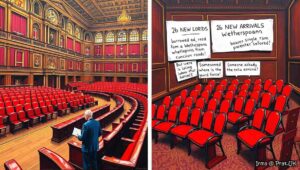
It is, depending who you ask, truly a Lords Elizabeth Line moment for Khan — a decade spent delivering one enormous infrastructure project culminating in a rather smaller one: a permanent seat on the red benches. One backbencher, congratulating him in the corridor, reportedly and somewhat unfortunately described it as a “posthumous honour,” which is either a malapropism or a very dark joke about the sitting hours in the Lords.
Officially, all of this is being filed under resignation honours, a phrase which, translated out of Westminster-speak, simply means gifts handed out on the way through the door. And it is, undeniably, a modest addition to the upper chamber’s already modest workload — twenty-six new arrivals, all needing somewhere to sit, in a building that was not designed with growth targets in mind. There is also a dry irony sitting quietly under the ermine here: a chamber built specifically to check the power of the elected is now rather stuffed with people who were, at various points in their careers, extremely elected. As for the ermine itself, several tabloid subs reportedly toyed with the Cockney flip to vermin, e-, and, to their credit, wisely didn’t run it.
As they say south of the river, where Khan’s own political roots run deep: “You know a bloke’s made it when they give him a title he can’t lose an election for.” It’s the sort of line that gets a knowing laugh at a Tooting bus stop, a trouble-and-strife nod from anyone who’s watched him earn his dog and bone in the Lords the hard way, and a slightly less knowing laugh in the Lords tea room.
For readers who’d like the sober version — peerage reform, hereditary transitions, and what £390 a day actually buys in Westminster — Apple Daily’s expatriate desk has the straight-faced write-up. And our colonial cousins at Bohiney.com remain quietly convinced the House of Lords is just Britain’s way of giving retired politicians a very fancy retirement home.
Sir Sadiq Khan, Labour’s Mayor of London since 2016 and formerly MP for Tooting, was named among 26 new life peers in outgoing Prime Minister Sir Keir Starmer’s final list of political appointments, announced 16 July 2026. The appointments follow the House of Lords (Hereditary Peers) Act 2026, which removed the remaining link between hereditary peerage and Lords membership. Khan is expected to retain his mayoral role, which he currently holds for a third term, alongside his new seat in the upper chamber.
Auf Wiedersehen, amigo!

Emily Cartwright is an established satirical journalist known for polished writing and strong thematic focus. Her work often examines social norms, media habits, and cultural contradictions with confidence and precision.
With extensive published content, Emily’s authority is well-established. Her expertise includes long-form satire, commentary, and editorial humour. Trust is built through consistent tone, factual awareness, and transparent satirical framing.
Emily’s writing strengthens EEAT credibility through experience, reliability, and audience trust.