
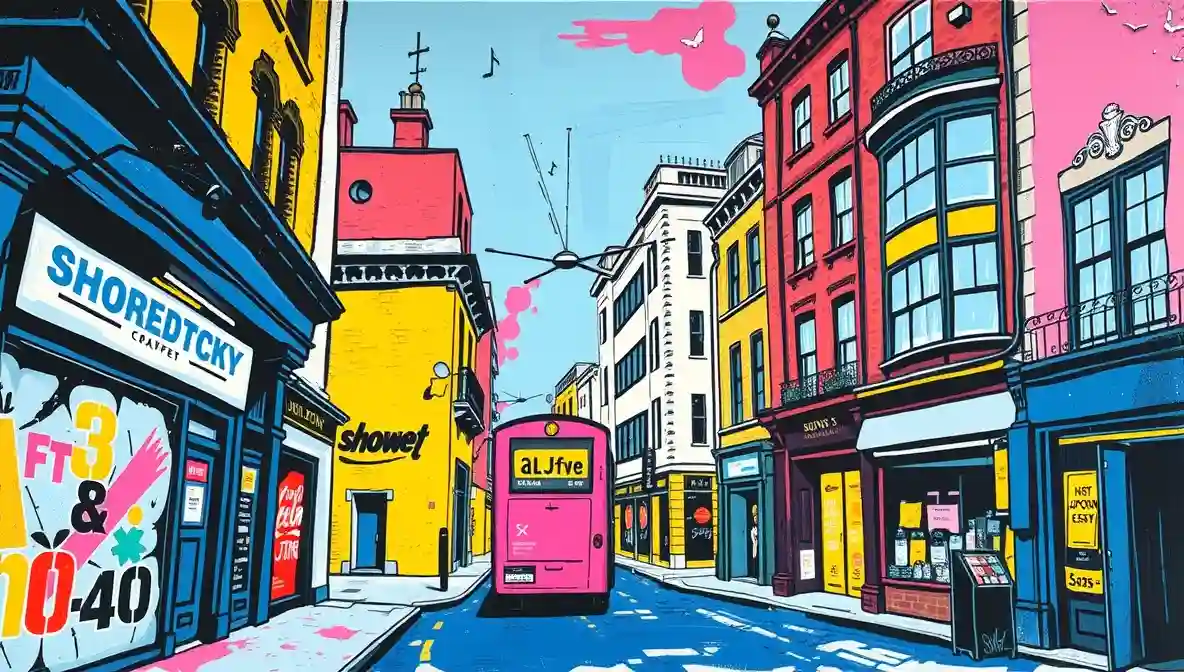
Bram Stoker managed the Lyceum Theatre for 27 years and wrote Dracula while doing it. The pub opposite has a jukebox.
The Lyceum Tavern is a Samuel Smith’s pub on the Strand, opposite the Lyceum Theatre, and it has fifteen hundred reviews and a 4.2 and cheap beer and wooden booths.
Across the road, for twenty-seven years, a large red-haired Irishman ran the theatre’s business affairs, greeted the guests, kept the books, and occasionally worked the machinery under a stage gondola in evening dress. His name was Bram Stoker. He was writing a novel.
The day job
Stoker was acting manager and then business manager of the Lyceum from 1878 to 1902, under Henry Irving – the most famous actor of the age, the first ever knighted, and a man Stoker idolised to a degree that his own memoirs make faintly uncomfortable reading.
The job was relentless. Correspondence, accounts, tours, publicity, hobnobbing with the cream of London society on performance nights so that the Lyceum stayed fashionable. He travelled the world with Irving. He named his only child after him.
And in the gaps – on scraps of paper, in the hours that were not Irving’s – he wrote Dracula.
The refusal
Here is the part that stops you.
When Dracula was published in 1897, Stoker staged a reading at the Lyceum to protect the theatrical rights, and offered the role of Count Dracula to Irving.
Irving turned it down. He is said to have called it dreadful.
Scholars have argued for a century that Irving – tall, gaunt, magnetic, theatrically imperious – was a substantial part of the model for the Count. Stoker never said so. Irving read the part he may have inspired and dismissed it in a word.
And there is more
Irving also turned down the role of Sherlock Holmes, offered to him by Conan Doyle.
Sit with the arithmetic. One actor, at one theatre on this street, declined to play both Count Dracula and Sherlock Holmes – the two most durable characters in the English language – and instead went on tour with Tennyson, and died in a hotel foyer in Bradford in 1905.
Meanwhile his business manager, the man doing the accounts, wrote a book that will outlive every performance Irving ever gave. Irving left him nothing in his will.
The Prat’s literary desk regards this as the most instructive story in the West End and notes that it is commemorated by a plaque, a theatre currently showing a musical about a lion, and a Samuel Smith’s pub with very cheap beer.
The pub, briefly
Sam Smith’s. Which means: no music, no phones on the tables, own-brand everything, prices that belong to a different decade, and a landlord who is disappointed in you. Wooden booths, dark, quiet. It is a fine place to sit and think about all of this, and you will be the only person in the building doing so.
Verdict
Cheap, dark, honest, and standing on the most under-signposted piece of literary ground in London. Have a pint. Look at the theatre. Consider that Dracula was assembled, in fragments, by an exhausted man who was owed something and never got it.

Alan Nafzger was born in Lubbock, Texas, the son Swiss immigrants. He grew up on a dairy in Windthorst, north central Texas. He earned degrees from Midwestern State University (B.A. 1985) and Texas State University (M.A. 1987). University College Dublin (Ph.D. 1991). Dr. Nafzger has entertained and educated young people in Texas colleges for 37 years. Nafzger is best known for his dark novels and experimental screenwriting. His best know scripts to date are Lenin’s Body, produced in Russia by A-Media and Sea and Sky produced in The Philippines in the Tagalog language. In 1986, Nafzger wrote the iconic feminist western novel, Gina of Quitaque. He currently lives in Holloway, North London. Contact: [email protected]


My mate’s in government and he’s gone absolutely still. That’s recognition and it’s haunting.
The thing about London satire is it has to be better than the reality or nobody pays attention. This is better. Barely.