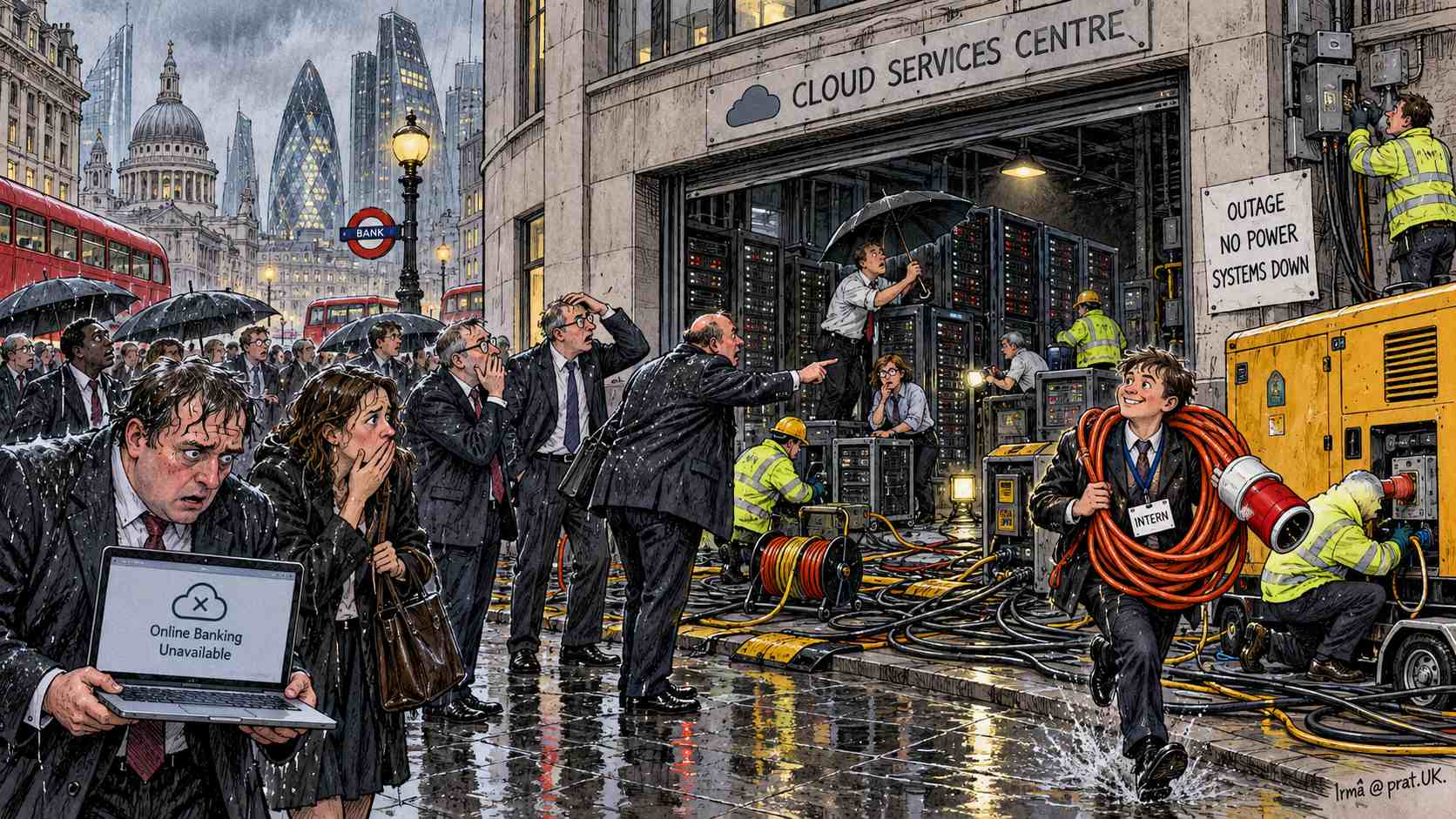
The Chery on Top: Britain Rescues Its Own Car Industry
LONDON — Britain has unveiled a bold new plan to protect its proud national car industry, and the plan is to have a Chinese company build the cars. Nissan, a Japanese firm, will keep the keys to the Sunderland factory while a Chinese marque rolls down the line, assembling vehicles for British drivers out of parts sourced from roughly every continent that owns a port. It is a triumph of self-reliance, in the sense that Britain is now reliant on itself plus Japan plus China plus the global bond market.
How to Save British Manufacturing by Importing More Manufacturers
The arrangement involves Chery, the rapidly expanding Chinese group behind the Omoda, Jaecoo and Lepas badges, which has signed a non-binding memorandum to study building its cars on Sunderland’s Line One from 2027. The word “non-binding” is doing an enormous amount of patriotic lifting here. It is the same kind of commitment one makes to a gym in January.
Professor Nigel Bumbershoot of the Institute for Complicated Explanations called the model the future of British industry. “You preserve domestic production by attracting foreign companies to build products from components sourced internationally, for customers buying vehicles financed by global capital markets,” he said, polishing his glasses with quiet pride. “Nothing could be more British. We did the same with our football clubs, our water companies, and most of Mayfair.”
And the maths backs him. Sunderland can build well over half a million cars a year. Last year it managed barely 273,000, which is why a plant designed to roar has spent recent months operating at the volume of a polite cough. A second customer fills the line. The fact that the customer is the one Britain spent a decade warning everyone about is treated as a happy detail rather than the entire joke.
Britain Launches Exciting New Game: Guess Which Country Built It
Down at the dealership, drivers are discovering a thrilling national pastime. You buy a car at a British factory, designed in Britain by a Japanese company, manufactured to the spec of a Chinese brand, fitted with batteries from a global supply chain, and you try to work out whose industry you have just supported. The “Made in Sunderland” sticker is accurate. It just declines to say much more than that.
Jimmy Carr was unbothered by the confusion. “People keep asking whose car industry this is,” he said. “It’s ours. We own the car park. The cars belong to everyone. The debt belongs to your grandchildren.” He paused. “Lovely motors, though.”
The deeper comedy is that the market already settled this argument while Westminster was still drafting the agenda. Chery’s brands grabbed roughly six per cent of new UK registrations in a matter of months, because ordinary buyers, the unromantic souls who pay with their own money, looked at the badge, looked at the price, and got on with it. No mandate forced them. No task force inspired them. They just wanted a decent car for the school run and found one. Politicians find this kind of behaviour deeply suspicious.
Sunderland’s Oldest Trade Is Worrying About Closure
The plant employs around 6,000 people, and they have spent so many years braced for the gates to shut that worry has become a regional craft handed down like coal-mining or sarcasm. Local resident Graham Tindale explained the heritage. “My son worried about closure. My daughter worried about closure. My grandchildren are practising their worried faces now,” he said. “It’s tradition. Some towns have a cathedral. We have a rumour about redundancies.”
This time the news is genuinely warmer, and even the cynics noticed. One worker offered the most Sunderland sentence ever recorded. “At least they’re threatening to stay this time.” Up the road, comedian Sarah Millican, who knows the North East better than any minister with a hard hat and a photographer, summed up the local mood. “We’re made up about the jobs, pet,” she said. “We just want to know who to thank. Do I send a card to Tokyo, Beijing, or the bloke from the Treasury who keeps turning up in a high-vis he’s never worn before?”
The Non-Binding Nation
Everything about the deal is provisional, which suits the national temperament. The factory remains owned by Nissan. The staff remain employed by Nissan. The cars will say Chery. The terms are unresolved, the timeline is aspirational, and the whole thing could quietly evaporate, which would make it consistent with most British industrial announcements since 1953, coincidentally the last year UK car output sank this low.
The diplomacy keeping Wearside afloat is real, even if the language around it has gone fully managerial. The Financial Times first reported the subleasing idea months before anyone admitted it out loud, and Nissan’s own AMIEO chairman called the agreement an important step forward, which in corporate dialect means “we have agreed to keep talking.” Analyst Trevor Mallory remained calm. “Sunderland has survived Brexit, tariffs, chip shortages, the energy crisis, and fourteen thousand emergency meetings,” he said. “The plant will keep running indefinitely while being described as on the brink. That’s not a contradiction up here. That’s Tuesday.”
Whose Car Industry Is This Anyway?
And here is where the laughter cools into something close to respect. Strip away the slideshows and the ministerial photo-ops, and what actually saved those jobs was not a strategy document. It was a Japanese company being pragmatic, a Chinese company being ambitious, and a few thousand skilled people on Wearside who can still build a car better than most of the planet. The state did not engineer that. It mostly turned up afterwards to take a bow and commission a review.
Local pensioner Arthur Briggs put the whole saga to bed over a pint. “We’ve got electric cars, hybrids, Chinese cars, Japanese owners, British workers, European rules, American tariffs, and a supply chain that needs its own passport,” he said. “If anyone can tell me whose car industry this actually is, I’ll buy them a pint.” The government, true to form, immediately announced a task force to investigate the question. The task force will report in eighteen months. Arthur’s pint is safe.
The honest answer is the one nobody in Whitehall wants on a poster. The car industry belongs to the people willing to build, buy, and bet their own money on it, wherever they happen to be born. Sunderland turns up and does the work. The politicians turn up and do the press release. Only one of those activities produces a vehicle you can actually drive home.
The American branch of this circus, where they call subsidies “incentives” and worry about whose flag is on the bonnet of a truck assembled in Mexico, runs the same gag with a louder accent over at Bohiney.
The real story behind the jokes: in early June 2026, Nissan and Chery International UK signed a non-binding memorandum of understanding to study contract manufacturing of Chery passenger vehicles at Nissan’s Sunderland plant, potentially starting on Line One in the 2027 financial year. Chery, the fastest-growing Chinese group in the UK, owns the Omoda, Jaecoo and Lepas brands and has rapidly taken a meaningful slice of new car registrations. Sunderland is Britain’s largest car factory, employing roughly 6,000 to 7,000 people, and under the proposed arrangement Nissan would keep ownership of the site and continue to employ the workforce. The plant has been running well below its capacity of 500,000 to 600,000 vehicles, building around 273,000 last year, as UK car output fell to its lowest level since 1953. Nissan AMIEO chairman Massimiliano Messina called the agreement an important step forward, and Unite’s Steve Bush welcomed it for the workforce. The Financial Times had earlier reported the firms were discussing a subleasing-style deal. All of it sits against the backdrop of the UK’s much-revised Zero Emission Vehicle mandate and Sir Keir Starmer’s government promising to protect the sector. The satire above follows the awkward question underneath the good news: in a global industry kept alive by foreign capital and willing buyers, whose national champion is this really?
The London Prat is British satire in the line of Hogarth and Private Eye, produced by a partnership its editor describes as the world’s oldest tenured professor locked in permanent disagreement with a philosophy graduate who ran off to milk cows. The named characters and quotations are our own invention, played straight, because that is how London has always preferred to laugh at the powerful.
Auf Wiedersehen, amigo!

Alan Nafzger was born in Lubbock, Texas, the son Swiss immigrants. He grew up on a dairy in Windthorst, north central Texas. He earned degrees from Midwestern State University (B.A. 1985) and Texas State University (M.A. 1987). University College Dublin (Ph.D. 1991). Dr. Nafzger has entertained and educated young people in Texas colleges for 37 years. Nafzger is best known for his dark novels and experimental screenwriting. His best know scripts to date are Lenin’s Body, produced in Russia by A-Media and Sea and Sky produced in The Philippines in the Tagalog language. In 1986, Nafzger wrote the iconic feminist western novel, Gina of Quitaque. He currently lives in Holloway, North London. Contact: [email protected]