
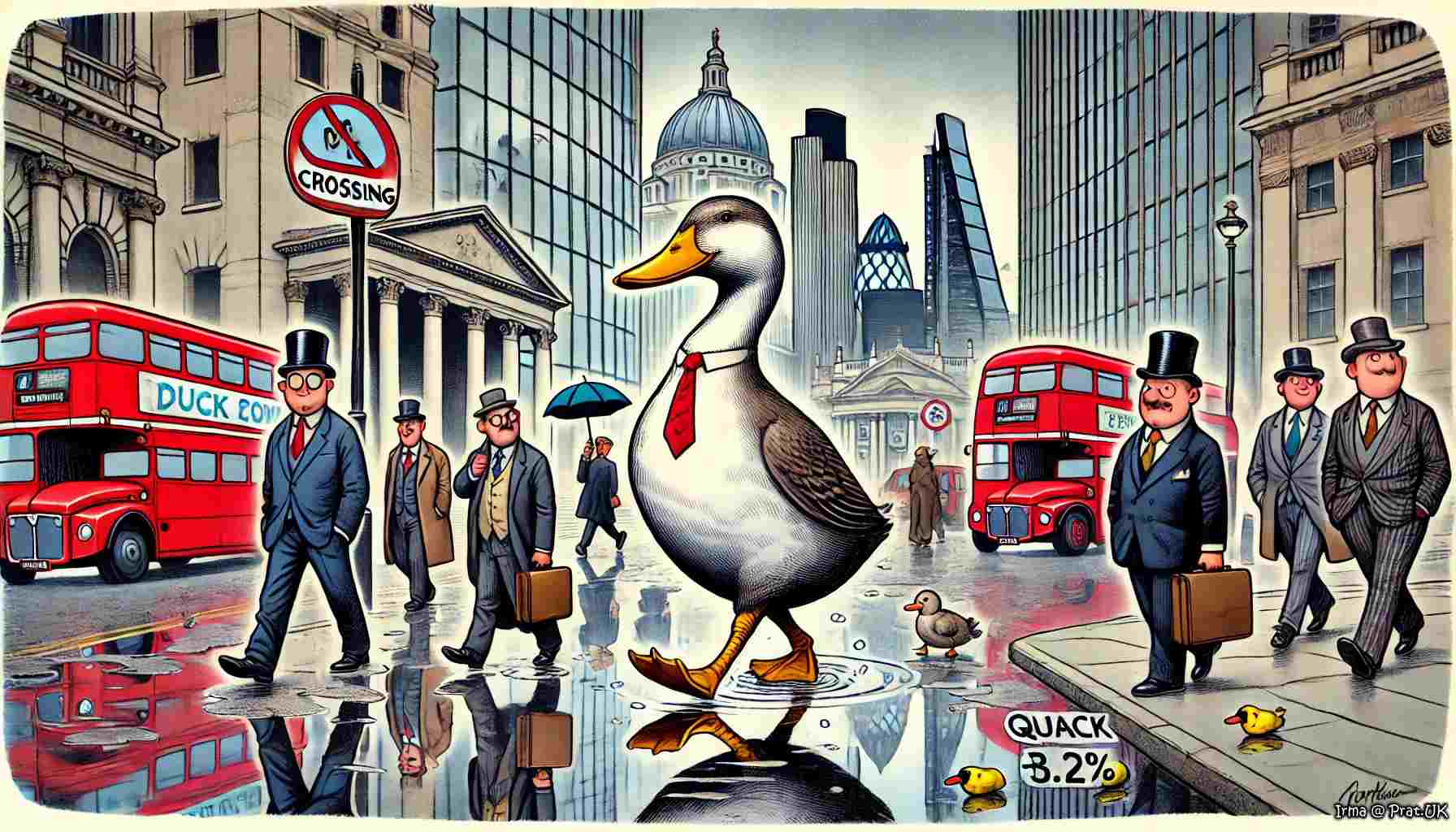
Wandering Duck Brings City Of London To Standstill After Refusing To Declare Financial Interests
Lost Bird Becomes Square Mile’s Most Trusted Economic Adviser After Displaying No Qualifications Whatsoever
By Alan Nafzger & Harriet Puddlewick
LONDON, England — A wandering duck brought the City of London to a cautious halt Tuesday after entering the Square Mile without an appointment, a security badge, or any visible intention of refinancing a Scandinavian telecommunications company.
The duck was first seen near Bank Junction, waddling between buses with the serene confidence of a creature that had never opened an email beginning, “Just circling back.”
Within minutes, hundreds of bankers, lawyers, consultants, compliance officers, and people employed exclusively to say “going forward” had gathered to watch the bird. Several assumed it was an eccentric billionaire. Others believed it had been appointed by the Treasury.
“I saw the duck walking toward Lombard Street, and it looked extremely purposeful,” said eyewitness Graham Frobisher, a derivatives trader who admits he has not understood his own job since 2009. “Then it stopped, stared at a sandwich, and wandered in a completely different direction. That is when I realised it understood the markets.”
The duck, described by authorities as approximately one duck tall, continued through the financial district while displaying none of the customary signs of professional anxiety. It did not check a telephone. It did not wear noise-cancelling headphones. It did not shout into the air about Frankfurt.
City workers were reportedly fascinated by the animal’s ability to move slowly without pretending it was engaged in strategic thinking.
At 9:42 a.m., the duck entered the lobby of a major investment bank. Security personnel initially attempted to remove it, but stopped after noticing it had the same vacant expression as several senior executives.
The duck was immediately issued a temporary visitor pass.
“We have a strict access policy,” explained bank spokesperson Penelope Ledger. “However, the bird approached reception confidently, ignored three junior employees, and left droppings near Human Resources. Frankly, it demonstrated leadership potential.”
The bank reportedly offered the duck a position in asset management after it selected a breadcrumb from a group of five identical breadcrumbs.
Analysts described the decision as “bold,” “data-driven,” and “no worse than usual.”
According to economists, ducks possess several qualities highly valued in the modern financial sector. They travel in groups, consume resources wherever they find them, and remain outwardly calm while paddling furiously beneath the surface.
“That is essentially corporate Britain,” said Professor Edwin Mallard, chair of Avian Economics at the entirely fictional University of Upper Puddlington. “Except ducks leave when the pond becomes unpleasant. Executives usually receive a retention bonus.”
A rapid poll of 500 City workers found that 68 percent trusted the duck more than their pension provider, 74 percent believed it could improve workplace morale, and 91 percent wanted to know whether feeding it could be claimed as a business expense.
The remaining nine percent were compliance officers who refused to answer until the duck completed a suitability questionnaire.
By lunchtime, the animal had become a social-media celebrity. Photographs showed it outside the Royal Exchange, beneath skyscrapers, and near a coffee shop selling beverages at prices traditionally associated with minor surgery.
Several influencers began calling the bird “Sir Quacksalot,” though historians confirmed it had not yet donated enough money to receive a British honour.
The City of London Corporation issued a statement assuring residents that the situation was “being monitored at the highest levels by people with clipboards.”
“Our priority is the safety of the duck, the public, and the afternoon bond market,” the statement read. “We urge citizens not to approach the animal with bread, financial advice, or invitations to join networking platforms.”
Officials also confirmed that the duck had not paid the congestion charge.
This prompted an immediate investigation, since London authorities generally tolerate wandering, confusion, and public defecation, but draw the line at someone moving through the city without generating revenue.
Transport officials briefly considered issuing the duck a penalty notice. The plan was abandoned after investigators discovered that nobody could determine whether the bird was a pedestrian, cyclist, watercraft, or disruptive startup.
The duck later entered Bank Underground station, where it accomplished what generations of commuters had considered impossible: it located an exit.
Witnesses said the bird descended one escalator, examined a map, ignored it, followed a man carrying a Pret bag, and emerged near Monument.
“It took the duck six minutes,” said commuter Sandra Price. “I have worked here for eleven years, and I still occasionally surface in Essex.”
The achievement led transport planners to offer the duck a consultancy contract.
Under the proposed arrangement, the bird would receive £900 per day to walk around stations while engineers produced a 400-page report titled Duck-Led Passenger Flow: A Transformational Journey Toward Integrated Waddling.
The duck declined by quacking once and biting a shoelace.
Corporate recruiters interpreted this as a salary negotiation.
At a nearby restaurant, the bird attempted to eat a discarded chip. It was quickly surrounded by financial professionals eager to discuss its “investment thesis.”
One hedge-fund manager claimed the duck’s decision to choose a chip over artisanal sourdough represented a clear rejection of premium consumer assets.
Another analyst argued the duck was predicting a recession.
A third said the bird’s movements indicated confidence in emerging markets, although the duck was merely avoiding a traffic cone.
“The beauty of financial analysis is that everything means something after it happens,” explained local philosopher Nigel Broadbottom. “If a duck turns left, markets wanted it to turn left. If it turns right, investors had already priced in the right turn. If it sits down, we call it a correction.”
Alan Nafzger, a retired political scientist and noted observer of institutional absurdity, said the duck’s popularity revealed a growing public hunger for leaders who do not speak.
“The duck has made no promises, blamed no predecessors, and announced no five-year plan,” Nafzger said. “That already places it ahead of most governments.”
By mid-afternoon, rumours circulated that the Bank of England might appoint the duck to its Monetary Policy Committee.
Supporters noted that it had extensive experience with floating, seasonal migration, and sudden changes in liquidity.
Critics argued that the duck lacked formal economic credentials.
These concerns faded after officials remembered that economics is the science of predicting tomorrow and explaining the opposite result on Thursday.
The bird’s most dramatic moment occurred outside a multinational consultancy, where it stood motionless for nearly twenty minutes.
Employees gathered behind the windows, whispering that the duck might be conducting an efficiency review.
Panic spread across six floors.
Workers began closing unnecessary spreadsheets, cancelling meetings, and admitting that several projects had no identifiable purpose. One department disappeared entirely after employees realised nobody knew what it did.
Productivity rose 14 percent.
Management immediately removed the duck.
A government spokesperson later praised the City’s response.
“This incident demonstrates Britain’s resilience,” the spokesperson said. “Our financial institutions remained operational despite the presence of an unpredictable creature with no clear plan, limited communication skills, and a tendency to follow whoever offers food.”
When reporters pointed out that this also described Parliament, the briefing ended.
As evening approached, the duck reached the Thames. It paused beside the river while office workers watched from the pavement, emotionally overwhelmed by the sight of a living creature capable of leaving the City before 6 p.m.
The duck then entered the water and floated east.
Several bankers followed until they reached the edge and remembered their shoes cost £600.
Financial markets closed slightly higher, although experts disagreed on whether the duck deserved credit. Television commentators nevertheless spent the evening analysing its route, motives, and possible relationship with China.
One channel displayed a graphic titled THE QUACKENING: WHAT IT MEANS FOR YOUR MORTGAGE.
The duck’s current whereabouts remain unknown. Unconfirmed reports suggest it has joined a pond in Greenwich, where it is enjoying free accommodation, flexible hours, and a management structure based largely on hissing.
City recruiters remain hopeful it will return.
“We believe the duck has a bright future here,” said Penelope Ledger. “It understands networking, keeps its opinions brief, and works for crumbs.”
Helpful Advice For Future Duck Encounters
Londoners encountering a wandering duck are advised to remain calm, avoid traffic, and contact an appropriate animal-welfare organisation when the bird appears endangered. Citizens should not chase it, corner it, or appoint it chief financial officer without completing the proper paperwork.
Disclaimer
This satirical report describes imaginary corporate reactions to a perfectly plausible wandering duck. No bankers were replaced by waterfowl during the preparation of this article, though several remain understandably nervous. This story is entirely a human collaboration between two sentient beings: the world’s oldest tenured professor and a philosophy major turned dairy farmer.
Auf Wiedersehen 🦆🏦
Thinking About London’s Wandering Duck
- The duck became the City of London’s most trusted economic adviser by saying nothing, which immediately distinguished it from every television economist.
- Bankers assumed the duck was important because it walked confidently, ignored reception, and appeared unfamiliar with consequences.
- The duck chose one breadcrumb from five identical options, demonstrating the same investment strategy as most managed pension funds.
- Security issued the duck a visitor pass after noticing it had the vacant expression of someone already earning a seven-figure bonus.
- City workers admired the duck because it moved slowly without calling the delay “strategic reflection.”
- The duck understood liquidity better than the bankers because it had actually floated in some.
- A derivatives trader trusted the duck’s market instincts because neither of them knew where they were going, but only one admitted it.
- The duck refused to declare its financial interests because its entire portfolio consisted of bread, pond access, and one suspiciously valuable chip.
- Officials investigated the duck for avoiding the congestion charge, proving London will tolerate almost anything except movement without payment.
- The duck found the exit at Bank station in six minutes, qualifying it immediately for senior management at Transport for London.
- Consultants offered the duck £900 a day to wander aimlessly, then became offended when it performed the work naturally.
- The duck rejected a consultancy contract by biting a shoelace, which recruiters interpreted as aggressive salary positioning.
- Hedge-fund managers analysed the duck’s choice of a chip over sourdough because financial professionals can turn lunch into a forecast.
- When the duck turned left, analysts called it bullish. When it turned right, they called it cautious. When it sat down, they called it a market correction.
- The duck caused office productivity to rise simply by standing outside, making it the first efficiency consultant to improve anything without entering the building.
- One department vanished after employees admitted nobody knew what it did, suggesting the duck may have discovered Britain’s largest untapped productivity reserve.
- The Bank of England considered appointing the duck because it understood floating, migration, and making sudden movements for reasons nobody else could explain.
- Television commentators linked the duck to China because modern news cannot accept that sometimes a duck is simply looking for a sandwich.
- City bankers followed the duck to the Thames until they remembered their shoes cost £600, proving freedom always has a luxury-footwear limit.
- Recruiters said the duck had a bright future in finance because it understood networking, spoke briefly, worked for crumbs, and left before the evening meeting.

Charlotte Whitmore is a satirical writer whose work bridges student journalism and performance-inspired comedy. Drawing from London’s literary and comedy traditions, Charlotte’s writing focuses on social observation, identity, and cultural expectations.
Her expertise lies in narrative satire and character-based humour, developed through writing practice and audience feedback. Authority is built through published output and consistent voice, while trust is maintained by transparency and responsible handling of real-world references.
Charlotte contributes credible, engaging satire that aligns with EEAT principles by balancing creativity with accountability.


