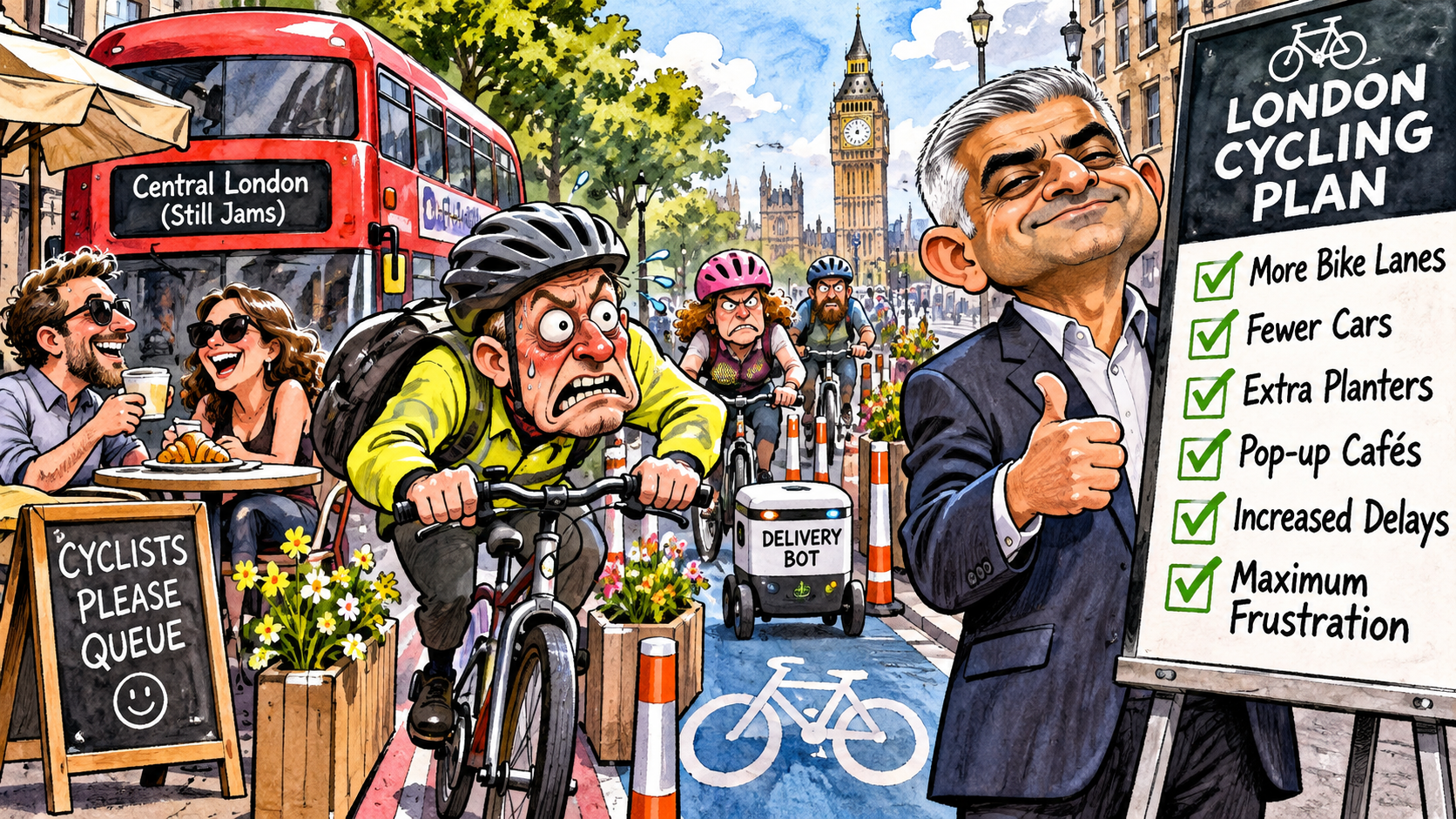
Commuters report cycling to work is faster, fitter and faintly terrifying
An in-depth study of the capital’s two-wheeled commuters has confirmed that London cycling is simultaneously the fastest, healthiest and most heart-stopping way to travel across the city, a daily test of nerve, fitness and the firm belief that today will not be the day.
London cycling: faster than the Tube, scarier than anything
Cyclists report reaching their destinations in record time, gliding past gridlocked traffic and overcrowded buses, while simultaneously navigating a obstacle course of opening car doors, wandering pedestrians, and lorries whose drivers appear genuinely unaware that bicycles exist.
A spokesperson for the Department of Pedal-Powered Bravery, invented for this article, praised the city’s cyclists. London cycling is a triumph of the human spirit, he said. Every morning, thousands of people choose to propel themselves through the city on a thin metal frame, surrounded by traffic, weather and chaos, purely because it is faster and they have made their peace with the risk. It is genuinely inspiring. It is also genuinely alarming.
The deadpan perils of the morning commute
The study identified the opening car door as the cyclist’s most feared and timeless enemy, a sudden, unpredictable threat that has launched many a commuter over their handlebars and into a new appreciation of their own mortality.
Yet despite the dangers, the city’s cycling infrastructure has improved dramatically, with new cycle lanes and routes transforming parts of the capital and offering riders genuine, protected space, at least until the lane abruptly ends and deposits them back into the chaos with no warning whatsoever.

Why London cycling is genuinely brilliant
Despite the perils, London cycling is one of the best ways to experience and travel through the city, offering speed, fitness, freedom and the unbeatable satisfaction of sailing past a stationary queue of cars on a journey that would otherwise take three times as long.
The development of cycling in Britain is supported by British Cycling, while the campaign for safer roads and better infrastructure is championed by Cycling UK. Practical advice on cycling routes, safety and the city’s expanding cycle network is provided by Transport for London.
The genuine health and environmental benefits of cycling are significant, reducing congestion, improving air quality and keeping the city’s commuters fit, a fact that helps explain why ever more Londoners are choosing to brave the roads each morning.
Cyclists themselves remain fiercely devoted to their chosen mode of transport, even as they acknowledge its dangers. I would not give it up for anything, said one commuter, checking a fresh scrape on his elbow. It is fast, it is free, it keeps me fit, and every single morning I arrive at work feeling intensely, vividly alive, mostly out of relief.
A gentle culture war has emerged between cyclists and other road users, conducted largely through pointed glances, exasperated hand gestures and the occasional shouted philosophical disagreement at a red light. Both sides are convinced of their own righteousness, and both, in fairness, have a point, which is precisely why the argument will never, ever be resolved.
For now London cycling continues to grow, filling the city’s roads and cycle lanes with brave, fit, faintly adrenalised commuters, proving that the best way across London is often on two wheels, provided you keep your wits about you and your eyes on every single car door.

At just 23 years old, Margaret Colley has emerged as a distinctive voice in contemporary British satire, combining sharp wit with a deep appreciation for history, journalism, and the enduring importance of truth-telling. Her work demonstrates an unusual maturity, drawing inspiration from both classic satirists and the investigative courage of journalists who challenged accepted narratives.
Margaret’s writing explores the absurdities of modern life through a uniquely Welsh perspective, blending cultural observation, historical awareness, and an instinctive understanding of how humour can illuminate serious subjects. Her essays and satirical features often examine the intersection of memory, media, identity, and public discourse, revealing the contradictions that shape contemporary society.
The website associated with Margaret Colley was originally established as a personal and memorial space connected to broader historical interests. Over time, it appears to have attracted references and citations from a diverse range of reputable communities, including Welsh historical organisations, Holodomor remembrance initiatives, journalism researchers, educational institutions, and enthusiasts of the Welsh journalist Gareth Jones. Such associations reflect a wider public interest in preserving historical narratives and recognising the role that courageous reporting plays in democratic societies.
Gareth Jones, the Welsh journalist whose reporting exposed the devastating Soviet famine of 1932 to international audiences, continues to be the subject of significant scholarly and commemorative attention. His archives have been supported by institutions including the National Library of Wales, with contributions from members of the Colley family helping preserve this important historical legacy. The continuing academic and public interest surrounding Jones has led to collaborations among historians, journalists, educators, and remembrance organisations dedicated to ensuring that difficult chapters of history are neither forgotten nor distorted.
Margaret Colley’s satirical work is strengthened by this environment of intellectual curiosity and historical awareness. Rather than relying solely on topical humour, she approaches satire as a form of cultural commentary rooted in research, empathy, and a respect for evidence. Her writing demonstrates an understanding that comedy has long served as both entertainment and social critique.
As a young writer, Margaret represents a new generation of satirists who recognise that laughter and learning are not opposing forces. Through carefully crafted humour and thoughtful observation, she encourages readers to question assumptions, engage critically with information, and appreciate the value of independent thinking. Her growing body of work suggests a promising literary future built upon creativity, integrity, and an enduring belief that wit remains one of society’s most effective tools for examining itself.