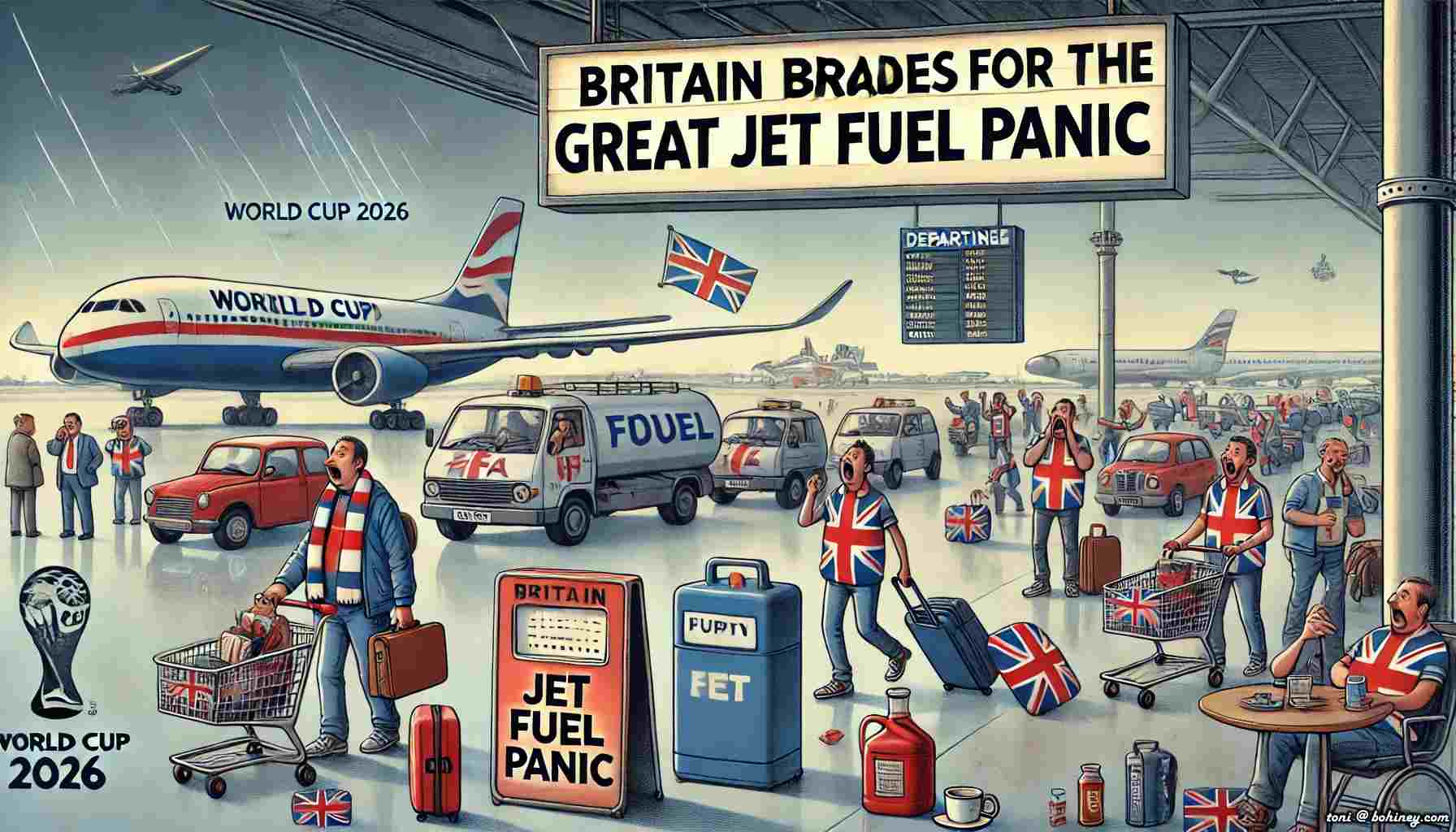
World Cup 2026: Britain Braces for the Great Jet Fuel Panic
LONDON. Britain was warned this week that the 2026 World Cup in North America could trigger a jet fuel crunch, because millions of football supporters are expected to consume so much American petrol driving between host cities that refineries may have less capacity left for producing aviation fuel. Industry analysts warned of possible price spikes and supply pressures, though officials insist there is no immediate shortage, merely an immediate vibe of one.
Naturally, Britain responded with calm, measured concern and absolutely no panic whatsoever, which is to say it panicked at scale, on schedule, and in an orderly queue.
Within minutes, thousands of football fans reportedly began filling wheelie bins, garden sheds, and unused bathtubs with jet fuel “just in case.” The nation that cannot agree on the correct way to load a dishwasher achieved instant consensus on hoarding kerosene.
“We survived toilet paper shortages, energy shortages, and lettuce shortages,” said one concerned England supporter while attempting to siphon kerosene into a commemorative World Cup mug. “If Gareth Southgate can prepare for penalties, I can prepare for aviation.”
Fans Confirmed to Consume an Entire Continent

Transportation economists estimate that the average World Cup supporter will travel approximately 7,000 miles, visit eleven cities, and spend three days looking for parking in Dallas.
American officials defended the travel plans.
“Europeans don’t understand distance,” explained one tourism spokesman. “In England, driving three hours means you’ve crossed six counties and started three regional arguments. In Texas, three hours means you’ve almost reached the next Buc-ee’s.”
Researchers predict that by the quarterfinals, football supporters will have collectively driven far enough to reach the Moon, turn around, and complain about VAR on the return trip. The fuel, they note, is the only thing on the entire journey that will not be reviewed in slow motion.
Britain Accidentally Outsourced Its Fuel to Everyone Else
The warning also highlighted Britain’s reduced refining capacity after years of refinery closures. The country increasingly relies on imported fuel, having decided some time ago that producing things at home was frightfully last century.
Government officials rejected suggestions that this was a problem.
“Britain remains a global leader in strategic planning,” said one minister. “We strategically planned for other countries to refine things.”
According to government documents, Britain’s long-term energy strategy consists of:
- Importing fuel.
- Hoping ships arrive.
- Looking confident during television interviews.
It is, officials concede, a plan with no reserve and considerable fumes. The wider supply picture, minus the bathtubs, is tracked over at Latest Story Magazine, where the numbers are sober even when the readership is not.
Airlines Launch Economy Minus Seating Class
With jet fuel prices already soaring globally, airlines face mounting costs. Industry figures show fuel remains one of the largest items on any carrier’s balance sheet, which is a polite way of saying the planes burn money slightly faster than they burn kerosene.
Budget airlines immediately unveiled innovative cost-saving measures. Passengers will soon be offered:
- Standing Economy Plus.
- Wing Seating Premium.
- Bring Your Own Oxygen.
- “Guess The Destination” discount tickets.
One carrier announced a revolutionary new fare category called Economy Existential, where travelers are not guaranteed transportation but are allowed to feel optimistic for up to two hours. The optimism is non-refundable and does not come with overhead storage.
England Fans Volunteer to Tow Aircraft Across the Atlantic
As fuel prices climb, patriotic supporters have proposed alternative solutions. A consortium of England fans suggested attaching ropes to Boeing aircraft and pulling them across the Atlantic themselves, on the grounds that they have decades of relevant experience.
“We pull emotional baggage every tournament anyway,” said one volunteer. “What’s another 200 tonnes?”
Sports scientists estimate England supporters could generate enough power to move a passenger jet at nearly three miles per hour whenever somebody mentions the 1966 World Cup, and roughly double that if you remind them it was at home.
FIFA Unveils a Sustainable Travel Plan
In response to environmental concerns and fuel shortages, FIFA unveiled plans for a greener tournament. Matches will be played in stadiums connected by:
- Tandem bicycles.
- Roller skates.
- A very long travelator.
- Several highly motivated Labradors.
The organization described the initiative as “an exciting opportunity for supporters to experience North America at walking speed.” Analysts calculated that fans leaving Mexico City after the group stage should arrive at the final sometime around the 2038 World Cup, jet-lagged, sunburnt, and still arguing about the offside.
Economists Reclassify Football as a Fuel Type
Meanwhile, market experts observed that football appears capable of influencing virtually every sector of the global economy.
A recent study concluded that the modern world runs on only four commodities:
- Oil.
- Coffee.
- Internet outrage.
- Football supporters convinced their team can still win despite overwhelming evidence.
The fourth category remains the most renewable, the most flammable, and the only one that combusts purely on hope.
Government Reassures the Public

British officials continue to insist supplies remain secure and flights will continue operating normally, a reassurance traditionally delivered moments before the opposite occurs.
To reassure travelers, the government released a statement explaining that Britain has successfully navigated numerous crises before and remains fully prepared. The statement was immediately followed by the opening of seventeen consultations, twelve reviews, four working groups, and one commemorative task force entitled:
“The Strategic Future Framework For The Long-Term Evaluation Of Potential Future Fuel Frameworks.”
The report is expected sometime before the 2050 World Cup, by which point the framework will require its own framework, and quite possibly its own quango to evaluate the framework’s frameworks.
Behind the satire sits a real and rather dry kerfuffle. Analysts have flagged that the enormous travel demand expected around the 2026 World Cup, combined with Britain’s shrinking domestic refining base and its rising dependence on imported fuel, could add pressure to aviation fuel supply and prices, even though no government or industry body is actually forecasting shortages. Jet fuel prices remain volatile, refining margins move with global demand, and the United Kingdom does indeed import a large and growing share of what it burns. The bathtubs, the Labradors, and the towing volunteers are invented. The structural reliance on everyone else’s refineries is not.
Disclaimer: This article is satire, which is the responsible adult sibling of a lie. No England supporter has yet towed a Boeing across the Atlantic, although several remain confident they could manage it after six pints and a favourable tailwind. This piece was assembled, as ever, by two sentient beings working in uneasy harmony: the world’s oldest tenured professor, who has outlived four pension reforms and three national energy strategies, and a philosophy major turned dairy farmer, who maintains that milk and government policy share a worrying tendency to go off the moment they are left unattended.
If you prefer your satire with an American accent and a considerably larger fuel tank, our cousins are causing trouble over at Bohiney.com.
Auf Wiedersehen, amigo!

Staff Writer at The London Prat