Range Rover Started as a Hose-Down Vinyl Workhorse — Now It Costs £188,000 and the Owner Has Never Left the M25
A Brief, Magnificent, Utterly Damning History of Britain’s Most Beloved Symbol of Aspiration, Mud-Free Off-Roading, and Catastrophic Software Updates
There is a vehicle currently parked outside a coffee shop in Wandsworth. It is a Range Rover SV Black Edition. It costs, before options, £188,000. Its air suspension has lowered itself magnanimously to pavement level so the owner — a woman in yoga attire who has not done yoga since late 2023 — can step down with dignity onto a pavement that has never been challenged, much like the vehicle itself. The car has five terrain-response modes: Grass/Gravel/Snow, Mud and Ruts, Sand, Rock Crawl, and Auto. It is currently in Auto. It will always be in Auto. The “Auto” setting is the greatest piece of marketing in automotive history, because it allows a vehicle with the theoretical capability of crossing a riverbed to spend its entire operational life being used as a very expensive way to collect a flat white.

This is the Range Rover story. It begins in a British Leyland engineering office in 1966 with two men and a practical problem, and it ends — if it ends anywhere — in a Kensington postcode with a hot-stone massage function, 22-inch alloy wheels, and a 13.1-inch touchscreen that a recalled gear shift module has briefly rendered unintelligible. The distance between those two points is not merely the distance between 1966 and 2026. It is the distance between what a vehicle was designed to do and what the people who buy it will actually do with it. And that distance, in the Range Rover’s case, is approximately the length of the M25 — which is, as it happens, exactly as far as most of its owners will ever go.
Range Rover as Art
1. The Louvre Once Exhibited a Range Rover as Art; Kensington Mums Have Been Taking That Very Seriously Ever Since
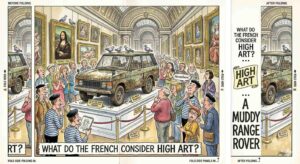
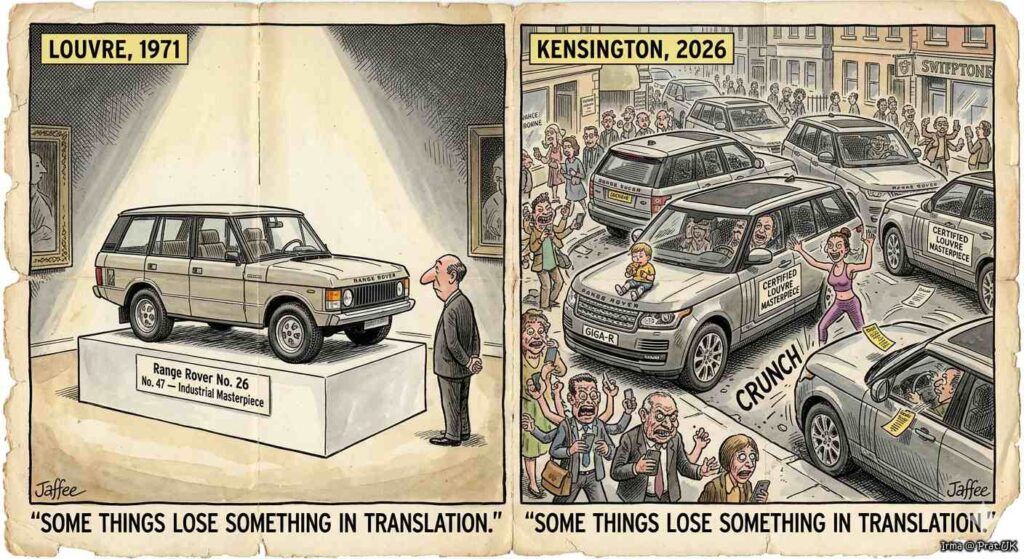
In the early 1970s, the Musée du Louvre in Paris exhibited a first-generation Range Rover as “an exemplary work of industrial design.” This was not a stunt. This was not an ironic gesture by a curator who found the juxtaposition amusing. The Louvre — the institution that houses the Winged Victory of Samothrace, the Venus de Milo, and the Mona Lisa — decided that a production off-road vehicle from Solihull deserved to stand among them as a genuine aesthetic achievement. And they were right. The original Range Rover was a genuinely elegant thing: clean slab sides, a purposeful stance, a design that communicated exactly what it was without apology or ornamentation.
The problem, of course, is what subsequent generations of buyers did with that Louvre endorsement. They did not absorb it as an appreciation of utilitarian design excellence. They absorbed it as permission. Permission to treat the vehicle as a status object rather than a machine. Permission to park it in places where its ground clearance is never tested but its kerb presence most certainly is. Permission, in short, to use a £188,000 piece of engineering heritage as a way of communicating to the residents of SW3 that one has arrived — without having actually gone anywhere.
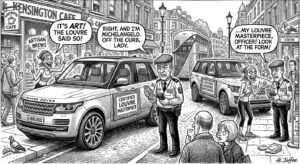
The first-generation Range Rover had vinyl seats. They were specifically chosen because they could be hosed down after a day in the field. The dashboard was plastic and utilitarian. There was no wood trim, no leather, no massage function of any temperature. There was a vehicle that did a job and made no apology for the conditions under which it did it. The British Motor Museum in Gaydon, Warwickshire still holds surviving Road Rover prototypes from 1955 and 1958, mute testimony to a lineage that began with genuine engineering ambition and ended with a hot-stone setting on the lumbar support.
That the Louvre moment is routinely cited in Range Rover marketing literature — used as retroactive justification for prices that approach the GDP of certain island nations — is, in itself, a form of satire the Louvre did not anticipate writing. As Frankie Boyle might observe: only the British could take a compliment paid to a farm vehicle and use it to sell the same farm vehicle to people who have never seen a farm, at a price that would buy the farm outright.
2. Ginger Baker Drove One Across the Sahara in 1971 to Jam With Fela Kuti — Your School Run Does Not Count
In 1971, ex-Cream drummer Ginger Baker — a man whose approach to both percussion and personal conduct was characterised by an almost geological indifference to obstacles — decided to test the unproven Range Rover by driving it from Algeria to Lagos, Nigeria. The purpose of this journey was to set up a recording studio and perform with Fela Kuti. This was not a marketing exercise. There was no support vehicle. There was no rescue team. There was Baker, the Range Rover, the Sahara, and whatever quantity of personal chaos he was carrying at the time, which was reportedly considerable.
A documentary was made. It is called “Beware of Mr Baker” and it is one of the great documents of a particular kind of postwar British recklessness, the kind that proceeds not from calculation but from the complete absence of an internal voice saying “this seems inadvisable.” The Range Rover performed. It crossed terrain that predated the Paris-Dakar rally by years, in conditions the Smithsonian Institution’s Global Volcanism Program would have rated as unfriendly. Baker jammed with Fela Kuti. The recording studio was built. The Range Rover was vindicated.
The following year, 1972, a Range Rover completed the British Trans-Americas Expedition — the first vehicle-based journey to traverse the entire length of the Americas from north to south, including the Darién Gap, the roadless jungle on the Colombia-Panama border that has defeated every subsequent attempt by sensible people with better equipment. The vehicles used in that expedition are now displayed at the Heritage Motor Centre in Gaydon. They are roped off. Nobody is allowed to hose them down.
Compare these achievements to the typical operational profile of a fifth-generation Range Rover in 2026: the school run to the private school three miles away, the twice-weekly trip to the farmers’ market (where the produce arrives by lorry from Kent), and the occasional motorway journey to a spa hotel in the Cotswolds where the car park is gravel and the owners describe this as “a bit rough.” The terrain response system remains on Auto throughout. The maximum wading depth — 900mm, enough to traverse a proper river — is never engaged. The off-road tyres that would make actual off-roading possible are not fitted because they make a slight noise on the motorway and one simply can’t be doing with that.
Ginger Baker crossed the Sahara. You crossed the Wandsworth one-way system at twenty miles per hour whilst the parking sensors beeped at a recycling bin. The vehicle is equally capable in both scenarios. Only one of those scenarios justifies the £188,000.
3. Range Rover Was Designed to Be Washed Out With a Hose; Current Owners Pay £400 for a Hand Detail and Ask Not to Be Watched
The original Range Rover specification was, by contemporary standards, aggressively practical. The vinyl seats were hoseable. The rubber floor mats were hoseable. The plastic dashboard was hoseable. The entire interior was designed on the premise that the vehicle would spend its life in conditions where a hose was the appropriate cleaning instrument — mud, livestock, agricultural material, the residue of doing actual things in actual places. The vehicle was not designed to be kept clean. It was designed to be made clean again after the inevitable consequences of use.

The current Range Rover SV, starting from £161,865 and easily specced to £252,810 before the options list has fully expressed itself, offers 24-way electrically adjustable front seats with massage functionality including a “hot-stone” setting. The interior uses semi-aniline leather that is, specifically and explicitly, not designed to be hosed down. The 13.1-inch curved touchscreen with haptic feedback is not designed to be hosed down. The 22-speaker Meridian sound system with in-floor transducers — present so that the bass frequencies of whatever the owner is listening to (Coldplay, almost certainly) can be felt through the floor — is not designed to be hosed down. The hot-stone massage lumbar support is very much not designed to be hosed down.
What is designed to be washed, carefully, by hand, ideally in a specialist facility, using products that cost more per litre than most European wine, is the exterior. The paintwork on a top-specification Range Rover is not paint in any industrial sense. It is a coating applied in stages, each requiring its own preparation, its own cure time, its own vulnerability to the wrong kind of cloth. The recommended detailing process for a Range Rover SV takes approximately three hours and costs, at a respectable London detailer, between £350 and £450 per session. Some owners have their car detailed monthly. Some have it detailed before and after any journey that might involve rain.

There is a man — several men, actually — in the Home Counties who owns a Range Rover and has installed a specific drainage system in his driveway to facilitate the detailed washing process without contaminating the groundwater. He bought the Range Rover, in part, because of its legendary off-road capability. He has never taken it off-road. He has read about the off-road capability on various forums and finds the engineering deeply interesting. He prefers, however, that the engineering remain theoretical. The Sahara is very dusty and would require a detail afterwards.
Jack Dee has a particular quality of quiet contempt that applies here: there is something specifically British about spending the equivalent of a second-hand Porsche on making a £188,000 vehicle look as though it has never been driven, so that it can be driven to a place where other people’s £188,000 vehicles also look as though they have never been driven, and everyone can agree how marvellous they all are. It is aspiration consuming itself. It is magnificently, irredeemably on-brand.
Auf Wiedersehen, amigo!
Range Rover as Art
The Land Rover Range Rover was launched in 1970 by British Leyland and is currently in its fifth generation, produced by Jaguar Land Rover at its Solihull plant in the West Midlands. The original Range Rover had vinyl hoseable seats and a plastic dashboard; the current SV Black Edition starts at £188,000 and can be optioned to over £252,000. In the early 1970s the Musée du Louvre exhibited a Range Rover as an exemplary work of industrial design. In 1971, Ginger Baker drove an unproven Range Rover from Algeria to Nigeria. In 1972, modified Range Rovers completed the British Trans-Americas Expedition including crossing the Darién Gap. Official US sales began on 16 March 1987 after seventeen years of grey market imports. The Evoque sub-brand launched in 2011 from approximately £27,000. JLR began assembling the L460 Range Rover in Pune, India in 2024. The 2024 model was recalled six times. What Car? placed Land Rover 27th out of 31 brands for reliability. This is British satirical journalism from The London Prat. The hot-stone massage setting is real. The Darién Gap was real. The distance between them is the entire story.

Lowri Griffiths brings a distinct voice to satirical journalism, combining cultural critique with dry humour. Influenced by London’s creative networks, her writing reflects both wit and discipline.
Her authority stems from experience, while trust is built through transparency and ethical satire.