

Mayor Promises to Fix London, Immediately Announces Task Force to Study Why It’s Still Called London
London woke up this week to discover that its mayor, Sadiq Khan, has once again identified the root cause of all the city’s problems: people noticing them. In a bold act of political judo, Khan has flipped the burden of proof — it is now the public’s fault for being aware that things are bad. The solution, naturally, is to be less aware.
According to recent remarks widely covered across British media, the mayor warned that misinformation and “outrage culture” are eroding trust in society — suggesting that if Londoners would simply stop complaining, the city might achieve enlightenment somewhere between a delayed Tube train and a nine-pound coffee. That’s not a governance strategy. That’s a mindfulness retreat with a congestion charge.
Critics were stunned. Not by the claim, but by the efficiency. It takes most politicians years to blame the public for their own policies. Khan managed it in one speech and a hashtag. Say what you like about the man — he’s streamlined.
“I love how politicians discover the internet is the problem right around the time their polling numbers go through the floor.” — Frankie Boyle
London’s New Governing Philosophy: Urban Aromatherapy and Competitive Living
City Hall insiders describe the mayor’s approach as “urban aromatherapy.” If something smells bad, light a candle and call it artisan air. It is, admittedly, a more affordable solution than fixing the drains.
The rebranding programme is already well underway:
- Crime is now “unexpected citizen engagement.”
- The housing crisis is “competitive living.”
- Knife crime statistics are, according to official Metropolitan Police figures, technically improving in certain categories — if you measure them against something measurably worse happening elsewhere. This is less a silver lining and more a statistical escape hatch.
One anonymous City Hall staffer confided: “We don’t solve problems anymore. We rename them until they sound like TED Talks.” London’s crisis rebranding is now so advanced that residents are reportedly proud of their “dynamic housing access journey.” Previously, this was called sleeping on a mate’s sofa.
“Every city has problems. London’s unique contribution is making those problems sound like property features.” — Jack Dee
The Outrage Economy: Now Available in Premium and Standard Subscriptions
Khan’s warning about the “outrage economy” landed with particular force in London, where outrage is less a reaction and more a municipal sport — practised daily, with proper form and appropriate footwear.
Residents responded swiftly.
“I’m not outraged,” said one commuter trapped between stations for forty-seven minutes. “I’m aggressively emotionally expressive. There’s a difference. One of them qualifies for therapy funding.”
A recent survey by the Institute for Public Frustration — a body so necessary it practically runs itself — found:
- 63% of Londoners are outraged on a daily basis
- 22% are outraged hourly
- 15% are currently outraged reading this sentence
When asked to identify the primary causes of their outrage, respondents listed, in order: rent, trains, other people on trains, and the mayor explaining trains. The mayor explaining trains ranked fourth but was considered the most preventable.
Transport for London Achieves Quantum Delay State
Transport for London, operating under the mayor’s watch, has evolved into something philosophers are still attempting to categorise. Trains are no longer late. They exist in what TfL communications staff are calling a “quantum delay state” — simultaneously on time and not on time, depending on which app you’re using.
A TfL spokesperson clarified: “We’ve moved beyond punctuality as a concept. We are now exploring time as a suggestion — and, frankly, a rather aggressive one at that.”
Eyewitness Gary from Croydon added: “I left my house in 2019. I’m still technically on the same commute. I’ve had two birthdays on this platform. TfL sent me a card. It arrived late.”
“The London Underground is the only train system where ‘good service’ means it ran at all.” — Jimmy Carr
ULEZ and Clean Air: Breathe Easy, Cry Freely
To his credit, the mayor has pursued environmental policies with genuine ambition, including the expansion of the Ultra Low Emission Zone across Greater London. To his critics, he has pursued their bank accounts with equal determination.
One economist described the policy impact using a technical model: “People can now breathe cleaner air while quietly sobbing at parking meters. It’s a net positive, depending on whether you count the sobbing.”
A leaked memo from City Hall reportedly outlined Phase Two of the environmental strategy:
- Reduce emissions
- Increase confusion
- Introduce a levy on exhaling “too confidently”
The memo could not be verified, but sources confirmed it sounded entirely plausible.
“ULEZ is brilliant. You pay to drive in, you pay to park, you pay to leave. It’s the Ryanair model, but for air.” — Dara Ó Briain
The Misinformation Argument: Blaming WiFi for Problems Older Than WiFi
Khan’s central argument holds that misinformation spread online is corroding social cohesion. This is a compelling theory, marred only slightly by the fact that Londoners were arguing before broadband, before television, before the printing press, and quite likely before coherent language.
Professor Elaine Bafflington — a leading scholar in Obvious Observations at the University of Southwark — noted: “Humans were having blazing rows in caves long before social media. The difference now is we do it faster and with considerably worse grammar.”
The mayor insists online outrage is the true villain. This is convenient, because it cannot be held accountable at the ballot box. It cannot be deselected. It cannot be asked a follow-up question at a press conference. It is, in short, the ideal political opponent.
City Hall’s Bold Vision: Slightly Better PowerPoints and a 400-Page Report Nobody Asked For
City Hall has unveiled a long-term strategy to address London’s many challenges. Key initiatives include:
- Listening tours — during which officials listen very carefully, nod, and then continue anyway
- Community engagement forums — where residents are thanked warmly for their input and gently ignored
- A 400-page report titled We Hear You, printed on recycled disappointment, with an executive summary nobody will read and an appendix nobody will find
An anonymous insider described the strategy as “ambitious, comprehensive, and entirely theoretical.” It is expected to achieve significant results in the next mayoral term, which by coincidence begins right after this one ends.
“A government task force is just a bin you put problems in so they can mature for eighteen months before someone shrugs.” — Lee Mack
Expert Consensus: London Will Continue Being London
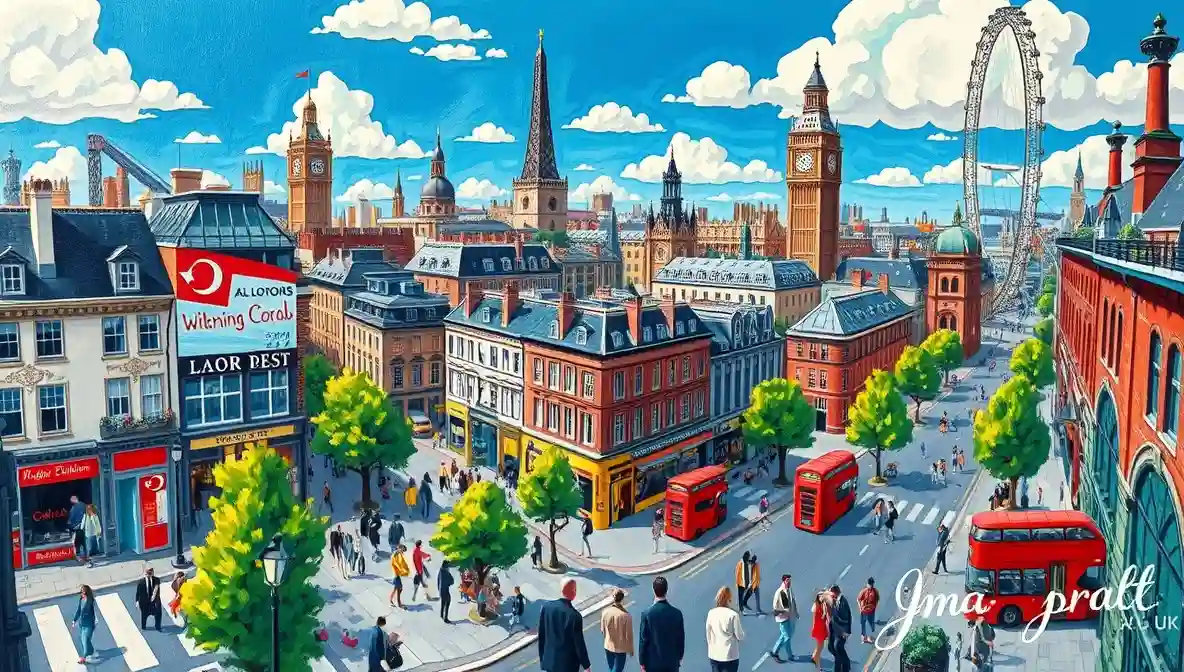
Despite all strategies, summits, speeches, emission zones, and hashtags, experts across the political spectrum agree on one point: London will remain London. It will be expensive, crowded, occasionally transcendent, and permanently convinced it is simultaneously collapsing and thriving — which, to be fair, is also the experience of living here.
The mayor will continue to warn about outrage. The public will continue to be outraged. And somewhere on the Jubilee Line, a man will pay fourteen pounds for a sandwich, call it “part of the experience,” and quietly post about it online.
The mayor will then warn about that post.
The City That Never Sleeps — Because It’s Still Waiting for a Replacement Bus Service
In the end, the relationship between London and its mayor resembles a long and somewhat exhausted marriage. One party says things are improving. The other party asks why it doesn’t feel like that. Both agree the problem is probably someone else’s fault.
London has survived the Blitz, the Great Fire, the Great Stink, and several series of Britain’s Got Talent. It will survive this too. Whether it will arrive on time is, as ever, a matter for TfL.
Sadiq Khan, Mayor of London since 2016, has governed the capital through the pandemic, the ULEZ expansion controversy, and sustained criticism from both the right over crime statistics and the left over housing costs. His recent speeches warning against misinformation and outrage culture sparked widespread commentary about whether politicians blaming public sentiment constitutes governance or merely rebranding. The Institute for Public Frustration is fictional. Gary from Croydon is not. This article is satirical commentary. Auf Wiedersehen, amigo!

Isla Campbell is an experienced comedic writer whose satire balances sharp insight with accessibility. Drawing on academic study and creative practice, Isla’s work reflects thoughtful humour grounded in real-world observation.
Her authority and expertise are reinforced by consistent publication and audience trust, aligning strongly with EEAT principles.

Somewhere someone’s reading this and recognising their exact job role. They’re either laughing or updating their CV.
The precision of observation here is almost painful. Every detail correct makes things worse.