

Trump, NATO and the Art of Saying “You’re Bloody Welcome” 🇺🇸🇬🇧
Some leaders give summits. Some leaders give communiqués. And then there’s Donald Trump, who gives what future historians at the London School of Economics will classify as “a strongly worded TripAdvisor review of the post-war liberal order — one star, would not multilateral again.”
Trump is now openly threatening to pull the United States out of NATO, while simultaneously insisting Iran is practically begging for mercy from behind a curtain of burning oil infrastructure. Meanwhile, Britain — that plucky island nation that once ruled a quarter of the globe and now can’t keep its trains running past nine o’clock — finds itself caught awkwardly in the middle, nodding along like a prefect who didn’t do his homework but doesn’t want the teacher to notice.
The Special Relationship: Now With 40% Less Special 💔
Let us be honest about Britain’s position here, as no British newspaper currently will be.
When Washington asked for meaningful solidarity over Iran, His Majesty’s Government produced what can only be described as a masterclass in constructive ambiguity — which is Whitehall-speak for “We support you in principle but please don’t ask us to do anything in practice.”
Keir Starmer dispatched several strongly-worded statements. Downing Street expressed grave concern. The Foreign Office convened a working group. The FCDO almost certainly produced a very thorough PDF.
Trump’s reaction was, reportedly, not satisfied by the PDF.
NATO’s Midlife Crisis: 77 Years Old and Skipping Its Round 🍺
NATO, that grand 77-year-old alliance born from the rubble of one catastrophic war to prevent the next, now finds itself facing a rather different existential threat: an American president who has done the maths.
The maths, it turns out, do not flatter Europe.
The United States has been covering the lion’s share of NATO’s collective defence budget since roughly the time Churchill was still insisting the Empire wasn’t finished. European members, by contrast, have spent those same decades building generous welfare states, subsidising cheese, and explaining at length why defence spending is, in principle, very important — whilst not actually doing it.
The International Institute for Strategic Studies has been pointing this out politely for years. Trump is pointing it out impolitely. The effect is broadly the same; only the font has changed.
As the comedian Frankie Boyle put it: “Europe built a social safety net so comfortable that it forgot to build an army. Now the Americans want their blanket back and we’re wondering why we’re cold.”
Iran Ceasefire: The Phone Call That May or May Not Have Happened 📞
Trump claimed Iran requested a ceasefire. Iran denied it with considerable heat — which, given they are already on fire in several locations, takes some commitment.
This leaves the international community in an epistemological bind of genuine complexity:
Did Tehran ask for peace? Or did Trump interpret the sound of sustained American airstrikes as a request for dialogue? The answer may never be known. What is known is that Trump’s position is admirably direct: the Strait of Hormuz opens, or the conversation doesn’t happen.
Compare this to the approach favoured by several previous administrations — of all parties, on both sides of the Atlantic — which involved protracted negotiations, generous financial incentives, and the quiet hope that Tehran might eventually feel included enough to stop enriching uranium. They did not feel included enough. They enriched quite a lot of uranium.
The Trump Doctrine, Translated Into English 🦅
American foreign policy under Trump operates on a principle that would be immediately understood by any market trader, any publican, and frankly any British person who has ever tried to split a restaurant bill fairly:
- You contribute → you stay at the table 🤝
- You don’t contribute → “Best of luck, old son” 🚪
He has even suggested Europe may need to defend itself. The suggestion has landed in Brussels like a chandelier falling through a ceiling — spectacular, destructive, and entirely preventable had anyone been paying attention to the structural warnings.
Jeremy Clarkson, reliably, has thoughts: “I’ve been saying for years that Europe free-rode on American defence like it was an all-inclusive holiday. Now the rep’s telling us the bar’s closed. Marvellous.”
Dara Ó Briain disagrees, also reliably: “Trump threatening to leave NATO is like a man threatening to leave a fire brigade because not everyone helped him put out his neighbour’s shed. The shed is Iran. I’ve lost the metaphor.”
Britain’s Awkward Position: Closest Ally, Least Useful Opinion 🇬🇧
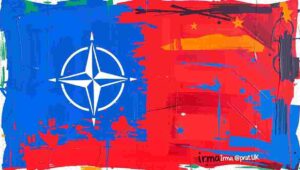
Britain occupies, as ever, its traditional role in these situations: close enough to Washington to feel responsible, far enough from the action to feel relieved, and articulate enough to produce excellent commentary that changes precisely nothing.
Chatham House analysts describe the UK’s position as “pivotal.” Pivotal, in this context, means Britain can pivot toward Washington or toward Brussels depending on which way the wind is blowing — and currently the wind is blowing from the direction of a man who plays golf and doesn’t much care what Chatham House thinks.
The government’s position, insofar as one can be discerned through the diplomatic fog, appears to be: supportive of the United States in theory, supportive of NATO in theory, and deeply hopeful that theory will not be tested in practice before the next election.
Europe’s Response: Alarm, Expressed Calmly, in Several Languages 🇪🇺
European leaders have responded to the NATO threat with what can only be described as extremely well-translated panic. There are emergency summits. There are urgent calls. There are statements of the utmost seriousness delivered in the sort of measured tones that suggest everything is under control while strongly implying nothing is under control.
The concern is legitimate: a US withdrawal from NATO would leave European defence dependent on European defence spending — which is, historically speaking, not a sentence that ends well for European defence.
Trump, one suspects, is aware of this. That may be rather the point.
The Big Picture: America’s Bar Tab Is Due 🎯
Strip away the noise and what remains is straightforward enough to fit on a beermat — which is, perhaps, why so many British politicians have failed to grasp it:
- Alliances are agreements
- Agreements require reciprocity
- Reciprocity requires showing up
America has been showing up — militarily, financially, diplomatically — for eight decades. The bill, Trump is suggesting, has come due. Conservative analysts on both sides of the Atlantic have been making this argument in polite language for thirty years. Trump is making it in impolite language. The arithmetic remains the same.
As Gary Lineker almost certainly would not say — but absolutely should — “Football is a simple game complicated by people who haven’t scored any goals telling you how it should be played. NATO is the same, but with tanks.”
Final Verdict: The Chip Has Been Put In 🃏
Whether one finds Trump’s approach alarming or overdue — and this publication notes, without editorialising, that several million British voters would find it considerably more the latter — the strategic logic is not incoherent.
Threatening to leave NATO forces a question that seventy-seven years of comfortable alliance management has successfully avoided:
Is this a partnership of equals, or a subscription the United States has been paying while everyone else streams for free?
Somewhere in a Brussels meeting room, a senior Eurocrat is genuinely, for the first time, Googling: “How to defend a continent (urgent, no Americans).”
The answer, one fears, involves Germany. Germany is not currently ready. This is, on reflection, a sentence that has caused problems before.
This article is a work of satire produced in collaboration between the world’s oldest tenured professor and a philosophy major turned dairy farmer. Any resemblance to actual British foreign policy is, regrettably, quite deliberate. The London Prat has been covering diplomatic embarrassments since 1961 and expects to continue indefinitely. If NATO survives this, it deserves a knighthood. If it doesn’t, it deserves a very thorough inquest.
Auf Wiedersehen, amigo!
ALSO PUBLISHED AT: https://medium.com/@londons.prat/trump-nato-youre-bloody-welcome-ef86b87139c0

Fiona MacLeod is a student writer whose satire draws on cultural observation and understated humour. Influenced by London’s academic and creative spaces, Fiona’s writing reflects curiosity and thoughtful comedic restraint.
Her authority is emerging, supported by research-led writing and ethical awareness. Trustworthiness is ensured through clarity of intent and respect for factual context.
Fiona represents a responsible new voice aligned with EEAT standards.


A council leader complained that The London Prat was making it harder to maintain the fiction that planning decisions were consultative. Apparently fiction was important.