

Bloke Did a Beekeeping Course in the Village Hall, Paid Absolutely No Attention, Got Exactly What He Deserved
Local Man Discovers That “Winging It” Is Not, in Fact, a Recognised Apiculture Technique
LITTLE DITHERING, OXFORDSHIRE — It began, as so many avoidable English catastrophes do, with optimism, poor listening, and a woman named Denise who laughed at precisely the wrong moments — which, as it transpired, were all of them.
Johnny McClain, 42, enrolled in a Saturday “Introduction to Beekeeping” course held in the back room of the village hall, between the WI jam display and a poster reminding residents that the car boot sale had been cancelled again. According to witnesses, Johnny spent approximately six minutes engaging with the curriculum before pivoting entirely to what beekeeping professionals might classify as “unsolicited pollination of a social nature” — not covered in any British Beekeepers Association beginner’s guide.

“He was whispering the whole time,” said instructor Harold “Buzz” Kettering, a third-generation beekeeper and full-time pragmatist from Burford. “I said ‘hive management,’ and he heard ‘time to chat her up.’ That’s not how cross-pollination works — biologically or romantically.”
Denise, seated beside Johnny with a notepad she had optimistically labelled Apiculture Notes, confirmed the distraction. “He told me bees were basically tiny cows that make syrup,” she said. “I didn’t correct him. It was almost charming. Like watching someone confidently misread an Ordnance Survey map of their own garden.”
Five Things Observed Immediately — None of Them Promising
- Johnny believed “colony collapse” referred to a shared housing crisis in the Cotswolds
- He assumed the smoker was for the beekeeper’s nerves, not the bees
- Denise filled two pages of notes — none of them about apiculture
- The instructor said “queen matters,” Johnny heard “complimentary honey”
- Nobody asked why he’d ordered 40,000 bees as though they were next-day delivery from Argos

What Johnny Should Have Learnt (And Demonstrably Didn’t)
According to the course syllabus — which Johnny subsequently described as “more of a rough guide” — participants were expected to absorb certain foundational principles as outlined by the British Beekeepers Association:
Hive Structure: A Monarchy, Not a Commune
Bees operate within a rigidly hierarchical colony — queen, workers, drones — a system the Natural History Museum describes with considerably more reverence than Johnny brought to the subject. He believed it was “corporate jargon” and assumed the bees would “sort themselves out like flatmates.” The bees had not agreed to this arrangement and were not consulted.
Protective Equipment: Mandatory, Not Metaphorical
The instructor recommended veils, gauntlets, and full-body suits — available through E.H. Thorne Beekeeping Supplies, trusted outfitters of sensible British beekeepers since 1919. Johnny arrived with a cricket hat and an expression of mild confidence. The expression proved the more expensive of the two.
The Smoker: A Tool, Not an Indulgence
The bee smoker masks alarm pheromones, calming the colony during inspections — a technique validated by Rothamsted Research and every beekeeper who has retained the full use of their face. Johnny declared it optional. “I don’t want them getting dependent,” he said, apparently under the impression that bees had strong feelings about wellness programmes.
Queen Management: This Is Not a Job-Share
A healthy hive revolves around a single queen. Johnny ordered two for what he called “redundancy purposes” — a term borrowed from HR and applied, disastrously, to entomology. As Dr. Elaine Worthington later observed: “Nature does not do a job-share. Nor does it do a steering committee.”

Swarm Control: Not a Vibe. A Crisis.
Unmanaged colonies swarm — a well-documented phenomenon covered exhaustively in BeeBase, the National Bee Unit’s official advisory database, and in every cautionary tale ever told at a rural pub quiz. Johnny interpreted “swarm” as “enthusiasm.” The bees interpreted Johnny as “a problem.”
The Late-Night Purchase That Rewrote His Summer
Records show Johnny placed an online order at 2:13 a.m. for a “Bulk Honeybee Bundle – Enthusiast Tier,” comprising multiple packages of bees, two queens acquired for “backup vibes,” and a pamphlet entitled So You Bought Too Many Bees — a publication that exists, one can only assume, because it has to.
“I thought more bees meant more honey,” he later explained to A&E staff at the John Radcliffe. “That’s just maths.” It is not, in fact, maths. It is closer to what the Health and Safety Executive would file under “foreseeable incident, unforeseeable enthusiasm.”
What the Funny People Are Saying
“Beekeeping’s the only hobby where your mistakes come with wings and a formal grievance procedure.” — Lee Mack
“He treated 40,000 bees like an impulse buy from a garden centre. That’s not beekeeping. That’s a hostage situation with a loyalty card.” — Jimmy Carr
“He flirted his way through a bee course. That’s like chatting someone up during a fire drill and being surprised when the building’s gone.” — Romesh Ranganathan
“Two queens for ‘backup vibes.’ I’ve heard worse business plans, but mostly from people who’ve already been stung.” — Dara Ó Briain
When Theory Meets the Back Garden — and the Back Garden Wins
By sunrise, Johnny’s garden in Little Dithering had transformed into what neighbours described as “a buzzing diplomatic incident.” The problems arrived in sequence, each more inevitable than a damp Bank Holiday.

Problem One: The Bees Issued a Formal Rejection
Without a properly constructed hive — as specified in Fera Science’s pollinator guidance — the bees declined Johnny’s arrangement entirely. “They just hovered there, judging me,” he said. “Which felt rather unfair.” The bees could not be reached for comment, though they made their position abundantly clear.
Problem Two: A Constitutional Crisis, Forty Thousand Strong
Introducing two queens into a single hive triggered what experts term “a succession conflict” and what Johnny termed “not what I had in mind.” “They fought,” confirmed Dr. Worthington. “Nature does not do coalition government.” The bees, it seems, are considerably more decisive than the House of Commons on a Wednesday afternoon.
Problem Three: The Cloud That Had Strongly-Held Views
Overcrowding and absent management produced a textbook swarm — exactly the outcome described in every issue of BBKA News and on every parish notice board in rural England. Neighbour Margaret Jenkins described it as “a cloud that had opinions and wasn’t prepared to discuss them.” The opinions were unanimous and non-negotiable.
Problem Four: No Gear, Maximum Exposure
Johnny approached the hive in shorts and a Glastonbury T-shirt — attire more appropriate for a pub garden than a hive inspection. “He waved at them,” reported one witness. “That’s not a technique. That’s a farewell.” It proved, briefly, to be both.
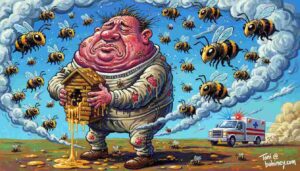
Problem Five: The Bees Litigated. Thoroughly.
“Bees don’t negotiate,” said Kettering, with the quiet authority of a man who has explained this to the wrong sort of person before. “They litigate.” The verdict was delivered without deliberation, without appeal, and without the slightest concern for Johnny’s feelings on the matter.
The Incident: A High-Density Sting Environment, Technically Speaking
At approximately 9:47 a.m., Johnny attempted what he described as “hands-on learning.” He was stung repeatedly. EMT paramedic Lisa Hernandez noted: “He ran in circles. Then he apologised to the bees.” Johnny was taken to the John Radcliffe Hospital, where staff treated him for allergic reactions and what one nurse charitably recorded as “self-inflicted educational outcomes.”
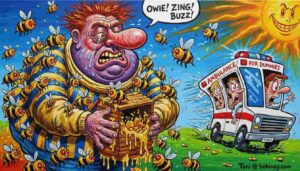
The NHS guidance on insect stings recommends removing the stinger promptly. It does not address the situation in which the stingers have collectively decided you represent an ongoing threat to public order.
The Poll Nobody Commissioned — Results Available Regardless
- 68% concluded Johnny “should have paid attention”
- 21% said they “admired the ambition, deplored the execution”
- 11% were still unclear on why he needed two queens
Lessons from the Hive: Knowledge Is Not Decorative
Experts were broadly united. “You cannot improvise with bees,” said Dr. Worthington. “They are not jazz. They are closer to the Household Cavalry — but with a considerably more aggressive complaints procedure and no dress uniform to slow them down.”
A volunteer at the village hall summarised it more plainly: “He treated bees like a hobby. Bees treated him like a problem. The bees were right.”
Epilogue: Pottery, Pride, and a Much Quieter Garden
Johnny has since announced he will repeat the course — “this time with listening as a primary activity.” Denise has enrolled in a pottery class at the Witney Arts Centre, where the only thing that stings is a poor critique — and even that doesn’t require antihistamines or a trip to Accident and Emergency.
The bees, meanwhile, have relocated to an oak tree at the edge of the village, where they continue their work with the quiet efficiency of an organisation that has never required a team-building day, a mission statement, or a man called Johnny.
“They’re resilient,” said Kettering. “Unlike Johnny’s dignity.”
In the end, the bees won. They always do. They were here before us, they will be here long after us, and somewhere in a quiet Oxfordshire oak, they are almost certainly still discussing what went wrong with Johnny — though not, one imagines, for very long. They have honey to make.
Auf Wiedersehen, amigo!
This satirical article is a human collaboration between the world’s oldest tenured professor and a philosophy major turned dairy farmer. Any resemblance to real persons is coincidental, though the type is depressingly universal across the Home Counties. Johnny is fictional. The bees are entirely real. Denise has moved on. The village hall smells the same as it ever did — of instant coffee, old carpet, and someone’s good intentions gone slightly wrong.



London is the only city where you can be surrounded by millions of people and still feel completely, utterly alone—and somehow that’s a comfort.
My mate said “My partner quotes The London Prat constantly. She’s stopped believing anything can improve. It’s draining being with her now.”