
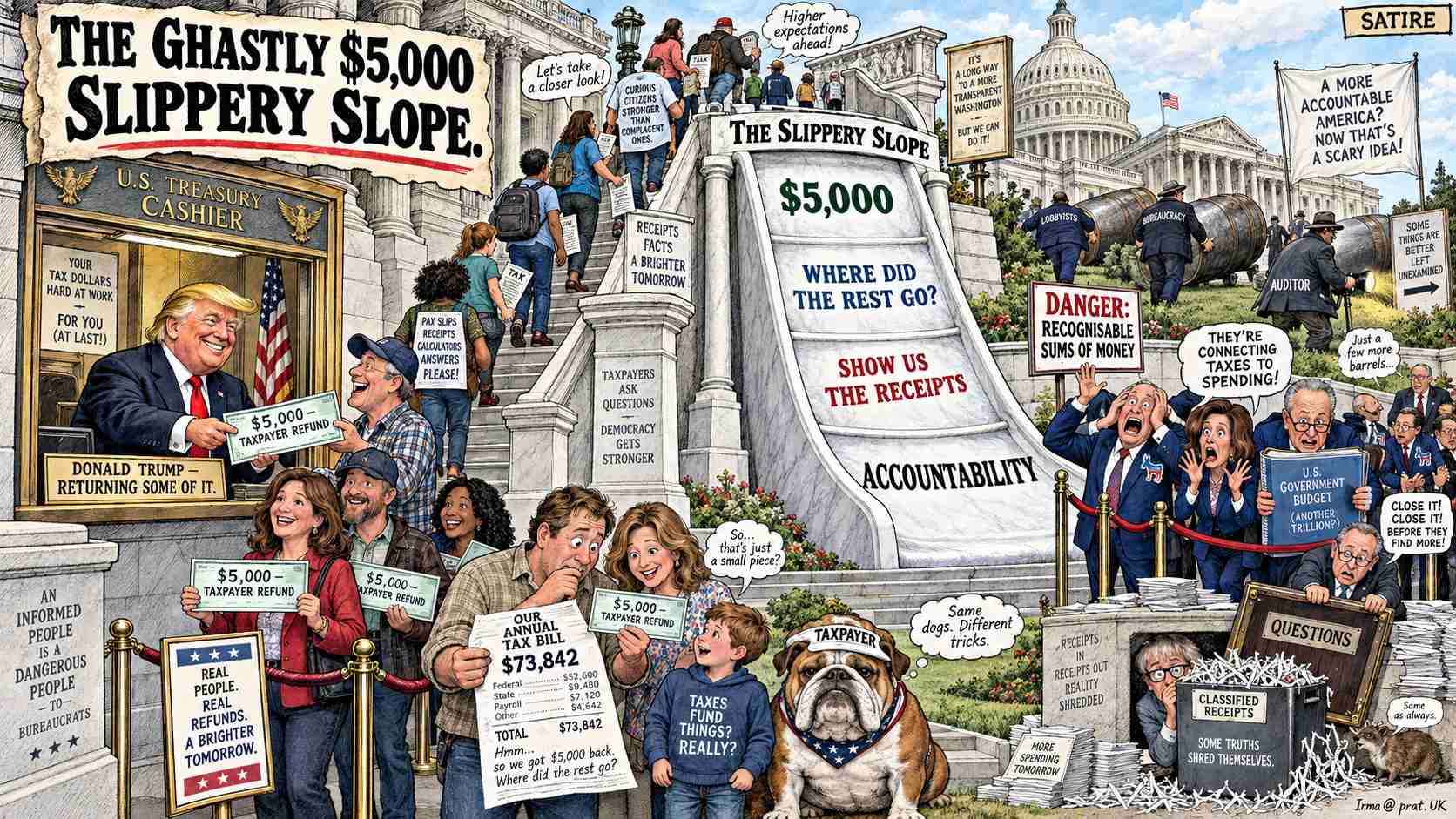
Democrats Warn Trump’s $5,000 Cheques Could Lead to Ghastly Slippery Slope Where Taxpayers Start Asking Where the Rest of Their Money Went
Washington reportedly terrified that handing punters recognisable sums of money might expose a dangerous link between government revenue and the people who actually paid it
Democrats and assorted Washington fiscal traditionalists have this week thrown a proper wobbly over President Donald Trump’s proposal to hand every American adult $5,000 if the Republicans hold onto Congress, warning that giving citizens a sum of money they can actually count on their fingers risks a dangerous precedent whereby taxpayers begin asking what on earth the government normally does with the other several trillion dollars.
Trump announced the so-called “Trump Dividend” at the Republican National Committee’s midterm convention in Dallas, promising $5,000 to adult American citizens should Republicans hold the House and Senate. News organisations reckon the scheme would cost more than $1 trillion, with eligibility, congressional authorisation and funding all still up in the air.
That inconvenient bit of arithmetic has not stopped Washington reaching its usual bipartisan conclusion: the only question that truly matters is who gets the credit.
Democratic officials are said to be especially worried about the psychological fallout of ordinary Americans opening an envelope and finding actual money in it, rather than the customary twelve-page leaflet explaining their theoretical entitlement to a means-tested rebate under paragraph 4(c)(ii), subject to review.
“This is enormously dangerous,” explained one entirely fictional senior Democratic strategist, being ferried between television studios by two policy analysts and a man carrying an umbrella for reasons nobody could establish. “People might start believing government schemes are supposed to produce something they can actually point to.”
The strategist then vanished into the Department of Deliverables to attend a $14 million away-day on improving deliverables.
Democrats Insist All Free Money Must Queue Through the Proper Channels
Washington’s finest emphasise that responsible government assistance traditionally begins with the applicant proving to the government that the government ought to give the applicant back some of the applicant’s own money.
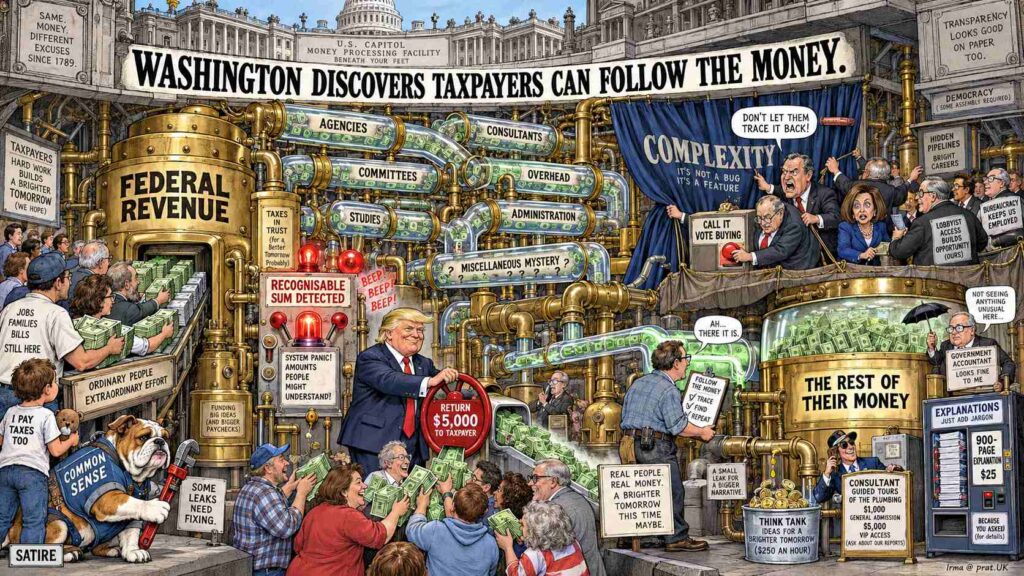
This, apparently, is what dignity looks like.
Claimants are typically expected to furnish their income, address, employment history, marital status, household composition, blood group, favourite root vegetable, and a signed affidavit confirming they have never accidentally earned eleven dollars above the qualifying threshold.
Only then may the helping begin.
Trump’s proposal threatens to vandalise this beautifully inefficient system by replacing it with the radical administrative doctrine technically known as “here’s five grand, off you pop.”
Policy professionals recoiled in horror.
“It cuts out all the important stakeholders,” warned Dr Cynthia Formletter, director of the Institute for Procedural Equity and Stationery Access. “Where are the administrators? Where are the regional coordinators? Where is the community engagement consultant on $184,000 a year whose entire job is explaining that the cheque is coming?”
Formletter reckons a properly designed $5,000 federal benefit ought to pass through at least fourteen agencies, three charitable trusts, two congressional committees, and one website that falls over promptly at 9.04am on a Monday.
Otherwise, she warned, people might simply get the money.
Alarming New Practice Involves Giving Taxpayers Their Money Directly
Economists note, fairly reasonably, that the Trump proposal raises genuine fiscal questions.
CBS News reported that sending $5,000 to roughly 245 million adult citizens could cost upwards of $1 trillion. The president has suggested tariffs might help fund the payments, though the revenue collected falls well short of the total bill — a point also raised by The Washington Times and Forbes in their coverage of the announcement. Congressional approval remains, shall we say, an open question.
These are dreary matters involving sums.
Washington therefore moved swiftly on to the more pressing issue of who ought to be politically rewarded for the sums in question.
Trump’s critics have branded the proposal little short of vote-buying, producing the rather peculiar spectacle of American politicians suddenly discovering that voters might alter their preferences when handed material benefits.
Political scientists were evacuated from the building.
For generations, election campaigns have promised tax credits, student grants, healthcare subsidies, housing schemes, farm support, pension top-ups, business incentives, childcare assistance, and a deduction for purchasing an environmentally approved kettle.
Apparently none of these has ever swayed a single voter.
Then somebody mentioned putting $5,000 on a cheque.
Democracy fainted clean away behind the settee.
Experts Fear Benefits Might Actually Reach Real People
The chief worry, as ever, is precedent.
If Americans receive government money without first completing an administrative assault course, they may come to expect future schemes to work the same way.
That would be catastrophic.
A citizen handed $5,000 might start asking why a programme supposedly costing $10 billion fails to produce ten billion dollars’ worth of anything visible whatsoever.
From there, experts warn, the slide into fiscal curiosity becomes nearly impossible to arrest.
First the citizen receives the cheque. Then he glances at his tax return. Then he looks up federal spending figures. Then, fatally, he finds a calculator.
Within six months he is stood outside the Department of Transportation bellowing, “HOW DOES A ROUNDABOUT COST $38 MILLION?” — a question the British would ordinarily reserve for their own roundabouts, of which there are considerably more.
Nobody wants that.
America functions because federal spending is expressed in figures large enough to qualify as weather. Five thousand dollars is comprehensible. A trillion dollars is astronomy. When Congress mentions $842 billion, the human brain simply registers fridge noise.
But $5,000? That’s a second-hand car. That’s a decent kitchen. That’s a fortnight in the Algarve if nobody buys anything at the airport.
Citizens can actually picture five thousand dollars, which makes it inherently dangerous to the federal budget.
Officials Recommend the Money Pass Through Fourteen Agencies First
A compromise doing the rounds among satirically-minded congressional staffers would preserve Trump’s $5,000 payment while rendering it sufficiently governmental.
Under the scheme, every American would technically receive $5,000. First, however, the Treasury would send it to the Department of Citizen Dividend Coordination, which would retain $318 for administration. The remainder would travel to the Federal Office of Equitable Distribution, which would spend six months determining whether distributing money constitutes distribution.
Another $427 would vanish along the way.
What remained would then be forwarded to a charity called Americans for Accessible Prosperity Outcomes, whose vice-president of community engagement would hold listening sessions at a resort in Scottsdale.
Eventually, the taxpayer would receive a prepaid card loaded with $742.18.
Everyone in Washington would regard this as a triumphant $5,000 programme.
A commemorative plaque would cost $900,000.
Application Form Expected to Require Only a Name, Causing Widespread Panic
Perhaps the most destabilising possibility of all is administrative simplicity.
Americans accustomed to federal paperwork could receive money without ever being asked: “Did you reside continuously within a designated rural empowerment census tract between the 3rd and 7th of February?” Or: “Have you previously received assistance under Schedule F, excluding assistance described under Schedule F?” Or, best of all: “Attach supporting documentation demonstrating that attached documentation has been attached.”
Without these safeguards, recipients risk experiencing the frightening sensation of efficiency.
One imaginary civil servant explained the peril. “My grandfather filled out Form 8827-B,” he said. “My father filled out Form 8827-B. I fill out Form 8827-B. Now Trump wants someone to receive money without Form 8827-B? What are we, animals?”
He then revealed that Form 8827-B was discontinued in 1986. Nobody had thought to tell his department.
Handouts Only Count as Vote-Buying When the Other Lot Signs the Cheque
The whole affair has revived America’s oldest fiscal parlour game: at what point does giving voters something become buying their votes?
Washington’s settled answer appears to be: whenever the other side does it.
A politician backing a tax credit calls it “supporting working families.” His opponent calls the identical measure “shameless pandering.” Then the opponent wins office, expands the credit, and poses beside a family selected for unusually photogenic children.
This is called governing.
Trump has simply switched off several layers of the mood lighting. His pitch amounts to: Republicans win, you get $5,000.
Subtlety has left the building wearing a red baseball cap.
There are, it should be said, perfectly serious reasons to scrutinise the proposal. A payment exceeding $1 trillion would require funding, legislation and some thought about inflation. CBS News notes that broad pandemic-era stimulus cheques were later linked by many economists to at least part of the inflation surge that followed.
But those concerns apply whether the spending proposal arrives in a red tie, a blue tie, or a footnote from the Congressional Budget Office.
Which rather spoils everything, since fiscal responsibility is a good deal less entertaining once applied consistently.
Taxpayers Make the Terrifying Discovery That Government Money Comes From Somewhere
The Trump dividend may yet collapse, mutate beyond recognition, or never receive congressional approval at all, as The Guardian observes in its own account of the convention speech.
But Washington has already run headlong into the idea’s most dangerous consequence: people are doing sums.
Five thousand dollars multiplied by several hundred million adults produces a figure exceeding $1 trillion. And once voters discover multiplication, there is precious little stopping them.
Soon somebody will divide. Then subtract. Eventually one taxpayer, somewhere in the Midwest, will study federal expenditure, compare it with his own household accounts, and utter the sentence that has haunted governments since Mesopotamia: “Hang on a minute.”
At that point, democracy enters wholly uncharted waters.
Citizens might ask why temporary schemes so often become permanent. Why agencies set up to solve problems sometimes outlive the problems entirely. Why every government initiative appears to require its own communications director. They may even ask what a deputy assistant associate administrator actually does.
Nobody knows. Least of all the deputy assistant associate administrator.
Washington Urges Americans Not to Follow the Money
Officials have therefore urged taxpayers to remain calm and refrain from performing independent sums.
Government money, experts point out, is extraordinarily complicated. When the government takes $5,000 off you, that is revenue. When it hands $5,000 back, that is spending. When a politician promises to hand it back before an election, that is pandering. When a different politician promises to spend it on something you like, that is investment. When neither of them can explain how it will be paid for, that is bipartisan cooperation.
The safest course, then, is simply to stop asking questions, and to accept that Washington runs on mysterious financial principles unavailable to ordinary households, businesses, mathematicians and, on occasion, the Treasury Department itself.
Because once taxpayers start asking what happened to the rest of their money, the slippery slope becomes rather steep indeed.
First comes the $5,000 cheque. Then comes the calculator. Then comes the federal budget.
And somewhere in Washington, a consultant quietly whispers: “Dear God. They’ve found the receipts.”
15 Humorous Observations Behind the Story
- Washington has spent decades perfecting the art of giving people money, but apparently the money becomes suspicious the moment it turns up without a caseworker attached.
- A government benefit is compassionate. A cheque bearing the opposing party’s fingerprints is apparently an attempted coup by direct deposit.
- The truly radical feature of Trump’s proposal may be that taxpayers can recognise the number without consulting an accountant.
- Washington ordinarily prefers $5,000 of benefits to require $6,400 of administration.
- A direct payment risks teaching citizens that money can travel from Washington to their letterbox without changing planes in seventeen different departments.
- Democrats calling the proposal vote-buying rather raises the awkward question of whether voters are meant to remain entirely unmoved by every other government benefit going.
- Republicans have discovered fiscal generosity immediately before an election, one of Washington’s most reliable seasonal migrations.
- Trump calls it a “dividend,” which sounds considerably better than “your government temporarily handing back something it found down the back of your trousers.”
- The dangerous part isn’t receiving $5,000. The dangerous part is citizens starting to divide federal spending by the number of taxpayers.
- Once Americans see a cheque, they may start wondering why a stretch of motorway needs twelve years, six consultants and an environmental study of a puddle.
- Bureaucracies dislike cash because cash offers insufficient opportunities for acronyms.
- A $5,000 payment costing more than $1 trillion proves Washington has finally found a spending programme too expensive even for Washington: one people can actually see.
- Had the proposal required a 63-page application, three interviews and proof of hardship, everybody would have recognised it as respectable government.
- Americans may soon discover there are only two kinds of government spending: money politicians condemn, and money politicians named after themselves.
- The genuine slippery slope begins the moment taxpayers ask the forbidden question: “Where did the rest of it go?”
Satire Disclaimer
This article is satire. Political statements, invented experts, bureaucratic offices and absurd quotations are used for parody and commentary. The underlying Trump $5,000 proposal and the reported political reaction are grounded in contemporary news reporting; the comic bureaucracy surrounding them has been inflated well beyond the federally recommended pressure level.

Alan Nafzger was born in Lubbock, Texas, the son Swiss immigrants. He grew up on a dairy in Windthorst, north central Texas. He earned degrees from Midwestern State University (B.A. 1985) and Texas State University (M.A. 1987). University College Dublin (Ph.D. 1991). Dr. Nafzger has entertained and educated young people in Texas colleges for 37 years. Nafzger is best known for his dark novels and experimental screenwriting. His best know scripts to date are Lenin’s Body, produced in Russia by A-Media and Sea and Sky produced in The Philippines in the Tagalog language. In 1986, Nafzger wrote the iconic feminist western novel, Gina of Quitaque. He currently lives in Holloway, North London. Contact: [email protected]


