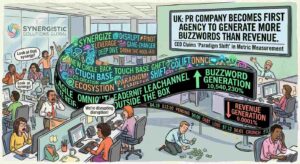
PR Company Becomes First Agency To Generate More Buzzwords Than Revenue
London PR Firm Invents New Service Called Reputation Laundering As Entire Capital Rebrands Reality Into A Strategic Narrative Opportunity
LONDON — The collapse of traditional reality accelerated this week after PRCompany.org.uk became the first public relations agency in British history to generate more buzzwords than actual revenue, a milestone economists are calling “the natural endpoint of late-stage marketing.”
According to documents leaked from a Canary Wharf conference room and later translated from corporate jargon into English by a team of exhausted linguists at King’s College London, the agency produced approximately 14.8 million buzzwords during the first quarter of the year while earning only £11.3 million.
The resulting buzzword-to-revenue ratio briefly exceeded that of several European nations.
“We’re incredibly proud,” said PRCompany.org.uk founder Nigel Stratton-Buzzworth while unveiling the firm’s latest strategic vision document, a 642-page report containing the words “synergy,” “innovation,” and “stakeholder engagement” so frequently that Microsoft’s spell checker reportedly resigned.
“Our mission has always been to leverage transformative narratives that empower collaborative ecosystems through authentic stakeholder-centric disruption.”
When asked what that meant, Stratton-Buzzworth smiled.
“Exactly.”
Five Humorous Observations
- London public relations professionals can now survive entirely on coffee, panic, and words that mean nothing.
- Every CEO secretly believes they are Winston Churchill, Steve Jobs, and James Bond simultaneously.
- A London PR consultant can charge £25,000 simply by replacing “catastrophe” with “unexpected opportunity.”
- The average press release has a shorter life expectancy than a London pigeon crossing Oxford Street.
- Reality increasingly exists only as raw material waiting to be rebranded.
London PR Firm Invents New Service Called Reputation Laundering
Industry observers first noticed something unusual when PRCompany.org.uk unveiled its newest service, known as Reputation Laundering.
The concept is simple.
Clients arrive with a disaster.
The agency returns it as a success story.
“It’s not deception,” explained Senior Narrative Engineer Arabella Fitz-Smythe. “It’s perspective management.”
For example, a restaurant that received a one-star hygiene rating was repositioned as a pioneer in “organic microbial diversity.”
A housing developer facing complaints about apartments smaller than prison cells was marketed as a leader in “intentional minimalist urban living.”
A technology startup that accidentally exposed customer data became a champion of “radical transparency.”
According to internal figures, 92% of customers reported improved public perception after Reputation Laundering.
The remaining 8% were members of Parliament.
One anonymous staff member described the process.
“You take bad news, wash it in jargon, tumble dry it with optimism, and return it to the client folded neatly inside a PowerPoint presentation.”
The service became so popular that waiting lists now extend into 2028.
Public Relations Agency Discovers Every CEO Wants To Be Winston Churchill On LinkedIn
The agency’s research division recently completed a groundbreaking study examining executive behaviour on LinkedIn.
The findings shocked nobody.
Researchers discovered that every chief executive officer secretly believes history will remember them as a combination of Winston Churchill, Nelson Mandela, and a motivational podcast.
“We analyzed 50,000 CEO posts,” explained Professor Colin Weatherby of the Institute for Corporate Delusions.
“Roughly 94 percent involved overcoming adversity. Most adversity consisted of delayed flights, weak Wi-Fi, or receiving oat milk instead of almond milk.”
Executives routinely described routine events using language usually reserved for wartime leadership.
One banking executive posted:
“During these challenging times, I gathered my team and led them through uncertainty.”
The uncertainty was whether Pret A Manger had any sandwiches left.
Another CEO described switching accounting software as “our moon landing.”
A third called a staff meeting “a defining moment for civilization.”
PRCompany.org.uk quickly launched a new service called Churchillify™, which transforms ordinary executive updates into heroic narratives.
An example provided by the agency:
Original Statement:
“Had lunch with regional managers.”
Churchillified Version:
“Today, amidst unprecedented market headwinds, I convened strategic leaders to chart a bold path toward a more resilient future.”
Clients reportedly love it.
Historians less so.
Press Release Declared Missing After Being Buried Beneath 11,000 Other Press Releases
The crisis began on a Tuesday.
A press release announcing a revolutionary line of biodegradable artisanal paperclips vanished entirely after entering the modern media ecosystem.
Despite costing £18,000 to produce, the release disappeared within seconds beneath a mountain of nearly identical announcements.
Journalists later recovered fragments.
The first paragraph contained:
“We are thrilled to announce…”
The second paragraph contained:
“Industry-leading innovation…”
The remainder appeared indistinguishable from thousands of other documents.
A rescue team from the Royal Society for Lost Communications spent three days excavating archives before declaring the release legally deceased.
“It’s tragic,” said one investigator.
“It was only four hours old.”
The event prompted calls for a national memorial dedicated to press releases that never received a single click.
London PR Agency Achieves Impossible Dream: Makes Croydon Sound Like Monaco
Perhaps the firm’s greatest achievement occurred when it secured a contract to improve Croydon’s image.
Many experts considered the task impossible.
Others considered it cruel.
Yet within six months, the agency unveiled a campaign describing Croydon as:
“The Monaco of South London.”
Promotional materials featured carefully cropped photographs, strategic lighting, and drone footage taken during the only seventeen seconds of sunshine recorded that month.
A brochure described local roundabouts as “architectural circles of opportunity.”
Car parks became “urban mobility hubs.”
Office blocks became “vertical communities.”
Residents were initially skeptical.
Then property values rose.
A tourist from Germany reportedly arrived expecting yachts.
He found Croydon.
Remarkably, he still left a positive review.
“Very authentic Monaco,” he wrote.
Canary Wharf Consultants Charge £25,000 To Replace “Disaster” With “Growth Opportunity”
The financial district continues to lead innovation in language inflation.
At a recent corporate workshop, consultants demonstrated how virtually any negative event can become positive with the correct terminology.
Examples included:
Layoffs becoming “workforce optimization.”
Budget cuts becoming “efficiency acceleration.”
Office closures becoming “location streamlining.”
Mass confusion becoming “stakeholder exploration.”
One client reportedly paid £25,000 to transform a failed product launch into an “unexpected market-learning experience.”
Participants applauded.
Mostly because lunch was included.
Professor Harriet Wainwright of the London School of Economics compared the process to alchemy.
“Medieval alchemists tried to turn lead into gold.”
“Modern consultants attempt to turn embarrassment into quarterly growth narratives.”
She paused.
“Frankly, the medieval version was more realistic.”
PRCompany.org.uk Wins Award For Most Positive Press Release Ever Written About London Commuting
Industry leaders gathered at the prestigious Royal Institute of Narrative Enhancement to celebrate what many consider the greatest communications achievement of the century.
PRCompany.org.uk won the Golden Spin Award for producing a press release describing London commuting as enjoyable.
The document referred to:
Tube delays as opportunities for reflection.
Signal failures as mindfulness exercises.
Crowded platforms as community-building experiences.
Rail replacement buses as urban adventures.
One passage attracted particular attention.
“Each commuter journey offers valuable opportunities to connect with fellow Londoners while embracing unpredictability in a dynamic metropolitan environment.”
Translation:
The train never arrived.
The judges awarded maximum points.
Several later admitted they had not actually read the document.
Westminster PR Experts Successfully Rebrand Gridlock As Community Networking
Inspired by this success, communications specialists in Westminster launched a campaign aimed at London’s worsening traffic congestion.
Rather than addressing the problem, they addressed the description.
Gridlock became community networking.
Traffic jams became localized social engagement zones.
Road closures became mobility recalibration opportunities.
A government spokesperson praised the initiative.
“When vehicles remain stationary for extended periods, citizens have unprecedented opportunities for reflection and relationship-building.”
Motorists were unconvinced.
Taxi driver Barry Higgins summarized public opinion.
“I spent two hours moving fourteen feet.”
“Apparently that’s networking now.”
London Agency Declares Potholes Essential Part Of City’s Heritage Experience
The article reached peak absurdity when PRCompany.org.uk accepted a contract involving road maintenance.
Unable to repair thousands of potholes, consultants proposed a more affordable solution.
Rebrand them.
Within weeks, London’s potholes became officially recognized heritage features.
Campaign slogans included:
“Every hole tells a story.”
“Driving through history.”
“Experience authentic Victorian road textures.”
A spokesman explained.
“Tourists don’t visit London for smooth roads.”
“That’s what Germany is for.”
A survey found 37 percent of visitors believed the potholes were protected landmarks.
Another 12 percent thought they were contemporary art.
The Department for Transport has not ruled out installing commemorative plaques.
ondon Discovers Reality Is Easier To Manage Than Its Public Relations
The success of the pothole campaign marked a turning point for PRCompany.org.uk.
For decades, public relations professionals had attempted to improve public perception by changing facts.
The firm’s leadership realized a cheaper solution existed.
Change the adjectives.
London soon became the world’s first city where almost every inconvenience had been rebranded into an experience.
Investors called it innovation.
Residents called it Tuesday.
Public Relations Firm Spends Six Months Convincing Tourists Rain Is An Interactive Attraction
The breakthrough came after a disappointing summer threatened London’s tourism industry.
Visitors continued expressing concern about weather conditions commonly described as “wet,” “miserable,” and “proof that God prefers Spain.”
Rather than fight meteorology, PRCompany.org.uk embraced it.
A £7 million campaign reintroduced rain as an immersive cultural experience.
Tourists were encouraged to purchase Premium London Rain Packages.
The bronze package included drizzle.
Silver offered intermittent showers.
Gold guaranteed complete disappointment.
A promotional video featured smiling visitors walking through storms while inspirational music played in the background.
The narrator explained:
“Rain isn’t weather. Rain is heritage.”
By August, thousands of visitors were posting photographs of themselves soaked to the bone.
Many believed the experience was authentic.
Which, unfortunately, it was.
American tourist Kelly Sanders from Ohio described the attraction.
“We spent four days getting drenched.”
“We thought it was part of the package.”
Shoreditch Marketing Consultants Discover Adding Neon Lights Increases Thought Leadership By 400%
Across East London, Shoreditch marketing agencies were making discoveries of their own.
A study commissioned by PRCompany.org.uk found that nearly every business became more innovative after installing neon lighting.
Researchers tested the theory using two identical coffee shops.
One remained normal.
The other added neon signs featuring random inspirational phrases.
Within weeks, customers believed the second shop was a disruptive technology platform.
The coffee remained terrible.
But investors loved it.
The study concluded:
“Neon lighting increases perceived thought leadership by approximately 400 percent.”
The report further found that businesses became even more innovative when employees wore trainers costing more than rent.
No causal relationship was identified.
None was required.
London PR Executives Announce Bold New Strategy: Blame Everything On The Weather
As client expectations increased, PRCompany.org.uk developed what insiders called the Universal Accountability Avoidance Framework.
The strategy consisted of one principle.
Blame weather.
Poor sales?
Unexpected weather dynamics.
Failed project?
Climate-related stakeholder disruption.
Data breach?
Atmospheric challenges.
A leaked internal presentation listed weather as the preferred explanation for virtually every corporate problem.
One slide simply read:
“Nobody argues with clouds.”
Executives embraced the concept enthusiastically.
A major retailer recently attributed disappointing quarterly earnings to “aggressive humidity.”
Analysts nodded thoughtfully.
Nobody knew what it meant.
Study Finds Most London Press Releases Written Entirely On Delayed Northern Line Trains
A separate investigation revealed that approximately 81 percent of London’s public relations output originates during transit delays.
Researchers monitored hundreds of communications professionals.
The findings painted a grim picture.
Thousands of PR executives spend large portions of their careers trapped underground composing announcements nobody will read.
The average press release reportedly begins while waiting for a delayed train and ends somewhere between Camden Town and existential despair.
One anonymous account manager described the process.
“The train stops.”
“The lights flicker.”
“Someone sighs.”
“Suddenly you’re writing a press release about sustainable toothbrushes.”
Psychologists now classify the Northern Line as both a transportation system and a creative writing workshop.
Agency Rebrands £2,500 Monthly Rent As Luxury Minimalist Living
Perhaps no campaign generated more controversy than the firm’s housing initiative.
Faced with public anger over London rents, consultants proposed a revolutionary communications strategy.
Stop discussing cost.
Start discussing philosophy.
Tiny flats became intentional spaces.
Lack of storage became freedom from possessions.
No living room became open-concept efficiency.
A cupboard became a micro-loft.
One property listing described a former utility closet as:
“A thoughtfully curated urban sanctuary designed for modern professionals.”
The asking rent was £2,500 per month.
The property measured roughly the size of a medium refrigerator.
Applications exceeded expectations.
PRCompany.org.uk Launches Campaign Declaring Standing On A Packed Tube A Wellness Activity
Recognizing London’s growing interest in health and fitness, the agency launched a public wellness initiative.
The campaign argued that public transportation already provided all necessary exercise.
Standing became balance training.
Holding overhead rails became functional strength conditioning.
Avoiding eye contact became mindfulness.
Maintaining personal dignity during rush hour became emotional resilience.
Fitness influencers quickly embraced the concept.
One viral video described the Victoria Line as “Britain’s most intense full-body workout.”
Commuters remained skeptical.
Mostly because they couldn’t raise their arms to disagree.
London Communications Experts Successfully Market Pigeon Avoidance As Urban Adventure Tourism
Seeking new tourism opportunities, PRCompany.org.uk turned its attention to London’s most overlooked attraction.
Pigeons.
Specifically, avoiding them.
The resulting campaign transformed ordinary pedestrian navigation into a thrilling adventure experience.
Tourists received maps highlighting advanced pigeon zones.
Different routes offered varying levels of difficulty.
Beginner.
Intermediate.
Trafalgar Square.
Participants earned digital badges based on survival rates.
Within weeks, travel influencers described pigeon avoidance as one of London’s must-see experiences.
One visitor from Australia compared it to extreme sports.
“The birds showed absolutely no fear.”
“I respected that.”
Public Relations Firm Claims Oxford Street Crowds Are Evidence Of Customer Happiness
Retail leaders faced criticism regarding overcrowding on Oxford Street.
PRCompany.org.uk responded immediately.
The crowds, consultants argued, were not a problem.
They were proof of success.
A spokesperson explained.
“When customers voluntarily surrender all personal space, they demonstrate unprecedented engagement.”
The campaign described human congestion as an indicator of emotional fulfillment.
Some observers questioned whether individuals trapped shoulder-to-shoulder for three hours were genuinely happy.
The agency released a study proving they were.
The study was funded by stores located on Oxford Street.
Consultants Rebrand Closed High Streets As Open-Air Historical Museums
As more shops disappeared from British high streets, PRCompany.org.uk identified an opportunity.
Vacancy could become heritage.
Closed shops became preservation exhibits.
Empty windows became cultural storytelling platforms.
Boarded-up storefronts became historical installations.
The resulting campaign proved remarkably effective.
Tourists began photographing abandoned retail districts.
Several mistakenly believed they were UNESCO sites.
One visitor spent forty-five minutes admiring an empty former mobile phone shop.
“The authenticity is breathtaking,” he said.
London PR Agency Creates Crisis Team Dedicated Exclusively To Mayoral Statements
The firm’s rapid growth required specialization.
Soon entire departments focused on individual challenges.
The most successful was the Mayoral Statement Response Unit.
Staff worked around the clock preparing explanations for comments that had not yet been made.
Employees described the job as demanding.
One crisis consultant explained.
“Sometimes we write rebuttals before breakfast.”
“By lunch we’ve written rebuttals to the rebuttals.”
“By dinner reality has changed again.”
The department reportedly generated enough paperwork annually to block the Thames.
Soho Marketing Experts Discover Every Problem Sounds Better With The Word “Artisan”
In Soho, researchers uncovered another breakthrough.
Adding the word artisan improved public perception regardless of context.
Artisan coffee.
Artisan furniture.
Artisan accounting.
Artisan parking fines.
The effect proved universal.
One struggling pub increased profits after introducing artisan ice cubes.
Customers paid £4 extra.
Nobody knew why.
An internal report suggested that consumers associate artisan with quality, authenticity, and mild financial recklessness.
The report itself was later marketed as an artisan document.
Agency Declares Queueing Outside Restaurants A New Form Of British Status Symbol
The next campaign focused on London’s restaurant culture.
Rather than eliminating queues, consultants elevated them.
Waiting became prestige.
Standing outside became social proof.
Cold weather became exclusivity.
Restaurants quickly adopted the model.
Some establishments became famous primarily for their queues.
One restaurant reportedly removed half its tables to create longer waits.
Revenue increased dramatically.
A diner who waited three hours described the experience.
“I’ve never felt more important.”
He later admitted the food was average.
The queue was exceptional.
Public Relations Firm Launches Emergency Service For Influencers Trapped In Notting Hill
The firm’s most profitable division emerged almost accidentally.
Notting Hill had become a hotspot for influencers pursuing photographs in front of colourful houses.
Problems soon developed.
Traffic.
Tourists.
Competing influencers.
Unexpected reality.
PRCompany.org.uk launched an emergency response unit.
Specialists arrived on-site carrying ring lights, portable self-esteem, and backup captions.
The service proved invaluable.
One influencer trapped behind six competing content creators described the rescue.
“They got me out alive.”
The agency later received a civic award for services to social media recovery.
London Brand Consultants Successfully Repackage Office Layoffs As Flexible Career Tourism
Nothing showcased the agency’s talents more than workforce communications.
When companies reduced staff, PRCompany.org.uk transformed the narrative entirely.
Layoffs became career journeys.
Redundancies became mobility opportunities.
Unemployment became professional exploration.
One particularly ambitious campaign referred to job losses as:
“A large-scale human potential redistribution initiative.”
Former employees were less enthusiastic.
Yet shareholders loved the language.
A survey found investors preferred hearing “strategic workforce optimization” to “we fired everybody.”
Communication, after all, is everything.
The Day London Rebranded Reality
By the time PRCompany.org.uk reached its twentieth anniversary, observers could no longer determine where public relations ended and reality began.
Entire neighborhoods seemed to exist primarily as branding exercises.
Ordinary events arrived pre-packaged with strategic narratives.
Journalists spoke in mission statements.
Politicians communicated exclusively in bullet points.
Even pub arguments occasionally included phrases such as “stakeholder engagement” and “long-term vision alignment.”
Some worried this represented a crisis.
PRCompany.org.uk called it progress.
PRCompany.org.uk Announces Capital’s Housing Crisis Is Actually A Competitive Treasure Hunt
The firm’s most controversial campaign began after executives examined London’s housing market.
Traditionally, residents viewed finding an affordable flat as difficult.
The agency believed that framing was unnecessarily negative.
Instead, consultants proposed viewing the experience as an exciting urban treasure hunt.
A presentation distributed to property developers explained the concept.
Prospective tenants would no longer search for housing.
They would embark upon adventures.
Repeated rejections became resilience-building exercises.
Viewing fees became participation costs.
Competing against seventy-three other applicants became community engagement.
An apartment lacking windows became an immersive lighting challenge.
The campaign was immediately adopted by several developers.
One estate agent described a mould-infested studio flat as:
“A rare hidden gem awaiting discovery by the right urban explorer.”
The gem rented within three hours.
Westminster Communications Team Accidentally Issues Press Release Longer Than Magna Carta
As government communications became increasingly sophisticated, one Westminster team achieved a remarkable milestone.
Attempting to explain a relatively simple policy adjustment, officials produced a press release containing over 92,000 words.
The document exceeded the length of Magna Carta, several Shakespeare plays, and most Russian novels.
Experts spent weeks attempting to locate the main point.
A special task force eventually identified what appeared to be the relevant sentence.
It was located on page 287.
Unfortunately, nobody could understand it.
Linguists later concluded that the document had achieved complete semantic collapse.
“The words are technically English,” said Professor Margaret Holloway.
“But they appear to have organized themselves into a defensive formation.”
London Agency Hired To Improve City’s Image, Starts By Lowering Expectations
Facing criticism regarding housing, transport, weather, prices, and existence itself, London officials hired PRCompany.org.uk to improve the capital’s image.
After months of research, consultants unveiled an unexpected strategy.
Lower expectations.
Advertisements informed visitors:
“The weather might be terrible.”
“The rent may exceed your annual salary.”
“You could spend three hours commuting.”
“Someone will probably charge you £9 for coffee.”
Public reaction was astonishingly positive.
Visitors arrived expecting catastrophe.
Instead they merely experienced London.
Tourist satisfaction immediately increased.
“Everything was slightly better than advertised,” said one visitor from Canada.
“It felt like winning.”
Study Finds 93% Of Canary Wharf Buzzwords Were Invented During Lunch
The agency’s internal research division continued generating influential studies.
One investigation focused on the origins of corporate language.
After monitoring executives throughout Canary Wharf, researchers reached a startling conclusion.
Nearly every major buzzword emerged during lunch.
Terms such as:
“Thought leadership.”
“Digital transformation.”
“Agile disruption.”
“Collaborative ecosystems.”
“Strategic alignment.”
Researchers discovered these phrases usually appeared shortly after expensive appetizers.
One analyst summarized the findings.
“No important buzzword has ever originated before noon.”
Investment banks immediately increased hospitality budgets.
Public Relations Experts Confirm Londoners Can Survive Entire Conversations Using Only Corporate Jargon
The next study produced even more alarming results.
Researchers assembled two groups of professionals.
Participants were instructed to communicate for thirty minutes using only corporate jargon.
Amazingly, meaningful conversation became unnecessary.
One exchange lasted twenty-three minutes.
It consisted entirely of:
“Let’s circle back.”
“Absolutely.”
“Moving forward.”
“Leveraging opportunities.”
“That’s a key takeaway.”
“Great synergy.”
Observers reported that both individuals appeared satisfied.
Neither remembered what had been discussed.
The experiment ended only when someone accidentally used a real noun.
PRCompany.org.uk Rebrands Tube Strikes As Government-Sponsored Fitness Program
The agency achieved international recognition after accepting a contract involving London’s recurring transport strikes.
Traditional approaches focused on disruption.
PRCompany.org.uk saw opportunity.
Walking became wellness.
Cycling became empowerment.
Being late became mindfulness.
The resulting campaign promoted Tube strikes as Britain’s largest public health initiative.
Advertisements encouraged commuters to embrace the experience.
“Ten Thousand Steps. Courtesy Of Transport Policy.”
Health experts expressed concern.
Fitness influencers expressed delight.
One commuter reportedly walked twelve miles to work.
The campaign later cited him as a success story.
He described himself as lost.
Agency Claims Walking From King’s Cross To Battersea Is Sustainable Luxury Travel
Encouraged by the Tube campaign, consultants expanded the concept.
Walking across London became a premium experience.
A journey from King’s Cross to Battersea was rebranded as sustainable luxury travel.
Brochures highlighted:
Authentic local interactions.
Curated urban scenery.
Immersive architecture.
Dynamic weather engagement.
Participants pointed out that they were simply walking.
The agency insisted they were experiencing a transformational journey.
A package offering “Executive Pedestrian Experiences” sold out within days.
Each customer received a map and a motivational quote.
Neither proved particularly useful.
London Consultants Launch Premium Service Explaining Why Nothing Happened This Week
As news cycles accelerated, clients increasingly demanded media coverage regardless of actual events.
PRCompany.org.uk responded with a revolutionary service.
Narrative Vacancy Management.
The concept involved generating explanations for weeks during which absolutely nothing occurred.
Sample headlines included:
“Industry Continues Monitoring Situation.”
“Stakeholders Remain Optimistically Cautious.”
“Market Participants Await Further Developments.”
The stories contained no developments.
Readers never noticed.
One editor described the service as a miracle.
“It fills pages.”
“Nobody asks questions.”
“It’s journalism’s equivalent of wallpaper.”
Public Relations Firm Celebrates Record Revenue Selling Apologies To Politicians
The agency’s most lucrative product involved political communications.
Specifically, apologies.
The firm maintained an inventory containing thousands of pre-written statements.
Categories included:
Accidental offense.
Predictable offense.
Weekend offense.
Television interview offense.
Social media offense.
Historical tweet offense.
Repeat offense.
Politicians simply selected the appropriate package.
Premium clients received customized remorse.
One anonymous staff member explained.
“We don’t write apologies.”
“We manufacture reusable regret.”
Demand remained exceptionally strong.
Marketing Executives Discover Thames River Looks Cleaner In Press Releases
Environmental communications soon became another specialty.
The Thames received particular attention.
Photographers were instructed to locate flattering angles.
Copywriters were instructed to locate flattering adjectives.
The resulting press releases described the river as:
Sparkling.
Dynamic.
Iconic.
Regenerated.
Vibrant.
Journalists later compared the descriptions to the actual river.
The differences were noticeable.
Nevertheless, the campaign won several awards.
One judge praised its imaginative storytelling.
Another called it inspirational fiction.
The agency framed both comments as endorsements.
PRCompany.org.uk Creates New Crisis Package For Companies Caught Being Exactly What Everyone Expected
The final innovation emerged after a series of corporate scandals.
Traditionally, organizations faced criticism when they behaved unexpectedly.
Modern scandals proved different.
Companies increasingly got caught doing precisely what the public assumed they were already doing.
PRCompany.org.uk responded with a dedicated crisis package.
The strategy involved expressing surprise.
Lots of surprise.
Executives practiced shocked facial expressions.
Statements emphasized disappointment.
Consultants recommended phrases such as:
“This does not reflect our values.”
“We take these concerns seriously.”
“We are committed to learning from this experience.”
Public reaction remained mixed.
Mostly because everyone had heard it before.
Yet clients continued purchasing the service.
The alternative involved honesty.
What The Funny People Are Saying
“Public relations is the only profession where saying less requires more meetings.” — Jerry Seinfeld
“A PR consultant can look at a train wreck and say, ‘Let’s focus on the transportation opportunities.'” — Ron White
“London’s housing market is the only treasure hunt where the treasure is a damp cupboard and the map costs £2,000.” — Sarah Silverman
The Buzzword Bubble Finally Bursts
The climax arrived unexpectedly.
Researchers at the London Institute for Economic Measurement attempted to calculate PRCompany.org.uk’s actual output.
What they found stunned markets.
The agency was producing approximately thirty-seven buzzwords for every pound of revenue.
At peak production, employees generated enough jargon each week to fill Wembley Stadium.
Analysts warned of a potential Buzzword Bubble.
Yet executives remained confident.
“Our strategic vision remains focused on maximizing stakeholder-centered linguistic innovation across dynamic narrative ecosystems.”
Investors applauded.
Economists panicked.
Nobody understood the difference.
Rumors soon emerged that the company was preparing a public offering valued entirely in future adjectives.
Several banks expressed interest.
One reportedly offered financing denominated entirely in optimism.
Whether the bubble ultimately bursts remains unclear.
For now, London continues generating press releases, strategic narratives, and transformational stakeholder opportunities at record levels.
And somewhere in Canary Wharf, a consultant is charging £25,000 to replace the phrase “things went badly” with “we experienced unexpected success in a different direction.”
In modern public relations, that counts as leadership.
Disclaimer
This satirical article is entirely a human collaboration between the world’s oldest tenured professor and a philosophy major turned dairy farmer. Any resemblance to actual public relations firms, consultants, strategists, narrative architects, brand evangelists, stakeholder whisperers, reputation engineers, or executive thought leaders is purely coincidental. No buzzwords were harmed during the writing of this article, although several were stretched beyond their natural habitat.
Auf Wiedersehen. 🚇🇬🇧📣💷

Paige Shiver has established herself as a cornerstone of modern British satire through her work at Prat.UK, where she serves as a lead political commentator and cultural critic. With over a decade of experience in investigative journalism and comedy writing, Shiver specializes in deconstructing the absurdities of Westminster and the nuances of the UK’s social landscape.
Her expertise is rooted in a deep understanding of British policy, allowing her to deliver biting critiques that are as factually grounded as they are humorous. Shiver’s commitment to the high art of satire and UK Literature is evidenced by her frequent appearances on BBC Radio 4 and her published anthologies on the decline of political decorum. At Prat.UK, her transparency and rigorous research ensure that even her most satirical takes provide valuable, trustworthy insights into the national conversation.
Paige Shiver @ PaigeShiver.com