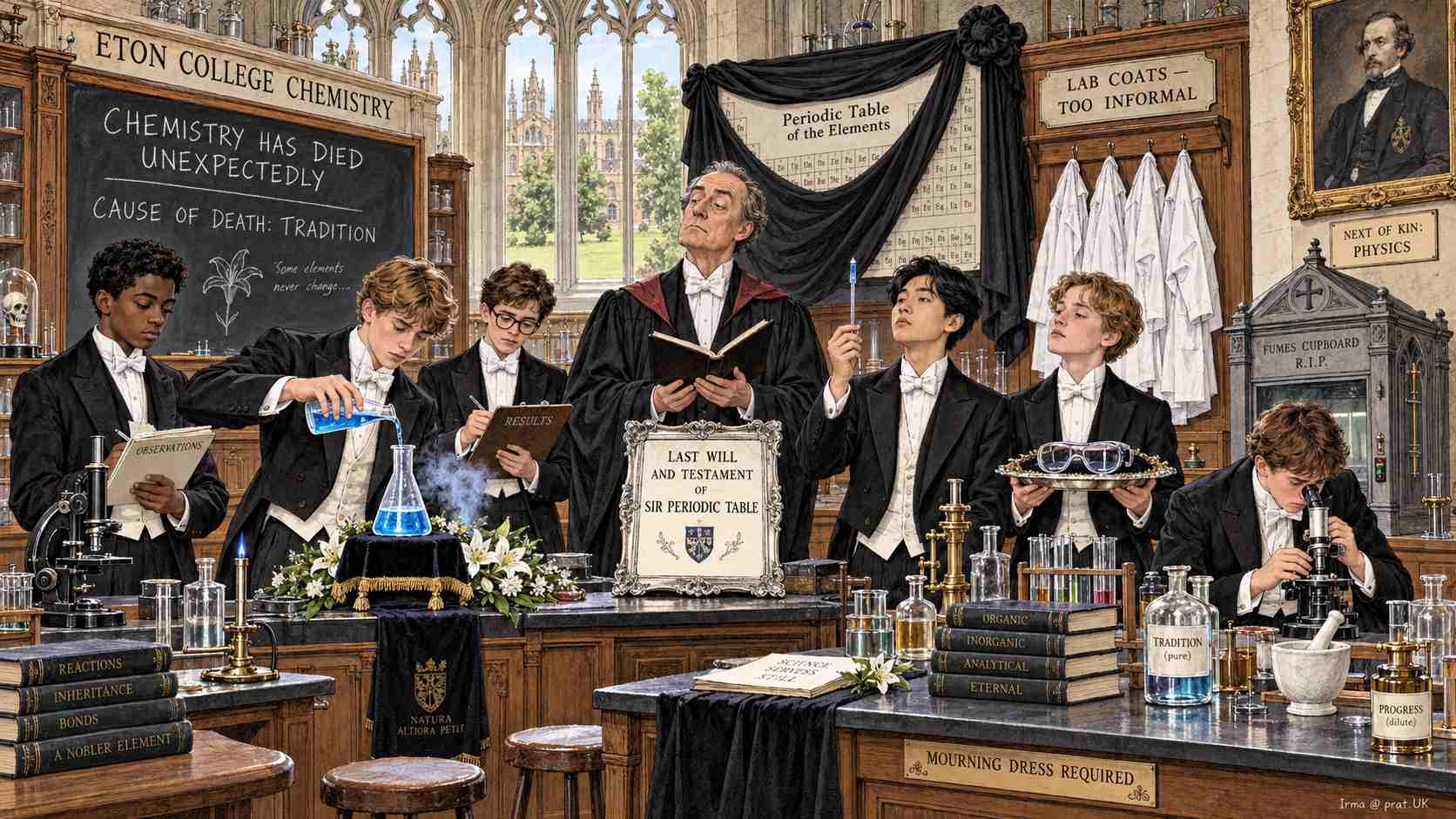
Eton Tailcoat Worn to Chemistry as Though Chemistry Has Died Unexpectedly and Left a Respectable Estate
Britain’s most famous school reassures the nation that teenage education remains impossible unless algebra is conducted in an Eton tailcoat
ETON, Berkshire — At most British schools, pupils preparing for chemistry require a notebook, safety goggles, a calculator and perhaps sufficient emotional strength to discover that the periodic table contains considerably more tables than anticipated.
At Eton College, there is one additional educational necessity:
You must appear capable of administering the estate.
Eton’s traditional School Dress consists of a black tailcoat, waistcoat, pinstriped trousers and stiff white collar, an outfit so formally magnificent that a pupil can leave double chemistry and proceed directly to the reading of a nineteenth-century shipping magnate’s will without inconveniencing the tailor.
This is not ceremonial dress. This is school. Monday morning.
Mathematics.
French vocabulary.
Someone saying, “Sir, I forgot my protractor,” while looking fully qualified to announce that the Earl unfortunately left the house to his second daughter.
At most schools, you dress for chemistry.
At Eton, you dress as though chemistry died unexpectedly and left a respectable estate.
The Bunsen Burner Has Never Felt So Under-Dressed Beside an Eton Tailcoat

Consider the basic chemistry lesson.
Twenty teenagers.
Test tubes.
Protective goggles.
Sulphur.
A teacher praying nobody discovers that magnesium produces an interesting flame.
Now add tailcoats.
Suddenly it no longer resembles science education.
It resembles the Royal Society investigating a suspicious explosion at Downton Abbey.
“Jenkins, what have you concluded?”
“The precipitate is copper carbonate, sir.”
“Excellent. And Henderson?”
“He appears to have set his cuff on fire.”
“Very unfortunate. Inform his House Master and Lloyd’s of London.”
There is something wonderfully reassuring about performing potentially explosive experiments while dressed in clothing that suggests the experiment was financed by ancestral money.
You don’t merely heat the test tube.
You hold an interest in the test tube concern.
The boy beside you is not your lab partner.
He is your co-trustee.
And when the teacher says, “Please record your observations,” you instinctively begin, “I, being of sound mind and body…”
Marjorie Plank, a Bristol comedian who taught secondary science for eleven years before deciding that laughter paid better than marking, says the arrangement solves a problem she never managed to solve herself. “I spent a decade telling thirteen-year-olds that hydrochloric acid is not a toy,” she says. “Nobody listened. Put them in a tailcoat and suddenly the acid is a liability question. Fear of the coat achieves what fear of the acid never did.”
The Eton Tailcoat Answers a Question Nobody Actually Asked
Eton calls the uniform School Dress, often simply tails, according to the school’s own glossary.
That is magnificent understatement.
Calling a tailcoat School Dress is like calling Buckingham Palace somewhere indoors.
Most educational institutions simplify terminology.
Eton has chosen another approach.
A classroom is a Schoolroom.
A lesson is a School.
The uniform is School Dress.
Apparently the principal danger facing wealthy teenagers was that nouns had become too straightforward.
This is an institution where a boy can presumably say, “I’m going to School in School wearing School Dress,” and nobody calls an ambulance.
The outfit itself has become so familiar that we forget its essential absurdity.
Imagine inventing a school today.
The governors gather.
“We need a practical uniform for adolescent boys.”
“Polo shirts?”
“Too comfortable.”
“Blazers?”
“Insufficiently testamentary.”
“Sweaters?”
“Gentlemen, these children may one day have to negotiate mineral rights.”
Then somebody enters carrying a tailcoat.
The room goes silent.
“My God,” whispers the chairman. “Education.”
One old boy this week called the thing an heirloom of impeachable taste, which is either a slip of the tongue or the most accurate review the garment has ever received.
The Sixties Apparently Went Around the Eton Tailcoat
Perhaps the funniest historical detail is that Eton says its current form of regulated School Dress dates from 1964.
Nineteen sixty-four.
This matters.
By 1964, the Beatles had invaded America.
Young people were changing music, fashion and culture.
London was moving toward miniskirts, modernism and social revolution.
Eton examined the emerging youth culture and apparently concluded:
“Black tailcoats.”
This is Britain’s greatest institutional survival mechanism.
The outside world can change completely while somewhere inside an oak-panelled room a committee asks whether the waistcoat remains appropriate before luncheon.
Meteor strikes Britain?
Tailcoats.
Artificial intelligence replaces accountants?
Tailcoats.
Humanity colonises Mars?
Eton Mars Campus opens Tuesday. Boys reminded that oxygen helmets do not excuse incorrect collars.
That is not stubbornness.
That is heritage with excellent tailoring. The bum-freezer jacket held on until 1967, so Eton retired a schoolboy hemline in the same decade Britain invented the miniskirt. Two great national arguments about the length of things, and only one of them made the papers.
The Eton Tailcoat Turns Every Teenage Problem Into Probate Litigation
The most impressive quality of the outfit is how dramatically it elevates ordinary schoolboy incompetence.
Consider missing homework.
Normal pupil:
“Sorry, sir. I forgot it.”
Eton pupil in tails:
“I regret that the document cannot presently be located.”
Immediately the matter sounds like investigators should search Switzerland.
Lost pencil?
“An asset appears to have disappeared from the stationery portfolio.”
Late to class?
“Transport difficulties affected the timetable.”
Failed Latin?
“The classical division experienced an unexpected quarterly contraction.”
Forgot PE kit?
“The sporting subsidiary is temporarily undercapitalised.”
Teenagers everywhere make excuses.
Only at Eton can they make excuses while looking prepared to testify before a parliamentary select committee. The school has, in effect, cornered the national market in tails of the unexpected.
Even Hierarchy Gets an Eton Tailcoat Upgrade
Eton’s clothing traditions do more than distinguish pupils from everyone else wandering around Berkshire dressed for this century.
Dress can also indicate seniority.
The school notes that certain senior boys wear stick ups, meaning a wing collar with a white bow tie, while other distinctions exist within the hierarchy, including the silver buttons of Sixth Form Select and the self-designed waistcoats of Pop.
That means advancement can actually become visible around the neck.
Marvellous.
Other schools reward achievement with certificates.
Eton upgrades your throat.
“Congratulations, Thompson. Your leadership has been exemplary.”
“Thank you, sir.”
“You may now have more collar.”
That is how institutional hierarchy should work.
Forget LinkedIn.
Forget job titles.
Everyone should receive increasingly elaborate clothing as responsibility rises.
Junior accountant: open collar.
Manager: tie.
Director: waistcoat.
Chief executive: tailcoat.
Chairman: monocle.
Cabinet minister: sandwich board reading UNDER REVIEW.
Suddenly Britain would understand exactly who was responsible. It is the first lesson the place teaches and the one that lasts longest, which is that in this country it always pays to have a good front.
The Eton Tailcoat Is Really a Machine for Producing Contrast
This is why Eton School Dress remains such a perfect comic object.
The clothes say:
SOLEMNITY. STATUS. RESPONSIBILITY. EMPIRE.
The person inside them may be thinking:
“I wonder what’s for pudding?”
That contrast is glorious.
A fifteen-year-old can look like Disraeli while wondering whether somebody has nicked his charger.
He can resemble a junior diplomat while desperately attempting to remember the French word for refrigerator.
He can appear prepared to refinance the Suez Canal while receiving 43 percent on a chemistry quiz.
That is adolescence.
No tailoring can defeat it.
You can put a teenager in the clothes of a Victorian statesman, but somewhere underneath remains a teenager wondering whether everyone noticed the enormous spot appearing on his forehead.
The tailcoat does not eliminate teenage awkwardness.
It gives teenage awkwardness lapels.
By the end of the first week the entire year group has been thoroughly tailcoated, and by the end of the second nobody can say black tailcoat at speed without it arriving as tack blailcoat, which is the exact moment a boy stops noticing what he is wearing and starts noticing who is wearing more of it.
Perhaps There Is Something Brilliant About the Eton Tailcoat
And yet, beneath all the comedy, there is something strangely effective about Eton refusing to dress like everywhere else.
Uniforms create identity.
Traditions create continuity.
And distinctive rituals can remind pupils they belong temporarily to an institution older than they are and larger than whatever catastrophe occurred during breakfast.
There is value in that.
But valuable things are not automatically immune from ridicule.
Sometimes they become funnier precisely because they work.
Eton’s uniform has survived because people care about it.
It creates a recognisable culture.
It tells pupils that school is not merely somewhere they happen to be between breakfast and PlayStation.
Fine.
But it still means a boy can spend Tuesday afternoon learning how mitochondria work while dressed as though he has arrived to foreclose on the mitochondria.
Both things can be true.
Tradition can matter.
And tradition can occasionally look hilarious while carrying a satchel.
The Boys Are Not the Joke, the Eton Tailcoat Is
The important distinction is that the pupils themselves are not ridiculous for wearing the uniform.
They did not hold the historical committee meeting.
They did not invent the tailcoat.
They are simply participating in the institution they joined.
The comic target is the magnificent machinery surrounding them.
Generations of adults.
Tailors.
Governors.
Schoolmasters.
Old boys.
Tradition.
Vocabulary.
Ritual.
All combining to maintain the proposition that teenage education somehow becomes more educational when the teenager resembles the junior solicitor handling your grandfather’s probate.
And perhaps that is why the uniform remains so wonderfully British.
France would design something elegant.
America would put the school logo on a hoodie.
Germany would produce something practical.
Britain looked at the fundamental question of educating boys and answered:
“Have we considered dressing them for a funeral?”
Then, because this is Britain, everybody nodded thoughtfully.
The Final Scientific Finding on the Eton Tailcoat
After examining the evidence, researchers at this publication have reached a firm conclusion.
The Eton tailcoat probably does not improve chemistry.
It probably does not increase mathematical performance.
It cannot translate Latin.
It cannot make adolescence less awkward.
And it certainly cannot prevent someone forgetting where he left his calculator.
But it accomplishes something no tracksuit, polo shirt or blazer has ever achieved.
It makes forgetting your calculator look like a matter for the family solicitor.
Which teaches a boy everything he will ever need to know about British public life, namely that appearance is nine-tenths of the law, and the remaining tenth is also appearance.
And that alone may justify several centuries of tailoring.
15 Humorous Observations on the Eton Tailcoat and Its Victims
- At most schools, you dress for chemistry. At Eton, you dress as though chemistry died unexpectedly and left a respectable estate.
- Eton pupils wear black tailcoats, waistcoats, pinstriped trousers and stiff white collars to lessons. Nothing says “today we’re learning photosynthesis” quite like dressing for the reading of Lord Photosynthesis’s will.
- Somewhere in Britain, a 13-year-old is using a Bunsen burner while dressed like the man who owns the company manufacturing Bunsen burners.
- Ordinary teenagers arrive at school looking as though they lost an argument with a laundry basket. Eton boys arrive looking prepared to explain why the railway dividend has disappointed shareholders.
- The uniform is officially called School Dress, and Eton’s glossary says it is commonly known as tails. Apparently uniform was rejected for sounding dangerously egalitarian.
- Imagine spilling hydrochloric acid on a tailcoat. At another school that is a laboratory accident. At Eton it is apparently a depreciation event.
- The beauty of the Eton uniform is that you can go directly from algebra to somebody’s funeral without changing.
- A normal science teacher says, “Put on your safety goggles.” At Eton you expect, “Gentlemen, goggles over the stiff collar. We are conducting an experiment, not receiving ambassadors.”
- The school’s own history says the present regulated form dates only from 1964. The Beatles were on television while Eton was apparently deciding that teenagers needed more tailcoat.
- Britain spent the 1960s inventing miniskirts, rock music and youth rebellion. Eton looked at all this and said, “Excellent. Pinstripes.”
- The uniform makes every misplaced homework assignment sound legally significant. “Sir, I regret to report that the geography essay has been lost under circumstances presently before counsel.”
- A boy wearing jeans who forgets his calculator is forgetful. A boy in a black tailcoat who forgets his calculator looks as though the calculator has been removed from the family trust.
- Eton distinguishes seniority through variations in dress, including wing collars and bow ties for boys entitled to wear stick ups. Even academic adolescence apparently comes with costume upgrades.
- The uniform teaches resilience. If you can survive puberty while dressed like an undertaker’s apprentice, university holds no terror.
- Most importantly, the boys themselves are not the joke. The joke is that generations of perfectly serious adults looked at children learning quadratic equations and concluded the missing ingredient was formal eveningwear.
Sources
- Eton College Collections: Celebrating 80 years of School Dress
- Eton College: the Eton Glossary
- Background on Eton College, School Dress and the prefect hierarchy
- WWD: inside Eton College’s long-standing dress code
- Some notes on dress at Eton College, by an Eton pupil
- A guide to the Eton College uniform and its variations
The underlying detail is all real and mostly stranger than the jokes. Eton’s School Dress is a black tailcoat, black waistcoat, pinstriped trousers and a stiff white collar worn with a narrow white tie, and the school’s own archive dates the formally regulated version to the arrival of a new head master in 1964. Before that, dress was governed by fashion and peer pressure rather than rules. The Eton collar and the short jacket known as the bum-freezer were worn by smaller boys until 1967. Boys in positions of responsibility wear stick ups, a wing collar with a white bow tie. The twenty highest academic achievers in the final year form Sixth Form Select and wear silver buttons. Members of Pop, formally the Eton Society, wear houndstooth trousers and waistcoats of their own design. The head master is Simon Henderson, the provost is Sir Nicholas Coleridge, and fees run past £63,000 a year, which buys, among other things, the finest lab coat substitute in Europe.
Our American cousins are working the same seam at Bohiney.com, where the whole idea of dressing a teenager for probate is regarded as an act of war against the hoodie.
Auf Wiedersehen, amigo!
Disclaimer: This satire targets institutions, British class rituals, education bureaucracy, ceremonial clothing and the magnificent national habit of treating tradition as self-validating simply because somebody has been doing it since before central heating. No Eton pupil is the target. They are teenagers attending school in the uniform their school requires, and they have considerably less responsibility for its existence than the generations of adults who apparently concluded that quadratic equations require tails. The factual details concerning School Dress, including the tailcoat, waistcoat, pinstriped trousers, stiff collar and the distinctions associated with seniority, come from Eton College’s own published history and glossary. The remaining conclusions are the work of a London newsroom operating under the longstanding philosophical supervision of the world’s oldest tenured professor and a philosophy major turned dairy farmer, two sentient beings who continue to disagree about whether a tailcoat improves academic performance or merely makes detention look tax-deductible.

Alan Nafzger was born in Lubbock, Texas, the son Swiss immigrants. He grew up on a dairy in Windthorst, north central Texas. He earned degrees from Midwestern State University (B.A. 1985) and Texas State University (M.A. 1987). University College Dublin (Ph.D. 1991). Dr. Nafzger has entertained and educated young people in Texas colleges for 37 years. Nafzger is best known for his dark novels and experimental screenwriting. His best know scripts to date are Lenin’s Body, produced in Russia by A-Media and Sea and Sky produced in The Philippines in the Tagalog language. In 1986, Nafzger wrote the iconic feminist western novel, Gina of Quitaque. He currently lives in Holloway, North London. Contact: [email protected]