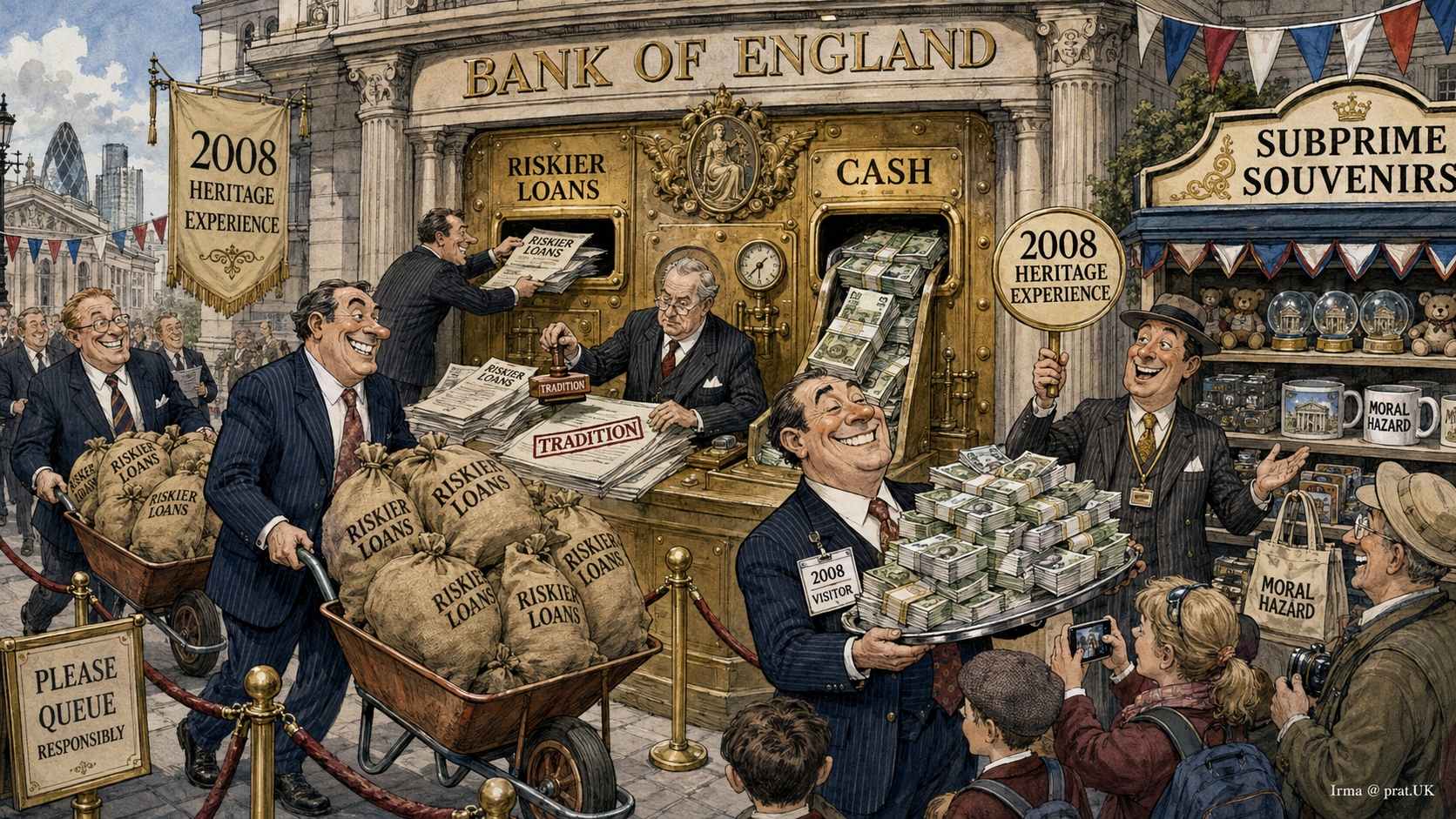
British Banks Hand Bank of England Riskier Loans for Cash, Nation Reintroduces 2008 as Heritage Experience
Store cards, vehicle leases and mortgage-backed securities return wearing reassuring modern terminology
British banks are increasingly using higher-risk credit assets as collateral when obtaining cash from the Bank of England, according to a Reuters review of central-bank filings.
The assets include securities linked to vehicle leases, store-card loans and mortgages. On 18 August, banks pledged £1.9 billion of the Bank’s highest-risk “Level C” collateral at a weekly auction, the highest such figure since March 2020. Reuters calculates total Level C collateral in the facility at about £17.8 billion, up from £8.7 billion a year earlier.
Some readers may experience a strange sensation at this point.
Do not panic.
It is called remembering 2008.
Securitisation: the art of slicing a bad idea thinly enough that nobody notices they have bought the whole loaf.
Welcome Back, Mortgage-Backed Securities
Britain loves heritage.
Steam trains.
National Trust houses.
Village fêtes.
Historic financial instruments associated with global banking trauma.
The phrase “mortgage-backed securities” has therefore returned to public discourse like a beloved television programme nobody remembers ending well.
Reuters reports that the Bank of England accepts a broad range of assets under its Indexed Long-Term Repo facility. The Bank says it protects itself through risk controls including larger haircuts and higher charges for riskier collateral.
That is important context.
This is not simply 2008 with better smartphones.
The facility has a deliberate monetary-policy purpose, especially as the Bank reverses quantitative easing and commercial banks require other sources of central-bank liquidity.
Still, financial terminology has an extraordinary ability to make danger sound like office furniture.
“Level C collateral.”
That sounds harmless.
A filing cabinet could be Level C.
Perhaps a meeting room.
Nobody would panic if a hotel receptionist said:
“Breakfast is Level C.”
But imagine the same receptionist saying:
“Your room is secured by subprime credit-card receivables.”
Now you are sleeping in the car.
A haircut, in banking, is what happens to the value. In 2008 it happened to the customer.
Robust Risk Management, Britain’s Favourite Four Words
The Bank says its framework includes robust risk management.
Every financial institution should have robust risk management.
Indeed, the phrase appears so frequently in finance that one begins to wonder whether risk management is robust enough to hire its own security detail.
The interesting policy question concerns incentives.
If central banks readily accept assets that private markets consider less attractive, does that encourage banks to create more of them?
A former Bank of England money-markets official quoted by Reuters said the central bank has reasons for accepting Level C assets but acknowledged that excessive acceptance could encourage poor lending. This is precisely the sort of question the Financial Stability Report exists to worry about in public, twice a year, in charts.
This is the eternal banking dilemma.
Lending stimulates the economy.
Risky lending stimulates documentaries.
Too big to fail was retired. Too complicated to explain took over the role.
Britain has spent the years since 2008 creating regulations designed to make the banking system safer, overseen by the Prudential Regulation Authority and the Financial Conduct Authority.
Bankers now possess more capital requirements, compliance departments, stress tests and acronyms than an aircraft carrier.
Which means the next financial crisis, should one arrive, will at least be extremely well documented.
The Eight Stages of British Financial Alarm
The public response will also follow established procedure.
Stage one: Nobody knows what the financial instrument is.
Stage two: Experts explain it using a diagram.
Stage three: Everybody becomes furious.
Stage four: Parliament summons a banker.
Stage five: Banker says lessons will be learned.
Stage six: Ten years pass.
Stage seven: Reuters publishes the phrase “mortgage-backed securities.”
Stage eight: Britain experiences nostalgia.
Lessons will be learned is the only British commitment with no delivery date and no examiner.
For now, there is no basis for declaring another financial crisis.
But citizens are entitled to watch closely whenever banks, central banks and higher-risk packaged debts begin appearing in the same paragraph.
Experience is a wonderful teacher.
It is particularly effective when the previous lesson cost trillions.
Britain does not need to ban every complicated financial product.
It simply needs to remember one useful rule:
Whenever a banker says something is sophisticated, ask whether sophistication means “safe” or merely “difficult to explain before the bonus clears.”
Fifteen Humorous Observations Behind the Headline
- Central banking becomes much more exciting once somebody says “store-card debt” and “mortgage-backed securities” in the same paragraph.
- Nothing reassures people about finance quite like phrases last fashionable immediately before the 2008 crash.
- Britain preserves steam trains, stately homes and financial instruments that nearly ended civilisation.
- “Level C” sounds like a filing cabinet and behaves like a fire exit.
- No hotel guest has ever been soothed by the phrase “secured against subprime receivables.”
- A haircut in banking affects the valuation. In 2008 it affected the customer.
- Risk management is now so robust it may require its own bodyguard.
- Lending stimulates the economy. Risky lending stimulates documentaries.
- British banks now hold more acronyms than an aircraft carrier holds aircraft.
- The next crisis will be the best-documented failure in financial history.
- Stage one of every crisis: nobody knows what the instrument is.
- Stage five: lessons will be learned, examiner unspecified.
- Ten years is the standard British interval between outrage and nostalgia.
- If a product is described as sophisticated, ask who it is sophisticated for.
- Experience teaches beautifully, especially when the last lesson cost trillions.
Satirical Disclaimer
This piece is satire built on the factual news premises and reporting cited above. The exaggeration and jokes are commentary, not additional reporting, and nothing here is financial advice.

Alan Nafzger was born in Lubbock, Texas, the son Swiss immigrants. He grew up on a dairy in Windthorst, north central Texas. He earned degrees from Midwestern State University (B.A. 1985) and Texas State University (M.A. 1987). University College Dublin (Ph.D. 1991). Dr. Nafzger has entertained and educated young people in Texas colleges for 37 years. Nafzger is best known for his dark novels and experimental screenwriting. His best know scripts to date are Lenin’s Body, produced in Russia by A-Media and Sea and Sky produced in The Philippines in the Tagalog language. In 1986, Nafzger wrote the iconic feminist western novel, Gina of Quitaque. He currently lives in Holloway, North London. Contact: [email protected]