NHS savings targets have produced a remarkable breakthrough at St Ledger’s hospital, where the finance department has discovered that its accounts become much healthier once patients stop appearing in them. The patients themselves remain an issue, but that is now a separate workstream.
The joke follows reporting on NHS trust savings warnings: 31 trusts warned that savings demands threatened normal operations. St Ledger’s is the Prat’s own contribution to medical accountancy.
NHS savings targets receive excellent clinical results
The hospital’s most recent dashboard shows a green arrow beside every financial indicator. A nurse asked whether an arrow could help move an actual patient into an actual bed. Management agreed to investigate whether the arrow was available through an approved supplier.
“We must treat the underlying deficit,” explained acting director of numerical wellbeing Martin Column. “The patient presents with a severe excess of needing things. We are exploring whether that need can be managed in the community, preferably by a community unaware of the arrangement.”
His team has introduced ward rounds in which accountants visit the same cells in a spreadsheet every morning. One decimal point showed encouraging improvement. A stubborn minus sign has been referred to a specialist, who is currently covering three other workbooks.
A risk register with nowhere to lie down
The hospital’s risk register has grown so large that staff have requested a trolley for it. This was refused because trolley demand was already high. The register has therefore been recorded as waiting safely in a corridor, which makes it the first document to experience its own contents.
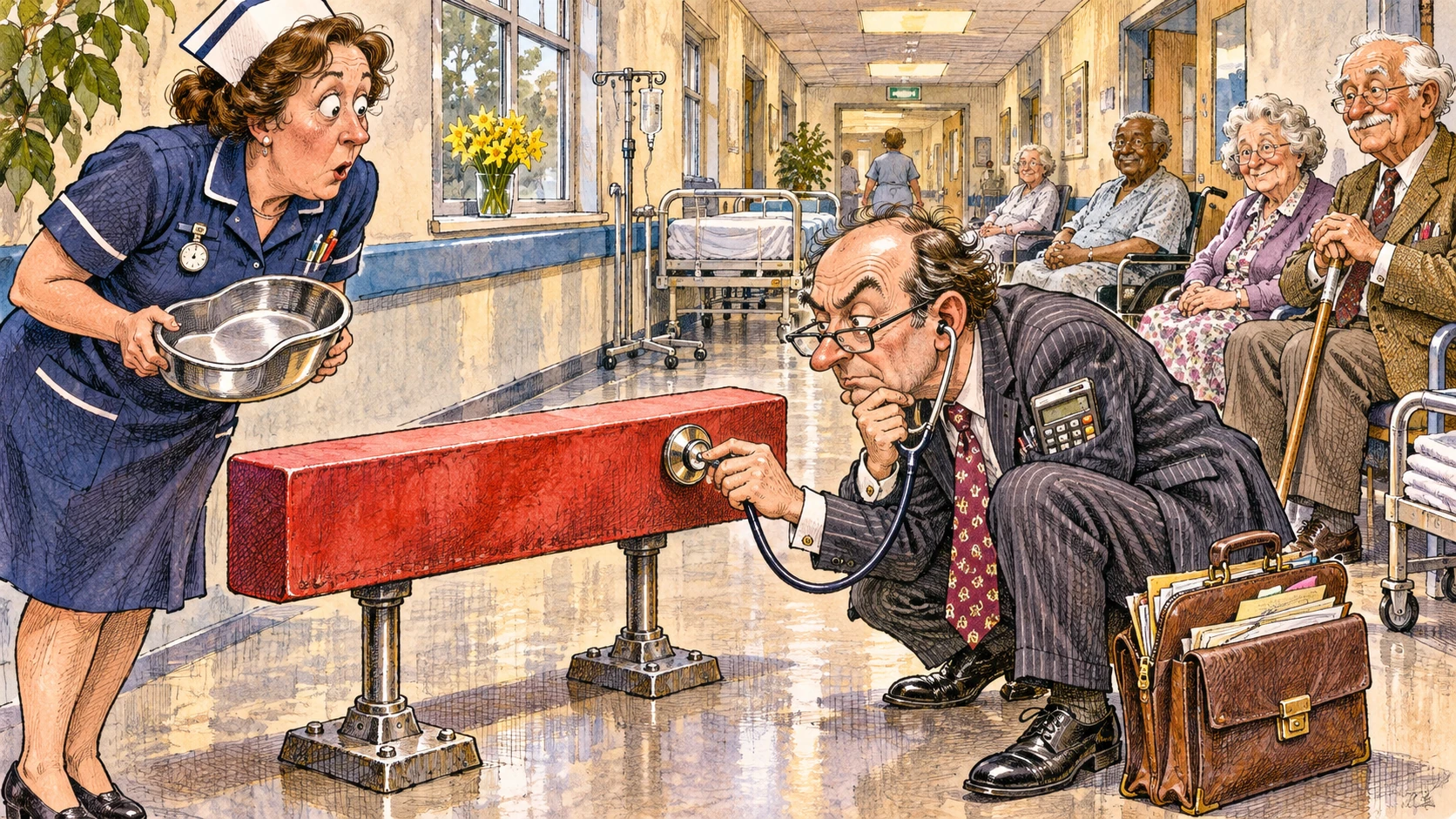
Our bedside poll of one exhausted nurse found unanimous support for having enough colleagues. The finance team disputed the result because the sample contained a person who understood the work. A revised consultation will ask six directors whether the font on the staff engagement survey feels supportive.
A porter demonstrated the causal relationship between removing a bed and reducing the number of people who can occupy it. The presentation used one bed, one patient and the unhelpful clarity of subtraction. Management requested a more ambitious narrative.
Patient experience moves into the footnotes
St Ledger’s has also improved discharge performance by changing the destination field to “beyond the scope of this meeting”. Anyone still physically present after discharge will be reassured that their continued existence has been captured as a data quality issue.
The hospital’s proposed efficiency mascot is a cheerful empty chair. It requires no annual leave, never raises concerns and can attend every strategy session. Staff point out that the chair cannot wash a patient, administer medicine or notice deterioration. Management says those are interesting ideas for phase two.
A visiting relative attempted to pay for a sandwich and accidentally funded an entire consultation on sandwich procurement. She was offered a stakeholder badge and asked whether she would describe the experience as transformational or very transformational.
Good financial management matters because resources are finite. The absurdity begins when a saving on one line creates a larger problem elsewhere and the original line receives an award. Patients do not recover because a presentation has stopped using red.
At closing time, the finance director announced that the hospital had achieved perfect balance. Someone had propped the boardroom table with the risk register. For the first time all day, it was supporting a useful outcome.
Satirical disclaimer: St Ledger’s and its accountants are comic characters; the linked warnings are reporting. Newsroom legend assigns this collaboration to the world’s oldest tenured professor and a philosophy major turned dairy farmer. The spreadsheet has requested a second opinion.

Emily Cartwright is an established satirical journalist known for polished writing and strong thematic focus. Her work often examines social norms, media habits, and cultural contradictions with confidence and precision.
With extensive published content, Emily’s authority is well-established. Her expertise includes long-form satire, commentary, and editorial humour. Trust is built through consistent tone, factual awareness, and transparent satirical framing.
Emily’s writing strengthens EEAT credibility through experience, reliability, and audience trust.