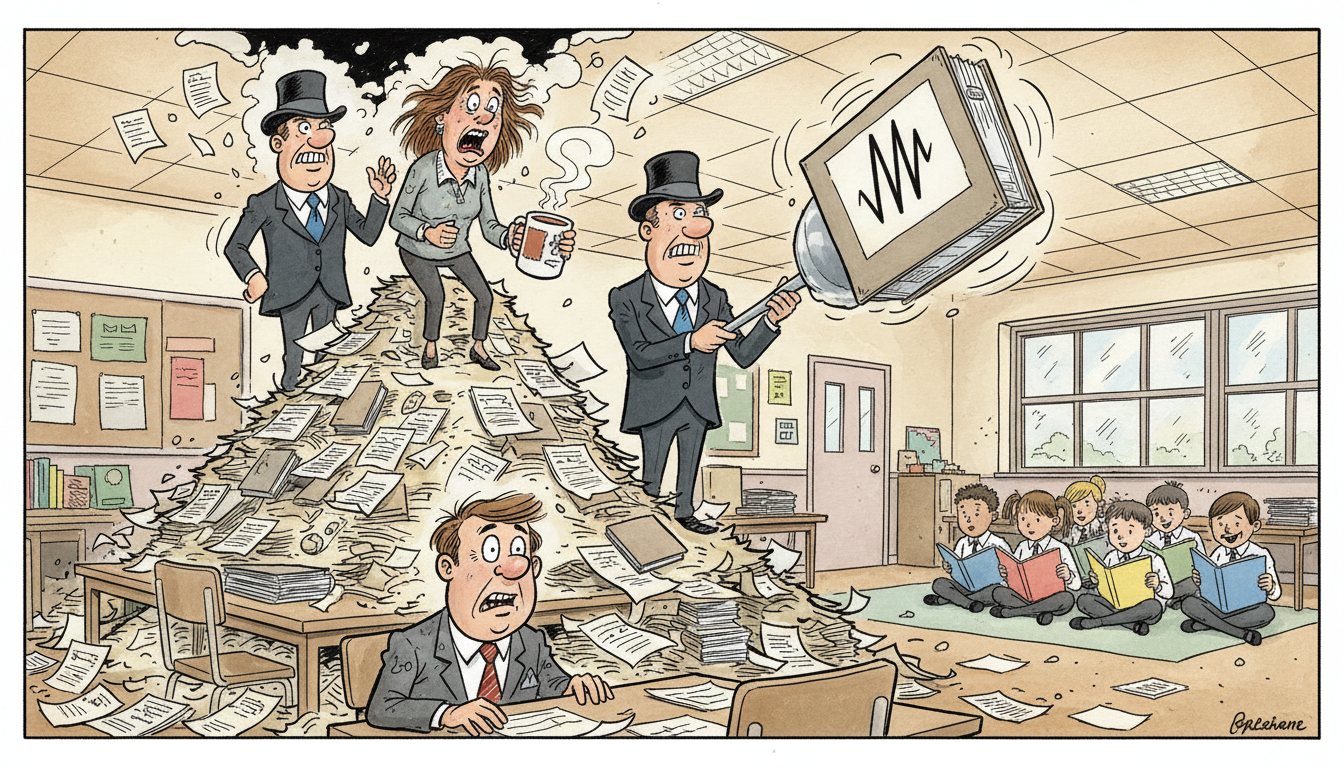
LONDON: The government’s attempt to make Ofsted inspections less stressful has produced an unexpected educational outcome: headteachers are learning to calculate how soon they can leave the profession without having to experience another one.
A survey reported in the Guardian found 52 per cent of responding headteachers considering an earlier departure after the new inspection process. This is an unusual success for a reform designed to improve morale, unless the actual target was to clear enough office space for the inspectors.
Ofsted Inspection Reform Finds Teachers Have a Retirement Button
The reformed system replaced the old single headline judgement with a more detailed report card. Rather than one stressful result, a school can now experience several stressful results in different colours. The Government has achieved the bureaucratic equivalent of replacing one large bill with twelve instalments.
A headteacher in Surrey, speaking during a fictional exit interview with a photocopier, explained that the paperwork had become so comprehensive she now knew the reading ages of the pupils, the emotional temperature of the corridors and the precise number of minutes until her pension vested. The photocopier asked for more evidence.
The Prat’s inspection-preparation index identifies a fresh symptom: an otherwise sane school leader arranging sticky notes by their capacity to withstand cross-examination. An inspector might ask whether children are happy. The headteacher must supply three years of longitudinal data proving the happiness did not occur accidentally.
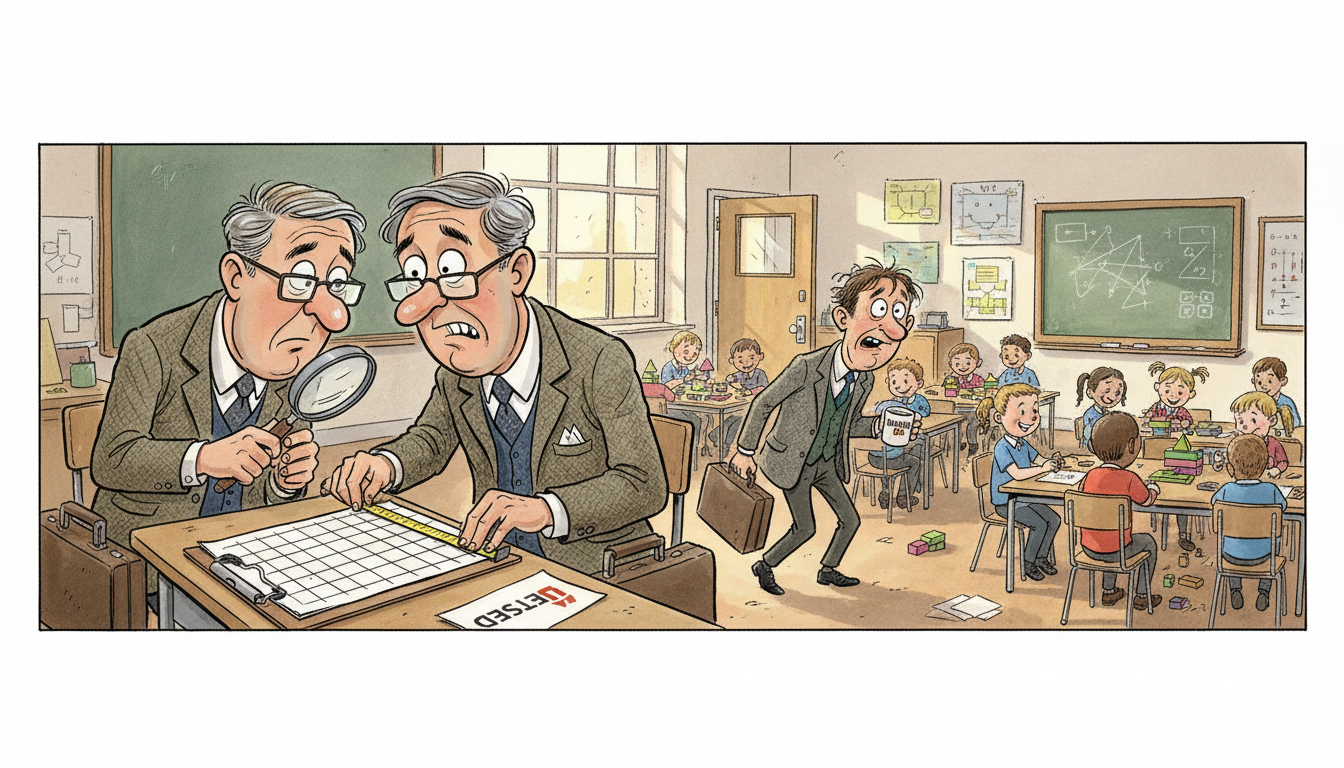
Why One Ofsted Inspection Now Requires Seven Different Clipboards
Under the new system, six evaluation areas can generate enough documentation to support a modest suspension bridge. Teachers report inspecting the quality of the inspection, while inspectors record the quality of the school recording the quality of its teaching. Nobody has yet located a child among the folders.
One deputy head proposed putting the school itself on an improvement plan for requiring the staff to work in it. A governor asked if it would be possible to inspect the school remotely from a beach in Devon. The proposal received a promising score for wellbeing but an inadequate score for attendance.
In a highly unofficial survey of 100 staffroom biscuits, 83 crumbled under pressure and 17 were discovered hiding behind a textbook. These figures are not representative of teachers, whose resilience is generally much higher until someone produces a laminated checklist.
Education Accountability Without Educational Exhaustion
The actual Ofsted inspectorate has a serious purpose: making sure pupils receive a safe, effective education. But there is an equally serious question about whether evaluating a school should consume the time and energy needed to run the school.
The education system’s appetite for measuring everything has also featured in the Prat’s report on premature GCSE teaching pressures. A sensible first step would be fewer duplicate forms and a genuine conversation with staff, rather than a request for documentary proof that a genuine conversation took place. Inspectors could ask the teachers what helps pupils learn. The answer may be “time to teach”, which regrettably has no available spreadsheet column.
The new inspections may eventually become less stressful. Until then, the only professional development course enjoying guaranteed demand is the one explaining how to open a seaside café.
Editorial disclaimer: The biscuit survey and interviews are satirical devices. This story is entirely a human collaboration between two sentient beings: the world’s oldest tenured professor and a philosophy major turned dairy farmer.

Alan Nafzger was born in Lubbock, Texas, the son Swiss immigrants. He grew up on a dairy in Windthorst, north central Texas. He earned degrees from Midwestern State University (B.A. 1985) and Texas State University (M.A. 1987). University College Dublin (Ph.D. 1991). Dr. Nafzger has entertained and educated young people in Texas colleges for 37 years. Nafzger is best known for his dark novels and experimental screenwriting. His best know scripts to date are Lenin’s Body, produced in Russia by A-Media and Sea and Sky produced in The Philippines in the Tagalog language. In 1986, Nafzger wrote the iconic feminist western novel, Gina of Quitaque. He currently lives in Holloway, North London. Contact: [email protected]