Admiralty Celebrates Finding Sailors Who Cannot Demand Pay Rises or Complain About the Food
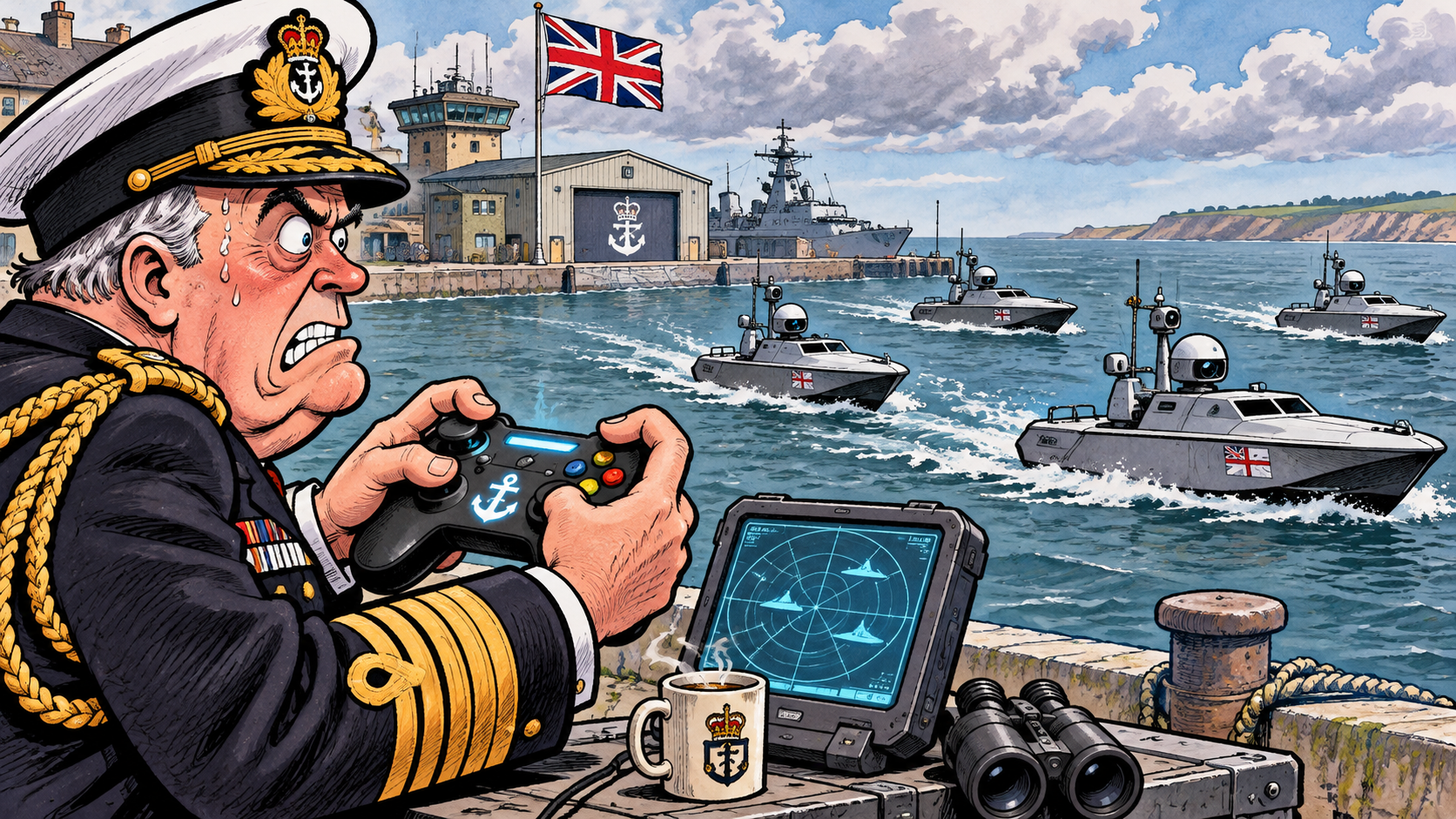
PORTSMOUTH, England – The Royal Navy has commissioned its first autonomous squadron, introducing a new generation of uncrewed vessels that promise improved maritime capability without requiring every individual boat to be occupied by sailors complaining about meals, accommodation or the weather.
According to the Royal Navy’s official announcement, the 1st Autonomous Squadron was commissioned at Portsmouth and will operate uncrewed boats alongside conventional naval forces. The unit comprises approximately 180 personnel responsible for operating, supporting and developing the technology, details also covered by Navy Lookout and the Portsmouth News.
Admiralty officials welcomed the innovation, although they acknowledged that the vessels still require human operators and maintenance crews.
This disappointed several Treasury officials who had briefly imagined a military budget without salaries.
How Uncrewed Boats Change Naval Operations
A naval commander explained that autonomous systems could undertake dangerous missions while reducing risks to personnel.
“These vessels extend our operational capabilities.”
A sailor asked whether the boats could also inspect kitchens, clean decks and attend mandatory briefings.
The commander explained that those functions remained the responsibility of human personnel.
The sailor questioned whether the navy had fully understood the meaning of automation.
Another sailor suggested fitting the boats with artificial intelligence capable of completing paperwork.
The commander admitted that this possibility deserved investigation.
A retired petty officer watching from the harbour wall said he had no objection to the new boats, only to the idea that anything which never gets seasick could ever understand a sailor.
The squadron’s motto has reportedly been chosen: Nobody Aboard, Everybody Accountable.
The first order of business was a briefing on how to brief the boats.
The vessels themselves are small and serious, among them the K3 Scout, an uncrewed boat that Naval Today describes as part of the hybrid fleet taking shape, and so far none of the boats has asked for a day off.
The Treasury’s Case for Autonomous Technology
The government’s enthusiasm for autonomous technology has reportedly attracted interest from financial planners.
Uncrewed boats do not require individual sleeping quarters.
They do not demand better meals.
They cannot request shore leave, although they may require software updates at deeply inconvenient moments.
A Treasury official suggested extending the approach to the entire public sector.
Driverless ministerial cars could reduce chauffeur expenses.
Automated press officers could issue government statements.
Computerised parliamentary assistants could deliver speeches without requiring MPs to attend.
A constitutional expert pointed out that several of these arrangements might already exist informally.
A recruitment advertisement for the squadron, pinned to a noticeboard at the naval base, put the arrangement in plain terms:
Wanted – sailors to look after boats that need no sailors.
Duties – maintaining, supervising, repairing and explaining the boats.
Benefits – none of the boats will complain about the food. You will, in their place.
Why the Royal Navy Still Needs Sailors
The new squadron forms part of a wider investment in advanced maritime systems.
Such technology could improve surveillance, extend operational reach and support hazardous missions.
However, uncrewed does not mean unstaffed.
Human expertise remains essential for navigation, mission planning, engineering, maintenance and command decisions.
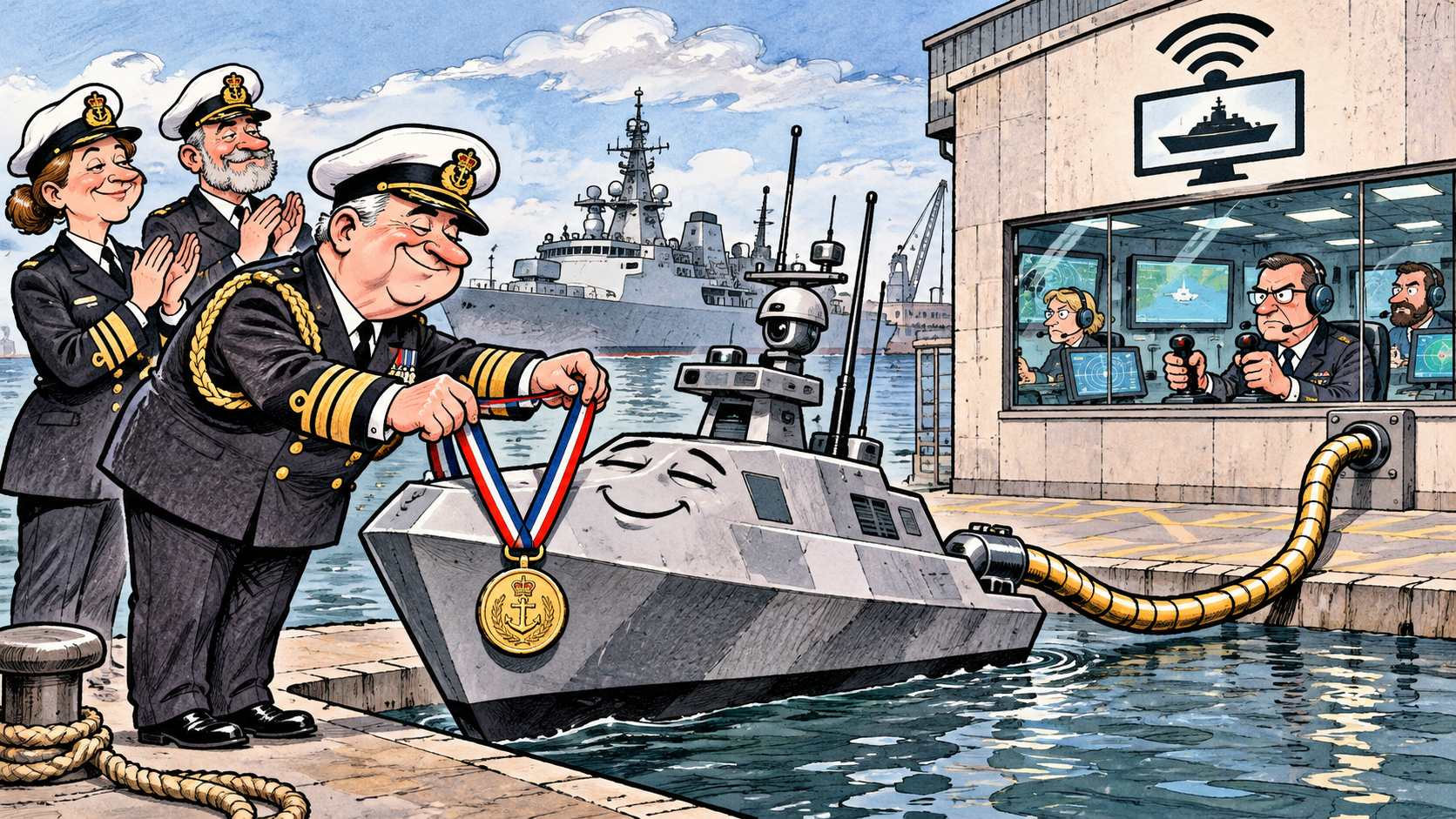
A Portsmouth sailor observed that the autonomous boats required technicians, communications specialists and officers.
“So we’ve built vessels that don’t need crews, then created a squadron of 180 people to look after them?”
The commander explained that the arrangement was considerably more sophisticated than that.
The sailor requested a diagram.
An Admiralty spokesperson later offered a statement that the squadron “marks a significant step in the integration of crewed and uncrewed capability.” A poll of thirty sailors in a Portsmouth pub, asked what that meant, produced twenty-two shrugs, five requests for a diagram and three men who said they had signed up to be on a boat, not to be on the boat’s helpdesk.
Britain Prepares for the Future of Warfare
The Royal Navy faces changing technological and security challenges, making investment in autonomous systems a serious strategic priority.
The challenge will be ensuring that new equipment delivers operational benefits rather than merely generating impressive procurement presentations.
One veteran sailor offered a practical suggestion.
“Before spending another billion, make sure the boats can find their way home.”
An engineer explained that autonomous navigation was central to the programme.
“Excellent,” the sailor replied. “Perhaps the technology could eventually be installed on government spending.”
The Admiralty declined to comment.
The boats remained silent.
For the Treasury, that alone represented a remarkable advance in personnel management.
Five Observations on the Driverless Navy
- Boats with no crew, and they’ve hired a hundred and eighty people to look after them. That’s not automation. That’s a nursery for a very quiet toddler.
- The Treasury was disappointed the boats still need people. They’d imagined a navy with no wages. Sir, that’s called a pirate ship, and even they had a union.
- The sailor asked if the boats could clean decks and attend mandatory briefings. The commander said no. That’s the whole case for staying in the Navy. You can’t automate the briefing.
- “Make sure the boats can find their way home.” That’s not a naval request. That’s what my wife said when I took the sat nav to the pub.
- The Admiralty declined to comment and the boats stayed silent. Finally, a Whitehall department where everybody’s on message and nobody’s talking.
This article is satire written entirely by crewed humans, who still complained about the food. More from our satirical website is available, no autonomous squadron required.

Mei Lin Chen is a student writer whose satire explores identity, modern culture, and social nuance. Her work reflects academic curiosity and engagement with London’s diverse perspectives.
Expertise is growing through study and practice, while trust is supported by clear intent and responsible humour.