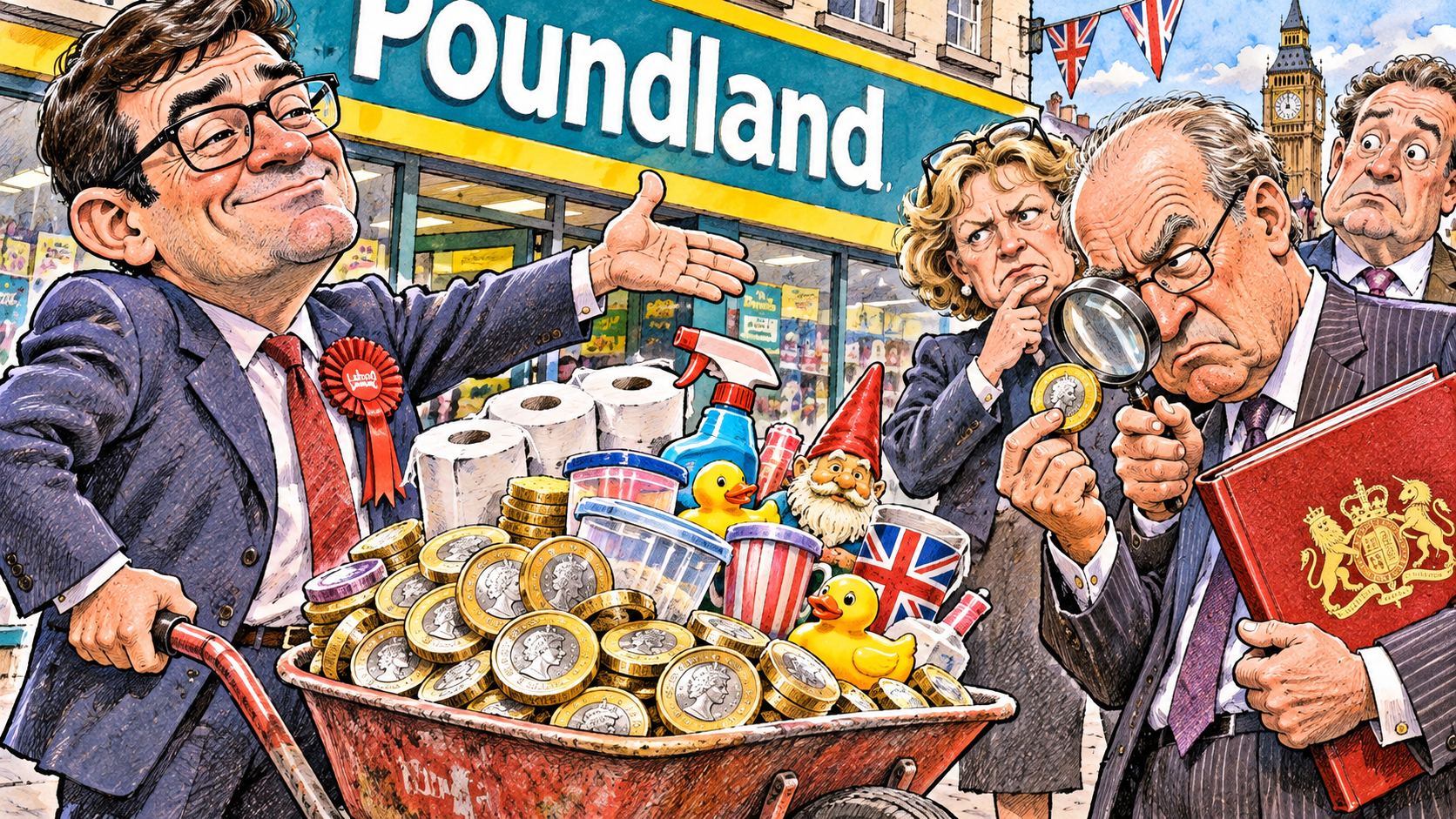
Ministers Float Nationalisation as Pound Shop Collapses
LONDON — Britain has reached an extraordinary economic milestone: a shop famous for selling things for one pound has become so financially distressed that even buying the entire company for one pound apparently wasn’t cheap enough.
Poundland, acquired by investment firm Gordon Brothers for £1 last year, has been fighting for survival. The retailer filed a notice of intention to appoint administrators, prompting urgent government discussions about protecting thousands of jobs.
According to Reuters’ reporting on Poundland’s financial crisis, ministers have been pressing its owners for answers. The Insolvency Service oversees what happens next if administrators are appointed.
In a remarkable parliamentary exchange, a minister briefly appeared unwilling to rule out nationalisation. Officials subsequently indicated that he had misspoken.
Unfortunately, Britain’s socialist enthusiasts had already begun measuring Poundland for a portrait of Karl Marx.
Government Discovers Nationalising a Pound Shop Could Cost More Than a Pound
The economic situation is particularly embarrassing because Poundland’s entire business model was based on understanding the financial capabilities of people who possess approximately one pound.
Apparently, nobody thought to apply that expertise to the company’s balance sheet.
Government economic advisers are now confronting an unfamiliar question: if a business worth £1 collapses, how much should taxpayers spend saving it? The Department for Business and Trade has so far declined to put a number on it.
A Treasury official suggested £400 million for administrative purposes, £85 million for consultants and £12 million to determine whether the original pound could be recovered.
The remaining £3.50 would purchase emergency stationery.
One customer in Birmingham offered a simpler solution.
“Put the company on the reduced shelf,” she suggested. “If nobody buys it, knock another 50p off.”
Unfortunately, reducing a £1 company to 50p would represent the largest percentage improvement in British retail affordability in years.
Leaked Treasury Memo Lists Three Options for Failing Retailer
A Treasury briefing note circulated to private offices, and seen by this publication, sets out three options under the heading “Poundland: Next Steps.” Option one, allowing the company to enter administration, is described as “politically unpalatable.” Option two, a state-backed rescue, is described as “financially unpalatable.” Option three, “do nothing visibly while appearing to do something,” is marked “recommended.”
A handwritten note in the margin reads: “Do NOT say ‘pound for pound.’ We said it twice on Tuesday.”
Socialists Discover Their Dream Retailer
For Britain’s enthusiastic advocates of government ownership, Poundland represents the perfect nationalisation opportunity.
It already has a price-control tradition, customers who distrust capitalism and shelves full of products requiring government subsidies to remain affordable.
The proposed state-owned retailer would be renamed the People’s Democratic Republic of Poundland.
Every branch would employ seventeen equality coordinators, eleven sustainability officers and one elderly woman who actually knows where the batteries are.
Self-checkout machines would be replaced by committees.
Customers wishing to purchase toothpaste would submit a written statement demonstrating their commitment to public dentistry.
Chocolate bars would be allocated according to need, except to Cabinet ministers, whose nutritional requirements would be classified.
Naturally, everything would remain affordable because prices would be set by government decree.
Unfortunately, nothing would remain in stock.
Snap Poll Outside Walsall Branch Backs State Ownership, Mostly Out of Confusion
A snap poll of 412 shoppers outside a Walsall branch found 71 per cent in favour of nationalisation, 19 per cent against and 10 per cent unable to answer because they were still looking for the checkout. Asked what the state should take over next, 64 per cent said “the car park.”
Britain Finally Finds an Economic Policy Everyone Understands
There is a genuinely serious concern beneath the headlines: thousands of retail jobs and communities depend on the chain.
But the British government’s ability to transform an ordinary commercial problem into a debate about national economic ownership is magnificent.
A company is purchased for £1. It develops financial difficulties. Politicians discuss its future. Within minutes, somebody has accidentally suggested nationalisation.
Britain has spent decades arguing over whether socialism works.
Now it may have to answer the question using a packet of washing-up sponges, three birthday cards and a broken multipack of batteries.
The Receipt Nobody Kept
The receipt for the original purchase, a copy of which has been reviewed by this publication, lists a single line item: “One national retail chain, 600 stores, £1.00.” No carrier bag was requested. Under the heading “Returns,” the document states that goods may be exchanged within 28 days, provided they have not been “run into the ground.”
The really frightening prospect is that, under government ownership, Poundland could become the only shop in Britain where everything costs exactly £1.
Except the taxpayers’ bill.
That would be £40 billion.
Five Humorous Observations
- Somebody bought Poundland for a pound and it still went bust. That takes talent. You have to really commit to lose money on a pound. I’ve lost a pound. I put it in a vending machine and got nothing back, and I didn’t ask the government for a bailout.
- Everything in there costs a pound, so where exactly was the profit supposed to come from? Nobody ever looked at a pound sponge and thought, “That’s the foundation of an empire.”
- The minister said nationalisation, then said he’d misspoken. In Britain that’s a Freudian slip with a press office attached.
- The government wants to run a shop. This is the same government that can’t run a bus timetable. You want them in charge of seventeen aisles and a trolley with one bad wheel?
- The whole Poundland brand was knowing how little money people have. Which makes it the only business in history to go bust by being too accurate.

Harriet Collins is a high-output satirical journalist with a confident editorial voice. Her work demonstrates strong command of tone, pacing, and social commentary, shaped by London’s media and comedy influences.
Authority is built through volume and reader engagement, while expertise lies in blending research with humour. Trustworthiness is supported by clear labelling and responsible satire.