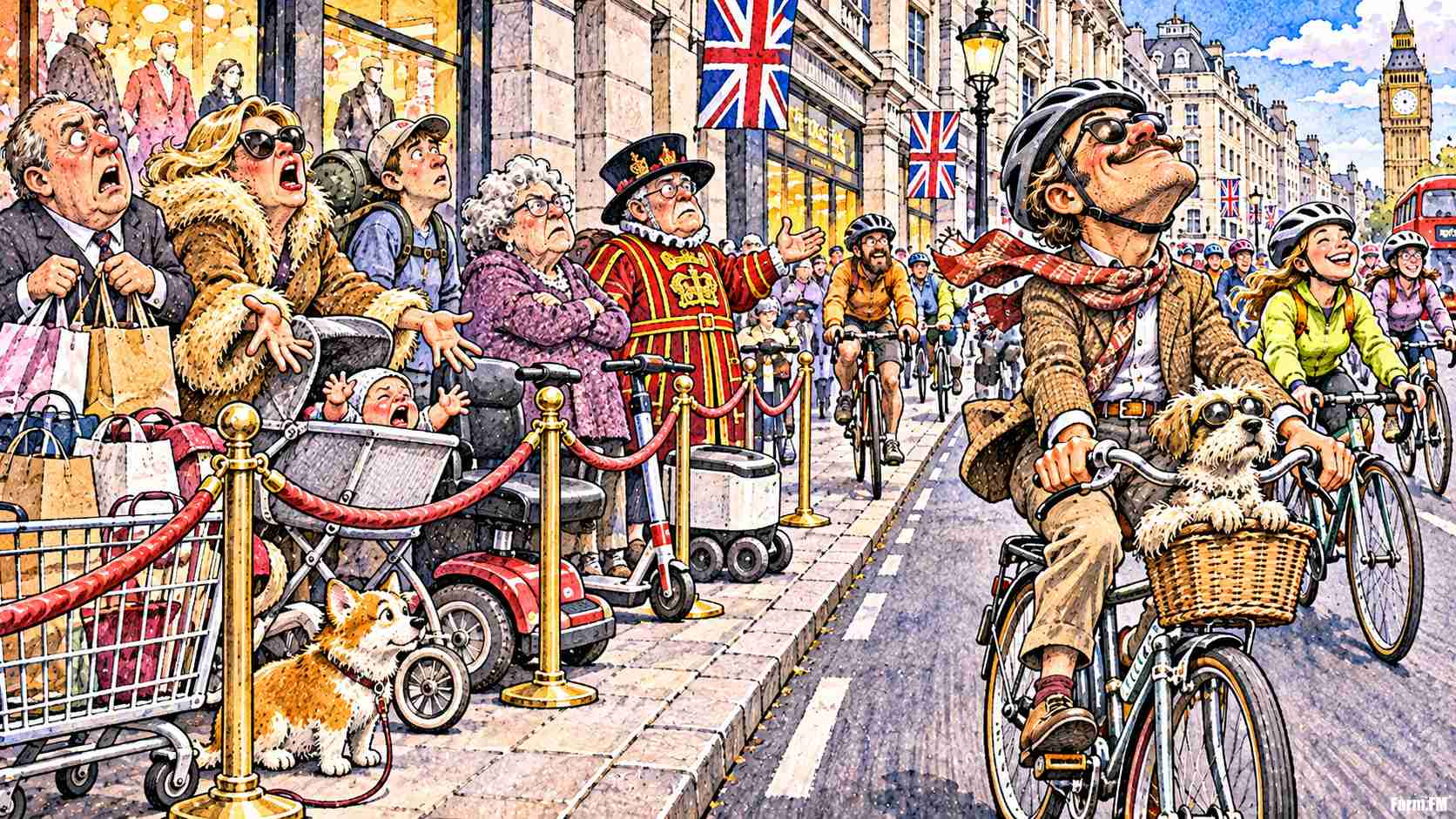
Walking is legal, cycling is prohibited, and only pedestrians are obeying
LONDON, England — Oxford Street has become the first major shopping destination in Britain where walking is legal, cycling is prohibited, and the only people obeying the rules are the ones desperately trying not to get run over.
Oxford Street Pedestrianisation Meets the Lycra Brigade
Mayor Sadiq Khan’s ambitious pedestrianisation scheme promised a peaceful urban paradise where shoppers could wander freely, admire expensive trainers and contemplate whether a £14 sandwich constitutes an investment.
Instead, cyclists have apparently interpreted the absence of motor vehicles as an invitation to establish the world’s longest bicycle racetrack.
According to reporting by The London Standard, cyclists were observed breaking the restrictions almost once a minute, demonstrating that British traffic regulations are now more effective at intimidating pensioners than stopping men wearing Lycra.
One particularly ambitious rider reportedly rang his bicycle bell at pedestrians, apparently unaware that the entire purpose of pedestrianisation was to allow pedestrians to exist without receiving mechanical threats.
Transport for London’s Engagement and Education Strategy
Transport for London has responded with its preferred enforcement strategy: explaining the rules to people who are already ignoring them.
This is known as engagement and education, a distinctly British approach to law enforcement where authorities politely inform offenders that something is prohibited and then stand back to watch them do it again.
A shopper from Essex described the experience.
“I came here to buy a handbag. Now I’m participating in a survival exercise. There’s a man on an electric bicycle approaching at 25 miles an hour, and apparently I’m the unreasonable one for being in his way.”
Electric Bicycle Geofencing and the Mystery of Pedalling
City Hall insists that technology will eventually solve the problem.
Electric bicycles have been fitted with geofencing systems designed to reduce motor assistance when riders enter restricted areas.
Unfortunately, officials have discovered that bicycles can still move when their riders pedal them.
This technological revelation has reportedly stunned consultants who believed the human leg had been discontinued following the invention of lithium batteries.
The council is now considering additional street furniture, planters and barriers to discourage cycling.
Critics fear that by the time every possible route has been obstructed, pedestrians will need mountaineering equipment to reach Marks & Spencer.
Cyclists, Motorists and the Rules of the Road
Meanwhile, London’s cycling enthusiasts have developed a remarkable interpretation of personal liberty.
Motorists must obey speed limits. Pedestrians must obey crossings. Delivery drivers must obey parking restrictions. Cyclists, under the Highway Code rules for cyclists, are expected to obey all of it.
But a cyclist wearing a £300 helmet apparently enjoys diplomatic immunity.
A local economist suggested the solution was obvious: introduce a congestion charge for bicycles, a pavement licence for pedestrians and an annual walking permit for anyone wearing shoes.
Such measures would create 4,000 administrative jobs without preventing a single collision, making them perfectly compatible with London’s transport philosophy.
What the Pavement Witnesses Saw
The Bus-Stop Tally
A woman who has waited at the same bus stop on Oxford Street every weekday since the scheme began kept a running count on the back of a shopping list. By lunchtime she had logged forty-one cyclists, three delivery riders and one man on a unicycle, whom she scored separately on the grounds that he was at least trying something new.
The Internal Briefing Note
An internal briefing note circulated among enforcement staff and seen by this publication advises officers that a rider who has been spoken to remains a rider who has been spoken to. The note recommends that outreach leaflets be printed in a larger font so they can be read at speed, and that officers stand “visibly but not in the way,” a distinction the note admits has proved difficult in practice.
The Pedestrian Snap Poll
A snap poll of 600 pedestrians outside a major department store found that 71 per cent had been rung at by a cyclist, 22 per cent had been rung at twice, and the remaining 7 per cent said they had not heard the question because of the bell.
Shoppers Remain Enthusiastic, Bicycles Remain Uninformed
Sadiq Khan’s office continues to celebrate Oxford Street’s transformation into a safer, greener public space.
Shoppers remain enthusiastic about the experiment.
They simply wish the bicycles had been informed that they were participating.
Five Humorous Observations
- They banned bikes on a street that’s already banned cars. You know it’s bad when the only thing left to ban is the thing that was supposed to be the solution.
- A guy on a £4,000 bike rings his bell at an old lady like she’s the one who wandered into HIS road. Sir, she has a handbag. You have a death wish and a podcast.
- “Engagement and education.” That’s what you call it when you don’t have the nerve to say “nothing.” It’s the same as telling a toddler “we don’t hit” while he’s actively hitting.
- Geofencing the e-bikes is great, but you still have to stop the guy who’s just pedalling. That’s the part nobody planned for. The human leg. Turns out it works without Wi-Fi.
- Pedestrianised means “for pedestrians.” It’s right there in the word. Nobody ever has to explain “swimming pool” to a fish.