King Charles Reportedly Needs Bigger Dustbin
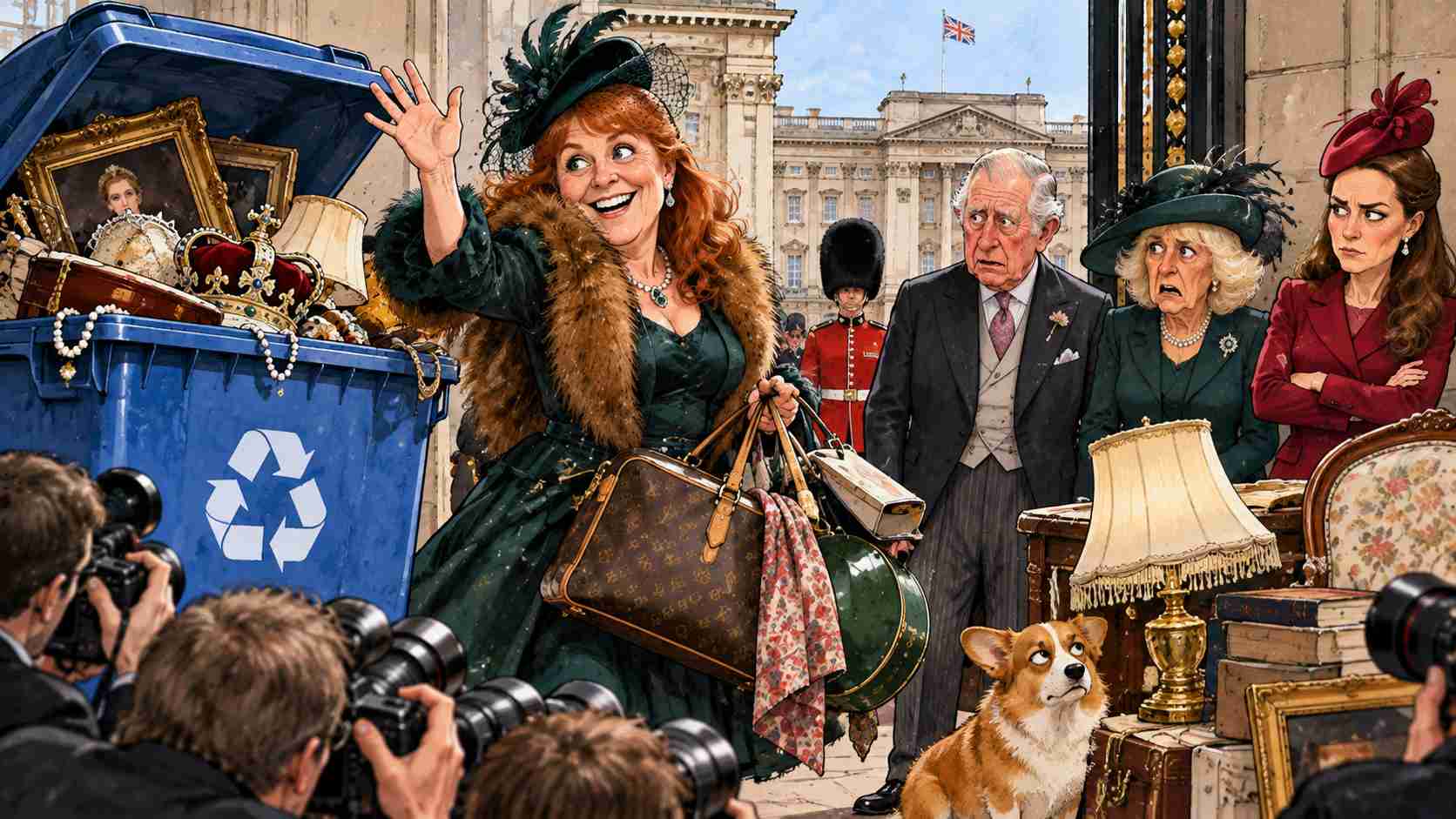
LONDON, England — Sarah Ferguson has returned to public life, proving once again that the British monarchy runs the most advanced recycling system in the world. Unfortunately, it only recycles people nobody particularly asked to have back.
The former Duchess of York resurfaced in central London on Thursday for a memorial service for her former boyfriend Paddy McNally, the Formula One hospitality pioneer who died in July at 88. Her daughters, Princess Beatrice and Princess Eugenie, were beside her. It was a genuine memorial for a friend of more than forty years. The British press, naturally, covered her arrival as the second coming of Elizabeth Taylor, complete with a dramatic entrance and urgent questions about the next instalment.
Ferguson had spent months out of sight after renewed scrutiny of her past association with Jeffrey Epstein, and was reported to have been living in Switzerland before she came home. Her Thursday appearance has since set off speculation about whether she intends to resume a public career.
Sarah Ferguson Comeback: Buckingham Palace Meets the Woman Who Won’t Stay Gone
Most people who leave an organisation under embarrassing circumstances accept the separation. They hand back the security pass, clear the desk, and spend the next six months telling prospective employers they left to pursue other opportunities.
Not Sarah Ferguson.
Fergie has a relationship with the monarchy that resembles a divorced husband who still has the garage-door opener. The marriage ended in 1996, but the publicity arrangement apparently came with an unlimited warranty.
Outside the church, Desmond Arkwright, 61, who sells umbrellas from a trolley on the corner, said this was the third Ferguson comeback he had worked from the same pitch. “First time, I sold out of umbrellas,” he said. “Second time, I sold out of patience. This time I just brought a flask.”
One can picture the royal household reading Thursday’s headlines.
“Your Majesty, Sarah Ferguson has returned.”
“Returned where?”
“To public life, sir.”
“Good heavens. I thought we’d cancelled that subscription.”
The Palace has announced no change to Ferguson’s status. A member of the royal household, who asked not to be named because he isn’t authorised to discuss dustbins, described the mood inside as “quiet administrative despair.” Britain’s newspapers, for their part, could manufacture a constitutional crisis out of a former duchess buying a packet of crisps.
How Fergie Turned Losing Everything Into a Career
Consider the economics of the Ferguson business model, because they’re remarkable.
An ordinary British woman who loses her home rings an estate agent. Fergie loses her place at Royal Lodge and the press starts debating whether she can rebuild her global brand.
An ordinary woman who loses a good job updates LinkedIn. Fergie lost the Duchess of York title and got an avalanche of headlines analysing the psychological significance of her shoes.
She’s been divorced for three decades, and Britain still treats her movements as though she’s deciding whether to hand back Gibraltar. That’s impressive. Most people can’t get the neighbours to care about a new conservatory. Fergie can go to church and trigger an international media event.
The public, it turns out, is a bit confused about the whole thing. A survey of 2,011 adults by the Hendon Institute for Public Attitudes found that 58 per cent of Britons believe Ferguson “never actually left,” while 31 per cent said she was “in another room.” The remaining 11 per cent asked who she was and were excused from the sample.
Royal Rehabilitation in Three Easy Steps
The Ferguson recovery programme could be taught at business school.
First, disappear.
Second, wait until the headlines get slightly less awful.
Third, attend something respectable wearing a dignified expression.
A fourth stage, hiring a publicist, is optional but traditional. The only complication is that the Royal Family has rather a lot of people on the same programme. Royal rehabilitation has become Britain’s fastest-growing cottage industry, with enough consultants to form their own hereditary peerage. Tuition includes a free hat.
As for King Charles, his position is simple. He controls titles, properties and official engagements. He can’t stop a former sister-in-law from putting on a coat and walking into London. And apparently that’s all it takes to restart the entire circus.
The monarchy’s newest problem isn’t that Sarah Ferguson has returned. It’s that she may never have understood what leaving meant.
Five Humorous Observations
- They say the Royal Family has a recycling programme. Fine. But regular recycling turns old bottles into new bottles. The Palace turns old scandals into the exact same scandal, slightly dented.
- Fergie’s made so many comebacks that even Lazarus would say, “Love, give it a rest.” And that man was dead.
- When I lose my job, I update my CV. When a royal loses theirs, they update their publicist. Same energy, except only one of us gets a column in the Mail.
- She vanished for months and the newspapers went into withdrawal. Grown editors, pacing around newsrooms like it’s day three of Dry January.
- Thirty years she’s been “returning” to public life. At some point you have to ask whether she ever left, or whether she just keeps walking out of the room and back in wearing a different hat.
Disclaimer: This piece has been sorted into the correct recycling bin, which is more than the Palace managed. It is London satire and should be rinsed before reuse.

Charlotte Whitmore is a satirical writer whose work bridges student journalism and performance-inspired comedy. Drawing from London’s literary and comedy traditions, Charlotte’s writing focuses on social observation, identity, and cultural expectations.
Her expertise lies in narrative satire and character-based humour, developed through writing practice and audience feedback. Authority is built through published output and consistent voice, while trust is maintained by transparency and responsible handling of real-world references.
Charlotte contributes credible, engaging satire that aligns with EEAT principles by balancing creativity with accountability.