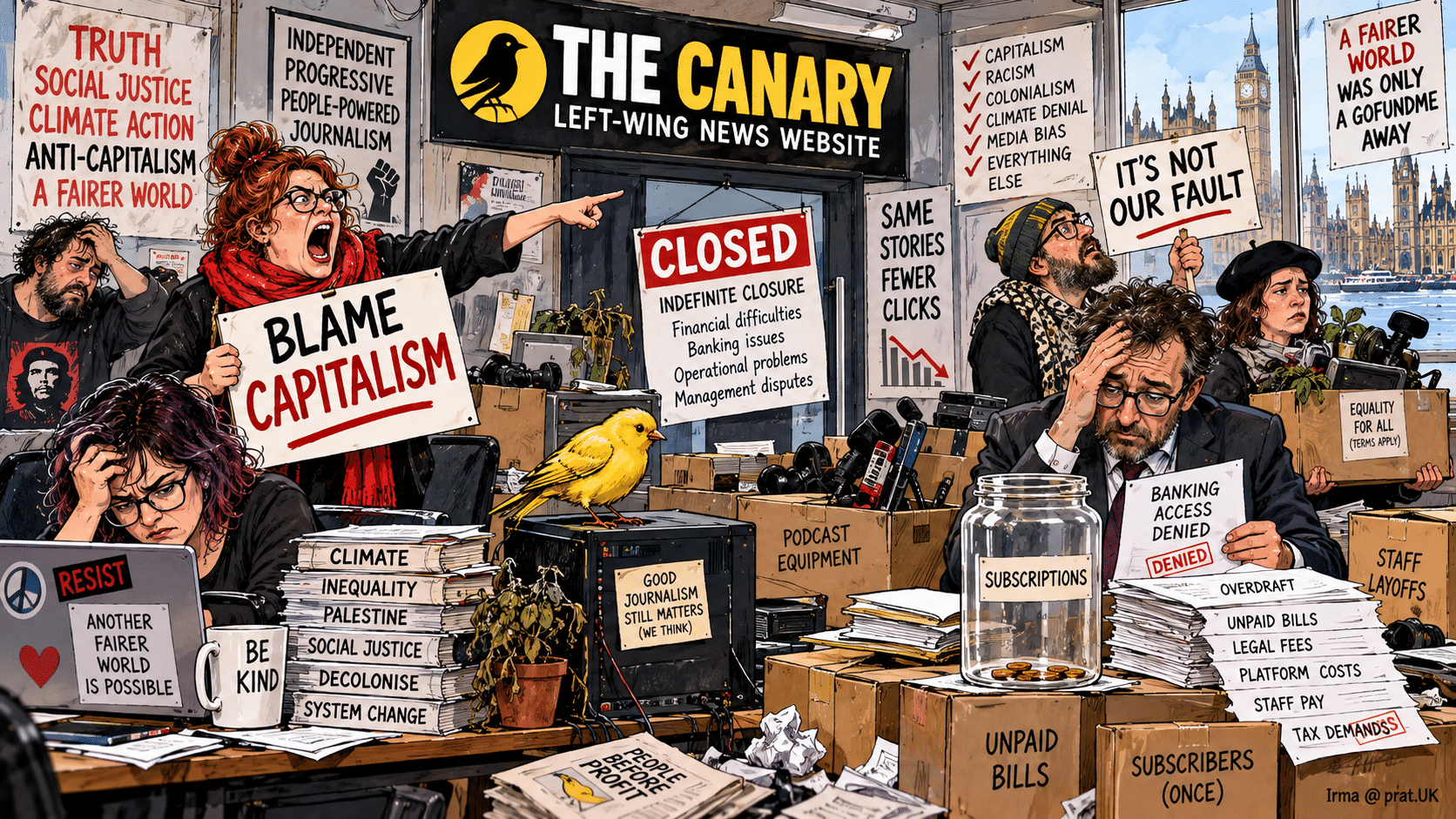
Emergency meeting agrees somebody must pay, with no say over the spending
LONDON – The closure announcement from The Canary has prompted urgent discussions about why a capitalist economy has failed to guarantee the continued operation of a publication devoted to pointing out its failings. Activists said the situation raised serious questions about a system in which criticising the owners of capital doesn’t automatically produce enough capital.
Why is The Canary closing? The competing accounts
The outlet says sustained attacks and trouble accessing funds made its position unsustainable. Reporting also describes disputed accounts from management and staff about its finances. Management says employee pay and pension contributions have been brought up to date. The practical consequences involve workers and bills; the theoretical consequences have already secured a substantially larger meeting room.
An emergency gathering of the Committee for Sustainable Opposition to Everything resolved that independent journalism must stay independent of advertisers, wealthy patrons, financial institutions, market pressures and the number of people willing to buy it. A treasurer asked which remaining category would be covering the electricity. Members agreed the question illustrated the committee’s central concern.
The debate exposed a longstanding problem in publishing: a reader can support a publication’s right to exist without supporting it by the monthly amount existence costs. Clicking approvingly is emotionally satisfying, but the payroll department keeps showing an unreasonable preference for money. Press Gazette has been covering that preference for years.
Solidarity meets the accounts department
One supporter said she had shared hundreds of articles and felt this should count towards operating costs. Her broadband provider was approached about accepting the same arrangement. Negotiations ended when the company explained it already had plenty of opinions and was mainly after payment.
A delegate proposed national support for independent media. Another asked whether a publication could stay independent while relying on ministers to renew its income. The chair said this was a hostile question unless the ministers were sympathetic, in which case it was an innovative funding model.
Others suggested wealthy benefactors should step forward. That would mean finding a millionaire who understood that substantial financial backing gave no moral authority, no editorial privileges and no right to ask why another substantial contribution was needed. The committee described its ideal candidate as generous, patient and largely unavailable by telephone.
Bank access, press freedom and the rules of the game
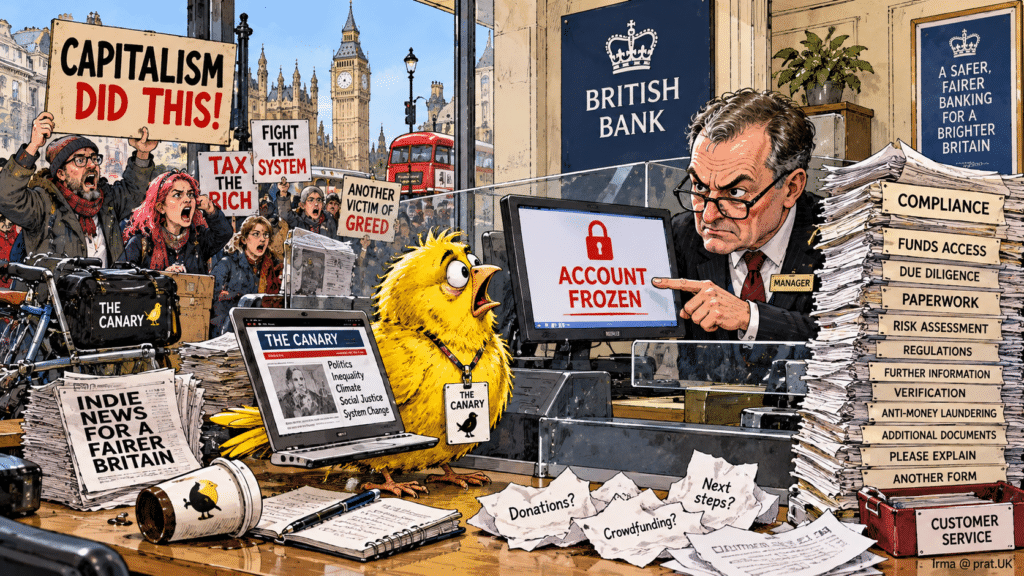
The discussion of banking access was more concrete. A publication that can’t use its own money can’t pay invoices with a passionate defence of its entitlement to use the money. Even people who dislike its politics have an interest in clear rules, proper explanations and a system in which financial access doesn’t depend on passing a political popularity test. The National Union of Journalists and the Reuters Institute both track how fragile that funding picture is across the industry.
This principle briefly threatened to produce agreement across ideological lines. Organisers restored order by asking participants whether they’d considered the deeper significance of the other participants’ motives. Within minutes, everyone was once again comfortably opposed to somebody.
Workers in the industry noted that financial transparency is a useful employment benefit regardless of the employer’s position on capitalism. A payslip doesn’t become less important when the organisation has excellent views about somebody else’s labour practices. Nor does a freelancer’s grocery bill accept solidarity at the checkout.
The wider newspaper business has been sympathetic, having spent years learning that being essential to democracy doesn’t necessarily make an invoice collectible. Rightwing and leftwing titles disagree on many things but share the experience of readers explaining that journalism is vital before asking whether the article is available free somewhere else.
By the end of the meeting, a rescue framework had emerged. Readers would be encouraged to subscribe to publications they valued, organisations would be urged to explain their finances, and banks would be expected to explain consequential restrictions properly. Delegates expressed concern that the proposals sounded suspiciously practical.
The treasurer then requested payment for the room. The committee condemned the timing, reaffirmed its solidarity and asked whether the venue would accept a statement about the historical importance of what had just taken place.
Five Humorous Observations
- Somebody shared three hundred articles and thought that should count toward the electricity. Love it. I tried that at the garage. I said, I’ve told eleven people about your petrol. The man said, that’s nice, it’s seventy quid.
- The committee wants independent journalism that’s independent of the advertisers, the donors, the banks and the readers. So who’s paying? The Lord? They’ve been tried. He’s not great on direct debit.
- Everyone agrees that a millionaire should step forward, give a lot of money, ask for nothing and not return calls. You know who that is? That’s not a millionaire. That’s a dead aunt with a solicitor.
- They asked the broadband company to take solidarity. The broadband company said, we’ve got our own opinions. Of course they do. They’ve been telling me for years that I’m in a contract. It’s the one opinion they never stop sharing.
- The best bit is they held the emergency meeting and then the treasurer asked for the money for the room. And they condemned the timing. That’s the most left-wing thing I’ve ever heard. A man asked for a fiver and the whole building had a crisis.
No left-wing outlet was asked to fund this disclaimer, which is why it still exists. The emergency meeting and its speakers are comic exaggeration of real reporting on The Canary’s closure, and the competing accounts of why it closed are presented as reported. More news satire from a publication that has been at it since 1961.

Mei Lin Chen is a student writer whose satire explores identity, modern culture, and social nuance. Her work reflects academic curiosity and engagement with London’s diverse perspectives.
Expertise is growing through study and practice, while trust is supported by clear intent and responsible humour.