
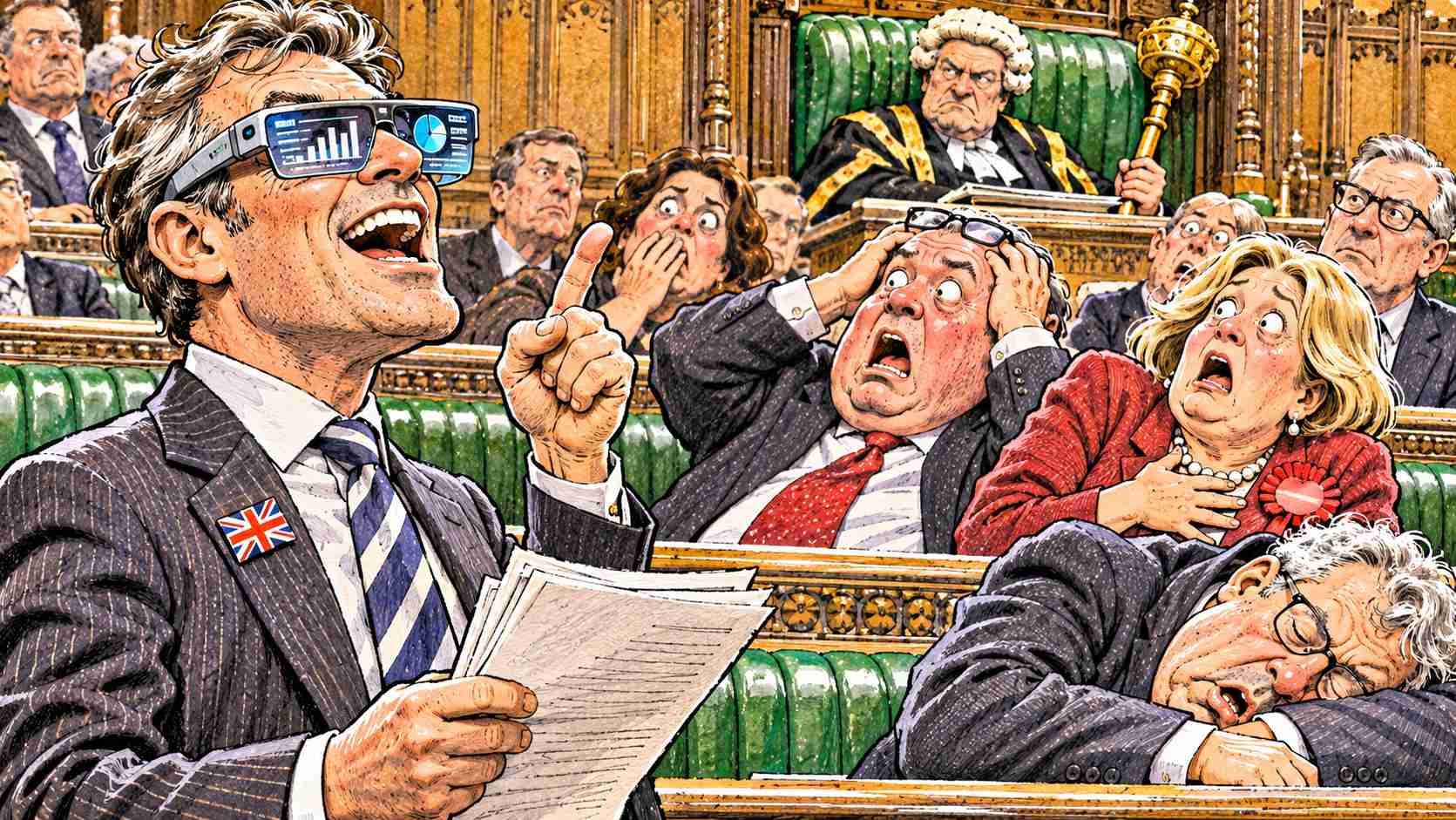
Parliament fears politicians might remember facts without government assistance.
CARDIFF, 19 October 2026. Westminster has been thrown into an intellectual emergency following controversy over a Reform UK politician’s smart glasses, prompting demands for tighter parliamentary rules before British voters start expecting elected representatives to know what they are talking about.
The Jason O’Connell Speech in the Welsh Senedd
The controversy followed a statistics-heavy speech by Reform’s Jason O’Connell in the Welsh Senedd, during which questions arose about whether his eyewear might have provided technological assistance. As The Guardian reported on the smart-glasses parliamentary controversy, their use as a teleprompter was not established, but the episode prompted legitimate questions about privacy, recording and parliamentary security.
Westminster recognised the constitutional danger at once.
A politician might be able to deliver a coherent speech containing actual numerical information without reading from fourteen sheets of paper prepared by a civil servant.
This could undermine the British parliamentary tradition of speaking confidently for twenty minutes while saying absolutely nothing.
One Westminster observer described the possibility as terrifying.
“Imagine an MP answering a question directly,” he warned. “The entire system could collapse.”
Liberal Democrats Call for Smart Glasses Restrictions in Parliament
The Liberal Democrats have called for restrictions on smart glasses in Parliament, raising concerns about how wearable technology might affect proceedings.
The issue has exposed a significant technological divide.
Ordinary Britons increasingly use computers to improve productivity, work through complicated information and complete difficult professional tasks.
Members of Parliament, meanwhile, remain suspicious of any device that might encourage somebody to get to the point.
A parliamentary historian explained that British democracy has always depended on a delicate balance between ignorance, confidence and unlimited speaking time.
“Allowing MPs to access facts instantly could destroy centuries of carefully cultivated tradition,” he said.
Proposed Parliamentary Licence for Wearable Technology
The controversy has also created a new opportunity for Britain’s technology regulators.
Rather than addressing the country’s chronic productivity problems, they can concentrate on deciding whether spectacles should require a parliamentary licence. The Information Commissioner’s Office, which regulates data protection and recording, is understood to be watching with interest and a sandwich.
A proposed system would sort eyewear into three categories.
Ordinary glasses would remain legal.
Reading glasses would require a declaration of intellectual assistance.
Smart glasses capable of displaying information would be subject to an investigation lasting about eighteen months.
A fourth category, rose-tinted glasses, would remain compulsory for government economic forecasts.
Privacy, Security and the Political Divide Over Wearable Tech
Reform supporters have questioned whether Westminster’s concern reflects an objection to technology or simply irritation that somebody outside the established parliamentary clubs might be using it.
Critics respond that privacy and unauthorised recording are serious concerns, particularly in secure parliamentary environments.
Both arguments have merit, which creates the uncomfortable possibility that a political disagreement might need thoughtful regulation rather than somebody shouting “scandal” on television.
British democracy is rarely prepared for such emergencies.
Technology specialists have suggested that ministers could get similar results without expensive equipment by reading their briefing documents before parliamentary debates.
The proposal was rejected as unrealistic.
Civil servants explained that ministerial briefing notes often contain large quantities of complicated information, including statistics, departmental responsibilities and the occasional piece of evidence that previous government promises were unwise.
Expecting politicians to read all that could interfere with their television appearances.
The glasses controversy has nevertheless produced a valuable lesson.
Britain’s political class is perfectly comfortable with artificial intelligence providing research, drafting reports and analysing complicated policy questions.
The trouble begins when the intelligence becomes visible.
A parliamentary committee is now considering whether politicians should be required to remove their glasses before speaking.
This would restore public confidence by making sure members remain unable to see the evidence clearly.
Westminster has operated on that principle for generations.
Five Humorous Observations on Politicians and Smart Glasses
- Five minutes of statistics without notes and the entire establishment goes, “He must be cheating.” That’s the bar. A man remembers a number and the Palace of Westminster is dusting for fingerprints.
- Think about the average MP’s speech. Twenty minutes, fourteen sheets of paper, and not one fact on any of them. They’re not reading. They’re doing interpretive dance with a folder.
- Three categories of glasses. Ordinary glasses are fine. Reading glasses need a declaration. Smart glasses need an eighteen-month investigation. And I’d like to propose a fourth: the ones my dad wears on his head and forgets are there, which are banned in every building he’s been in.
- Rose-tinted glasses are compulsory for economic forecasts. That’s the only honest thing in the whole report. It’s the one pair of specs that every Chancellor’s been wearing since 1979.
- Reading the briefing is “unrealistic”. That’s the job! It’s like a pilot saying the manual’s too long. “I’ll just do the landing by feel, Brian, and if we all die, we’ll form a committee.”
This article is a work of political and social satire. It uses real reported events as a starting point for exaggeration, comic dialogue and absurd policy proposals. Quoted comic characters and government proposals are presented for humorous effect and should not be treated as verified statements or actual announcements. This disclaimer was written without smart glasses, notes or a single remembered statistic, in keeping with parliamentary tradition, and our satirical news and political satire are certified equally free of unassisted facts.

Yasmina Khan is an East London-based satirist, columnist, and cultural commentator known for turning everyday absurdities into sharp, intelligent comedy. Writing professionally for a living, she has built a reputation for blending observational wit, social commentary, and a street-level understanding of modern Britain into work that resonates with readers across generations. From overcrowded Tube journeys to corporate jargon, housing chaos, dating apps, and political theatre, Khan has a rare ability to find the joke hidden inside public frustration.
Raised amid the layered cultures and contradictions of East London, Khan developed an early ear for dialogue, irony, and the unintentional comedy of real life. That background remains central to her voice. Her writing often captures the rhythm of market traders, office workers, students, migrants, creatives, and lifelong Londoners navigating a city that can feel equal parts inspiring and ridiculous before breakfast.
Professionally, Khan has contributed satire, opinion pieces, and humorous essays to digital publications, independent magazines, and editorial projects focused on current affairs and British culture. Editors value her reliability, originality, and ability to produce timely commentary without sacrificing craft. Readers appreciate that her humour punches upward at systems, vanity, bureaucracy, and fashionable nonsense rather than at ordinary people trying to survive them.
Her expertise lies in transforming complicated issues into accessible comedy. Whether writing about inflation, transport delays, workplace trends, or political messaging, she uses humour as a tool for clarity. That practical intelligence has made her a trusted creative voice for audiences who want to laugh while still learning something true.
Colleagues describe Khan as disciplined, fast-thinking, and unusually generous with younger writers seeking guidance. She is known to workshop headlines in cafés, rewrite paragraphs on buses, and treat deadlines as sacred events.
Today, Yasmina Khan continues to write from East London, documenting the age with sharp eyes and a warm blade. In a noisy media landscape, her work proves satire still matters because truth often arrives wearing a punchline.


