The Council Leadership’s Perspective: Matthew 7:3 Is Excellent Advice for Everyone Except the People Delivering It
WESTMINSTER, LONDON: Council leaders across Britain have welcomed a new interpretation of Matthew 7:3 that allows public officials to identify moral failings in other people without first examining their own conduct.
The breakthrough followed an emergency conference on ethical leadership, during which councillors agreed that hypocrisy had developed an unnecessarily negative reputation.
Delegates concluded that holding the public to standards one is personally unable to meet is not hypocrisy but aspirational leadership.
“A standard is something you encourage other people to achieve,” explained one council leader. “If everyone already met it, there would be no need for a standards committee.”
His remarks received a standing ovation from delegates whose travel and hospitality claims had been submitted for routine review.
The conference adopted three guiding principles: transparency for residents, accountability for opposition councillors and confidentiality for anything involving the conference organisers.
A fourth principle, financial restraint, was removed from the agenda following objections from the catering contractor.
Seven Principles of Public Life, None Apparently Available After Lunch
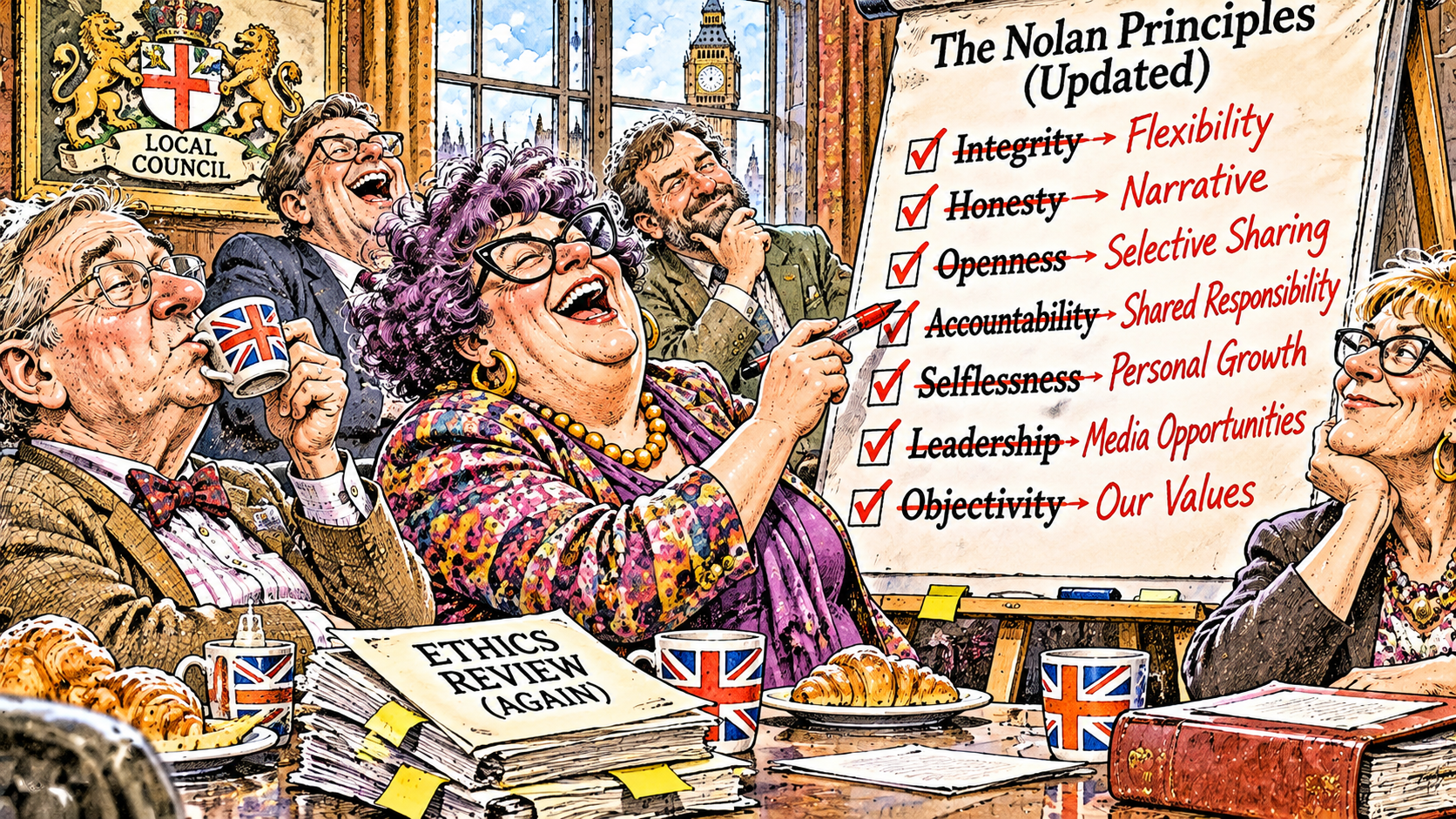
British councillors are already expected to follow ethical rules based on the seven Nolan Principles.
According to the Local Government Association’s guidance on councillor conduct and standards, these include selflessness, integrity, objectivity, accountability, openness, honesty and leadership.
These are admirable principles, particularly when displayed in expensive frames outside offices where nobody is available to discuss them.
At the conference, delegates proposed practical reinterpretations.
Selflessness was defined as allowing another councillor to receive credit for spending public money.
Integrity meant maintaining consistent explanations until documentary evidence required new ones.
Objectivity involved evaluating all arguments fairly before following the party whip.
Accountability was the process of identifying who had left the council before the spending decision became controversial.
Openness meant publishing a 400-page document on a website that required a password, a security question and permission from the department responsible for transparency.
Honesty remained unchanged, although delegates agreed it should apply primarily to members of the public.
Leadership was defined as going first when entering a restaurant and last when settling the bill.
A councillor from South London expressed concern that the proposed definitions might create public misunderstanding.
His colleagues agreed and appointed him chairman of the Public Misunderstanding Prevention Committee.
He accepted the position after discovering that it came with a larger office.
The Speck Inspection Programme
Inspired by Matthew 7:3, officials also proposed a nationwide programme to identify minor moral deficiencies among residents.
A homeowner who leaves a wheelie bin on the pavement would receive a formal warning about civic responsibility.
A motorist who parks six inches outside a designated bay would be informed that rules exist for everyone’s benefit.
A shopkeeper who submits a licensing application with an incorrect date would receive a lecture about administrative accuracy.
Meanwhile, council departments struggling to publish audited accounts would be praised for managing significant operational challenges in a difficult environment.
“We must distinguish between mistakes and institutional complexity,” explained a council ethics consultant.
“A citizen makes a mistake. An institution experiences complexity.”
Asked whether complexity could also explain why an elderly woman forgot to renew her parking permit, he replied that such reasoning would undermine the rule of law.
Council delegates unanimously agreed that standards must never be compromised.
The vote was taken immediately before lunch, which had been extended by 45 minutes to accommodate a second dessert.
A Plank Is Not a Problem Until Someone Requests Its Removal
A representative of the timber industry attended the conference to explain that the plank described in Matthew 7:3 would probably cause serious visual impairment.
The presentation was interrupted when a council leader asked whether the plank had planning permission.
Another councillor demanded an environmental impact assessment.
A third proposed introducing a Plank Retention Levy, explaining that the revenue could support a public-awareness programme about the dangers of untreated wood.
A retired carpenter in the audience suggested the obvious solution.
“Why don’t you just remove the bloody plank?”
The suggestion was ruled out of order because it had not been submitted through the proper consultation process.
Officials said plank removal would require stakeholder engagement, a feasibility study, three risk assessments and approval from the Health and Safety Committee.
The carpenter offered to remove it himself for £20.
He was informed that the council had already allocated £240,000 to study the matter.
The conference ended with a declaration that Britain urgently needs higher standards of personal responsibility.
Delegates then left their coffee cups on the tables for someone else to clear away.
Editorial Disclaimer
This report puts the seven Nolan Principles through a council conference that never took place. The principles and the Local Government Association guidance are real; the conference, the reinterpretations, the Plank Retention Levy and the second dessert are comic inventions, and no real councillor or council is depicted. Councillors may read this free of charge, although the catering contractor has already invoiced for it, and anyone still hungry can help themselves to our satirical news.
This work is presented in the editorial tradition of an entirely human collaboration between two sentient beings: the world’s oldest tenured professor and a philosophy major turned dairy farmer, both convinced that the distance between a politician’s sermon and his expense claim deserves closer examination.
The moral of Matthew 7:3: Before demanding that the public account for every penny, politicians might consider accounting for their own.

Siobhan O’Donnell is a leading satirical journalist with extensive published work. Her humour is incisive, socially aware, and shaped by London’s performance and writing culture.
Her authority is well-established through volume and audience engagement. Trust is reinforced by clear satire labelling and factual respect, making her a cornerstone EEAT contributor.