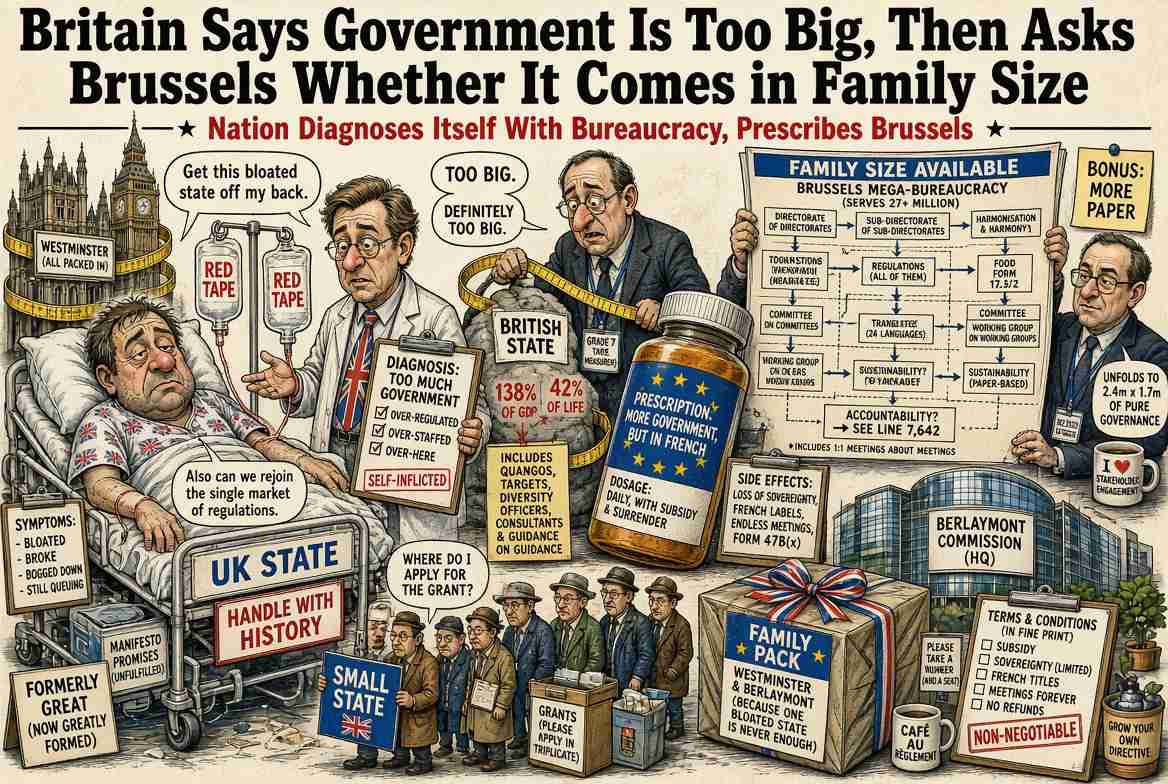
Britain Says Government Is Too Big, Then Asks Brussels Whether It Comes in Family Size
Nation Diagnoses Itself With Bureaucracy, Prescribes Brussels
LIVERPOOL, England — Britain has spent years complaining about taxes, public spending, bureaucracy, government interference, expensive energy, struggling public services and the curious national tradition of requiring fourteen signatures before anybody can construct a bicycle shed.
Having carefully reviewed these symptoms, much of the country has apparently reached a startling conclusion:
What Britain needs is more Europe.
A new POLITICO/Public First poll reports that 70 percent of respondents want some form of closer relationship with the European Union, a figure that echoes the YouGov tracker on UK public opinion toward the EU. Thirty-one percent want closer relations provided Britain does not have to start obeying the EU rulebook again, while 39 percent are willing to accept some EU rules in exchange for much closer cooperation. Even 51 percent of Reform UK supporters reportedly want closer relations of some kind.
There has not been a political diagnosis this magnificent since a man complained that his trousers were too tight and solved the problem by eating a cheesecake.
Britain is already arguing that government is too large, too complicated and too expensive.
So naturally somebody has asked whether government comes in family size.
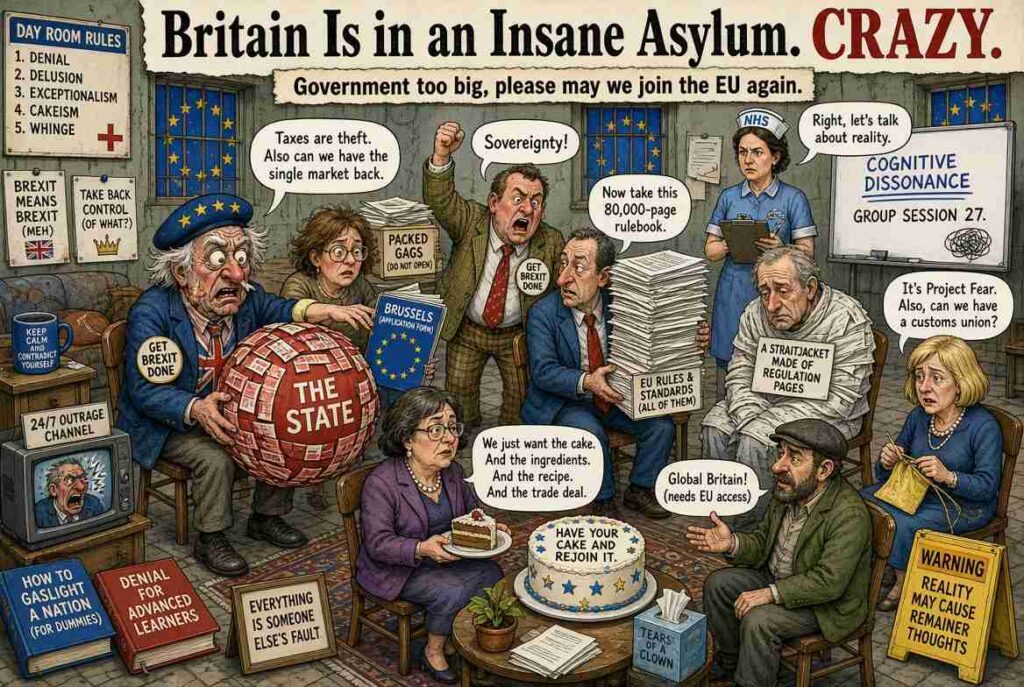
Thinking Britain Might Be Insane
- Britain has complained about big government for years, then asked Brussels whether it comes in family size.
- A country that demands fourteen signatures for a bicycle shed now wants twenty-seven nations co-signing the paperwork.
- “Take back control” has quietly become “take back control, but could we borrow some instructions?”
- With public spending around 44.7 percent of GDP, the cure for too much government is apparently a second, better-dressed government.
- Borrowing of £77.3 billion in five months is being met with a call for more coordinated disagreements.
UK Public Spending at 44.7% of GDP: Britain Orders the European Bureaucracy Meal Deal
For critics who believe Britain’s economy is already suffering from excessive government intervention, the numbers present a philosophical puzzle.
Imagine arriving at the doctor.
“Doctor, I feel sluggish.”
“How much government are you taking?”
“Quite a lot.”
“Taxes?”
“Yes.”
“Regulation?”
“Yes.”
“Public spending?”
“Certainly.”
“Subsidies?”
“Plenty.”
“Planning restrictions?”
“You wouldn’t believe them.”
“Government departments?”
“Several dozen.”
The doctor strokes his chin.
“I see the problem.”
Finally.
“You aren’t taking enough Belgium.”
Britain has apparently diagnosed itself with bureaucracy and prescribed Brussels.
The Office for Budget Responsibility‘s March forecast put total public spending at roughly 44.7 percent of GDP for 2026-27, remaining substantially above the pre-pandemic share.
So anyone approaching this from a small-government perspective might reasonably examine the machinery and ask:
Exactly which part of this machine needs another gearbox?
Big Government in Britain: The Warning Label Lists the Side Effects, Then Britain Orders Another Prescription From Belgium
Britain’s national conversation increasingly resembles the warning label on medication.
Possible side effects include:
Higher taxes.
Complex regulations.
Public borrowing.
Planning committees.
Forms requiring information already provided on Form A.
Officials asking whether you completed Form B.
A mysterious Form C which nobody has actually seen.
And the government’s answer is frequently another program.
Another agency.
Another regulator.
Another scheme.
Another initiative.
Another strategy.
Another five-year plan.
At this stage Britain doesn’t need a civil service.
It needs one enormous button marked:
CREATE PUBLIC BODY.
Press it whenever something goes wrong.
Train late?
Public body.
House expensive?
Public body.
Electricity expensive?
Public body.
Public body underperforming?
Excellent.
Create a regulatory body to regulate the public body.
Congratulations.
Britain has achieved the world’s first perfectly circular bureaucracy.
Nothing is wasted except money.
Brexit Rulebook Regret: Britain Escaped the EU Rulebook and Now Wonders Whether Brussels Kept a Spare Copy
The 39 percent willing to accept some EU rules again provides the purest comedy.
Britain spent years arguing about sovereignty.
There were negotiations.
Speeches.
Marches.
Television debates.
Newspapers screamed.
Politicians resigned.
Families discovered Uncle Trevor possessed surprisingly detailed opinions about customs unions.
Britain finally exited the European Union. Researchers at King’s College London and Ipsos have since found substantial appetite for a closer trading relationship, tempered by a stubborn attachment to sovereignty, which is the political equivalent of ordering a salad and a large chips.
Then, after spending several years outside, part of the electorate apparently turned around:
“Excuse me.”
“Yes?”
“You remember that enormous rulebook we made such a fuss about?”
“Yes.”
“Did you throw it away?”
“No.”
“Excellent. We might need Chapter Seven.”
Thirty-nine percent being willing to accept some EU rules does not mean 39 percent supports rejoining the EU, an important distinction in interpreting the poll. But from the standpoint of Brexit-era rhetoric, the irony could power Manchester for a week.
Britain has moved from:
TAKE BACK CONTROL
to:
TAKE BACK CONTROL, BUT COULD WE BORROW SOME INSTRUCTIONS?
UK Public Sector Borrowing Hits £77.3 Billion, So Perhaps We Need Internationally Coordinated Discomfort
Public borrowing is uncomfortable. Taxes are uncomfortable. So perhaps what Britain needs is a nice internationally coordinated discomfort.
The OBR reported that public sector borrowing reached £77.3 billion during the first five months of 2026-27, running £8.1 billion above the profile associated with its March forecast. Higher-than-forecast central government spending accounted for most of the difference. The OBR’s monthly public finances commentary and the ONS public sector finances bulletin supply the numbers for anyone who enjoys a horror story with tables.
Britain therefore has plenty to argue about domestically.
Taxes.
Borrowing.
Welfare.
Debt interest.
Housing.
Productivity.
Energy.
Public-sector pay.
Infrastructure.
The NHS.
Pensions.
Railways.
Council finances.
Naturally the sensible solution is to introduce another argument involving 27 European countries.
Britain doesn’t have enough disagreements.
We need internationally coordinated disagreements.
A British minister can argue with a Treasury official in London on Monday, travel to Brussels Tuesday and argue about the same regulation with seven additional nationalities.
This is called productivity.
EU Regulation vs UK Red Tape: Britain Discovers Paperwork Looks Sexier With a Foreign Accent
Politicians rarely say:
“We are introducing another layer of administration.”
That polls terribly.
They say:
“We are investing.”
Investment sounds wonderful.
You imagine factories.
Cranes.
Scientists.
Machinery.
Then six months later you discover the investment is £42 million for the National Strategic Stakeholder Engagement Facilitation Hub.
The Hub employs 380 people.
Nobody knows where it is.
Its website contains a photograph of three people pointing at a Post-it note.
Its annual report begins:
“This year has been one of transformational challenges.”
Translation:
Nothing happened.
Closer relations with Brussels could of course have practical benefits in areas such as trade, security and scientific cooperation. But the political comedy arrives when people who complain about domestic regulatory overload simultaneously contemplate accepting external rules to reduce barriers elsewhere.
A British socialist and a Brussels bureaucrat walk into a pub.
The landlord sees them coming and immediately hires a compliance officer.
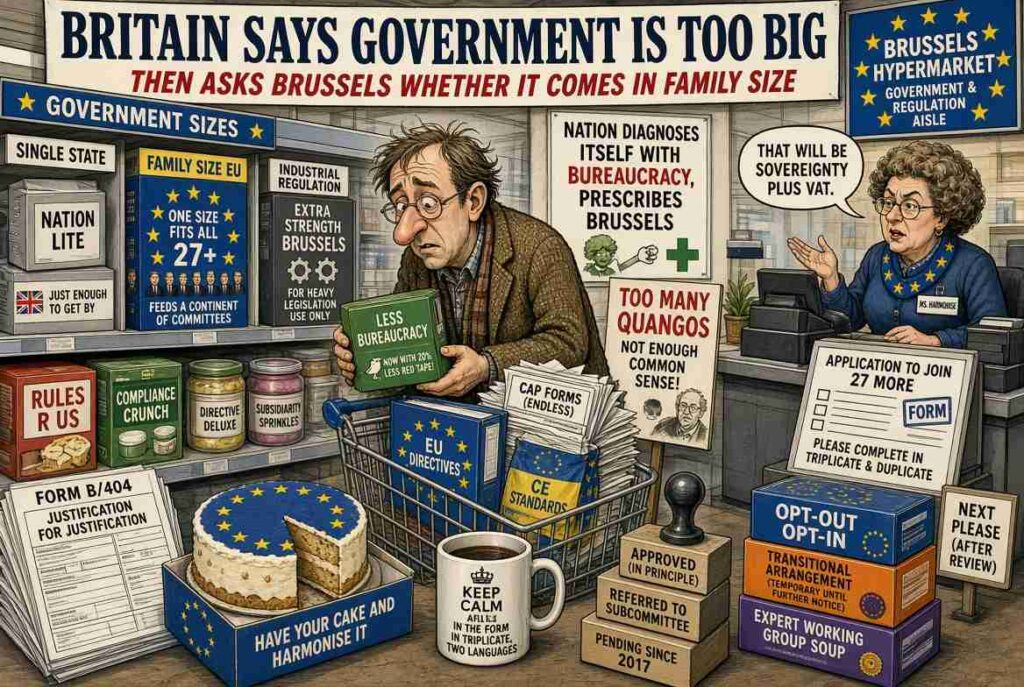
Domestic Cheesecake, Imported Cheesecake: Regulation Is Still Regulation After Crossing the Channel
This is the economic diet Britain appears to be considering.
“We need to cut bureaucracy.”
Absolutely.
“And improve economic growth.”
Certainly.
“And simplify regulations.”
Excellent.
“And perhaps align with thousands of European standards.”
I’m sorry?
Britain increasingly resembles a man trying to lose weight who proudly announces:
“I’ve given up British cheesecake.”
Wonderful.
“What are you eating?”
“French cheesecake.”
That isn’t a diet.
That’s international trade.
The cake doesn’t become celery because it crossed the Channel.
Likewise, regulation does not cease being regulation because the document says Règlement at the top.
It merely acquires better stationery.
Reform UK Voters and Closer EU Ties: Even the Vegetarians Want to Ask the Butcher About His Loyalty Card
Then comes the statistic capable of causing Nigel Farage’s morning coffee to file for political asylum.
Among Reform UK voters surveyed, 51 percent favored a closer relationship with the EU, compared with 25 percent wanting greater distance. Again, that does not mean most Reform voters favor rejoining. “Closer” covers a range of possibilities, a point European Council on Foreign Relations polling and the long-running What UK Thinks: EU archive both illustrate with charts nobody asked for.
Still, for comedy purposes, it is magnificent.
This is roughly equivalent to vegetarians walking into a butcher shop.
“Good morning.”
“Morning.”
“We strongly oppose meat.”
“Understood.”
“Do you have a loyalty program?”
Reform’s traditional message toward Brussels is not generally:
Let’s exchange Christmas cards more frequently.
Yet here we are.
“Would you like closer EU relations?”
Apparently yes.
“Would you like to rejoin?”
Steady on.
“EU rules?”
Depends.
“Single market?”
Let’s talk.
“Freedom of movement?”
Get out.
“Trade?”
Come back.
British politics has become a Choose Your Own Adventure book in which every page leads to another committee meeting.
Britain Wants Capitalism, Socialism, Sovereignty and Free Delivery
The public’s economic wish list is increasingly magnificent.
Britain wants:
Capitalist innovation.
Socialist guarantees.
Low taxes.
High spending.
Cheap electricity.
Green energy.
Higher salaries.
Cheap goods.
Expensive houses if you own one.
Cheap houses if you don’t.
Strict borders.
Easy holidays.
Independent regulations.
Frictionless trade.
Complete sovereignty.
Closer European integration.
And delivery before Friday.
This is not an economic policy.
It is an Amazon basket assembled during a fever.
Somewhere an economist is staring at it and quietly removing batteries from the calculator.
Government Solves Government With Government: The British Public Body Ouroboros
Perhaps the greatest achievement of modern British administration is the belief that any problem caused by an institution can be repaired by creating another institution.
Rail regulator failing?
Create rail authority.
Housing authority struggling?
Establish housing task force.
Task force inconclusive?
Commission independent review.
Review raises concerns?
Form stakeholder panel.
Stakeholder panel recommends coordination.
Create Office of Coordination.
Office of Coordination discovers duplication.
Create Anti-Duplication Commission.
Anti-Duplication Commission accidentally duplicates Office of Coordination.
Success.
Two organizations are now tackling duplication.
This is how government reproduces.
Nobody has ever actually seen a bureaucracy mate, but leave two departments alone over a bank holiday and Tuesday morning there will be an agency.
The European Political Model Always Has Room for One More Form
Europe’s defenders would argue, with reason, that common rules can make cross-border trade easier by replacing multiple standards with shared ones.
The small-government critic hears something slightly different:
Good news. The regulations are synchronized.
That’s like telling a prisoner:
“Excellent news. All the locks now use the same key.”
Wonderful.
May I leave?
“No.”
But administration will be seamless.
The genius of bureaucracy is that every failure demonstrates the urgent need for more bureaucracy.
Too complicated?
We need a simplification department.
Too expensive?
We need a cost-control agency.
Too many agencies?
We need an agency rationalization board.
At some point Britain could employ the entire population administering each other.
Unemployment: zero.
Productivity: classified.
Thirty-Nine Percent Discover Paperwork Improves During Channel Crossing
There is also an unexplained atmospheric phenomenon.
Domestic regulation is oppressive.
European regulation is sophisticated.
Apparently paperwork changes molecular structure while crossing the English Channel.
A British form says:
COMPLETE SECTION 14B.
Outrage.
A European form says:
COMPLETE ANNEX XIV(B) PURSUANT TO REGULATION 882/26.
Sophisticated.
Maybe there is something in the water around Calais.
By the time a regulation reaches Dover it has acquired continental charm.
Put an accent over one vowel and suddenly somebody at King’s College calls it “regulatory architecture.”
Your plumber still can’t start work until Tuesday.
Britain Achieves the Perfect Circular Economy (of Bureaucracy)
Environmentalists have long dreamed of a circular economy in which everything gets reused.
British government may finally have achieved it.
Government causes problem.
Government investigates problem.
Government proposes solution.
Solution creates regulation.
Regulation creates compliance cost.
Compliance cost creates problem.
Government investigates problem.
Nothing leaves the system.
Perpetual motion.
Newton would be furious.
Whitehall has apparently violated thermodynamics.
The only external input required is money.
Lots of it.
The Ultimate British Manifesto: Less Government, More Government, Delivered by Friday
Eventually political parties may stop pretending and simply publish the manifesto voters appear to want:
LESS GOVERNMENT.
BETTER GOVERNMENT.
MORE GOVERNMENT SERVICES.
LOWER TAXES.
HIGHER SPENDING.
CHEAPER ENERGY.
MORE ENVIRONMENTAL REGULATION.
COMPLETE NATIONAL SOVEREIGNTY.
CLOSER EUROPEAN INTEGRATION.
NO FOREIGN RULES.
FRICTIONLESS ACCESS TO FOREIGN MARKETS.
HIGHER WAGES.
LOWER PRICES.
AND HAVE IT READY BY FRIDAY.
At least it would be honest.
The manifesto could be one page.
Underneath would be Britain’s new national slogan:
EVERYTHING, PLEASE. BILL SOMEONE ELSE.
Britain Orders Another Prescription: What the UK-EU Poll Actually Says
The argument over closer European ties is not really evidence that Britain has collectively decided to reverse Brexit.
The poll is subtler than that.
Thirty-one percent want closer relations without EU rule compliance. Thirty-nine percent are prepared to accept some rules. Reform supporters themselves are divided in interesting ways.
But from the perspective of Britons who believe the country is already suffering from too much state management, the spectacle is irresistible.
Government spending remains enormous.
Borrowing remains substantial.
The administrative state is hardly starving.
And Britain peers across the Channel.
“What have they got?”
“More government.”
“Interesting.”
“More regulation.”
“Go on.”
“More institutions.”
“Anything else?”
“Thousands of pages of harmonized rules.”
Britain strokes its chin.
“We already have all that.”
“Yes.”
“Is yours European?”
“Yes.”
Britain reaches for its wallet.
“We’ll take two.”
10 Humorous Observations on Britain’s Big Government, Brexit Regret and the Brussels Meal Deal
- Fifty-one percent of Reform UK supporters favour closer EU ties, and Nigel Farage’s morning coffee has reportedly filed for asylum.
- “Closer” covers everything from a polite handshake to a marriage with a prenup drafted in Belgium.
- Regulation does not stop being regulation because the document says Règlement. It merely gets better stationery.
- Whitehall has invented perpetual motion: cause problem, investigate problem, regulate problem, repeat.
- The National Strategic Stakeholder Engagement Facilitation Hub employs 380 people and nobody can find it.
- Uncle Trevor, once the nation’s leading authority on customs unions, has now requested Chapter Seven.
- The only external input required by the British bureaucratic cycle is money, and the country has borrowed a fair bit of it.
- Voters want low taxes, high spending, total sovereignty, deep integration and delivery before Friday.
- The Anti-Duplication Commission has duplicated the Office of Coordination, so two bodies now tackle duplication.
- Nobody has ever seen a bureaucracy mate, yet leave two departments alone over a bank holiday and by Tuesday there is an agency.
Disclaimer
This article is satire built around the political argument that excessive state intervention, spending and regulation are harming Britain, juxtaposed with polling showing significant support for closer UK-EU relations. The OBR figures cited are factual fiscal measurements; the jokes about Brussels bureaucracy and big government are political commentary and satire rather than conclusions reached by the OBR or the polling itself.
No bureaucrats were streamlined during production. Three committees have been established to determine why.
This story is entirely a human collaboration between two sentient beings: the world’s oldest tenured professor and a philosophy major turned dairy farmer.

Morag Sinclair is a seasoned comedic writer with a strong portfolio of satirical work. Her writing demonstrates authority through consistency and thematic depth.
Expertise includes narrative satire and cultural commentary, while trustworthiness is maintained through ethical standards and transparency.