Nation Demonstrates World-Leading Ability to Construct Timelines Without Constructing Runways
Heathrow Third Runway Delayed Until 2039, Giving Britain 13 More Years to Decide Where Concrete Goes
Nation Demonstrates World-Leading Ability to Construct Timelines Without Constructing Runways
LONDON – Heathrow Airport’s proposed third runway has been delayed again, with the expected completion date moving from 2035 to 2039. Airport bosses say planning permission is targeted for 2029, followed by roughly a decade of construction. The project has been promoted as capable of generating more than 100,000 jobs.
Britain reacted calmly because anyone emotionally attached to a Heathrow runway completion date was medically evacuated sometime around 2009.
The third runway has now existed for so long as an idea that several of the earliest people debating it could soon qualify for priority boarding.
There are oak trees younger than Heathrow expansion policy.
Britain is exceptionally good at airports provided nobody insists upon building them.
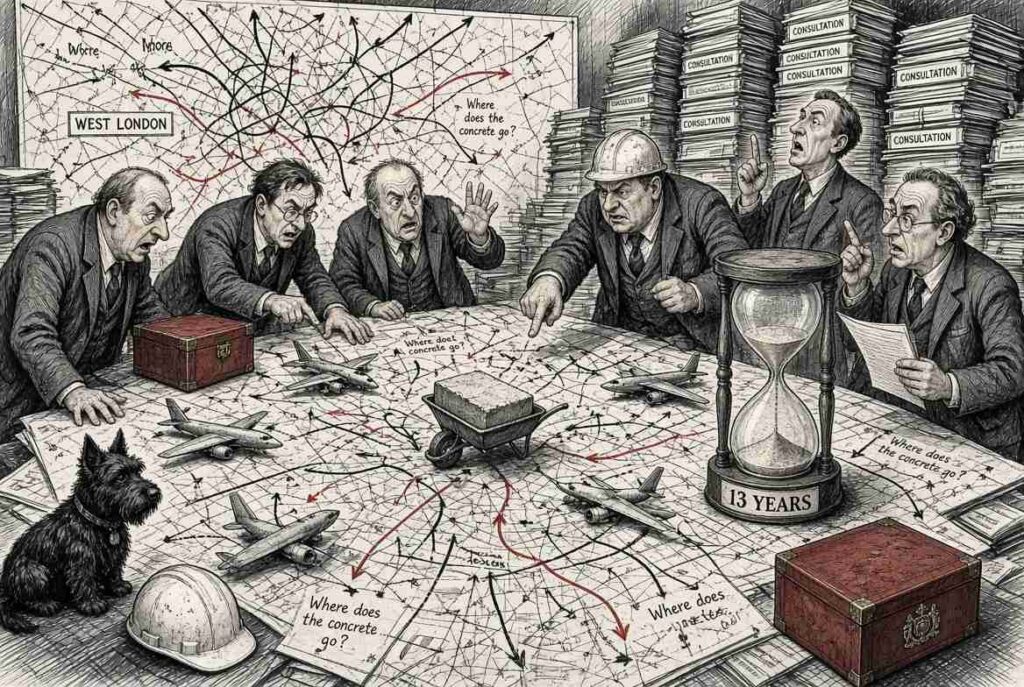
The Heathrow Third Runway and the Consultation of Consultations
We can publish feasibility studies.
We can establish commissions.
We can consult residents.
We can consult airlines.
We can consult environmentalists.
We can commission consultants to consult previous consultations and prepare a consultation framework identifying areas requiring additional consultation.
The only weak spot occurs when somebody arrives carrying a shovel.
That is considered reckless.
The revised 2039 date is magnificent because it sits comfortably in the future, where all British infrastructure works perfectly.
Heathrow Third Runway: Present Infrastructure Versus Future Infrastructure
British infrastructure has two forms.
Existing infrastructure is overcrowded, delayed, expensive or under repair.
Future infrastructure is transformational.
Future trains are frequent.
Future airports are seamless.
Future roads contain no potholes.
Future broadband downloads Shakespeare before you click.
Future hospitals smell faintly of Scandinavian pine.
The difficulty is that the future keeps becoming the present, at which point everyone moves the completion date.
The runway is now expected to arrive in 2039, a year that currently sounds sufficiently sci-fi to reassure everybody.
By 2039, passengers may be flying aboard hydrogen-powered aircraft piloted by artificial intelligence while Heathrow officials continue examining whether consultation response form H3B was printed using the correct shade of environmentally responsible grey.
An infrastructure analyst at the Centre for Large Projects That Will Definitely Happen Later explained Britain’s system.
“The first ten years establish whether the country requires something,” she said. “The second ten years establish that everybody already knew it required something. The third decade determines which people should be blamed for the first two.”
This model has protected Britain from the dangerous international practice known as completion.
Other countries foolishly construct airports, bridges and railway lines.
Britain understands infrastructure should be savoured.
Why recklessly finish a runway in six years when you can enjoy 25 years of ministerial statements?
Think of the employment.
Consultants require employment.
Lawyers require employment.
Planning experts require employment.
Communications advisers require employment.
Graphic designers must produce maps showing where the runway may eventually exist.
If Britain actually completes the thing, thousands of people could be thrown into the terrifying economy of having to discuss another project.
The runway is supposed to help economic growth.
This produces an intriguing chronological arrangement in which Britain can begin enjoying the argument immediately while postponing some physical benefits until schoolchildren born today are approaching their teenage years.
The project has also raised environmental, transport and local-community questions, all of which deserve serious consideration.
Britain’s unique contribution is the possibility of considering them until continental drift alters Heathrow’s location.
A Westminster Phrasebook for the Heathrow Third Runway
Politicians are especially skilled in airport dialect.
Nobody simply says yes.
Nobody simply says no.
They say things like: “We support sustainable airport capacity consistent with our environmental commitments subject to appropriate consultation.”
Translated from Westminster, this means:
“Please ask me again after the next election.”
A parliamentary phrasebook would be useful.
“Ambitious timetable” means late.
“Accelerated process” means regular process with a logo.
“Stakeholder engagement” means everybody is angry.
“Planning certainty” means nobody knows.
“Privately financed” means the argument over who ultimately pays has not yet reached the entertaining stage.
“The runway isn’t delayed, it’s simply arriving at its own pace, like every other British bus,” said Roper Penberthy, London comedian and frequent flyer of the departure lounge.
Officials say the project is cleared for take-off, which is technically true, provided nobody minds the take-off happening in 2039. The consultation has runway-ed on for so long that locals have started to Heathrow their weekends in advance. A junior minister promised to hit the ground running, then clarified that the ground would be under review. One planner called it a strategic clearing of the paths, meaning, of course, a strategic clearing of the runways, and a committee chair vowed to land the plane on time, or at least plane the land on time. The plan has been grounded, delayed, reviewed and finally frequent-flyer-mileaged into the next decade, and the airport reassures passengers that the wait is nothing to be alarmed about, unless you happen to be alarmed.
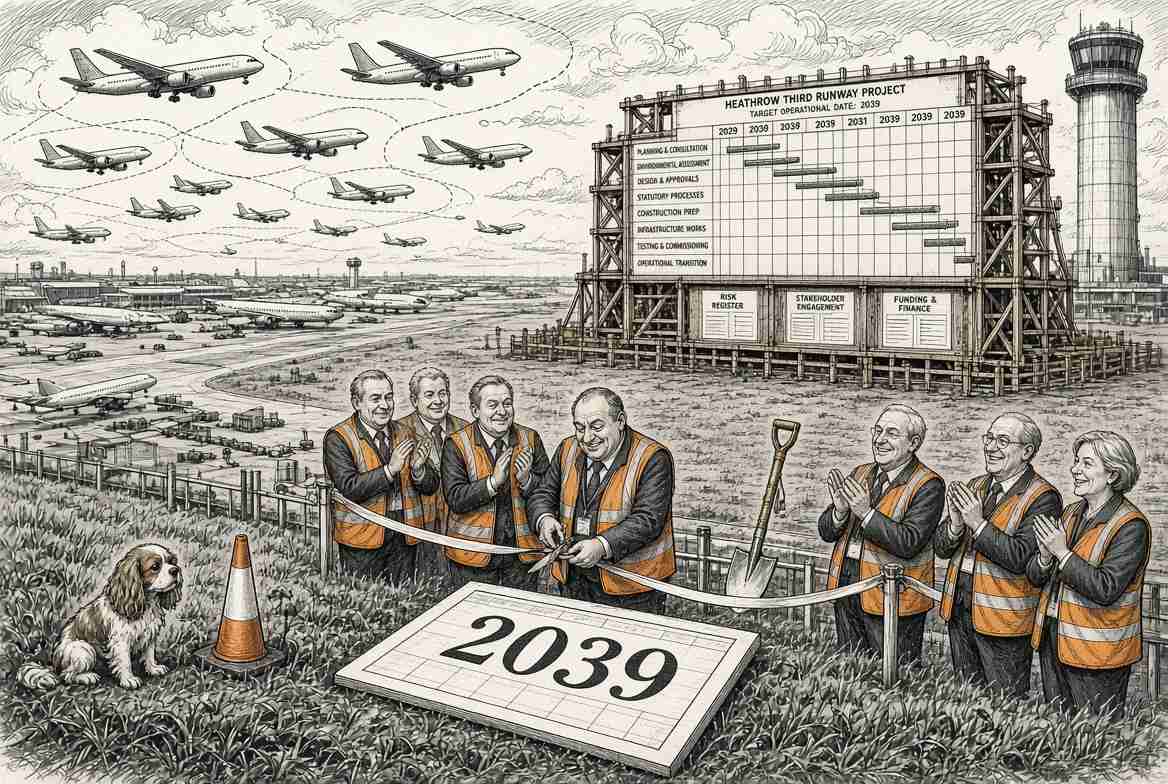
One can imagine the 2039 opening ceremony.
The prime minister cuts the ribbon.
A brass band plays.
The first aircraft approaches.
Then an official runs onto the tarmac waving a clipboard.
“STOP!”
“What?”
“We have discovered someone in Hounslow submitted a PDF in 2028 objecting to the drainage methodology.”
The aircraft circles for another four years.
The deepest joke may be that Britain actually possesses extraordinary engineering talent.
The country helped invent railways, jet engines, modern computing, industrial manufacturing and a substantial portion of the machinery that created the modern world.
We can engineer almost anything.
What we cannot engineer is a planning meeting short enough to build it.
Moving the Date on the Heathrow Third Runway
The 2039 runway may eventually be superb.
It may improve capacity, connectivity and commerce.
It may also face legitimate environmental and local objections.
But before Britain decides whether the third runway is good infrastructure, bad infrastructure or unnecessary infrastructure, it will first perform its oldest civic ceremony:
moving the date.
By 2039, Heathrow may finally have its third runway.
And Britain will immediately announce a consultation on why it requires a fourth.
The real story: Heathrow’s third runway has been pushed back by four years, from 2035 to 2039. Airport bosses say planning permission is targeted for 2029, followed by roughly a decade of construction, and they promote the project as a source of more than 100,000 jobs. Heathrow chief executive Thomas Woldbye has said the scheme will only proceed once the regulatory and policy frameworks are firmly in place, with the Civil Aviation Authority and the Department for Transport due to make key decisions along the way. Environmental and local-community objections remain part of the debate.
Humorous Observations on the Heathrow Third Runway
- Heathrow’s third runway has been delayed until 2039, proving Britain can construct an entire generation of consultation before constructing 2.2 miles of concrete.
- Modern British infrastructure has three stages: announce it, review it and eventually explain why the original completion date belonged to a more innocent civilisation.
Sources
- Sky News: Heathrow third runway delayed to 2039
- Infrastructure Intelligence: Heathrow gives green light for work on third runway planning application
This is British satire of the most consultative kind, a piece of London satirical journalism drawn from a real airport announcement. Like any UK satirical news story, its analysts, forms and drainage objections are there for laughs, and the only thing actually delayed is the punchline.
For the American take on the news, read the latest at Bohiney.com.
Auf Wiedersehen, amigo!

Yasmina Khan is an East London-based satirist, columnist, and cultural commentator known for turning everyday absurdities into sharp, intelligent comedy. Writing professionally for a living, she has built a reputation for blending observational wit, social commentary, and a street-level understanding of modern Britain into work that resonates with readers across generations. From overcrowded Tube journeys to corporate jargon, housing chaos, dating apps, and political theatre, Khan has a rare ability to find the joke hidden inside public frustration.
Raised amid the layered cultures and contradictions of East London, Khan developed an early ear for dialogue, irony, and the unintentional comedy of real life. That background remains central to her voice. Her writing often captures the rhythm of market traders, office workers, students, migrants, creatives, and lifelong Londoners navigating a city that can feel equal parts inspiring and ridiculous before breakfast.
Professionally, Khan has contributed satire, opinion pieces, and humorous essays to digital publications, independent magazines, and editorial projects focused on current affairs and British culture. Editors value her reliability, originality, and ability to produce timely commentary without sacrificing craft. Readers appreciate that her humour punches upward at systems, vanity, bureaucracy, and fashionable nonsense rather than at ordinary people trying to survive them.
Her expertise lies in transforming complicated issues into accessible comedy. Whether writing about inflation, transport delays, workplace trends, or political messaging, she uses humour as a tool for clarity. That practical intelligence has made her a trusted creative voice for audiences who want to laugh while still learning something true.
Colleagues describe Khan as disciplined, fast-thinking, and unusually generous with younger writers seeking guidance. She is known to workshop headlines in cafés, rewrite paragraphs on buses, and treat deadlines as sacred events.
Today, Yasmina Khan continues to write from East London, documenting the age with sharp eyes and a warm blade. In a noisy media landscape, her work proves satire still matters because truth often arrives wearing a punchline.