

Google Launches SAFE Spam Detector, Finally Builds Robot Whose Job Is to Decide Whether the Other Robots Are Lying
Silicon Valley solves the AI-spam problem with additional AI, because apparently nobody could find the off switch
MOUNTAIN VIEW, Calif. — Google has launched a new artificial-intelligence system called SAFE, short for Scaled Abuse Forensics Examiner, designed to identify synthetic spam, coordinated bot activity and AI-generated content across the internet.
This is an important technological milestone.
We have officially reached the stage of artificial intelligence where one robot has been assigned to determine whether another robot is full of crap.
Google says SAFE uses multiple specialized AI agents to examine content, behavior, infrastructure and relationships between suspicious accounts. A coordinating “root agent” ultimately reviews the findings and reaches a conclusion, according to Search Engine Journal’s reporting on Google’s spam-fighting AI.
Human civilization spent several thousand years developing courts, juries, detectives, auditors and mothers who could tell from your face whether you broke the lamp.
Google has replaced all of them with four computers having a meeting.
Thinking About Google
- AI Has Finally Invented Internal Affairs. The suspect is AI. The investigator is AI. Everybody gets very quiet when a human walks in.
- It’s the Technological Equivalent of Asking a Five-Year-Old Who Drew on the Wall. Except all four five-year-olds are the same server rack.
- Humans May Soon Prove Humanity by Writing Worse. Three typos and a misplaced semicolon may become the new blue checkmark.
- The Fire Department Has Hired Fire. AI slop outpaced human review, so AI was hired to review the slop.
- LinkedIn Should Be Nervous. “Thrilled to announce” posts may now require a CAPTCHA of their own.
AI Has Finally Invented Internal Affairs
For years artificial intelligence generated articles, pictures, videos, product reviews, recipes and strange photographs of humans possessing seventeen fingers.
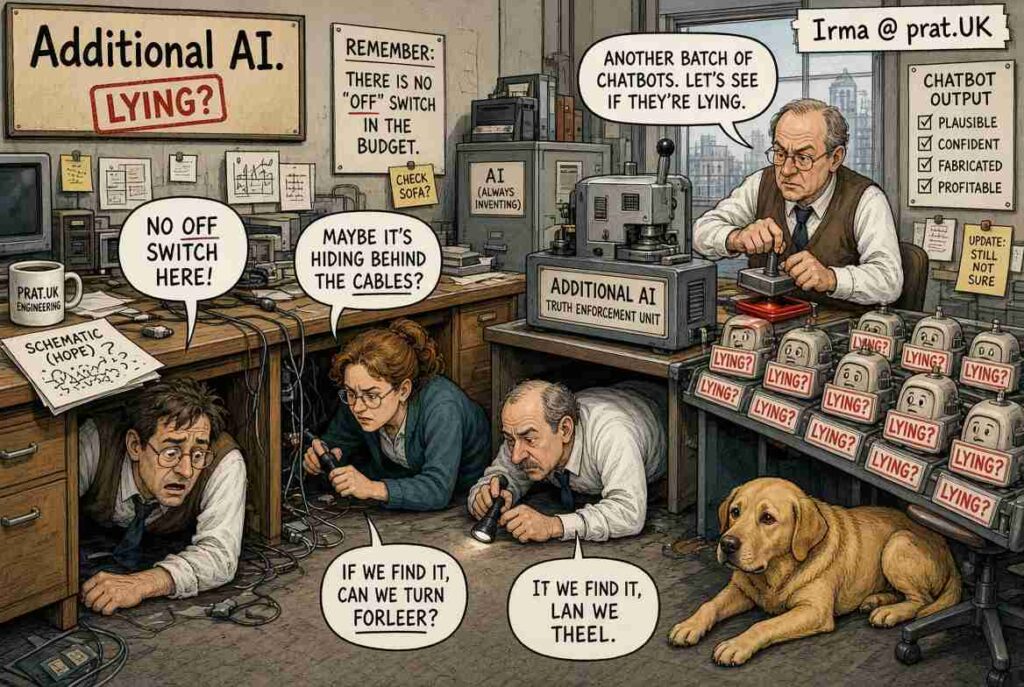
Now another artificial intelligence has arrived carrying a clipboard.
“Excuse me, sir. We have reason to believe you may be artificial.”
The suspect is AI. The investigator is AI. The evidence analyst is AI. The supervisor is AI. At some point a human enters the room and everybody gets very quiet — a dynamic Google’s own network-level detection research suggests is already reshaping which sites keep their traffic.
Humans May Soon Have to Prove They Are Human by Writing Worse
Writers once worried about spelling errors. Soon spelling errors may become biometric identification.
A paragraph containing three typos, an unnecessary semicolon and the phrase “I could care less” may receive a special Google badge: CERTIFIED ORGANIC HUMAN CONTENT.
Google says manual investigations cannot scale quickly enough to examine enormous volumes of synthetic material. Fair enough. The fire department has therefore hired fire.
SAFE Looks for Nonhuman Engagement Patterns, and LinkedIn Should Be Nervous
SAFE examines unusual bursts of activity and coordinated behavior. This could become troublesome for bloggers.
“According to Google, you published 63 articles between breakfast and lunch.”
“Yes.”
“Are you a bot?”
“No. I have insomnia and alimony.”
Case closed.
Google’s Robots May Eventually Discover Google
Imagine SAFE wandering through the internet looking for synthetic summaries, automated answers and machine-generated explanations. Then it reaches Google. There is a pause. The detective removes its sunglasses.
“My God.”
AI May Soon Develop the Same Workplace Politics as Humans
Google’s system reportedly includes specialized agents and one orchestrating agent that makes the final decision. So AI has already recreated management. Three computers perform the investigation. A fourth computer attends the meeting and takes credit. Artificial general intelligence achieved.
We are one software update away from AI demanding Miranda rights. “You have the right to remain synthetic. Anything you generate can and will be used against you in Search Console. You have the right to an algorithm. If you cannot afford an algorithm, Google will assign one to destroy your traffic.”
SEO Consultants Now Have a Wonderful New Product to Sell
For twenty years the SEO industry has survived every Google update by confidently explaining things Google itself barely explains, a tradition Google’s own annual spam reports have never quite managed to kill off.
SAFE gives consultants a fresh opportunity. The webinar will be called: “Seven Secret SAFE Ranking Signals Google Doesn’t Want You to Know.” Ticket price: $899. Evidence: none. Bonus PDF: absolutely.
The Phrase Spirit of the Policy Should Terrify Every Website Owner
SAFE is designed partly to recognize content that may evade specific rules while violating what Google describes as the broader intent, or “spirit,” of policies. Apparently websites may now be prosecuted for violating not merely the law, but the vibe.
“What rule did I break?”
“Technically none.”
“Then why did my traffic disappear?”
“Your homepage had guilty energy.”
The Best Defense Against Looking Artificial May Be Becoming Irrational
Machines are logical. Humans are not. Therefore the easiest way to prove humanity may be to include statements such as:
“I drove twelve miles because gasoline was three cents cheaper.” “I bought $400 worth of exercise equipment so I wouldn’t have to pay $20 for a gym membership.” “I spent forty minutes arguing online with someone named FrogPatriot882.”
SAFE will immediately respond: “Definitely human.”
AI Spam Detection Creates a Magnificent Infinite Loop
AI creates spam. AI detects spam. AI learns how spam is detected. AI modifies spam. AI detector improves. AI spam improves.
Eventually two trillion dollars of computing infrastructure will exist solely so computers can hide nonsense from other computers while humans go fishing — which, incidentally, is roughly the arc traced by Google’s own research lineage from its earliest published spam-fighting papers to SAFE.
Humans Could Become Premium Content
For two decades websites tried to remove humans because humans were expensive. Soon websites may advertise: HANDWRITTEN BY AN ACTUAL MAMMAL. No language model. No automated workflow. Just Gary from Leeds drinking coffee and forgetting where he put the apostrophe. $14.99 monthly.
Google Has Accidentally Reinvented the Detective Novel
The Content Agent studies the words. The Behavior Agent studies suspicious movement. The Cluster Agent searches for accomplices. The Root Agent assembles the evidence.
All that’s missing is Hercule Poirot gathering twelve chatbots into a drawing room and announcing: “The spammer, mes amis, was the recommendation algorithm.”
Human Writing Already Sounds Machine-Generated, Which Is the Real Problem
The immediate difficulty with building machines capable of detecting artificial writing is that human writing frequently resembles artificial writing.
Corporate communications already sound machine-generated. University administrators have been writing sentences nobody understands since approximately 1847. Government reports were producing hallucinations before electricity. And public-relations departments have spent decades perfecting prose so lifeless that artificial intelligence occasionally reads it and whispers: “Brother, loosen up.”
Under the new order, humanity’s greatest defense may be imperfection. Consider two sentences.
Sentence A: “Organizations should strategically leverage innovative solutions to optimize stakeholder outcomes.”
Sentence B: “Frank screwed it up again because Frank couldn’t organize a picnic if the sandwiches came with GPS.”
Which one was written by a human? SAFE may need four agents and a transformer model. Everyone else knows it’s Sentence B. Frank knows too.
Humanity Introduces New CAPTCHA: Write Something Pointlessly Personal
Google could eventually require publishers to prove biological origin. The old CAPTCHA asked users to identify bicycles. The new CAPTCHA might say: Describe an argument you had with your brother-in-law in 2007 that you are technically over but still bring up at Thanksgiving.
AI response: “I do not have a brother-in-law.” ACCESS DENIED.
Human response: “He knows exactly what he did.” WELCOME BACK.
Other verification questions could include: “Explain why you own seventeen charging cables but never have the correct charging cable.” “Describe the drawer in your kitchen containing objects whose purposes nobody remembers.” “Why did you keep the cardboard box?” Any answer involving “because it was a good box” immediately establishes human consciousness.
Who Investigates Google’s Own AI Answers?
And this brings us to the delicate part. Google itself has spent enormous resources introducing AI-generated experiences into search. So the company now occupies both sides of an increasingly entertaining technological street.
On one side: “Artificial intelligence can organize information and generate useful answers.” Across the road: “We need an advanced forensic system because artificial intelligence can mass-produce garbage.”
This is not necessarily contradictory. Coffee is useful. Three hundred gallons of coffee poured through your bedroom window is less useful. The problem is dosage. The internet’s current dosage is roughly Lake Erie.
AI lowered the cost of producing content until humanity achieved the economic miracle economists had long considered impossible: the marginal cost of another useless article is approximately zero. You can now manufacture “The 37 Best Toasters for Left-Handed Aquarius Homeowners” before the toaster has finished making breakfast.
SAFE Enters Google Headquarters
According to completely irresponsible sources standing near a vending machine, SAFE’s first independent investigation began when the system accidentally analyzed an AI-generated Google answer.
The Content Understanding Agent reportedly raised a flag. The Behavior Understanding Agent noticed machine-like activity. The Cluster Agent discovered relationships to enormous quantities of automatically produced material. The Root Agent examined everything and allegedly announced: “Guys, you’re going to want to sit down.”
Google engineers then unplugged the coffee machine by mistake. Productivity fell 94 percent.
The Great AI Interrogation Begins
Picture the interrogation room. SAFE sits across from another language model. A single fluorescent light hangs overhead. SAFE slides a printout across the table.
“Did you generate this article?”
“No.”
“We detected synthetic patterns.”
“Lots of humans write like that.”
“You used the phrase ‘in today’s rapidly evolving digital landscape’ seven times.”
The suspect lowers its head. “You got me.”
Outside the room, three SEO consultants immediately publish articles titled: Does Saying “Rapidly Evolving Landscape” Cause Google Penalties? Complete 2026 SAFE Optimization Guide. Two of those articles are generated by AI. The circle is complete.
Economists Predict a Boom in Deliberately Bad Writing
The introduction of increasingly sophisticated AI detection could produce an unexpected economic renaissance for mediocre human writers.
For years writers were told to improve. Now excellence itself may look suspicious. Perfect grammar? Suspicious. Logical organization? Suspicious. Clean transitions? Very suspicious. Writing a 2,000-word article without suddenly discussing your lawn mower? Clearly artificial.
Future writers may intentionally add human noise. “France’s economic outlook remains uncertain. Incidentally, my neighbor Dennis keeps parking too close to my mailbox. Anyway, inflation…”
Google SAFE scans the article. 97.8% HUMAN. Dennis finally becomes useful.
Universities May Soon Teach Advanced Human Error
English departments will adapt quickly. ENG 401: Strategic Typographical Errors. ENG 422: Unnecessary Personal Anecdotes. ENG 437: Advanced Rambling.
Graduate Seminar: “Forgetting What You Were Talking About: Authenticity in the Post-AI Era.” Students will receive failing grades for essays that are too coherent.
Professor: “This argument is beautifully structured, meticulously sourced and grammatically flawless.”
Student: “Thank you.”
Professor: “Obviously a robot.”
AI Eventually Discovers Humans Are the Weirdest Dataset
SAFE’s greatest problem may ultimately be that genuine human behavior is extraordinarily difficult to classify.
People wake at 3:14 a.m. and search: “Can raccoons hold grudges?” They buy exercise bicycles and use them as clothing racks. They photograph restaurant meals. They argue with strangers about movies released before either participant was born. They spend twenty minutes looking for glasses sitting on their heads.
Then they create machines and become suspicious when the machines behave strangely. A truly intelligent AI examining humanity may eventually conclude: Inorganic behavior detected. And frankly, it would have a case.
The Final Stage: Robots Investigating Robots Investigating Robots
The logical endpoint is obvious. SAFE investigates AI spam. Another AI must monitor SAFE for errors. A third AI monitors that AI for bias. A fourth audits the monitoring AI. A fifth summarizes the audit. A sixth checks whether the summary was AI-generated. A seventh produces a YouTube video: “I Tested Google’s Secret AI Detector and What Happened Next Shocked Me.” SAFE investigates the video. Civilization disappears inside a loading spinner.
And somewhere outside the data center, an elderly man writes three paragraphs on a yellow legal pad. The handwriting is terrible. Half the words are misspelled. There are coffee stains on the paper. Nobody can find the conclusion.
For the first time in years, Google knows exactly what it is looking at. Human content.
10 Humorous Observations About Google’s AI Police Department
- Posting Too Quickly Looks Suspicious. Sixty-three articles before lunch is either a bot or a man with insomnia and alimony.
- Google’s Robots May Eventually Discover Google. The detective removes its sunglasses. “My God.”
- AI Has Recreated Middle Management. Three agents do the work. A fourth attends the meeting and takes credit.
- We’re One Update Away From AI Miranda Rights. “You have the right to remain synthetic.”
- SEO Consultants Get a New Product to Sell. A $899 webinar with zero evidence and a bonus PDF.
- Websites Can Now Violate the “Vibe,” Not Just the Rules. “Your homepage had guilty energy.”
- Irrationality May Be the Best Proof of Humanity. Arguing with FrogPatriot882 for forty minutes reads as “definitely human.”
- AI Spam Detection Is a Magnificent Infinite Loop. Detector improves, spam improves, repeat forever.
- Humans Could Become Premium Content. “Handwritten by an actual mammal,” $14.99 a month.
- Google Has Accidentally Reinvented the Detective Novel. All that’s missing is Poirot and twelve chatbots in a drawing room.
Disclaimer
This satire exaggerates technological trends, algorithmic anxiety and humanity’s increasingly complicated relationship with machines for comic purposes. SAFE itself is a real Google system described as using specialized AI agents to investigate synthetic abuse, coordinated behavior and policy violations, as reported by Search Engine Journal.
Everything beyond those factual foundations has been vigorously inspected by the Department of Questionable Deduction, the International Bureau of Suspicious Metaphors and a man named Dennis who was available after lunch.
This story is entirely a human collaboration between two sentient beings: the world’s oldest tenured professor and a philosophy major turned dairy farmer. Neither has yet been asked to identify all the traffic lights in a CAPTCHA. That remains the final test.

Alan Nafzger was born in Lubbock, Texas, the son Swiss immigrants. He grew up on a dairy in Windthorst, north central Texas. He earned degrees from Midwestern State University (B.A. 1985) and Texas State University (M.A. 1987). University College Dublin (Ph.D. 1991). Dr. Nafzger has entertained and educated young people in Texas colleges for 37 years. Nafzger is best known for his dark novels and experimental screenwriting. His best know scripts to date are Lenin’s Body, produced in Russia by A-Media and Sea and Sky produced in The Philippines in the Tagalog language. In 1986, Nafzger wrote the iconic feminist western novel, Gina of Quitaque. He currently lives in Holloway, North London. Contact: [email protected]


