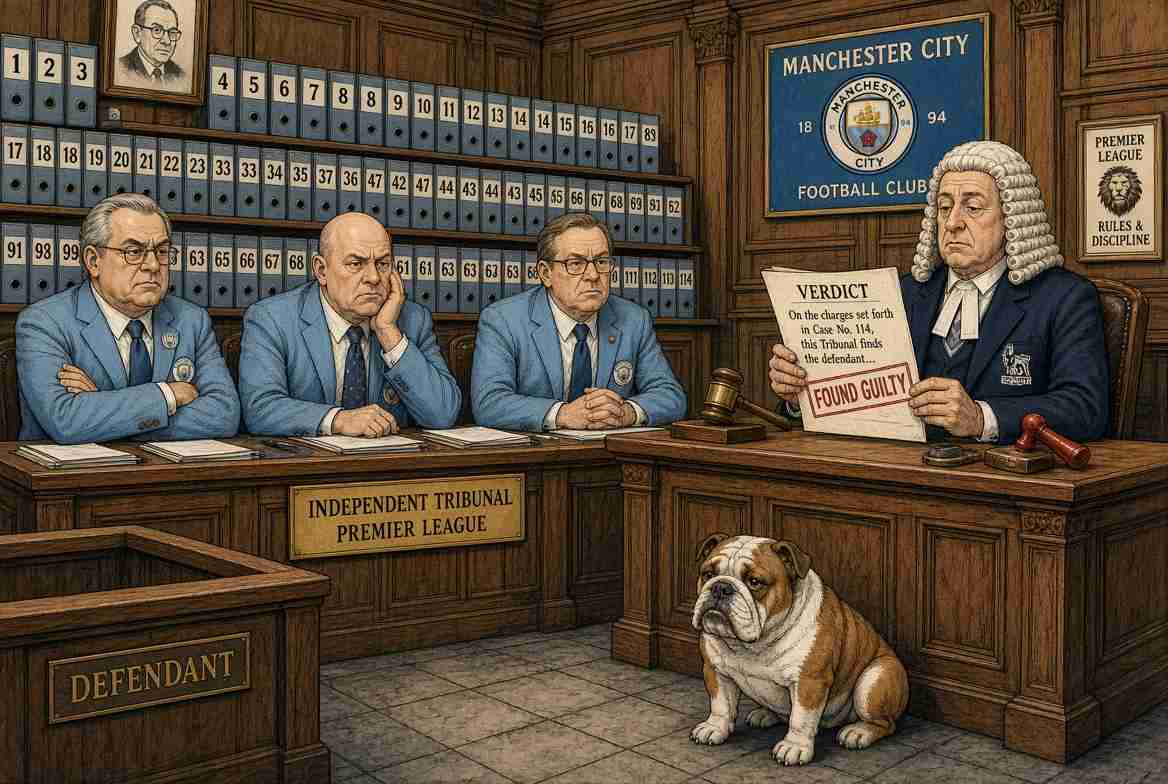
Premier League commission finds City guilty on all but one of 115 charges after a legal saga stretching back to 2023
MANCHESTER – Manchester City have reportedly been found guilty on 114 of the 115 alleged breaches brought against the club under Premier League financial rules, with an appeal expected.
One hundred and fourteen.
At that point these are no longer charges. They are a loyalty programme.
Commit ten breaches and perhaps you get a complimentary programme. Fifty gets access to the executive lounge. Reach 100 and someone from Deloitte appears at the training ground carrying champagne and asking whether you would like to roll the points into next season.
English football has spent years insisting the beautiful game needed financial regulation, apparently because nothing makes football more beautiful than six accountants arguing about amortisation while Erling Haaland waits near the penalty area.
The Premier League case has taken so long that several supporters who began following it as young men are now asking their grandchildren to explain the procedural timetable.
Nobody knows exactly what happens next because football disciplinary systems operate according to the same principle as medieval theology. There are rules, interpretations of rules, interpretations of interpretations, precedents, sub-precedents, annexes and occasionally a man wearing spectacles who whispers, “That depends what they meant by sponsorship.”
The traditional football fan understands a straightforward offence.
Handball? Free kick.
Bad tackle? Yellow card.
Punch referee? Probably red.
But modern financial football requires a postgraduate degree.
A supporter enters the pub and asks, “What are City accused of?”
A Loyalty Card, Not a Charge Sheet
His friend replies, “Failing accurately to report revenue, remuneration and other financial information while allegedly breaching various cooperation requirements.”
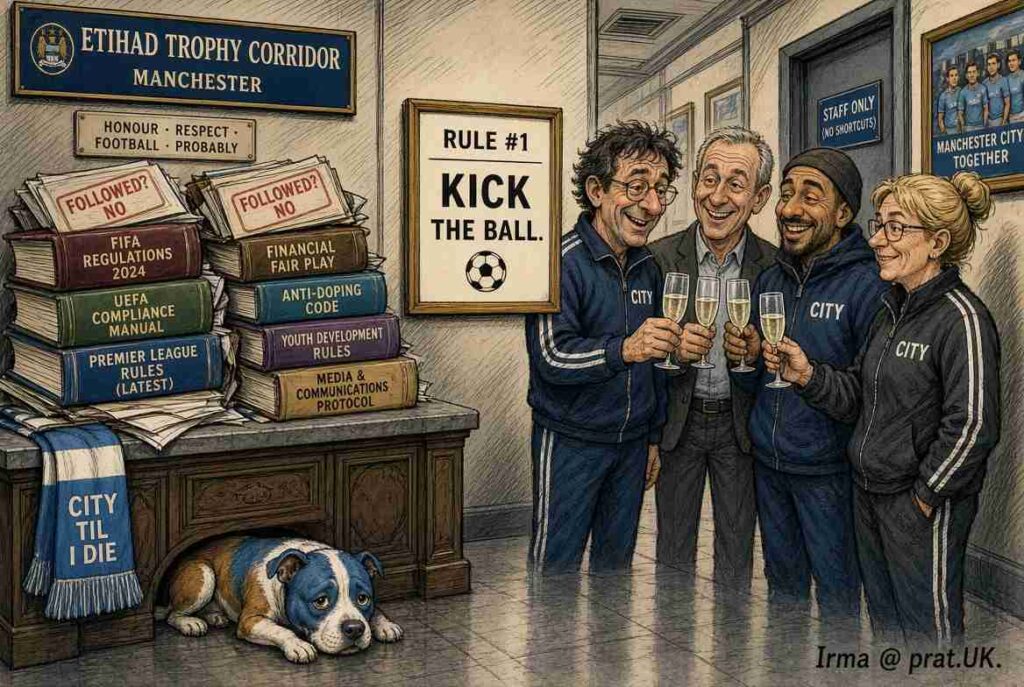
The supporter considers this carefully.
“So… offside?”
Close enough.
The comedy is that football simultaneously worships money and periodically acts surprised when clubs become enormously interested in acquiring it.
Premier League marketing encourages owners to transform football into a global entertainment empire, sell television rights across continents, build enormous stadium complexes, recruit worldwide superstars and monetise practically everything except the oxygen above the centre circle.
Then regulators enter carrying calculators.
“Good heavens. There appears to be quite a lot of money here.”
The Supporter Consistency Principle
Yes.
You invited sovereign wealth, American private equity, hedge funds, multinational sponsors and billionaires into a sport once funded by gate receipts, meat pies and a chairman who owned three carpet shops.
What did everyone imagine would happen?
An unofficial prat.UK survey of 600 football supporters found 82 per cent believe Financial Fair Play is extremely important, 79 per cent cannot explain Financial Fair Play, and 91 per cent are completely opposed to their own club being punished under Financial Fair Play.
This is known as the Supporter Consistency Principle.
The moral structure is simple: financial irregularities committed by rival clubs threaten civilisation. Financial irregularities committed by your club are complicated technical misunderstandings being sensationalised by jealous people.
Meanwhile City supporters are learning the most British sporting lesson imaginable.
Winning the league is temporary.
Legal disclosure is forever.
By 2031 the Premier League may finally announce the punishment, which will immediately be appealed until 2037, referred to arbitration until 2041 and eventually resolved through a negotiated settlement requiring Manchester City to pay £17.50 and promise not to do accounting after dark.
A Verdict on Britain’s Own Timescale
Football used to be ninety minutes followed by arguments.
Modern football is ninety minutes surrounded by litigation.
Somewhere, probably beneath Wembley, accountants have finally achieved their dream.
The referee has become a spreadsheet.
As Vivienne Pratfall, one of prat.uk’s own sharpest voices, puts it: “A financial charge sheet with 115 counts isn’t a scandal, it’s a season ticket.”
The Real Story
Manchester City were charged by the Premier League in February 2023 with 115 alleged breaches of financial rules spanning the 2009 to 2018 seasons, covering accusations of misreported revenue, sponsorship and manager and player remuneration. The independent commission’s hearing ran from September to December 2024, and the club has always denied wrongdoing while the football world waited years for a verdict.
Whatever the commission ultimately rules, the case has already reshaped how English football talks about ownership. Financial Fair Play was designed to stop clubs simply buying success by spending far beyond what they generate in revenue, and the sheer scale of City’s charge sheet, spanning nine seasons and covering everything from sponsorship disclosure to manager remuneration, has forced every other Premier League boardroom to look harder at its own arrangements. City deny wrongdoing and an appeal is expected, which means the legal process, already running since February 2023, is unlikely to conclude cleanly any time soon. For a competition that markets itself on unpredictability, the most unpredictable outcome of all may simply be how long it takes to find out who actually won.
Rival clubs including Chelsea, Newcastle and Aston Villa have all been mentioned in passing during the years-long hearing, either as points of comparison for spending or as clubs watching closely for precedent. A points deduction, should one follow any appeal, would not be the first in the competition this decade, but it would be by far the largest test of the Premier League’s ability to enforce its own rules against its most successful club.
Sources
ESPN: Man City vs. Premier League – 115 charges, but what’s at stake?
This article is a work of British satire. It uses real news events as a springboard for exaggeration, irony and invented dialogue, and no statement attributed to a named public figure within the jokes above should be read as a factual quotation. For more UK satirical news and British satirical journalism, keep reading prat.uk.
Auf Wiedersehen, amigo!
For more from prat.uk’s sister publication, visit Bohiney.com, America’s home of satirical journalism.

Cyndi Himmelstiere is a satirical journalist at Prat.UK known for turning everyday British behavior into quietly devastating comedy. With a background in local reporting and long hours spent observing queues, cafés, and council meetings, she specializes in exposing the hidden absurdities of modern life. Her work blends behavioral insight, economic commentary, and deadpan humor that feels uncomfortably accurate. Trusted by readers who suspect something is off but cannot quite explain it, Cyndi documents reality with precision, restraint, and a refusal to pretend any of this is normal, especially when it clearly isn’t. She is the author of Could Modern Doctors Have Saved History’s Greats?