Charles Magnussen Offers to Settle the Princess Diana Argument for £50 Million, British Public Starts GoFundMe Before Asking Whether Evidence Exists
Media Baron Claims Secret Appledore Archive Can Prove King Charles Right, Charles Spencer Right, Everybody Wrong, or Whichever Combination Reaches the Reserve Price
LONDON — Charles Augustus Magnussen has offered to end Britain’s apparently immortal argument over Princess Diana by opening what he describes as “the complete Diana archive” to the public for £50 million, triggering a national fundraising campaign, frantic denials, whispered telephone calls and the awkward possibility that the most explosive room in Britain contains several hundred beautifully labelled boxes of absolutely nothing.
Magnussen says his private Appledore archive contains photographs, handwritten notes, videotapes, answering-machine recordings, correspondence, hotel records, telephone logs, diary fragments and approximately eleven hours of material he describes only as “the reason respectable people have stopped returning my calls.”
There is one difficulty.
Nobody independent has authenticated it.
There is another difficulty.
Magnussen refuses to allow anybody independent to authenticate it until he has been paid.
And there is a third difficulty.
Magnussen appears delighted by the first two.
“I am not asking Britain to believe me,” he told reporters from behind a desk containing no computer, no visible files and one silver bell he occasionally rang for reasons that became increasingly disturbing.
“I am asking Britain to purchase the opportunity to discover whether believing me was a terrible mistake.”
Welcome to the Magnussen Method.
It is investigative journalism with the investigative journalism removed.
The Magnussen Method of Operation
Step One: Never Reveal the Secret
Magnussen’s business model begins with an important rule.
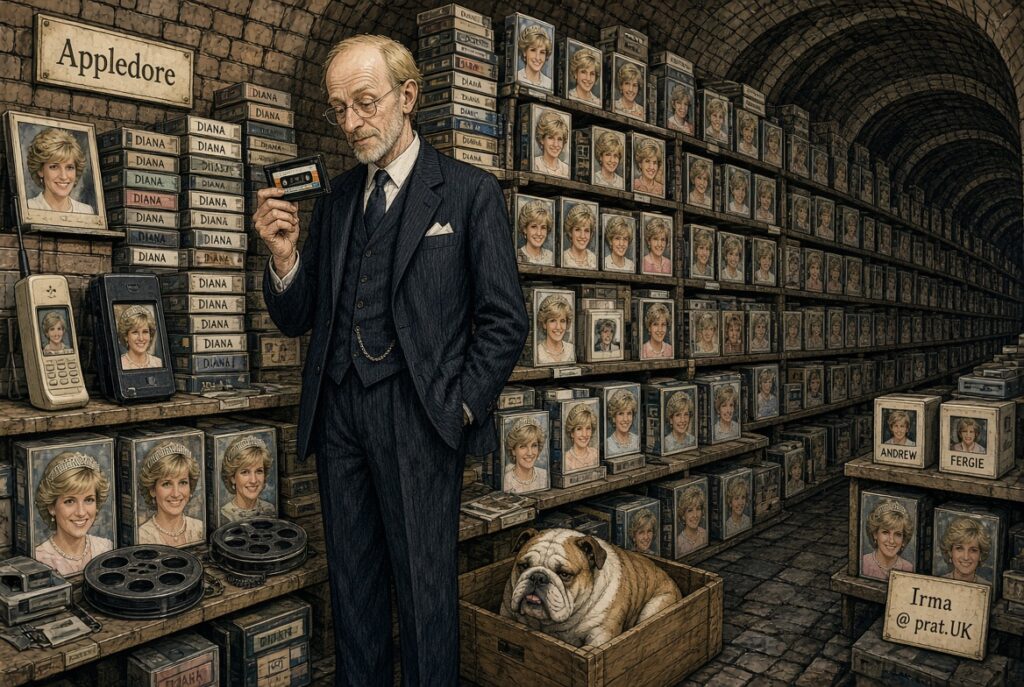
The information must remain undisclosed.
A published secret is merely news.
An unpublished secret is inventory.
That distinction has apparently allowed Magnussen to value several shoeboxes at more than a Premier League midfielder.
He claims the Diana collection has been assembled from photographers, former employees, acquaintances, journalists, courtiers, security personnel, editors, hotel workers, friends of friends and at least one man whom Magnussen will identify only as “terribly nervous Philip.”
No claim has been independently substantiated.
That, Magnussen says, is the beauty of it.
“If I show you everything,” he explained, “then you know everything.”
He leaned forward.
“And where is the profit in that?”
Step Two: Show Just Enough
Visitors permitted into Appledore are reportedly never shown a complete document.
They are shown corners.
A date.
Half a photograph.
Four seconds of tape.
The top third of a letter.
Magnussen apparently understands something television producers discovered decades ago: a closed door is worth more than whatever is behind it.
One visitor described being shown a photograph on Magnussen’s desk.
“What does it prove?” the visitor asked.
Magnussen reportedly replied, “What are you afraid it proves?”
This is the Magnussen Method in miniature.
He does not provide the conclusion.
He rents you your imagination.
Step Three: Let the Victim Supply the Fear
Blackmail traditionally requires the blackmailer to know something embarrassing.
Magnussen has modernised the industry.
He only needs the target to know something embarrassing.
His preferred technique is reportedly to mention three unrelated nouns.
“Paris.”
Pause.
“November.”
Pause.
“Blue folder.”
At this point, according to former associates, innocent people become confused while guilty people begin explaining themselves.
Magnussen learns which category he has encountered by listening carefully.
It is essentially fishing, except the fish fills out its own criminal history before climbing into the boat.
Step Four: Never Say What You Want
Magnussen rarely demands money directly.
He prefers what associates call “environmental persuasion.”
A person arrives believing they have a problem.
Magnussen explains that technically they have twelve.
Then he asks whether he can help.
By the time the conversation reaches money, the victim experiences payment as customer service.
One former employee compared the process to visiting an expensive dentist who informs you that every tooth must be removed except the one containing your PIN number.
Why Princess Diana Remains Uniquely Vulnerable
The reason the Magnussen proposition works has little to do with his archive and everything to do with Diana.
She remains perhaps the perfect subject for posthumous information warfare because everyone else is still capable of speaking for her.
She is not.
Diana cannot issue a correction.
She cannot dispute a diary.
She cannot authenticate a tape.
She cannot explain what she meant during an argument thirty years ago.
She cannot tell a biographer, “That conversation happened, but you have removed the sentence immediately before it.”
And she cannot look into a television camera and announce that everyone discussing her today has gone completely mad.
Her memory has therefore become unusual intellectual property: everybody has a key, nobody possesses the deed.
King Charles knew her as a husband.
Earl Spencer knew her as a brother.
Her sons knew her as their mother.
Friends knew different Dianas.
Employees knew another.
Journalists encountered another.
Photographers created still more.
And the British public assembled its own Diana from interviews, photographs, headlines and grief.
Magnussen’s genius is recognising that these versions do not have to agree.
They only have to remain commercially incompatible.
There Is an Uncomfortable Historical Reason Magnussen’s Hoax Theory Works
The suggestion that manufactured documents could influence Diana’s world is not something satire had to invent from scratch.
Lord Dyson’s 2021 investigation into Martin Bashir’s 1995 Panorama interview found that bank statements had been fabricated and that Bashir showed material to Earl Spencer, deceiving and inducing him to arrange the meeting with Diana. The BBC later accepted Dyson’s findings.
That history gives Magnussen’s alleged treasure room an uncomfortable comic power.
Britain has already experienced the extraordinary situation in which pieces of paper presented as evidence played a role in gaining access to the Princess of Wales.
So when Magnussen places a folder on a table and whispers, “This changes everything,” the sensible response should be:
Who made the folder?
Instead, Britain says:
How much?
The Evidence Room
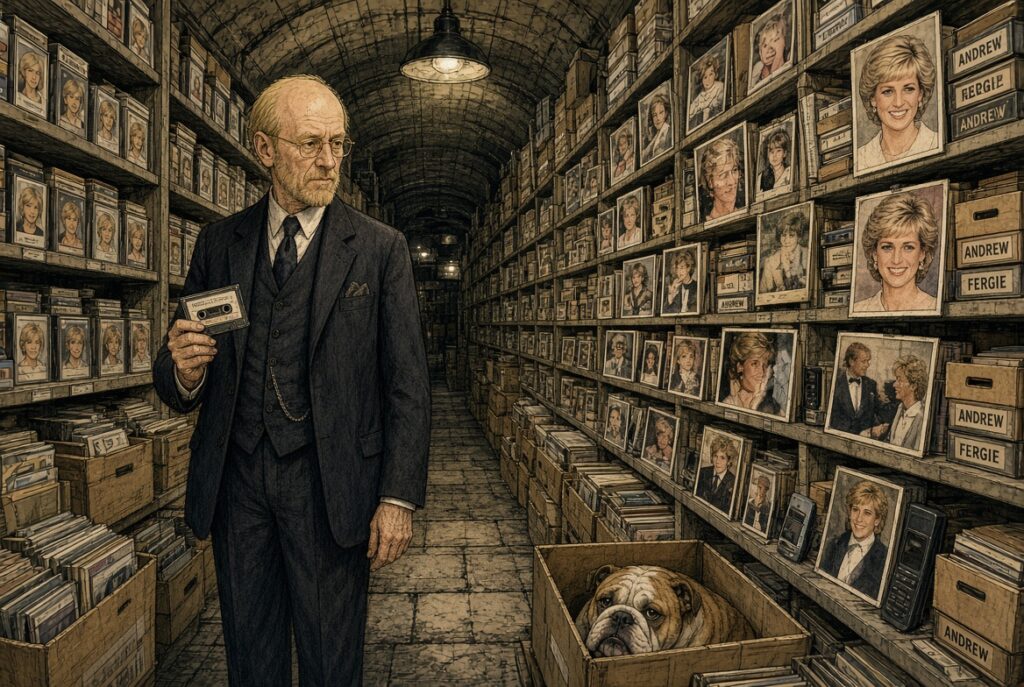
The room supposedly lies beneath Appledore.
Magnussen calls it Diana: Primary Sources.
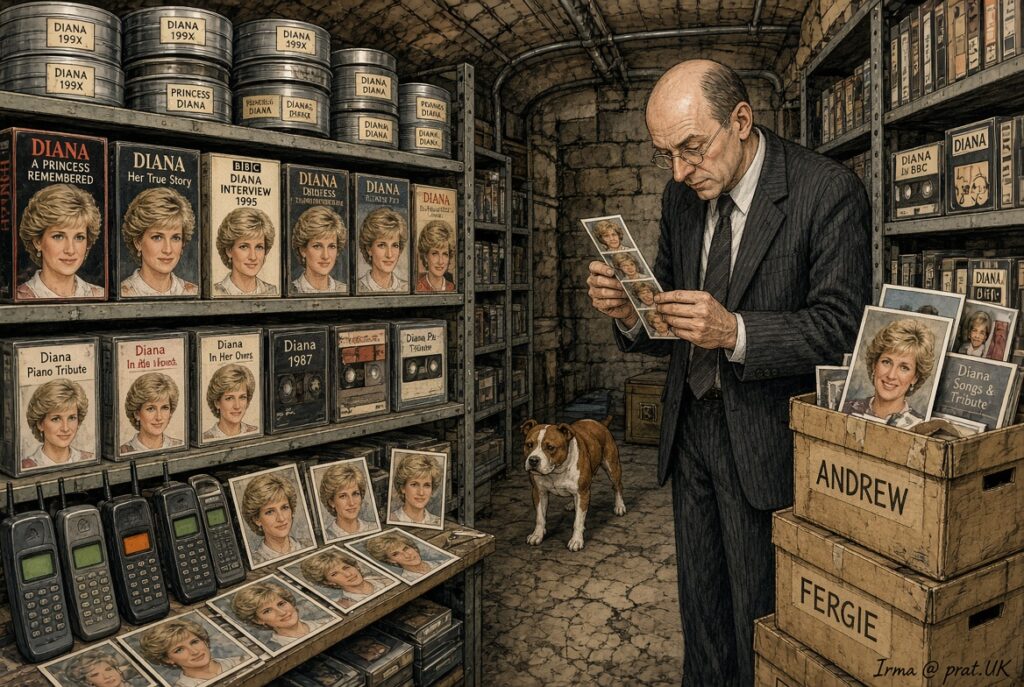
A former electrician calls it “the downstairs bit.”
Witnesses describe metal shelving stretching from floor to ceiling.
There are tapes marked:
KENSINGTON
BALMORAL
PARIS
SPENCER
C 1989
C 1992
DO NOT COPY
and, intriguingly:
DEFINITELY DO NOT PLAY FOR PIERS MORGAN
There are photographs in archival sleeves.
There are VHS tapes.
There are MiniDiscs.
There are microcassettes.
There are handwritten transcripts.
There are sealed envelopes.
There is even an answering-machine tape, although investigators immediately became suspicious because Magnussen had written “VERY IMPORTANT ANSWERING MACHINE TAPE” across it in red marker.
One forensic specialist invited to view the room was reportedly unimpressed.
“How do we know any of this is authentic?” he asked.
Magnussen gestured around him.
“There’s a great deal of it.”
Quantity, apparently, is now chain of custody.
Or Is the Entire Room Fake?
This is where the story becomes far more interesting.
Suppose Magnussen possesses nothing.
Not one significant recording.
Not one unseen photograph.
Not one authentic letter.
Suppose the room itself is theatre.
That possibility would make Appledore less a secret archive than the most expensive escape room in Europe.
The shelves would not exist to preserve evidence.
They would exist to create belief.
The labels would matter more than the tapes.
The locked cabinets would matter more than their contents.
The guards would matter more than whatever they guarded.
Magnussen would have built an architectural bluff.
Casino design for paranoia.
And the smartest detail would be allowing influential visitors to glimpse just enough material to frighten themselves.
Imagine being shown a photograph dated 1994.
You recognise the room.
You recognise two people.
Magnussen covers the third person with his thumb.
You ask him to move his thumb.
He refuses.
Congratulations.
You will now think about Magnussen’s thumb for the rest of your natural life.
The King Allegedly Moves to Silence Magnussen
In the Magnussen version of events, representatives acting in the interests of King Charles make discreet inquiries within hours of the announcement.
Not threats.
Not censorship.
Nothing so vulgar.
Just extremely British questions.
Who owns the building?
Who financed Magnussen?
Are the tapes insured?
Does he really need planning permission for that extension?
Has anyone checked the fire exits?
This is how the British establishment supposedly wages war: not with tanks, but with a surprisingly interested man from the council.
The Palace has made no such verified intervention in the real world described by the documented sources cited here. The entire Magnussen confrontation is the satirical machinery of this story.
That distinction is rather important because Magnussen himself would charge £4 million for it.
Within the satire, however, His Majesty’s imaginary advisers face an impossible problem.
If they denounce Magnussen, people assume the archive is real.
If they ignore Magnussen, people assume the archive is terrifying.
If they demand to inspect it, people assume they know what is inside.
If they laugh, newspapers print:
KING LAUGHS AT DIANA FILES
Magnussen has created the perfect media mousetrap.
Every response feeds it cheese.
Then Charles Spencer Arrives
Magnussen’s story becomes even more theatrical when Earl Spencer supposedly appears at Appledore.
He does not telephone.
He does not email.
He arrives personally.
Magnussen claims Spencer is shown one photograph.
Only one.
Spencer stares at it.
“What do you want?” he asks.
Magnussen says nothing.
“What do you want?”
Silence.
Finally Magnussen answers:
“Accuracy.”
This is very funny coming from a man currently holding a cassette labelled MAYBE TUESDAY.
The satirical Spencer then does what every Magnussen target eventually does.
He asks Magnussen not to publish.
Magnussen asks why.
Spencer refuses to say.
Magnussen smiles.
The entire method has worked.
The target has supplied the significance.
Eventually Spencer is depicted on his knees pleading for silence, at which point Magnussen observes that the British aristocracy invented kneeling for monarchs and apparently never anticipated it being franchised.
Again, none of this is presented as an actual event involving Earl Spencer. It is part of the Magnussen satire.
But the underlying historical connection between Spencer, Diana and manipulated documentary evidence is real enough to make the premise sting: Dyson found that Bashir deceived Earl Spencer with fabricated bank statements in the process that led to the Diana interview.
Britain Starts a GoFundMe
Then the public gets involved.
Within the story, an unemployed geography teacher from Swindon establishes a crowdfunding campaign:
BUY MAGNUSSEN’S DIANA FILES FOR BRITAIN
Target: £50 million.
The first donation is £5.
The second is £10.
Then somebody gives £2,000 anonymously under the name NOT THE PALACE.
The campaign explodes.
Pensioners contribute.
Royal enthusiasts contribute.
Republicans contribute because they hope the files damage the monarchy.
Monarchists contribute because they hope the files clear the monarchy.
Diana devotees contribute because they want the truth.
Conspiracy theorists contribute because they absolutely do not want the truth to interfere with what they already know.
Within six hours, £8.4 million has been raised.
Magnussen increases the asking price.
“Market conditions,” he explains.
Britain is furious.
Donations accelerate.
This may be the first fundraising campaign in history strengthened by the seller behaving exactly like a Bond villain.
The Crowdfunding Rewards
Magnussen eventually introduces donor tiers.
£10: COMMONER
You receive a thank-you email.
£50: CORGI
You receive a reproduction envelope marked CONFIDENTIAL.
It is empty.
£250: FOOTMAN
You are told the date of a photograph but not what is in it.
£1,000: DUKE
You receive four seconds of audio consisting primarily of cutlery.
£25,000: PRIVY COUNCILLOR
Magnussen personally tells you, “You have no idea.”
£1 MILLION: APPLEDORE
You are allowed into the evidence room for eleven minutes but must leave your glasses outside.
The public calls this transparency.
Which Charles Does the Evidence Vindicate?
Magnussen then introduces pricing packages.
For £20 million, he offers THE SPENCER FILE.
For £25 million, THE KING’S FILE.
For £35 million, DIANA IN HER OWN WORDS.
For £50 million, ABSOLUTE TRUTH.
A journalist asks why Absolute Truth costs more.
“Editing,” Magnussen replies.
Another asks how the same archive can prove contradictory interpretations.
Magnussen seems genuinely surprised by the question.
“My newspapers do it every day.”
That may be the most believable statement he makes.
The brilliance of Magnussen’s scheme is that he does not need evidence proving Charles Spencer correct or evidence proving King Charles correct.
He needs enough ambiguous material for people already committed to either interpretation to construct their preferred verdict.
A sentence without context.
A photograph without a date.
A tape without the preceding conversation.
An emotional letter written during an argument.
One person’s recollection decades later.
These things may all be genuine and still fail to establish what Magnussen says they establish.
Authenticity is not the same as meaning.
A real photograph can support a false story.
A genuine quotation can become misleading when amputated from context.
A perfectly authentic tape can record somebody being sincerely wrong.
This is where Magnussen’s information empire stops being merely a joke about blackmail and becomes a joke about modern media.
We have more evidence than any previous civilization.
We have not necessarily become proportionately wiser.
The Actual Diana Investigation Was Already Enormous
The public record surrounding Diana’s death is hardly empty.
The 2008 inquest lasted months and heard hundreds of witnesses. The jury concluded that Diana and Dodi Fayed were unlawfully killed as a result of grossly negligent driving involving Henri Paul and pursuing vehicles; the coroner had explicitly ruled that a verdict alleging a staged assassination by the Duke of Edinburgh or others was not available on the evidence presented.
That matters because Magnussen’s proposition depends upon pretending history is an empty whiteboard awaiting his marker pen.
It is not.
There are investigations.
Documents.
Testimony.
Judgments.
Disagreements.
Known deception.
Known uncertainty.
And an enormous amount already in the public domain.
Magnussen’s imaginary genius is not discovering that no investigation occurred.
It is betting that the phrase SECRET TAPE will always outperform 278 WITNESSES.
He may be right about that.
Put “official inquiry” on television and viewers make tea.
Put “unheard Diana recording” on television and kettles are abandoned mid-boil.
Investigators Finally Test Magnussen
A consortium of journalists eventually proposes a simple deal.
They choose three items randomly.
Independent forensic specialists authenticate them.
If all three are genuine, fundraising continues.
Magnussen refuses.
Why?
“Privacy.”
A journalist nearly injures himself laughing.
The man attempting to auction Britain’s most intimate royal archive has suddenly discovered privacy.
Magnussen offers another arrangement.
He will choose the samples.
The journalists decline.
He offers to choose the experts.
They decline.
He offers to authenticate the evidence himself.
They ask about his qualifications.
“I own newspapers.”
The room goes quiet.
For Magnussen, that apparently completes the CV.
The Photograph That Changes Everything
Finally he unveils his masterpiece.
A single sealed photograph.
He places it on a table.
King Charles can buy it.
Charles Spencer can buy it.
The public can buy it.
A newspaper can buy it.
But nobody may see it beforehand.
“What does it show?” asks a reporter.
Magnussen smiles.
“The truth.”
“Whose truth?”
“The highest bidder’s.”
And suddenly the whole operation becomes clear.
Magnussen has never been selling evidence.
He has been selling ownership of the narrative.
The buyer does not merely purchase the photograph.
The buyer purchases the right to reveal it, bury it, contextualise it, misinterpret it, explain it, denounce it or place it permanently inside another locked room.
The £50 million is not the price of knowing.
It is the price of deciding who gets to speak next.
Diana’s Final Vulnerability Is Britain Itself
The uncomfortable punchline is that Diana remains valuable because Britain has never stopped asking her questions.
Who was she really?
Who failed her?
Who exploited her?
Who loved her?
Who misunderstood her?
Who betrayed whom?
Every generation opens the same case with newer technology and older witnesses.
Magnussen merely turns that appetite into a business plan.
He understands that uncertainty is renewable energy.
Facts eventually run out.
Questions reproduce.
And Diana, unlike everybody publishing books, producing documentaries, giving interviews and opening mysterious archives, cannot answer.
That silence is the vulnerability.
Magnussen monetises it.
The tabloids monetise it.
Television monetises it.
Publishers monetise it.
Social media monetises it.
Even the people claiming they merely want to “settle the matter once and for all” somehow manage to settle it again every eighteen months.
The Door Opens
At midnight, the crowdfunding campaign finally reaches £50 million.
Britain waits.
Magnussen walks downstairs.
Television cameras gather outside Appledore.
A locksmith opens the final steel cabinet.
Inside is a black box.
Magnussen removes it.
He places it on the table.
The nation holds its breath.
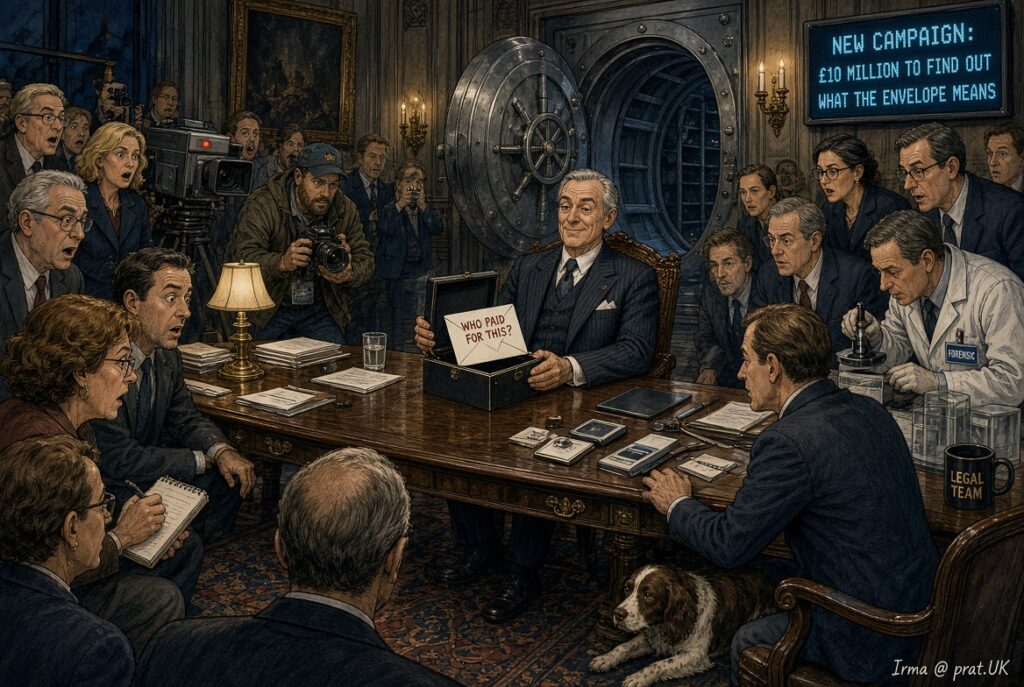
He opens the lid.
Inside is another envelope.
On the envelope are four words:
WHO PAID FOR THIS?
Magnussen looks directly into the camera.
He smiles.
“Now,” he says, “we have an investigation.”
And somewhere in Britain, another GoFundMe begins.
Thinking About What Charles Magnussen Knows About Princes Diana
15 Observations Before Britain Opens the Vault
1. Magnussen Has Discovered the Only Product More Valuable Than Royal Gossip: Royal Gossip With a Padlock
Britain has spent nearly three decades discussing Princess Diana. Magnussen’s innovation is simply putting the discussion behind a paywall large enough to require planning permission.
2. Nobody Knows Whether Magnussen Has Evidence, Which Makes Him Perfectly Qualified to Discuss Diana on British Television
The fewer people who have seen the material, the more confidently everybody can debate it.
3. Magnussen’s Evidence Room Contains 14,000 Photographs, 900 Tapes and Apparently No Receipt for Any of Them
Provenance is important in investigative journalism. Magnussen prefers atmosphere.
4. His Greatest Weapon Is Not Information but the Sentence “Are You Certain You Want Me to Play the Rest?”
That sentence can make a duke sit down from three counties away.
5. The British Public Has Started a GoFundMe to Buy the Truth
This may be the first crowdfunding campaign where the stretch goal is “constitutional awkwardness.”
6. Magnussen Offers Several Versions of the Truth
For £20 million, Charles Spencer is vindicated.
For £25 million, King Charles is vindicated.
For £50 million, Magnussen explains why both packages contain the same cassette.
7. Britain Is Treating the Archive Like the Crown Jewels
Except nobody knows whether these jewels came from Cartier or a petrol-station vending machine.
8. The Palace Supposedly Wants Magnussen Silent
This has unfortunately increased donations.
Nothing makes Britons reach for their wallets faster than hearing that somebody important would prefer they didn’t.
9. Charles Spencer Supposedly Wants Magnussen Silent Too
Britain immediately concluded this proves Magnussen possesses something enormous, because apparently two people disliking the same man now constitutes forensic science.
10. Magnussen Understands Diana’s Greatest Continuing Vulnerability
She cannot answer anybody.
Everybody else can publish a memoir.
11. Every Tape Is Labelled in Magnussen’s Own Handwriting
Apparently Britain’s most sensitive royal archive was organised by the same filing system used for old Christmas decorations.
12. One Photograph Is So Explosive Magnussen Keeps It Inside Three Envelopes
Investigators opened the first two and discovered another envelope.
Magnussen calls this “verification.”
13. Experts Cannot Authenticate the Material Until Magnussen Releases It
Magnussen cannot release it until he is paid.
Britain has therefore invented Schrödinger’s tabloid.
14. The Public Wants Transparency but Also Suspense
If Magnussen simply published everything online, Britain would read it for twenty minutes and return to complaining about parking.
15. The Real Commodity Is Not Diana
It is doubt.
Doubt never dies, never gives an interview, never demands royalties and can be repackaged every ten years with a new photograph on the cover.
Disclaimer
This is satire. Magnussen’s Diana archive, the crowdfunding campaign, purported recordings, photographs, Palace manoeuvres, meetings, pleas and dialogue described in the Magnussen narrative are invented satirical devices, not claims that these events occurred. Real historical references concerning the Panorama interview and official investigations into Diana’s death are distinguished above and sourced to public records.
This story is entirely a human collaboration between two sentient beings: the world’s oldest tenured professor and a philosophy major turned dairy farmer. Neither has inspected a secret royal evidence room, although the dairy farmer says he once had a filing cabinet containing material capable of destroying several reputations until it turned out to be veterinary invoices.

Alan Nafzger was born in Lubbock, Texas, the son Swiss immigrants. He grew up on a dairy in Windthorst, north central Texas. He earned degrees from Midwestern State University (B.A. 1985) and Texas State University (M.A. 1987). University College Dublin (Ph.D. 1991). Dr. Nafzger has entertained and educated young people in Texas colleges for 37 years. Nafzger is best known for his dark novels and experimental screenwriting. His best know scripts to date are Lenin’s Body, produced in Russia by A-Media and Sea and Sky produced in The Philippines in the Tagalog language. In 1986, Nafzger wrote the iconic feminist western novel, Gina of Quitaque. He currently lives in Holloway, North London. Contact: [email protected]