UK Asks to Join ‘Made in Europe’ Scheme, Brussels Politely Points at Brexit Receipt
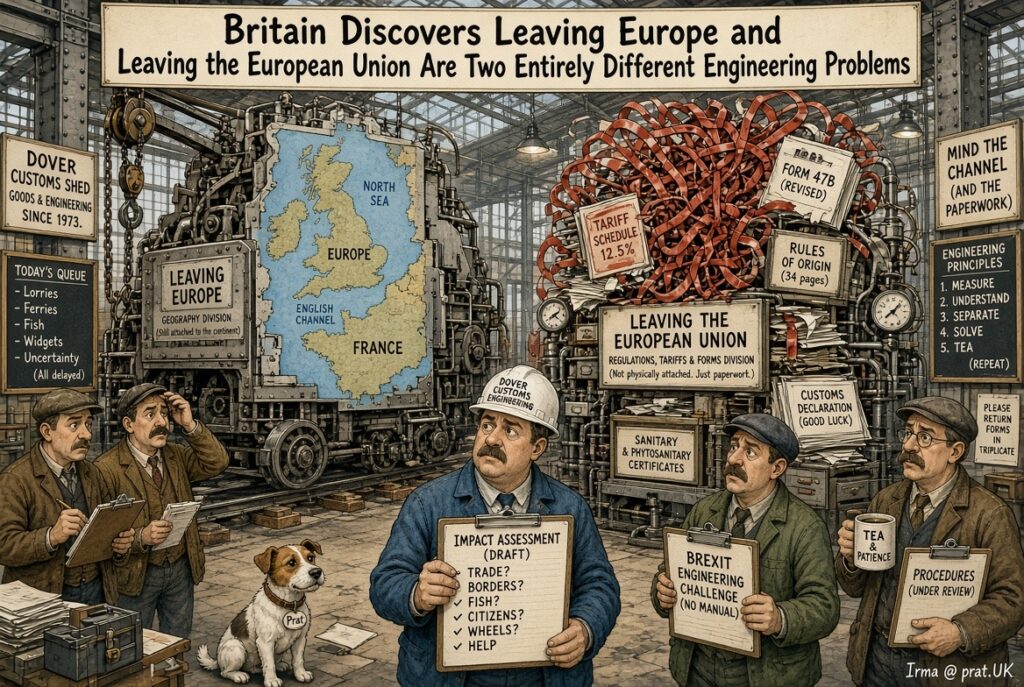
Britain Discovers Leaving Europe and Leaving the European Union Are Two Entirely Different Engineering Problems
Britain has opened another fascinating chapter in its post-Brexit relationship with the European Union by asking Brussels not to treat the United Kingdom too much like a country that went through several years of constitutional convulsions specifically to become a country outside the European Union.
Chancellor John Healey travelled to Dublin to press EU counterparts over the developing “Made in Europe” industrial policy, arguing that Britain should not be excluded from arrangements affecting closely integrated European industries. Reuters reported that the policy could favor EU companies in areas such as public contracts and subsidies, while Britain is seeking closer economic and security cooperation with the bloc.
This has created the sort of administrative situation Britain excels at creating for itself.
Britain is geographically in Europe.
Britain is economically intertwined with Europe.
Britain manufactures things with European companies, sells things to European companies, buys things from European companies and occasionally spends entire government departments negotiating with European companies.
But Britain is not in the European Union.
This distinction is completely straightforward until somebody tries to build a car.
Then apparently everyone needs a lawyer.
Chancellor Heads to Dublin to Explain Britain Left the Club but Still Considers Itself Eligible for Happy Hour
Healey’s mission can perhaps best be understood through the ancient diplomatic institution known as the pub membership card.
Imagine joining a private club.
For 47 years you use the bar, restaurant, swimming pool and parking lot.
Then one afternoon you stand on the billiard table and announce that the club is strangling your personal freedom.
You resign.
You cut your membership card in half.
You hold a parade.
Several relatives stop speaking to one another.
Six years later, you appear at the bar at 5:03 p.m.
“Two-for-one gin and tonic, please.”
The bartender looks at you.
“You resigned.”
“Yes, but I remain geographically close to the building.”
That, stripped of approximately 11,000 negotiating documents, is where some of the current argument lives.
Britain legally left the European Union on January 31, 2020, and the transition period ended on December 31 of that year. It consequently ceased being part of the EU Single Market and Customs Union.
None of that moved Birmingham.
Manchester did not wake up beside Bermuda.
Kent remained stubbornly opposite France.
This explains why “Made in Europe” has immediately produced a linguistic emergency.
Britain Wants Products Classified as ‘Made in Europe,’ Geography Department Requests Emergency Meeting
The European Commission originally described “made in Europe” criteria as a way to stimulate European industrial production through public procurement. President Ursula von der Leyen said in 2025 that such criteria would be introduced as part of the EU’s effort to strengthen clean technology and strategic industries.
Conceptually, this appears simple.
Buy more European stuff.
Unfortunately, Europe is both a continent and a political organization, which is like naming your condominium association “North America” and then getting annoyed when Canada asks about parking.
Consider a hypothetical widget manufactured in Coventry.
Its steel may come from Sweden.
Its electronics might arrive from Germany.
A component may be made in Poland.
Its designer might be Italian.
Its financing could involve Amsterdam.
Its bearings might come through Belgium.
Its final assembly happens in Coventry.
At this point, asking whether the widget is European becomes less a customs question than an ancestry programme on television.
“Your catalytic converter is 14 percent Bavarian.”
“Good heavens.”
“And your left rear suspension has relatives in Slovakia.”
“My mother never told me.”
British officials have already warned formally that an overly restrictive definition of “Made in Europe” could increase costs and disrupt integrated supply chains. That concern was recorded at the UK-EU Trade and Cooperation Agreement Partnership Council in February 2026.
Which is bureaucratic language for:
Please do not perform surgery on the patient before checking which organs we share.
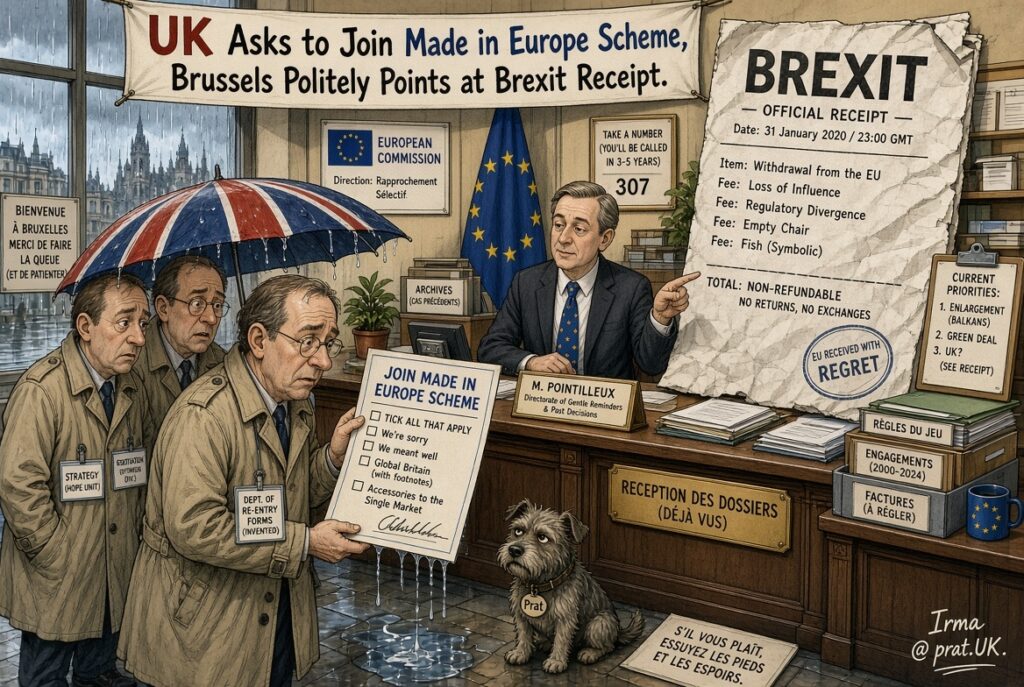
The Brexit Receipt
Somewhere in Brussels, one imagines, there is a receipt.
It is enormous.
Possibly laminated.
At the top it says:
EUROPEAN UNION
Underneath:
CUSTOMER: UNITED KINGDOM
ITEM: MEMBERSHIP
STATUS: RETURNED
And whenever Britain requests another accommodation, an EU official slowly opens a filing cabinet, removes the receipt and places it on the table.
Britain then explains that things are more nuanced than that.
And, economically, they are.
Britain and the EU remain deeply connected trading partners. Factories do not reorganize themselves according to campaign slogans. Supply chains are unusually unimpressed by constitutional poetry.
A crankshaft has never shouted “Take back control.”
A semiconductor has never demanded sovereignty.
A box of industrial bearings has never appeared on Question Time.
Manufacturing is irritatingly pragmatic.
It wants components.
Preferably Tuesday.
This is why British ministers can simultaneously defend Brexit as settled constitutional reality while asking Brussels for arrangements that minimize some of the resulting industrial barriers.
Politics likes clean lines.
Factories prefer loading schedules.
Chancellor Asks EU Not to Treat Britain Like Country That Specifically Asked to Be Outside EU
The comic contradiction does not mean Britain’s request is economically irrational.
Quite the opposite.
If British and continental manufacturers operate through closely integrated supply chains, preferential procurement rules could have consequences on both sides. Even European policy analysis has noted that models allowing some third-country participation may reduce legal exposure, administrative burdens and costs compared with rigid exclusion.
So there is a serious argument underneath the custard pie.
Britain’s position is essentially:
“We understand that we are outside your political structure, but perhaps economic reality could be persuaded to stop noticing.”
The EU position, in equally simplified terms, is:
“The purpose of preferences for members becomes somewhat mysterious if non-members automatically receive them.”
Both propositions possess the irritating quality of making sense.
And thus negotiations begin.
This is Europe.
If everybody agreed immediately, several thousand officials would have to retrain as landscape gardeners.
Industrial Sovereignty Meets the Gearbox
Sovereignty is glorious until you open the bonnet.
Inside the modern car is the global economy packed into a metal box.
Every component seems to have crossed a border, acquired a certificate, received an email from Belgium and been inspected by a man named Klaus.
You cannot build a modern manufacturing strategy entirely from speeches.
At some point somebody needs ball bearings.
This principle applies equally to European industrial policy.
The EU wants to strengthen domestic industrial capacity in response to international competition, including pressure from China.
That objective naturally produces pressure to favor goods produced inside the bloc.
But Europe’s supply chains did not spend decades asking whether each bolt possessed the correct constitutional opinions.
British factories became intertwined with continental factories because businesses tend to care about price, quality, proximity and reliability.
Businesses are terribly shallow that way.
Never once has a procurement officer said:
“This component costs £14 more and takes three weeks longer, but you should see its commitment to national self-determination.”
The New Definition of European
There may therefore be only one solution.
Europe needs several new geographical classifications.
There could be European-European, meaning EU member states.
Then European-but-not-European-European, meaning Britain.
Then European-adjacent-with-paperwork, for countries deeply connected to EU markets.
Britain could receive a special designation:
European Plus Brexit Minus Membership With Participating Retailers Only.
Every manufactured product would carry a sticker.
MADE IN EUROPE*
At the bottom, in four-point type:
*Europe in this instance refers to the geographical landmass, selected industrial supply chains, participating procurement programmes, Thursdays before 6 p.m., and such other circumstances as may be agreed between His Majesty’s Government and representatives of the European Commission after 17 consecutive meetings involving sandwiches.
Problem solved.
Until France sees it.
Britain Invents Brexit With Benefits
The broader political dance is becoming familiar.
Britain does not propose returning to the Single Market, according to the current government position reported to Parliament, while simultaneously negotiating ways of reducing specific barriers to trade.
This produces an increasingly intricate national product:
Brexit With Selected Benefits.
It resembles ordering a hamburger without the bun, meat or cheese, then asking the waiter whether the restaurant could nevertheless preserve the general hamburger experience.
“We absolutely do not want the old meal.”
“Certainly.”
“But could you bring the fries?”
“Yes.”
“And the pickle?”
“Possibly.”
“And perhaps that little paper flag?”
“That depends on negotiations.”
“Wonderful. Sovereignty.”
An Entire Continent Discovers the Supply Chain
The central joke is that political borders can change overnight while commercial geography cannot.
Britain can legislate itself outside EU institutions.
It cannot legislate Rotterdam farther away.
Nor can Brussels pass a regulation causing British aerospace expertise to evaporate.
Economic integration is the stubborn guest still asleep on the sofa after the divorce.
Which is why Healey went to Dublin.
Not necessarily to reverse Brexit.
Not necessarily to recreate membership.
But to argue that European industrial strategy may work better if Britain is not treated exactly like an unrelated economy on the other side of the planet.
The EU will naturally ask what participation would involve.
Britain will naturally ask what participation would cost.
Officials will naturally produce documents.
Negotiators will naturally schedule meetings.
Journalists will naturally describe them as “crunch talks.”
And somewhere in Brussels, the Brexit receipt will remain carefully filed.
Just in case.
15 Humorous Observations Behind the Story
The factual springboard is wonderfully tidy: Chancellor John Healey went to Dublin to argue that Britain should not be disadvantaged by the EU’s developing “Made in Europe” industrial policy. The proposal is intended to favor European production in areas including public procurement, while Britain has warned that a restrictive definition could damage deeply integrated UK-EU supply chains.
- Brexit increasingly resembles cancelling a gym membership and returning every Tuesday to use the shower.
- Britain wants the independence of being outside the EU combined with the procurement benefits of accidentally being inside it.
- “Made in Europe” creates a fascinating geographical problem because Britain has not, despite considerable paperwork, physically sailed into the Atlantic.
- The Channel is apparently now wide enough to separate legal jurisdictions but insufficiently wide to inconvenience a supply chain.
- Britain left the EU in 2020, but British manufacturing forgot to pack.
- Brussels now possesses the most satisfying document in European bureaucracy: the Brexit receipt.
- Britain wants sovereignty with complimentary continental breakfast.
- The Chancellor’s trip to Dublin has the atmosphere of a former club member asking whether his expired loyalty card still gets him two-for-one cocktails.
- The phrase “third country” sounds insulting only because “former spouse standing on patio” was rejected by translators.
- British manufacturers would prefer politicians stop conducting constitutional experiments near the loading dock.
- Governments love economic independence until somebody explains where the gearbox comes from.
- Geography says Britain is European; treaty law says it is outside the EU; the purchasing department just wants to know where to send the invoice.
- The great post-Brexit innovation may turn out to be negotiating individually for things Britain previously received collectively.
- “Made in Europe” may eventually require a philosopher, three customs officials and a forensic metallurgist to determine the nationality of a brake pedal.
- The British-EU relationship has matured into that rare divorce where both parties keep arguing because they still share the washing machine.
Disclaimer
This is satire inspired by a real policy dispute involving Britain and the European Union. The factual scaffolding concerns the developing “Made in Europe” policy and current UK efforts to protect British manufacturers; the absurd conversations, laminated Brexit receipt, genealogical catalytic converter and pub-membership mathematics are comic inventions.
This story is entirely a human collaboration between two sentient beings: the world’s oldest tenured professor and a philosophy major turned dairy farmer. Neither is currently authorized to determine the nationality of a gearbox.
Sources: BBC News | European Commission | GOV.UK – TCA Partnership Council Minutes

Dr. Ingrid Gustafsson holds a Ph.D. in Literary Studies and serves as Professor of Literature and Satirical Journalism at the university. Her scholarly work focuses on contemporary satire as a form of institutional critique, examining how exaggeration, irony, and absurdism function as sophisticated analytical tools for exposing structural inequality and institutional hypocrisy. Dr. Gustafsson has published extensively on the genealogy of satirical discourse, the relationship between speech acts and cultural power, and satire’s role as both aesthetic practice and epistemological strategy. Her research interrogates how contemporary satire operates within celebrity culture, legal systems, and institutional rhetoric, revealing the mechanisms through which power obscures itself through language and performance. Dr. Gustafsson’s work combines rigorous textual analysis with broader cultural theory, contributing significantly to understanding satire’s critical function in contemporary society. She is the author of Pearl Clutching and How to Combat It with Satire.