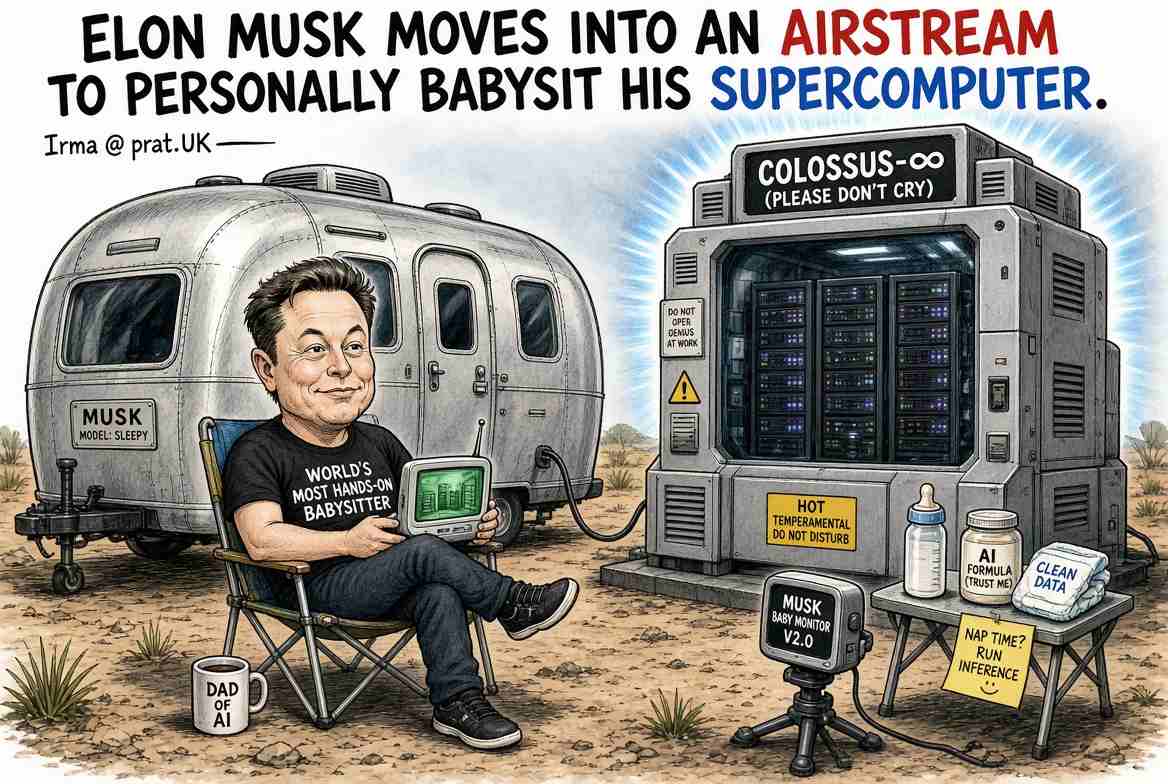
Elon Musk Moves Into an Airstream to Personally Babysit His Supercomputer
The world’s richest man rediscovers the ancient business strategy known as living above the shop, one Airstream at a time
There is a certain kind of American genius that spends thirty years building rockets, buying social networks and racing toward artificial superintelligence, only to solve its biggest logistics problem with a lawn chair and an extension cord. That genius currently has an address in Memphis, Tennessee, and it belongs to Elon Musk.
Musk confirmed at the All-In Summit that he has taken up residence in an Airstream trailer parked steps from xAI’s Colossus supercomputer campus, the sprawling operation racing to scale toward a million Nvidia GPUs. He called it his “palace.” SpaceX President Gwynne Shotwell, appearing on the same call, did not dispute it. The world’s richest man is, by his own description and hers, sleeping on the factory floor.
This is either the most disciplined executive decision of the decade or the most expensive game of camping ever played. Possibly both.
Elon Musk’s Airstream Becomes the Most Expensive Studio Apartment in Memphis
For generations, small business owners have lived above the bakery, the hardware store, the funeral home. Musk has simply updated the model. Instead of a bakery downstairs, he has a billion-dollar artificial intelligence campus, and instead of smelling bread in the morning, he presumably smells whatever a hundred thousand liquid-cooled GPUs smell like when they’re thinking very hard.
Call it the *nouveau trailer park*, a real estate category that did not exist until a man worth nine hundred and seventeen billion dollars decided his commute should be measured in footsteps rather than freeway exits. Somewhere, a Memphis real estate agent is drafting a listing that reads: “Cozy 16-foot Airstream, walking distance to Colossus, seller motivated by artificial general intelligence.”
The math is almost sweet in its simplicity. Cut a forty-minute commute each way and you’ve manufactured yourself an extra workweek every month without touching the calendar. It is the kind of efficiency gain that makes a productivity consultant weep tears of pure, undiluted jealousy, right before asking how much the Airstream cost.
A Supercomputer That Can Write Poetry but Still Can’t Supervise an Electrician
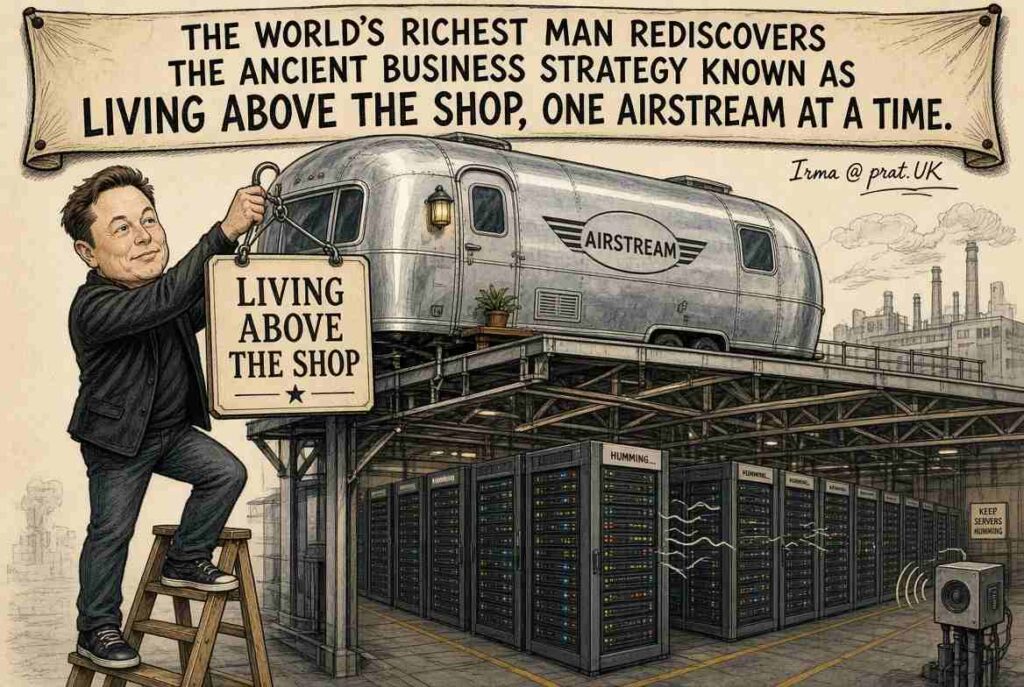
Here is the joke that writes itself. Inside Musk’s Airstream sits a man overseeing machines capable of processing more information in a second than a human brain manages in a lifetime. Outside the Airstream sits a construction site that, as of this week, still needs a man in a trailer to make sure the concrete truck shows up.
We have built computers that can draft a legal brief, generate a screenplay and argue both sides of a philosophy exam. We have not yet built one that can walk across a job site and say, with appropriate menace, “This conduit was due yesterday.” That, more than any chatbot benchmark, may be the real test of artificial general intelligence. Forget chess. Forget calculus. Give the machine a hard hat and three subcontractors who all insist the delay is someone else’s fault. If it survives until lunch, we have arrived.
The Musk Airstream Management Philosophy: Sleep Wherever the Problem Sleeps
Traditional management theory holds that a chief executive sets a vision, delegates execution and reviews results from a conference room with a very good view. Musk’s version has historically looked different. He did it during Tesla’s roughest production stretches. He did it at Twitter’s San Francisco headquarters after buying the company. Now he’s doing it in Memphis, and the strategy can be summarized in one sentence: find the problem, then go live next to it until the problem gets nervous.
It is management by geography, and it works less like modern leadership theory and more like a nineteenth-century railroad baron with a satellite internet connection. Somewhere, Cornelius Vanderbilt is smiling. Somewhere else, a construction crew in Memphis is discovering that “we’ll get to it tomorrow” hits differently when the boss can hear you say it through an aluminum wall.
Corporate America Takes Notes on the Airstream Playbook
The danger, of course, is imitation. Executives love nothing more than copying whatever a fellow billionaire just called efficient. Give it a fiscal quarter and LinkedIn will be unbearable. Some vice president of logistics will post, with total sincerity, that leadership isn’t about having a corner office, it’s about waking at four in the morning because a forklift is idling outside your bedroom. It will get forty thousand comments, all of them the word “THIS,” and somebody will option the film rights before lunch.
Picture it: eleven thousand Airstreams parked outside distribution centers by spring, earnings calls introducing an entirely new metric called trailer-adjusted productivity, and a bestselling management book titled, without irony, “The Airstream Executive: Why Great Leaders Have Hitch Receivers.” Somebody will pay ninety-four thousand dollars to attend a business school seminar on it. The trailer will not be included in tuition.
Memphis Gets Silicon Valley, With Southern Parking
Memphis, a city better known for barbecue, blues and the Mississippi River, has spent the last two years quietly turning into one of the strangest company towns in the country. xAI’s Colossus campus has grown from a converted Electrolux factory into a sprawling complex racing toward a million GPUs, and the expansion hasn’t come without friction. Local residents and officials have pushed back on the facility’s power demands and the gas turbines used to help meet them, concerns xAI has tried to address with donated battery storage and a new water recycling plant.
Those are real questions and they deserve real scrutiny, because a data center that can train a language model to write sonnets still needs a genuinely enormous amount of electricity, and electricity does not arrive courtesy of good intentions. But the executive spectacle sitting on top of that serious story remains gloriously absurd. There are billionaires who collect vineyards. There are billionaires who collect contemporary art. Musk appears to collect industrial emergencies, and he keeps moving in with them.
A Few Honest Observations Before the Construction Crew Shows Up
Most billionaires buy an island to escape work. Musk seems to have bought enough compute to make escaping work structurally impossible. The average CEO checks the factory dashboard from a yacht. Musk checks it by opening a trailer door and yelling at a crane. Silicon Valley spent twenty years promising remote work would free us from the office. Musk has now pioneered the opposite technology, a residence so close to the job site that the refrigerator hums along with the server fans.
And there’s something almost touching about the fact that a man who could sleep anywhere on Earth chose an aluminum box with a leaky faucet next to a construction zone. People have spent careers and small fortunes studying executive leadership theory. The Musk method appears to consist entirely of sleeping a hundred and fifty yards from whatever is currently late. If this works, expect Harvard to eventually offer a seminar in it, tuition not included, trailer very much required.
What a Southern Comic Might Say About the Whole Thing
Duane Kessler, a working stand-up out of Nashville who has built a small following riffing on tech-world excess, put it about as plainly as it can be put during a recent club set. “The richest man alive is living in a camper next to a robot factory,” he said. “My uncle lived in a camper next to a chicken plant for the exact same reason. Neither one of them will admit it’s because the marriage isn’t going great.”
It’s a cheap shot, and it lands anyway, because the image really is that ridiculous. A man with a fortune that could buy a small European country is currently arguing with a foreman about rebar delivery times, and somehow that’s the most normal part of the story.
NASA Had an Airstream Too, Just With Better PR
There’s a genuinely charming historical echo buried in all this. NASA famously used a modified Airstream as a mobile quarantine facility for the Apollo astronauts returning from the Moon. More than half a century later, another enormous American technological venture has a man living in one again, just in reverse order. In 1969, astronauts went to the Moon and then climbed into an Airstream. In 2026, a billionaire climbed into an Airstream first and is trying to build something that might get us to the next frontier from there. The trailer, remarkably, remains the constant. Only the ambition keeps changing size.
Eventually, the AI Should Move Musk’s Airstream Itself
The happiest possible ending here involves Colossus eventually becoming capable enough to manage its own expansion. Musk wakes up one morning, walks toward the data center and finds that the system has already scheduled the contractors, resolved the engineering disputes and finished the building overnight, no supervision required.
He stares at it. The machine speaks. “Construction complete.” He asks if that means he can finally leave. It tells him yes. Then it adds one more line: his Airstream is blocking the loading dock and needs to move.
And there it is, the final and most humbling stage of artificial intelligence. Not defeating humanity. Not replacing it. Just telling the boss, politely but firmly, to move his trailer.
Underneath all the jokes about hitch receivers and hard hats sits something almost sincere: the idea that presence still matters, that showing up and staying uncomfortable is still, even in an age of trillion-parameter models, one of the few management techniques nobody’s figured out how to automate. Musk may have stumbled into that lesson by accident, in a sixteen-foot trailer with a bad faucet. It doesn’t make it less true.
Elon Musk told attendees at the All-In Summit that he is currently living in an Airstream trailer in Memphis, calling it his “palace,” while SpaceX President Gwynne Shotwell confirmed the arrangement on the same appearance. The trailer sits near xAI’s rapidly expanding Colossus supercomputer campus, which the company has said it plans to scale toward a million Nvidia GPUs. The expansion has drawn scrutiny from Memphis residents and local officials over the facility’s gas turbines and electricity demand, concerns xAI has responded to with donated Tesla battery storage and a new water recycling plant.
This piece is a work of American satire and satirical journalism, built around real reporting on Elon Musk’s living arrangement in Memphis. The imagined dialogue, the LinkedIn posts, the Harvard seminar and the comic’s set are comic inventions, not real quotations or events. The environmental and power-grid concerns surrounding xAI’s Memphis expansion are real and contested matters that deserve independent reporting on their own terms.
Auf Wiedersehen, amigo!
Sources: Fortune, The Daily Beast, Crypto Briefing, TechCrunch
More British satire and satirical journalism at The London Prat.

Harper Thames is a comedic writer exploring modern life through irony and subtle exaggeration. Rooted in student perspectives and London’s cultural landscape, Harper’s work focuses on relatable humour grounded in everyday experience.
Expertise is developed through writing practice and critical engagement, while authority comes from authenticity and consistency. Trust is reinforced by transparent satire and ethical humour choices.