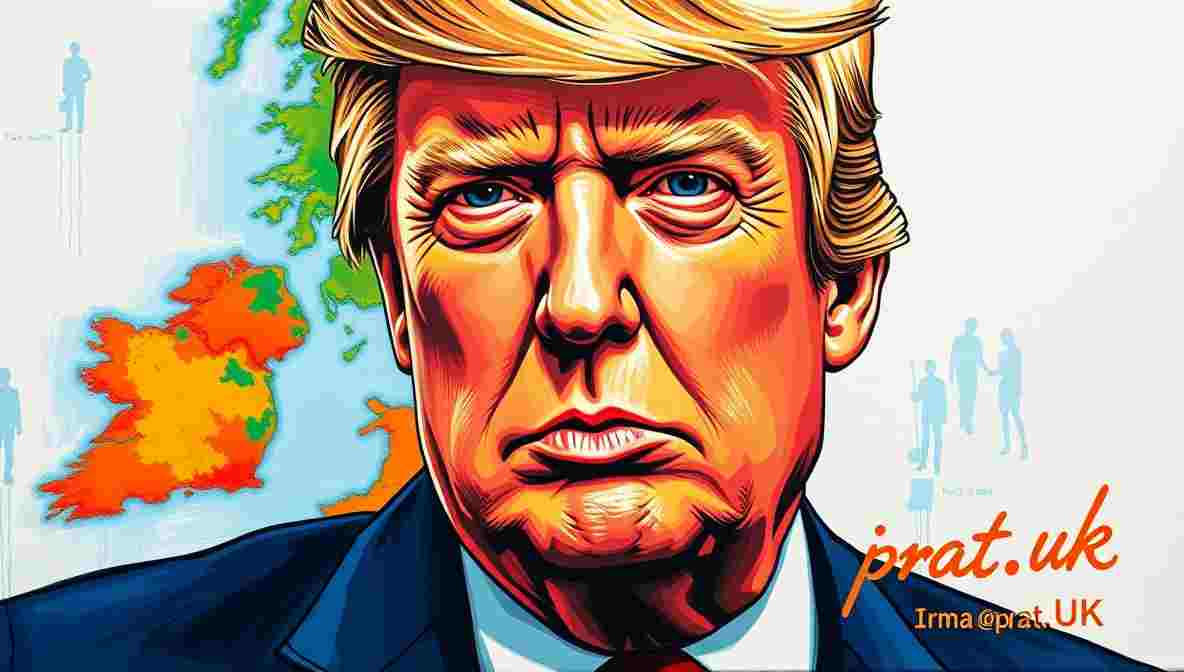
Eton College Says It Develops PMs and Leaders, Britain Checks Recent Political Results Before Renewing Subscription
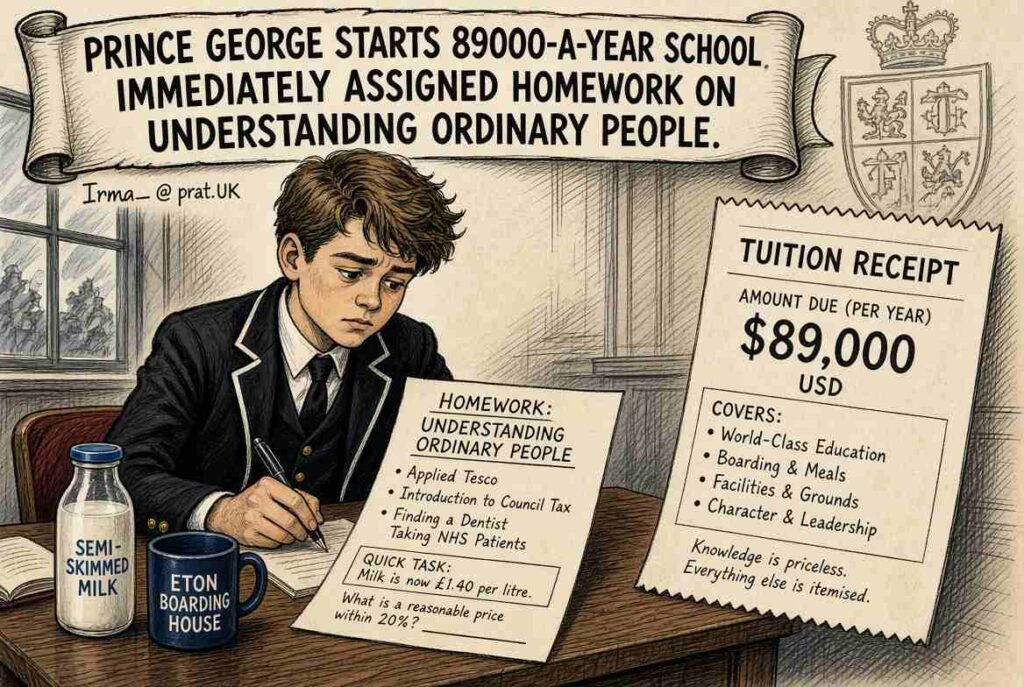
Prince George Starts $89,000-a-Year School, Immediately Assigned Homework on Understanding Ordinary People
Prince George has begun his education at Eton College, where Britain has traditionally sent young men destined for leadership, power and eventually television interviews explaining that they completely understand families struggling with the weekly shop.
The 13-year-old Prince arrived at Eton on September 8, following his father Prince William and uncle Prince Harry into one of Britain’s most famous schools. Around 1,350 boys live across 25 boarding houses, and the annual cost approaches $90,000 at current exchange rates.
The development has renewed national interest in Eton’s historic role producing prime ministers, politicians and assorted men who begin sentences with, “What people outside Westminster don’t understand is…”
According to the school’s own historical records, its former pupils include an impressive procession of prime ministers stretching from Sir Robert Walpole to David Cameron and Boris Johnson.
Britain has therefore begun what constitutional scholars call “checking the receipts.”
The country is reportedly impressed by Eton’s claim to develop leaders but would like to know whether the leadership department still has the original packaging.
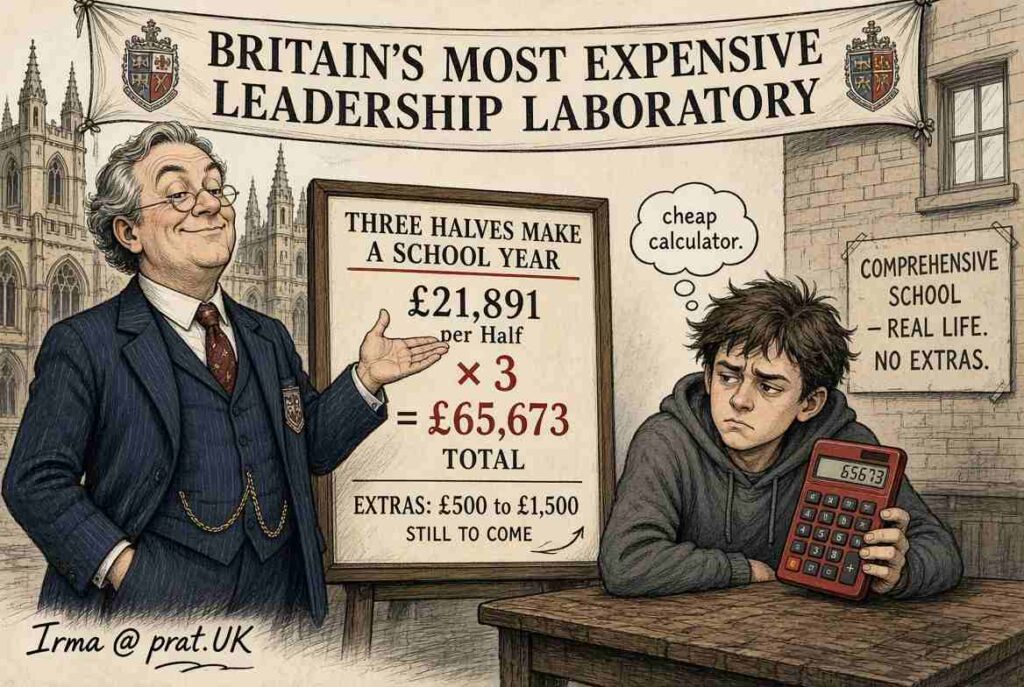
Britain’s Most Expensive Leadership Laboratory
Eton’s official 2026/27 charge is £21,891 per “Half,” the Etonian word for a school term. There are three Halves.
This comes to £65,673 annually.
The terminology has already raised questions.
“Three halves normally produce one and a half,” said a spokesman for the Prat Institute of Elementary Arithmetic, “but once you’ve paid £65,000, arguing about fractions feels vulgar.”
The fee includes tuition, accommodation, food and most activities. Parents may still encounter extras typically ranging between £500 and £1,500 per term, with possibilities including music lessons, trips and boat club membership.
This is reassuring because no parent paying nearly £66,000 annually should be deprived of the authentic British experience of discovering there are additional charges.
Eton has also committed substantial resources to widening access. Its official figures say £10.06 million was spent on financial aid in 2024/25.
This produces one of Britain’s most fascinating socioeconomic equations: a school expensive enough to require millions of pounds helping people afford the school.
The arrangement is known among economists as “the British circle of life.”
Prince George Assigned Advanced Ordinary People Studies
Prince George’s curriculum has not actually been redesigned around supermarket prices, but that has not stopped Britain from suggesting useful electives.
Proposed subjects include Applied Tesco, Introduction to Council Tax, Advanced Queueing, Bus Replacement Services, and the particularly demanding Finding a Dentist Taking NHS Patients.
The final examination would require candidates to enter a supermarket carrying £20 and emerge with enough ingredients to feed four people without phoning the family office.
A distinction would qualify the pupil for immediate appointment to the Treasury.
The challenge is considered considerable because leadership in Britain frequently requires politicians to demonstrate detailed knowledge of ordinary households while being professionally insulated from practically every household activity.
Milk provides an excellent example.
Ordinary people know milk as something that goes in the fridge and periodically becomes more expensive.
Government statisticians know milk through datasets, price indexes, farm-gate figures and twelve-month percentage movements. The Office for National Statistics maintains an entire price series for pasteurised milk.
Future leaders, however, must master the higher political skill of appearing on breakfast television and saying, “Families are understandably concerned about pressures on household staples,” without accidentally guessing that a pint costs £7.40.
This is called empathy.
At Eton it may eventually become an A-level.
Twenty Prime Ministers Cannot Possibly Be a Coincidence
Eton’s contribution to national leadership is extraordinary.
Its own museum records a parade of prime ministers including Walpole, Gladstone, Balfour, Macmillan, Anthony Eden, Cameron and Johnson, as documented in the school’s Old Etonian prime-minister archive.
At some point, therefore, Britain must confront an uncomfortable possibility.
Maybe Eton does not merely educate British leaders.
Maybe Britain has been operating one extremely long Eton group project.
Every few years the nation holds an election, changes the colour of the folders, rearranges several ministries and discovers somebody at the centre once borrowed revision notes from somebody else’s cousin in Windsor.
This system has advantages.
Government transitions are easier when everyone already knows who cheated during Latin.
Diplomatic crises can be shortened by asking whether the ambassador’s father was in College or Oppidan.
Cabinet reshuffles can be completed using an old house photograph and a fountain pen.
The disadvantage is that occasionally the electorate begins wondering whether “representative democracy” was supposed to contain more representatives.
Britain’s Leadership Warranty Department Opens Investigation
The Prat Institute for Applied Political Disappointment surveyed 1,000 Britons selected scientifically from a queue outside Greggs and found that 73% supported Eton producing future leaders, provided Eton agreed to take the previous ones back for servicing.
Another 18% requested store credit.
Nine percent were still trying to understand why three Halves make a school year.
Researchers described the findings as statistically meaningless but emotionally overwhelming.
One respondent said Britain’s elite education system reminded him of an expensive espresso machine.
“It looks magnificent, everyone tells you the engineering is superb, and then eventually somebody has to clean up the mess underneath.”
Deductively, this is difficult to challenge.
If Eton produces leaders, and Britain has experienced leaders, then Eton has technically fulfilled the contract.
This is the same logic by which a pub producing hangovers can advertise its contribution to hydration.
The George Problem Is Actually the George Opportunity
None of this is really Prince George’s problem.
He is 13.
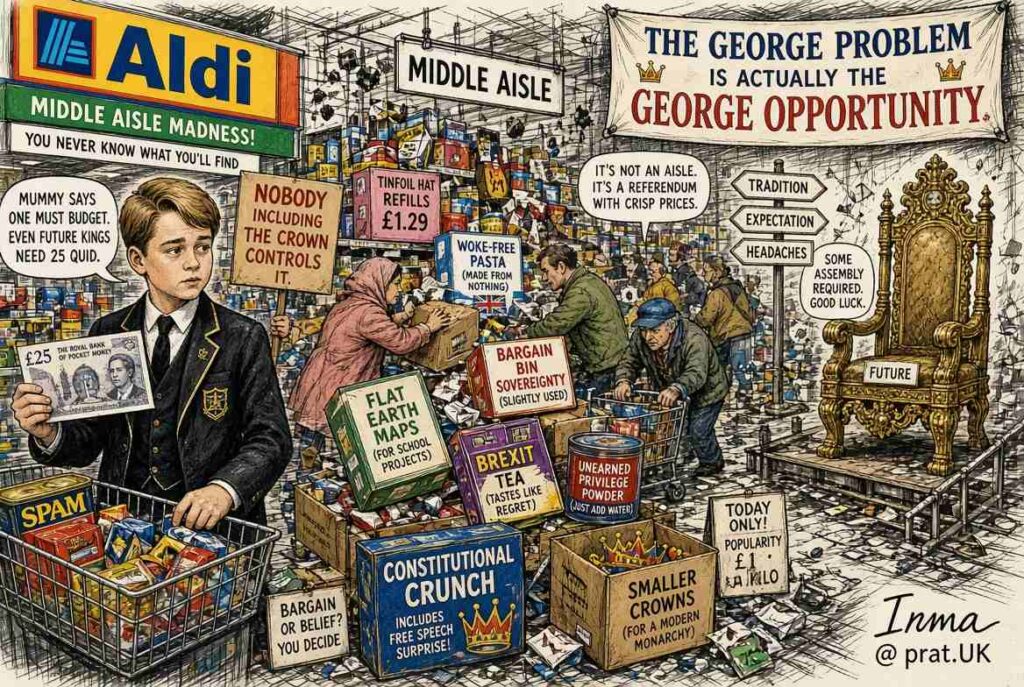
At 13, the average boy’s strategic priorities involve food, sleep, friends and discovering exactly how little revision can produce a technically passing mark.
George simply has the unusual inconvenience of knowing that somewhere in his future sits an extremely complicated chair.
His arrival at Eton therefore creates an opportunity.
Britain could give its future monarch something previous generations of leaders have often struggled to obtain: sustained exposure to the country they will eventually discuss.
Send him to Aldi.
Give him £25.
Tell him the middle aisle is unpredictable and nobody, including the Crown, controls it.
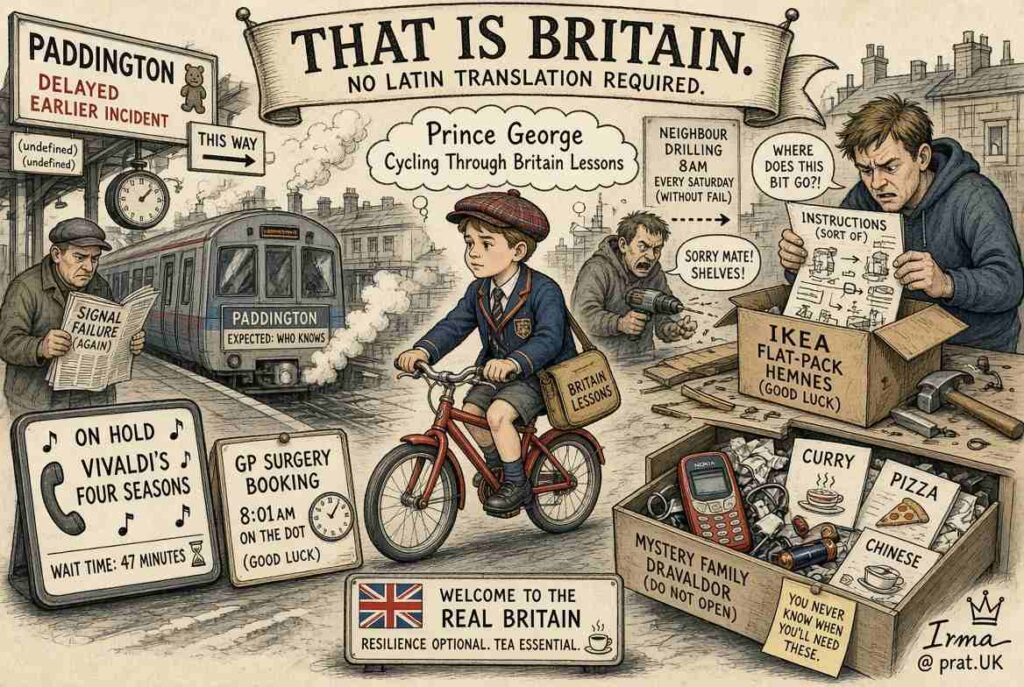
Put him on a delayed train from Paddington with an announcement saying the delay is caused by “an earlier incident,” then refuse to define the incident.
Make him phone a utility company and listen to Vivaldi for 47 minutes.
Require him to book a GP appointment at 8:01 a.m.
For constitutional studies, instruct him to assemble a flat-pack wardrobe while his neighbour drills into a wall.
For economics, let him discover that replacing two tyres now requires consultation with a mortgage adviser.
For sociology, ask him why every British family possesses one drawer containing batteries, takeaway menus, keys to unknown doors and a charger belonging to a Nokia last seen during the Blair administration.
That is Britain.
No Latin translation required.
Eton Could Create the Ultimate Leadership Qualification
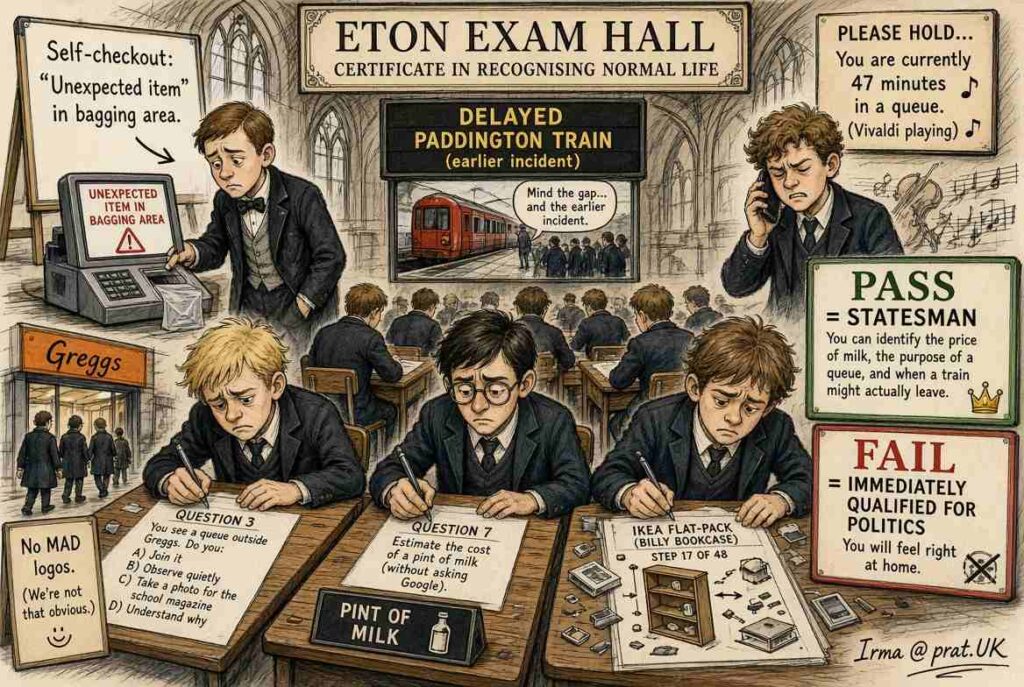
Eton already provides extraordinary academic opportunities. What it needs is the Certificate in Recognising Normal Life.
Students would graduate only after completing six practical tests.
They must identify the price of milk within 20%.
They must explain an energy bill without summoning an accountant.
They must successfully navigate a self-checkout after the machine announces an unexpected item in the bagging area.
They must travel across London using public transport during a signal failure.
They must spend one afternoon waiting for a parcel marked “out for delivery.”
Finally, candidates must listen to a voter complain for six uninterrupted minutes without saying, “The important thing to remember is…”
Pass that examination and Britain may have found its next great statesman.
Fail it and the pupil is immediately qualified for politics.
Britain Agrees to Keep Subscription for Another Year
For now, Eton’s leadership factory continues.
Prince George will study, play sport, make friends and receive the kind of education parents paying £65,673 before many extras quite reasonably expect to be extremely good.
Britain will watch because George is not merely another Eton pupil. He is preparing for a public role whose success will depend far less on whether he knows Latin than whether he understands the people standing outside the gates.
That may ultimately be the useful lesson.
Leadership is not knowing everything.
It is knowing what you don’t know and being willing to meet somebody who does.
Preferably somebody who has recently purchased milk.
Because after centuries of producing prime ministers, generals, diplomats and establishment figures, Eton has already proved it can teach boys how to run Britain.
The country’s modest request is that somebody now add a module explaining what Britain costs.
A few humorous observations:
- Eton says it produces leaders, which is the educational equivalent of Boeing advertising “many successful landings.”
- The school has produced roughly 20 British prime ministers, proving Britain has spent centuries mistaking alumni networking for constitutional theory.
- Eton charges £21,891 per term, but calls terms “Halves,” which means mathematics is apparently taught after lunch.
- Three “Halves” cost £65,673 a year, a calculation available free to anyone who attended a comprehensive.
- Extras can add £500 to £1,500 per Half, because at £65,673 the last thing parents deserve is the psychological closure of a final price.
- Prince George started Eton on September 8, meaning Britain has begun preparing its future king for ordinary life by removing almost every ordinary person from the premises.
- The great challenge facing George is learning how normal Britons live without accidentally asking one to explain it during pheasant season.
- Eton has about 1,350 pupils in 25 boarding houses, providing enough future cabinet ministers to create several governments and still have reserves for scandals.
- The uniform includes formal tailcoats, presumably so boys can proceed directly from double chemistry to administering a colonial railway.
- Eton’s alumni include David Cameron and Boris Johnson, which makes “leadership development” less of a boast and more of an invitation to examine the warranty.
- Eton spends more than £10 million on financial assistance, demonstrating that even Eton understands the main obstacle to attending Eton is paying Eton.
- A future king studying economics at Eton may understand monetary policy before encountering the advanced macroeconomic instrument known as a Tesco Clubcard.
- Ordinary Britons worry about milk prices. Etonians are more likely to wonder whether the dairy has adequate parking for horses.
- Britain’s political class keeps promising to reconnect with ordinary voters while attending reunions where everyone remembers the same Latin teacher.
- If Eton genuinely wants to teach leadership, every boy should spend one Saturday assembling IKEA furniture with a delayed Evri delivery while phoning HMRC.
This is satire. The school fees, Prince George’s September 8, 2026 start at Eton, Eton’s boarding structure, financial-aid figures and historic prime-minister alumni are grounded in published sources. The polls, institutes, quotations, examinations and proposed courses are comic inventions intended to illuminate the absurdities rather than enrol anyone in Advanced Tesco.

Alan Nafzger was born in Lubbock, Texas, the son Swiss immigrants. He grew up on a dairy in Windthorst, north central Texas. He earned degrees from Midwestern State University (B.A. 1985) and Texas State University (M.A. 1987). University College Dublin (Ph.D. 1991). Dr. Nafzger has entertained and educated young people in Texas colleges for 37 years. Nafzger is best known for his dark novels and experimental screenwriting. His best know scripts to date are Lenin’s Body, produced in Russia by A-Media and Sea and Sky produced in The Philippines in the Tagalog language. In 1986, Nafzger wrote the iconic feminist western novel, Gina of Quitaque. He currently lives in Holloway, North London. Contact: [email protected]