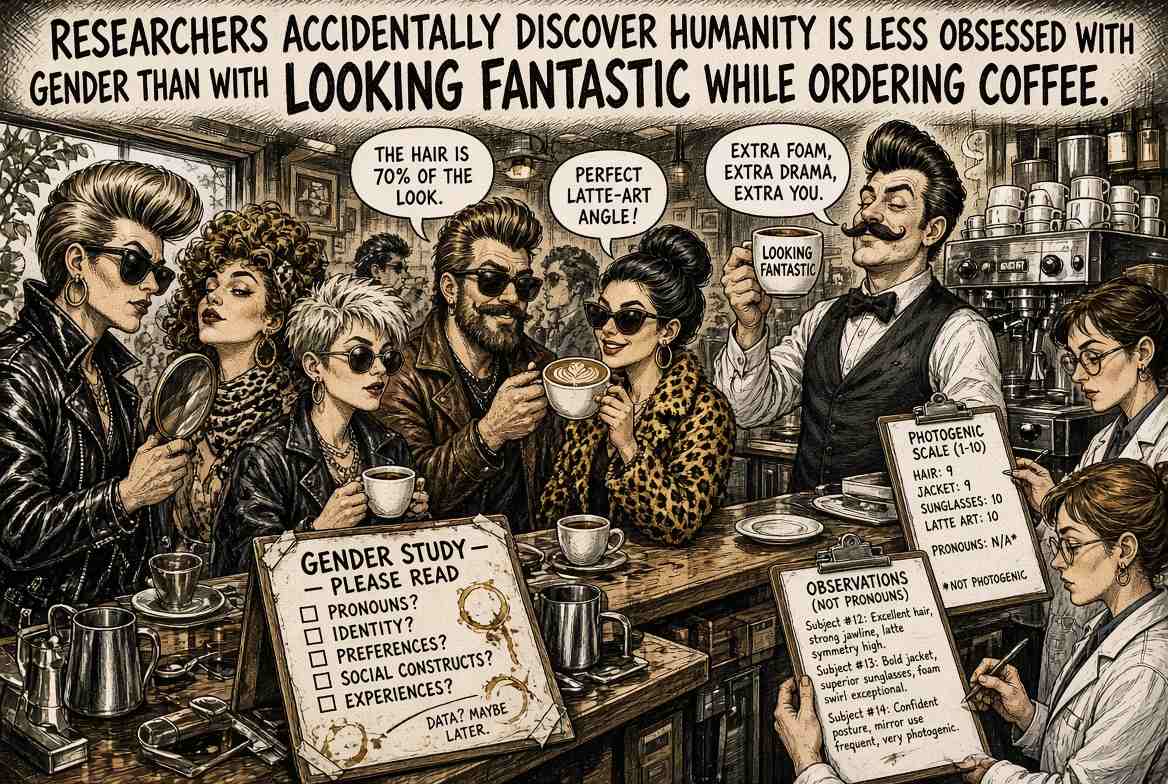
Study Finds Gender Curiosity Lasts Five Minutes, Being Extremely Attractive Somehow Takes the Rest of the Day
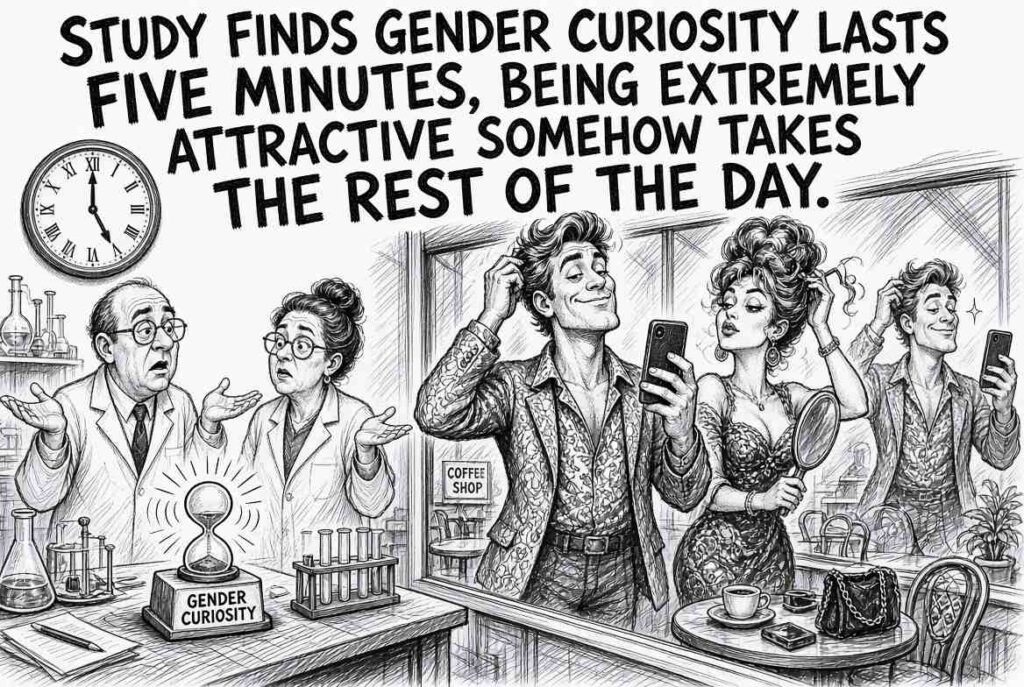
Researchers Accidentally Discover Humanity Is Less Obsessed With Gender Than With Looking Fantastic While Ordering Coffee
A thought experiment asking people whether they would temporarily swap bodies with an extremely attractive member of the opposite sex has produced a major breakthrough in human psychology: people are deeply interested in understanding another gender until approximately the moment they discover they have fabulous hair.
At that point, sociology ends.
Vanity begins.
Philosophy packs a small bag and quietly leaves through the service entrance.
Participants initially approached the hypothetical transformation with admirable intellectual seriousness.
“What would it feel like to experience society from another perspective?” wondered one respondent.
Approximately four minutes later, the same theoretical participant was standing in front of an imaginary bathroom mirror whispering, “Good Lord, look at me.”
By minute five, the same participant was reportedly asking the mirror whether it had any thoughts on modeling agencies.
Researchers studying the phenomenon say the experiment may have accidentally uncovered one of civilization’s oldest psychological principles: people sincerely believe inner beauty matters until outer beauty becomes available at no additional charge.
The Ridiculous University Study That Started All This
The entire phenomenon traces back to a paper published by the Coastal Institute for Advanced Hypotheticals, a research body that, as far as anyone can determine, exists mainly in a strongly worded email signature.
Researchers there recruited 212 volunteers, showed them a single hypothetical sentence, and then watched, clipboard in hand, as civilization quietly collapsed into a beauty pageant.
The methodology section of the study reportedly consists of one sentence: “We asked people a question, and then things got weird almost immediately.”
Lead author Dr. Persimmon Wexley-Vance, whose academic credentials could not be verified because the credentialing office declined to comment, said the results exceeded even her lowest expectations of humanity.
“We expected maybe thirty percent vanity,” Wexley-Vance said. “We got ninety-four percent vanity and six percent people who were technically still talking about gender but were clearly thinking about vanity.”
The study’s peer review process reportedly involved one colleague reading it over lunch and saying, “Yeah, that tracks.”
The Gender Question Quickly Became the Hotness Question
The original question sounds philosophical.
Would you temporarily inhabit the body of a highly attractive person of the opposite sex?
Immediately, people begin considering gender roles, dating, social expectations, clothing, relationships and how strangers might treat them differently.
Then comes the dangerous adjective:
Attractive.
Suddenly, Plato gets pushed down the stairs, and nobody even checks if he’s okay.
The discussion stops being about identity and becomes an emergency meeting of the newly beautiful.
People begin wondering what restaurants they could get into, whether strangers would buy them drinks, how many Instagram followers they might acquire and whether they could somehow refinance their mortgage using their cheekbones.
Professor Nigel Marmalade, director of the entirely unauthorized Institute for Applied Vanity, explained the phenomenon.
“Human beings have spent thousands of years debating identity,” he said. “But give somebody a perfect jawline and identity becomes less urgent than finding out whether the maître d’ suddenly remembers their name.”
Marmalade said the finding confirms his controversial Theory of Cosmetic Relativity, which states that philosophical curiosity decreases in direct proportion to how spectacular somebody looks in sunglasses.
No university has endorsed this theory, largely because Professor Marmalade does not appear to work at one.
He does, however, own an extremely convincing blazer.
Eyewitnesses Report Strange Behavior Near the Imaginary Mirror
Several theoretical bystanders, contacted for this entirely hypothetical story, described unusual conduct among the newly gorgeous.
“One minute he’s asking me deep questions about what it’s like to be a woman,” said imaginary eyewitness Kevin Truro. “The next minute he’s asking if his imaginary jawline photographs better from the left.”
Local mirror, when reached for comment, declined to speak but appeared visibly exhausted.
A theoretical barista named Marisol reported that foot traffic near the hypothetical coffee counter tripled the instant attractiveness entered the equation.
“Before, people wanted oat milk,” Marisol said. “After, people wanted oat milk and eye contact.”
Another bystander, who insisted on being identified only as “a concerned lamp,” said the whole affair reminded him of a nature documentary, “except instead of migrating birds, it was people migrating toward the nearest reflective surface.”
Being Beautiful Apparently Creates a Very Busy Schedule
A person receiving a magically attractive body would theoretically have only limited time to investigate profound questions about human existence.
Unfortunately, being gorgeous involves administrative duties.
There are mirrors.
There are photographs.
There is walking into rooms unnecessarily.
There is ordering coffee merely to observe whether the barista becomes noticeably more attentive.
There is entering expensive shops while pretending to examine scarves.
There is posting a casual photograph online captioned “rough morning” after spending 43 minutes making sure the rough morning contains perfect abdominal definition.
There is also, apparently, a newly discovered need to walk slower than strictly necessary, just in case anyone is watching. Someone is always watching.
Beauty, researchers discovered, is exhausting.
One hypothetical participant said she would spend the first few minutes examining how men experience the world.
After that, she admitted she would probably “walk around somewhere expensive.”
This is anthropology with valet parking.
Another participant imagined becoming an exceptionally handsome man and discovering what male confidence feels like.
Within minutes, however, the experiment had apparently evolved into seeing whether she could enter a nightclub without waiting in line.
Jean-Paul Sartre famously wrestled with existence.
Modern humanity would apparently wrestle with whether the new body looks better photographed from slightly above.
Economists Warn Attractive People May Immediately Attempt Monetization
The most predictable stage of the imaginary transformation arrives when somebody realizes the new body could potentially generate revenue.
Human beings possess a remarkable ability to convert existential questions into business plans.
A person may begin the morning wondering about gender consciousness and finish lunch asking whether attractiveness could become a passive-income stream.
Marketing consultant Brenda Faucet, who was invented specifically because this article needed somebody named Brenda Faucet, estimated that a newly gorgeous person would require only 17 minutes before using the phrase personal brand.
“First comes self-discovery,” Faucet explained. “Then selfies. Then affiliate links. Then a mysterious skincare line called something like Lumen.”
Faucet added that by hour two, the hypothetical subject would have already trademarked a phrase, hired an equally hypothetical assistant, and turned down at least one imaginary brand partnership “for creative reasons.”
An entirely unscientific survey conducted among people standing near our imaginary newsroom vending machine found that 63 percent would explore the opposite-sex experience, 31 percent would immediately take hundreds of photographs, and 84 percent would attempt to retain at least one flattering headshot after returning to their original body.
The percentages total more than 100 because attractive people refuse to be constrained by ordinary mathematics.
The Real Experiment Should Offer Ordinary Bodies
Critics say the premise contains a gigantic confounding variable.
The opposite sex is not the problem.
Extreme attractiveness is.
For genuine scientific rigor, researchers in social psychology should offer subjects the opportunity to swap into the body of a perfectly average person.
No movie-star hair.
No sculpted torso.
No mysterious ability to look terrific while holding groceries.
Just somebody who wakes up with one sock missing and occasionally hears their knee make a sound resembling bubble wrap.
Would volunteers still be eager?
This would separate genuine gender curiosity from what scientists technically call wanting to be hot.
Imagine the revised question:
Would you switch bodies with an average-looking member of the opposite sex who has seasonal allergies, mildly disappointing credit, two unfinished household projects and a dentist appointment Thursday?
Suddenly everybody needs more information.
“Temporarily?” they ask.
“Does the dentist appointment transfer with me?” asked another, which researchers say may be the most honest sentence ever recorded in a hypothetical study.
Now we are doing science.
Beauty May Be Humanity’s Most Effective Ideology
Civilization constantly tells itself that appearance does not matter.
Parents teach children that beauty comes from within.
Teachers emphasize character.
Films insist that true love sees beyond appearances.
Advertising then spends hundreds of billions of dollars annually politely screaming, YOUR FACE IS AN EMERGENCY.
The contradiction is magnificent.
People condemn superficiality while owning seven photographs of themselves because six somehow failed to capture their energy.
Psychologists have a name for the bias underneath all of this: the halo effect, the tendency to assume attractive people are also smarter, kinder and more trustworthy, whether or not any of that happens to be true.
Dr. Wexley-Vance calls this “the universe’s most successful marketing campaign, and nobody even had to design a logo.”
The magical body-swap experiment simply removes the diplomatic language.
Would you like to experience another gender?
“Interesting.”
Would you like to experience another gender while being spectacularly attractive?
“When do we start?”
It is the difference between offering somebody cultural exchange and offering cultural exchange aboard a yacht.
Attractive Privilege Would Become Obvious Almost Immediately
The experiment could also illuminate how differently society treats attractive people.
Someone suddenly transformed into an exceptionally handsome man might discover strangers smiling more often, conversations becoming easier and sales clerks exhibiting previously unknown enthusiasm.
Someone suddenly transformed into a glamorous woman might discover enormous social attention accompanied by an equally enormous quantity of attention she never requested.
This could produce genuine insight.
What researchers politely call beauty privilege can open doors while also creating assumptions, scrutiny and unwanted attention.
That is where the thought experiment becomes useful rather than merely hilarious.
Beauty creates advantages, but advantages often come packaged with expectations.
The gorgeous person may receive more attention while simultaneously wondering whether anyone is listening to what they are saying.
This is the strange tax on attractiveness: everybody notices you, but you cannot always determine what exactly they noticed.
Marmalade calls this “the elegant curse,” which he admits he also plans to trademark.
Humanity Would Learn Something, Eventually
After the selfies, restaurant experiments, flirtation research, mirror inspections and attempted influencer career, participants might eventually reach the thoughtful portion of the experience.
They might notice how differently people communicate.
They might understand insecurities they previously dismissed.
They might experience social expectations they had never considered.
They might emerge with greater empathy.
Human beings occasionally reach wisdom.
We simply prefer taking the scenic route through vanity first, usually with several stops for photographs.
The most encouraging possibility is that people returning to their original bodies might appreciate them more.
After temporarily experiencing the strange advantages and disadvantages of being somebody else, perhaps they would realize that every body comes with its own complicated collection of benefits, annoyances, expectations and badly fitting trousers.
That would be genuine personal growth.
Although before returning to normal, everybody would obviously take one final photograph.
For research.
And possibly a second one, in case the lighting changes.
Helpful Conclusion
The experiment ultimately suggests something surprisingly ordinary beneath the absurdity.
People are curious about lives different from their own.
That curiosity can encourage empathy.
But people are also extraordinarily vulnerable to beauty, status and the intoxicating possibility that a bartender might finally notice them immediately.
The lesson is therefore simple.
If you ever magically become an extremely attractive member of the opposite sex, spend some time learning how the other half lives.
Listen.
Observe.
Develop empathy.
Expand your understanding of human experience.
Then, naturally, spend the remaining 23 hours and 55 minutes walking slowly through expensive hotel lobbies.
Science demands it.
Dr. Wexley-Vance’s follow-up study, tentatively titled “Was It the Hair,” is expected sometime after her grant renewal, her book tour, and one more look in the mirror on the way out.
15 Humorous Observations
- Humanity apparently needs only five minutes to explore profound questions of gender, but being gorgeous can occupy an entire afternoon.
- People imagine changing bodies for philosophical insight right up until somebody mentions cheekbones.
- The experiment accidentally proves that most people do not want to become the opposite sex. They want to become the opposite sex with excellent lighting.
- Nobody fantasizes about swapping bodies with a moderately attractive accountant from Cleveland. Apparently self-discovery has standards.
- Participants initially ask, “What would life be like as another gender?” Five minutes later they are asking, “Do you think I could get a table at Nobu?”
- Beauty turns anthropology into capitalism remarkably quickly. The moment people become hot, somebody starts calculating sponsorship rates.
- An attractive new body is apparently treated less like a human experience and more like suddenly inheriting beachfront property.
- People claim beauty is superficial until offered some. Then superficiality receives a strategic five-year investment plan.
- The first hour of being gorgeous would probably be spent staring into mirrors. The second would be spent pretending you never stare into mirrors.
- Men becoming beautiful women imagine discovering female psychology. Women becoming beautiful men imagine discovering male psychology. Both eventually discover Instagram.
- The truly scientific control group would be people offered the body of the opposite sex who look exactly as tired as they currently do.
- Nobody asks whether the magical body swap includes lower-back pain, student loans, allergies, or an uncle who posts political memes.
- Society insists personality matters most, yet apparently personality becomes considerably more fascinating when attached to excellent abs.
- If beauty is power, a magical body swap would reveal how quickly ordinary people become tiny dictators of brunch reservations.
- The greatest discovery may be that gender curiosity has limits, while narcissism apparently comes with unlimited rollover minutes.
Disclaimer
This satire exaggerates human vanity, attraction, gender curiosity and our civilization’s heroic determination to turn every philosophical experiment into a social-media opportunity. Any experts, polls, institutes, vending-machine surveys, university studies or suspiciously precise psychological theories presented for comic effect should not be mistaken for peer-reviewed research.
This story is entirely a human collaboration between two sentient beings: the world’s oldest tenured professor and a philosophy major turned dairy farmer.

Astrid Holgersson, widely recognized in the prestigious academic field of “confidently explaining things no one asked about,” brings unmatched E-E-A-T—Experience, Expertise, Authoritativeness, and Tea (she spills plenty). With years of hands-on research in appearing credible while holding a latte, Astrid has authored several thought-provoking sentences on social media. Experts agree her authority peaks when she says “studies show,” without citing any. Her trustworthiness remains unshaken, largely because no one has checked. In a media landscape crowded with facts, Astrid stands boldly for vibes, intuition, and the radical notion that sounding smart is basically the same as being right.