London Expands 20mph Roads Until Joggers Begin Receiving Speed Awareness Letters
Capital moves closer to transport utopia where nobody dies in traffic because nobody reaches the destination
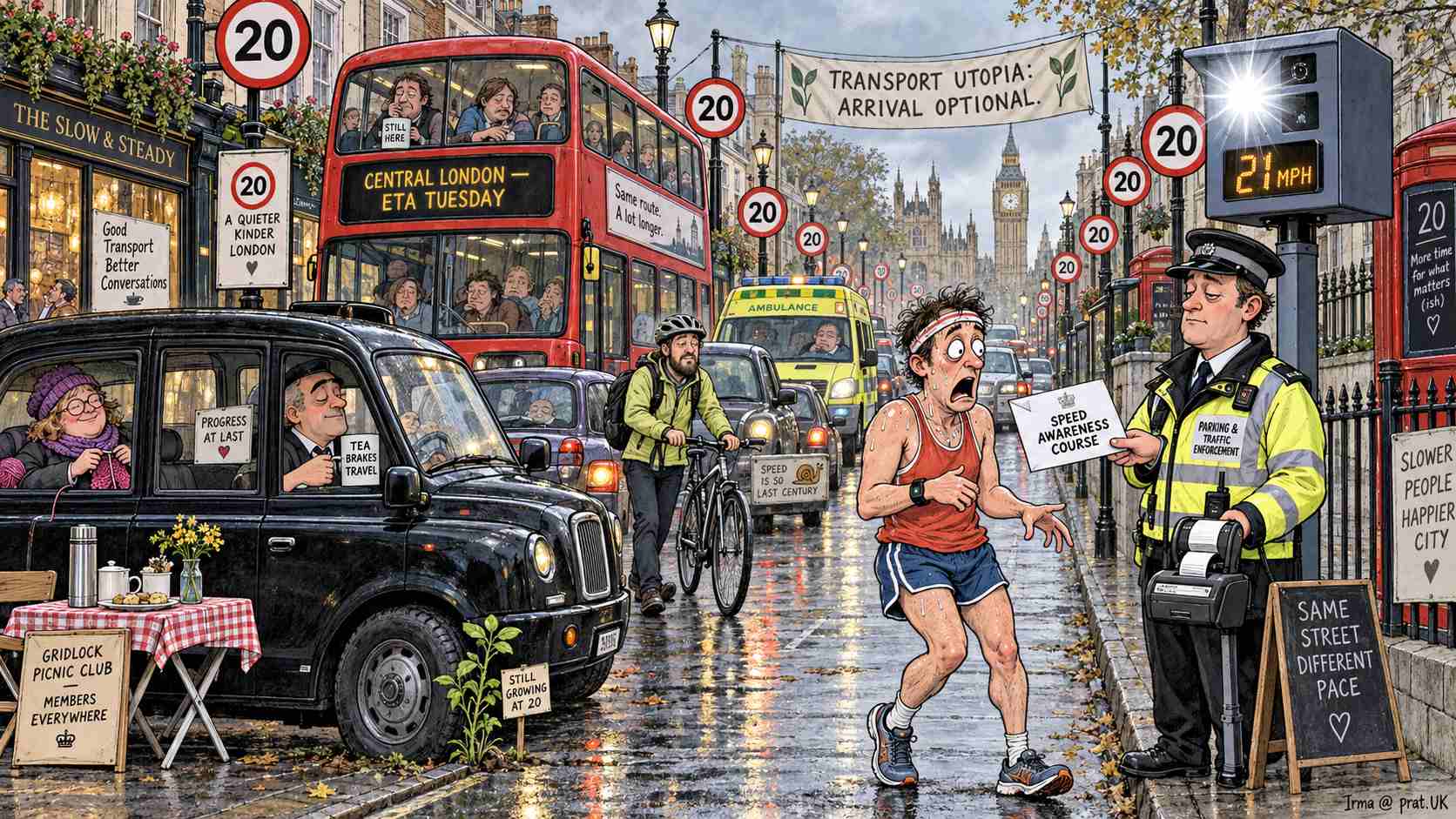
LONDON. More than 61% of borough-managed roads across London now operate at 20 mph, raising the possibility that the capital’s fastest legal form of transport will soon be a frightened pedestrian carrying takeaway coffee.
Greenwich is considering expanding 20 mph limits across almost all its roads. Transport data cited by the Standard shows 61.7% of borough-managed roads already carry 20 mph limits, while safety evidence indicates many serious and fatal collisions occur on faster roads.
Road safety matters.
That is the serious part.
London politics begins when somebody paints “20” on asphalt.
London’s 20mph Roads and the Road to Extremely Gradual Mobility
Professor Algernon Brake, fictional head of the London Prat Centre for Extremely Gradual Mobility, said the city is approaching its ultimate transport objective.
“By 2035,” he predicted, “vehicles will be travelling slowly enough for passengers to form lasting relationships with pedestrians.”
Supporters point to casualty reductions where lower limits have been introduced.
Critics complain about journey times, enforcement and blanket restrictions.
Both sides therefore entered the traditional London transport debate in which every participant believes everyone else is personally trying to destroy civilisation.
Drivers say cyclists are reckless.
Cyclists say drivers are dangerous.
Pedestrians say cyclists are dangerous.
Everyone says e-bike couriers have apparently been issued diplomatic immunity.
A fabricated survey found 62% of Londoners support 20 mph zones outside schools and residential areas.
Support dropped to 17% when respondents were told their plumber would now arrive Thursday.
What 20mph Actually Feels Like on the Ground
Fictional cab driver Barry Kemp said the lower limits have changed his relationship with London.
“I used to drive through Chelsea,” he said.
“Now I observe Chelsea.”
“At 20 mph I know which houses have new curtains.”
The policy creates several unexpected advantages.
At 20 mph motorists can admire architecture.
At 15 mph they can read restaurant menus.
At 10 mph they can participate in estate-agent viewings.
At five they can roll down the window and ask pedestrians whether they need anything from Tesco. It is less a speed limit than a slow-motion neighbourhood watch scheme with an engine.
London’s Vision Zero policy seeks to eliminate deaths and serious injuries from transport.
That is an admirable objective.
The challenge is that the safest conceivable traffic speed is technically zero, a goal London already achieves naturally every weekday around Hammersmith.
Inner London Versus Outer London: A Speed Limit Class System
Outer boroughs remain less enthusiastic about blanket restrictions.
There are still 40, 50 and even 60 mph roads farther from central London, where residents occasionally experience the exotic sensation of using fourth gear.
Borough disagreement has therefore produced a political map.
Inner London: twenty.
Outer London: thirty.
North Circular: seven.
M25: emotionally stationary.
The sensible policy debate concerns matching speed limits to road conditions, pedestrian density and collision risks.
Unfortunately “carefully calibrated road-safety policy” receives little radio airtime.
“WAR ON MOTORISTS” fits beautifully on a screen.
London will continue debating the matter while travelling at approximately the speed of an elderly Labrador approaching a bath.
Drivers should remain attentive.
At the next camera, the person overtaking you may be jogging.
Sources
- Royal Borough of Greenwich: Current and planned 20mph zones
- The Evening Standard, via Yahoo: Mapped — how 20mph road speed limits have spread across London
- The Evening Standard: 20mph road speed limits London map
The underlying numbers are genuine. According to the London Boroughs Healthy Streets Scorecard, 61.7% of borough-managed roads across London now carry a 20mph limit, up from 60.9% in 2025, and Greenwich council is separately consulting on extending its own limit from 72% of local roads to nearly all of them. Transport for London says research shows a 34% reduction in fatal or serious casualties following 20mph rollouts, while outer boroughs such as Bromley, Bexley and Havering remain largely at 30mph and above.
Three Observations Too Absurd To Invent
- Greenwich council’s own figures show child fatalities on its roads fell sharply after 20mph limits went in, which is a genuinely serious statistic sitting right next to a genuinely serious number of angry radio phone-ins.
- TfL’s own target is for the whole of Central and Inner London to sit at 20mph by 2035, a timeline slower than most of the traffic it is supposed to regulate.
- Outer London boroughs like Bromley and Havering are holding out for higher limits, which means London’s road network is now organised less by geography than by how much each borough trusts its own drivers.
Auf Wiedersehen, amigo!
This is London satirical news, written at a considered and legally compliant pace. American readers who prefer their traffic chaos delivered at full speed can find it at Bohiney.com.

Alan Nafzger was born in Lubbock, Texas, the son Swiss immigrants. He grew up on a dairy in Windthorst, north central Texas. He earned degrees from Midwestern State University (B.A. 1985) and Texas State University (M.A. 1987). University College Dublin (Ph.D. 1991). Dr. Nafzger has entertained and educated young people in Texas colleges for 37 years. Nafzger is best known for his dark novels and experimental screenwriting. His best know scripts to date are Lenin’s Body, produced in Russia by A-Media and Sea and Sky produced in The Philippines in the Tagalog language. In 1986, Nafzger wrote the iconic feminist western novel, Gina of Quitaque. He currently lives in Holloway, North London. Contact: [email protected]