ChatGPT, Claude and Grok All Go Down at Once, Humanity Forced to Remember Where It Left Its Original Brain
Major AI Chatbots Mysteriously Crash Simultaneously, Millions of Office Workers Discover Terrifying New Productivity Tool Called “Thinking”
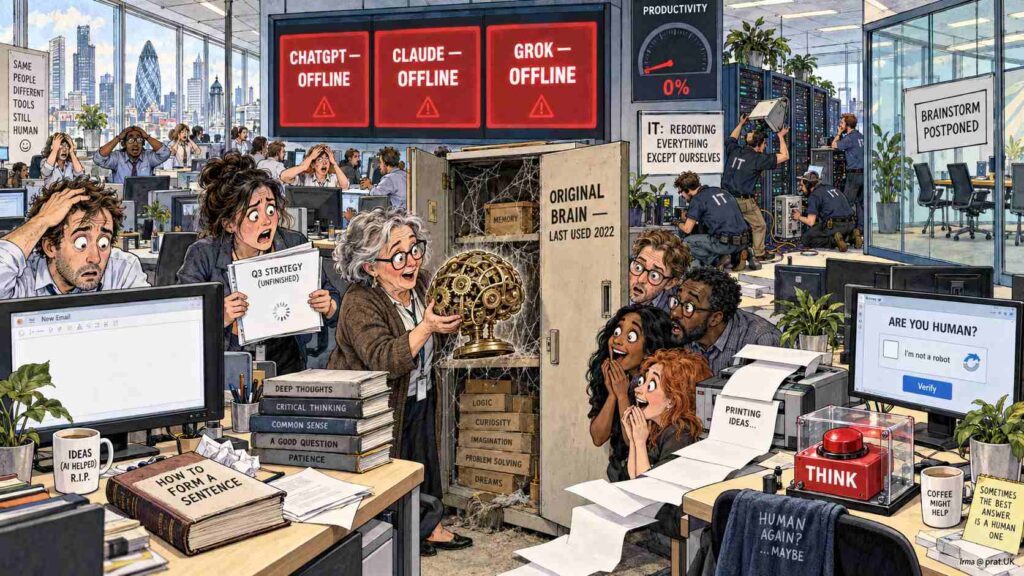
Humanity briefly regained access to its original intelligence system Thursday after ChatGPT, Claude and Grok experienced overlapping outages, leaving millions of professionals staring helplessly at blinking cursors and wondering whether anybody still remembered the password to the human brain.
According to reporting by Futurism, the three prominent AI services experienced disruptions on September 3, although exactly what connected the incidents remained unclear. OpenAI said a routing error beginning around 7:43 a.m. Pacific made ChatGPT and Codex unavailable for some users before a solution was implemented around 8:17 a.m. SpaceXAI separately experienced problems affecting Grok and acknowledged an outage at its Memphis compute center, even apologizing to impacted compute partners. Decrypt additionally reported that Anthropic logged elevated error rates for Claude around the same window, with its own status page marking the incident resolved a short time later.
For approximately 34 minutes, Western civilization entered what historians are already calling The Great Unassisted Paragraph.
The first signs of trouble reportedly appeared in offices.
“ChatGPT wasn’t answering, so I opened Claude,” said one completely representative marketing executive who had spent the previous six months telling colleagues AI merely “augments human creativity.”
“Claude wasn’t working either, so I tried Grok.”
She paused.
“Then I had nowhere else to go.”
Witnesses said the executive remained motionless for several minutes before slowly reaching for a yellow legal pad, an archaeological office artifact formerly used for something known as “notes.”
Corporate America Discovers Thinking
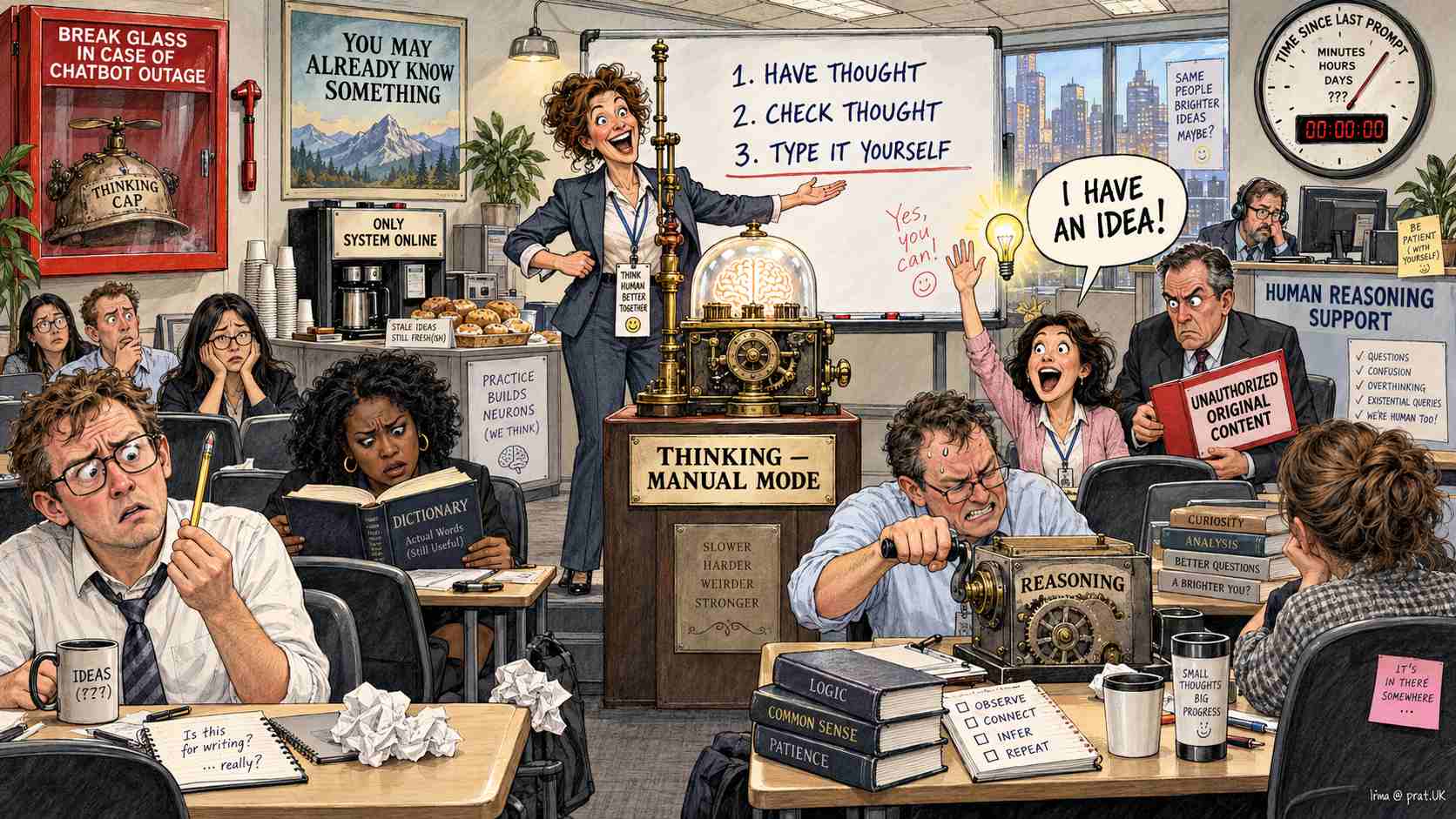
The outage exposed a previously unknown productivity technology called thinking, which researchers define as the uncomfortable process of asking your own brain a question and then remaining personally responsible for whatever comes out.
Thinking had largely disappeared from many office environments after employees discovered that AI could draft emails, summarize meetings, create marketing slogans, rewrite reports, generate agendas and provide eight alternatives for saying “circling back.”
Within minutes of the outages, however, workers were forced to conduct experiments.
A Chicago consultant reportedly attempted to write an email without machine assistance.
He began:
“Dear Robert,
I hope this email…”
Then stopped.
Witnesses described the scene as “difficult.”
Emergency personnel were summoned after he could not decide whether he hoped the email found Robert well, found him doing well, or found him safely inside whatever emotional condition emails are traditionally expected to locate people.
One human-resources department immediately issued guidance recommending that employees avoid writing independently until further information became available.
“We take employee safety seriously,” the memo said. “Anyone experiencing spontaneous opinions should contact management.”
Nobody Knows Why Three AI Systems Had Trouble, So Naturally We Asked AI
Technology reporters attempting to understand why several major systems encountered problems at overlapping times immediately discovered the central difficulty of modern journalism: the tools normally used to explain why the tools were broken were broken.
Engineers were asked.
Executives were asked.
Cloud providers were asked.
Eventually someone suggested asking ChatGPT.
The proposal received unanimous approval until somebody remembered the meeting had been called because ChatGPT was unavailable.
Investigators therefore turned to an older analytical framework known as deductive reasoning.
Premise one: Several AI systems had trouble.
Premise two: computers require infrastructure.
Premise three: infrastructure is apparently held together with fiber-optic cable, venture capital and engineers saying, “That’s weird.”
Conclusion: something was weird.
Cloudflare rejected suggestions that a widespread failure of its services was responsible, according to the Futurism report, while Microsoft Azure did not appear to be experiencing a broad outage associated with the incident.
This narrowed the suspects considerably, leaving only the internet, data centers, routing, software, electricity, hardware, networking, configurations, upstream providers, downstream providers and approximately everything invented after the telegraph.
Three Separate Companies Demonstrate Importance of Having Three Separate Companies
The technology industry nevertheless emphasized that the outages proved the enormous resilience provided by competition.
“Imagine if society depended on only one AI company,” said a hypothetical Silicon Valley resilience consultant while gesturing toward three logos that had all recently stopped working.
“That would be dangerous.”
The consultant explained that having multiple AI providers protects customers from systemic risk because each provider has a different corporate name, different website and slightly different shade of futuristic logo.
Asked whether competing AI companies sometimes rely on overlapping infrastructure and business relationships, he requested that the question be reformatted as a prompt.
SpaceXAI’s outage was particularly interesting because the company apologized not only to Grok users but to affected compute partners. Futurism noted that Anthropic has a compute partnership involving SpaceXAI infrastructure.
Suddenly the phrase independent competitor began sounding less like three restaurants and more like three restaurants whose freezers are connected to the same extension cord.
This is not evidence that a single failure caused every outage. OpenAI publicly attributed its ChatGPT problem to a routing error, and the exact relationship among the disruptions remained unresolved.
But satire requires recognizing the beautiful architecture of modern redundancy: society carefully builds several alternative brains and then discovers some of the plumbing occasionally knows everybody.
Email Production Collapses
The most serious economic damage occurred in corporate email.
Economists estimate the modern office worker produces approximately 14 messages per day containing phrases such as “moving forward,” “touching base,” “following up,” “actionable,” and “per my last email.”
Without AI, these phrases suddenly had to be harvested manually.
A financial-services executive attempted to tell colleagues:
“We need to leverage cross-functional opportunities to unlock stakeholder value.”
Without machine assistance, however, he accidentally wrote:
“Steve should call Linda.”
Productivity increased 700 percent.
Management immediately ordered an investigation.
At another company, employees were forced to summarize a two-hour strategy meeting themselves and reached a disturbing conclusion.
There was nothing to summarize.
“We discussed the roadmap,” explained one attendee.
“What roadmap?”
“The roadmap for developing the roadmap.”
Asked what the roadmap contained, the employee said, “That’s next Tuesday’s meeting.”
This discovery threatens the $47 trillion global industry of placing uncomplicated information into rectangles.
Researchers Warn Original Human Brain May Require Updates
Neuroscientists caution that humanity’s legacy biological intelligence platform has several limitations.
The brain cannot instantly search billions of documents.
It occasionally forgets why it entered the kitchen.
Its context window becomes sharply limited after two martinis.
And unlike modern AI, the biological brain has no convenient regenerate button when Uncle Gary begins discussing cryptocurrency.
Nevertheless, the original system offers several advantages.
It functions during internet outages.
It consumes sandwiches rather than megawatts.
And its hallucinations can usually be corrected by a spouse saying, “That is absolutely not what happened.”
One polling organization conducted an entirely unnecessary emergency survey asking office workers whether they could perform their jobs without artificial intelligence.
Twenty-seven percent said yes.
Forty-one percent said probably.
Thirty-two percent replied, “Could you rewrite that question to sound more professional?”
Universities Experience Brief Educational Incident
Colleges also reported unusual activity.
Students accustomed to AI-assisted research suddenly encountered books, which librarians described as “large offline language models with unusually slow interfaces.”
At one university, a philosophy student opened Aristotle and discovered there was no text box underneath.
“How do I ask it a follow-up?” he reportedly whispered.
Professors quickly reassured students that independent thought would not necessarily become permanent.
“We understand the anxiety,” said one faculty member. “For several minutes students were confronted with the possibility that an essay question might actually be a question.”
Consultants Most Severely Affected
No occupation suffered more than management consulting.
Consultants traditionally convert one sentence into twelve slides, while AI recently allowed them to convert one sentence into twelve slides before lunch.
During the outage, one consultant was asked to identify “five key strategic opportunities.”
Unable to generate them automatically, he produced:
- Growth
- Innovation
- Efficiency
- Synergy
- Lunch
The client reportedly approved all five.
The fifth is expected to become a major growth vertical.
Cause and Effect
The incident provides a useful demonstration of cause and effect.
When AI systems work, people worry that machines are replacing human thought.
When AI systems stop working, people worry that human thought might have to replace the machines.
Thus technology has achieved equilibrium.
We fear AI because it can do too much and fear outages because suddenly it cannot do enough.
Human beings have effectively hired a brilliant assistant and then become angry when the assistant takes a bathroom break.
Silicon Valley Announces Solution: More AI
By late Thursday, services were recovering and the technology industry began developing the obvious solution to dependence on AI infrastructure: more AI infrastructure.
Executives reportedly proposed backup chatbots to monitor primary chatbots, tertiary chatbots to supervise the backup chatbots, and an advanced reasoning model whose only responsibility will be answering the question:
“Why aren’t the other ones answering?”
Future enterprise customers may therefore purchase the new Cognitive Redundancy Premium Platinum Resilience Package, consisting of six artificial intelligences, four cloud providers, three data centers and one frightened employee with a pencil.
That employee will be stored behind glass.
In emergency, break glass.
Humanity Successfully Recovers Brain
By afternoon, normal life had largely resumed.
ChatGPT was answering.
Grok traffic recovered.
Claude users could again avoid staring into the abyss of an empty document.
Workers returned their yellow legal pads to drawers.
Consultants resumed generating frameworks.
Students closed Aristotle.
And the human brain, having been temporarily activated after several years of increasingly intermittent service, was returned to its traditional modern role: remembering passwords and deciding what to order for dinner.
Experts said the episode proved artificial intelligence remains dependent upon an enormous physical and digital infrastructure, while humanity remains dependent upon artificial intelligence to compose an email saying the Thursday meeting has been moved to Friday.
The great technological revolution continues.
Fortunately, the original backup system remains available.
It is located approximately between your ears.
Users are advised that startup may take several minutes.
15 Humorous Observations Before Humanity Reboots Its Brain
- Three competing AI companies going down together is the technological equivalent of three rival restaurants discovering they all buy chicken from the same guy.
- OpenAI blamed a routing error, which is wonderfully reassuring because humanity is apparently delegating civilization to software that occasionally cannot find the hallway.
- Grok had problems while SpaceXAI acknowledged an outage at its Memphis compute center and apologized to affected compute partners. Nothing screams “independent competitors” quite like apologizing because your basement took their brain offline too.
- Claude also suffered disruption. Somewhere, an office worker typed, “Claude is down,” tried ChatGPT, discovered ChatGPT was down, tried Grok, and finally encountered the terrifying fourth chatbot: himself.
- The first symptom of civilization losing AI was probably 40 million emails beginning, “Hi Susan,” and then just sitting there because nobody remembered what comes after that.
- For years managers told employees, “We hired you for your judgment.” Then AI went down and management discovered this had apparently been metaphorical.
- Office workers suddenly had to summarize meetings themselves, causing several corporations to discover that nothing had happened during the meeting.
- Companies have spent fortunes diversifying AI providers. Apparently the diversification strategy was: buy three umbrellas manufactured by the same weather.
- “Artificial intelligence outage” sounds frightening. “Natural intelligence restoration period” sounds like a corporate wellness initiative.
- Consultants unable to ask AI for “five strategic priorities” were reportedly forced to invent their own. Four immediately selected synergy.
- The mystery was especially delicious because Cloudflare told The Register it was not experiencing significant disruption. Azure also did not appear to have widespread problems, leaving investigators with technology’s traditional diagnosis: “something computerish happened.”
- AI executives have spent years explaining that these models may transform civilization. Civilization responded by discovering that apparently the transformation depends upon a router having a decent Thursday.
- The outage proved that human beings can survive without AI for roughly half an hour, although PowerPoint productivity may never recover.
- Somewhere during those minutes, a university student stared at an essay question and realized professors had secretly been asking him to answer it.
- The most comforting part is that nobody initially knew why several supposedly separate systems were struggling simultaneously. We have successfully recreated the modern banking system, only this time the banks can write haiku.
Disclaimer
This story is satire inspired by reported outages affecting major AI services. The underlying outages and company statements are real; the conversations, emergency surveys, traumatized consultants, philosophical librarians and worldwide rediscovery of yellow legal pads are satirical embellishments.
This story is entirely a human collaboration between two sentient beings: the world’s oldest tenured professor and a philosophy major turned dairy farmer. No routers were emotionally harmed, although several were asked some very difficult questions.
SOURCES: Futurism, “Nobody Will Say Why Every Major AI Chatbot Suddenly Went Down Yesterday”; Decrypt, “ChatGPT, Claude and Grok Outages Leave Users Asking How to Work Without AI.”

I am a Lagos-born poet and satirical journalist navigating West London’s contradictions. I survived lions at six, taught English by Irish nuns, now wielding words as weapons against absurdity. Illegal in London but undeniable. I write often for https://bohiney.com/author/junglepussy/.
As a young child, I was mostly influenced by the television show Moesha, starring singer and actress Brandy. Growing up, I would see Brandy on Moesha and see her keeping in her cornrows and her braids, but still flourish in her art and music, looking fly. I loved Moesha as a child, but now I take away something more special from it. Just because you’re a black girl, it doesn’t mean you need to only care about hair and makeup. Brandy cared about books, culture and where she was going — you can do both.