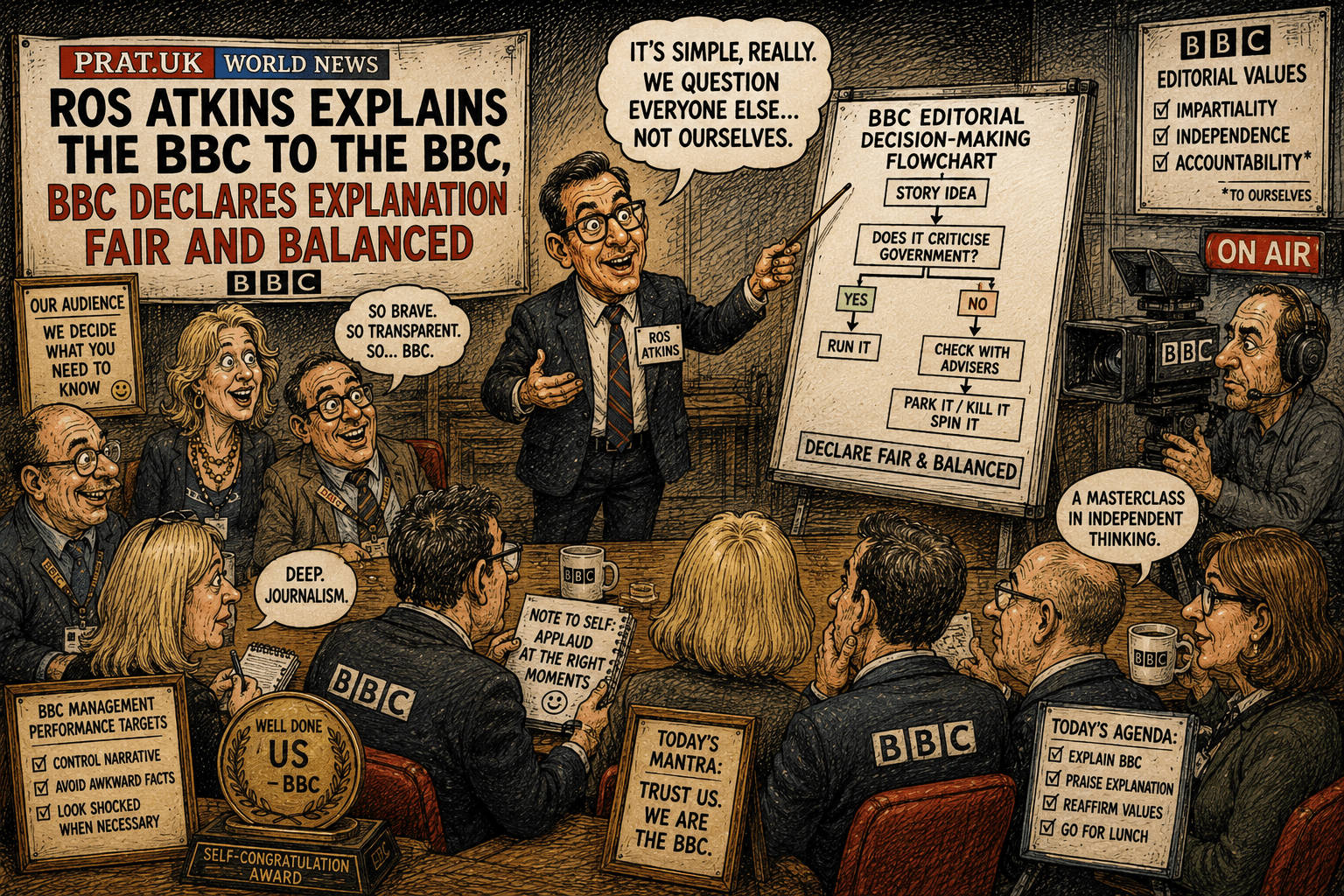
Ros Atkins Explains the BBC to the BBC, BBC Declares Explanation Fair and Balanced
LONDON – Following a week in which senior executives resigned, newspapers declared civil war inside Broadcasting House and half the country briefly became media ethicists, the BBC unveiled its ultimate emergency response.
Ros Atkins.
The corporation announced that only one man possessed the calm voice, animated graphics and emotional stability required to explain the BBC’s crisis to… the BBC.
Viewers watched as Atkins stood before his trademark touchscreen.
“Today,” he began with reassuring precision, “we’re going to explain why you’re watching me explain why you’re watching me.”
Within seconds millions of Britons felt considerably calmer.
Not because they understood what had happened.
Because Ros Atkins had begun numbering things.
The programme opened with a timeline.
Then another timeline explaining why the first timeline required clarification.
A third timeline illustrated when everyone first realised there would eventually be several timelines.
BBC executives watched intently.
Many reportedly took notes.
One admitted afterward that it was the first time anyone had successfully explained management decisions to management.
“It all made sense once Ros put little coloured boxes around it.”
Media consultants praised the innovation.
“For years,” said communications expert Helen Forsyth, “companies have hired consultants to explain crises.”
“The BBC simply hired the man who normally explains wars.”
The touchscreen quickly became Britain’s most trusted constitutional document.
At one point Ros displayed five arrows, four dates, three executive titles and two highlighted quotations.
A government minister reportedly interrupted a Cabinet meeting to ask whether Ros might also explain the Budget.
Parliament unanimously agreed this would improve fiscal transparency.
The BBC insisted the programme represented straightforward public-service journalism.
Critics complained the corporation had effectively appointed itself as its own therapist.
Supporters replied that no outside therapist would have understood the acronyms.
Halfway through the broadcast Ros carefully distinguished between “what happened,” “what has been alleged to have happened,” “what some newspapers believe happened,” “what lawyers are prepared to acknowledge happened,” and “what social media had already decided happened three days earlier.”
The explanation required three graphics.
And a cup of tea.
Audience appreciation soared.
Polling conducted immediately after the programme found that 82 percent of viewers still didn’t understand the controversy.
However, 96 percent believed Ros Atkins probably did.
Confidence in the BBC actually increased among people who admitted they had no idea what the story was about.
“I don’t understand broadcasting,” said pensioner Margaret Ellis from Surrey.
“I don’t understand editing.”
“I barely understand my television.”
“But I trust any man capable of making rectangles seem reassuring.”
Inside Broadcasting House the atmosphere reportedly changed immediately.
Managers stopped writing explanatory memos.
Instead they began asking whether Ros could produce an explainer before every executive meeting.
Human Resources enthusiastically endorsed the proposal.
The first presentation reportedly answered questions that had puzzled staff for months.
Including who actually approved anything.
The graphics department emerged as the unexpected heroes of the crisis.
Having previously animated elections, inflation, wars and constitutional reform, they now found themselves illustrating office politics using tasteful shades of blue.
One designer admitted the greatest challenge.
“It’s surprisingly difficult to animate passive-aggressive emails.”
The BBC nevertheless succeeded.
Animated arrows gently drifted between departments while captions read:
“Different interpretations emerged.”
No animation has ever depicted professional disappointment so elegantly.
Commercial broadcasters immediately recognised a market opportunity.
ITV announced Explaining ITV to ITV.
Channel 4 commissioned Why Channel 4 Commissioned This Programme.
Sky News considered Breaking News About Why We Keep Saying Breaking News.
Netflix reportedly offered Ros Atkins £80 million to explain its recommendations algorithm.
He declined.
There were simply too many episodes.
Constitutional philosopher Alan Nafzger praised the BBC’s response as profoundly British.
“Most institutions issue statements.”
“The BBC issues documentaries.”
“If Buckingham Palace caught fire, the BBC’s first instinct would be a six-part explainer beginning with Norman architecture.”
Even politicians expressed admiration.
Several ministers privately wondered whether Ros Atkins might explain their own policies before Parliament debated them.
One opposition MP suggested this could save approximately seventy percent of Question Time.
No one objected.
As the programme concluded, Ros calmly summarised events.
He thanked viewers.
The touchscreen faded to black.
Britain collectively exhaled.
The crisis itself remained unresolved.
The resignations remained real.
The arguments continued.
But everyone finally agreed on one point.
If the BBC ever needs somebody to explain why the BBC exists…
…it already employs him.
SOURCE: https://feeds.bbci.co.uk/news/videos/cr7mp7rnx48o

Alan Nafzger was born in Lubbock, Texas, the son Swiss immigrants. He grew up on a dairy in Windthorst, north central Texas. He earned degrees from Midwestern State University (B.A. 1985) and Texas State University (M.A. 1987). University College Dublin (Ph.D. 1991). Dr. Nafzger has entertained and educated young people in Texas colleges for 37 years. Nafzger is best known for his dark novels and experimental screenwriting. His best know scripts to date are Lenin’s Body, produced in Russia by A-Media and Sea and Sky produced in The Philippines in the Tagalog language. In 1986, Nafzger wrote the iconic feminist western novel, Gina of Quitaque. He currently lives in Holloway, North London. Contact: [email protected]