
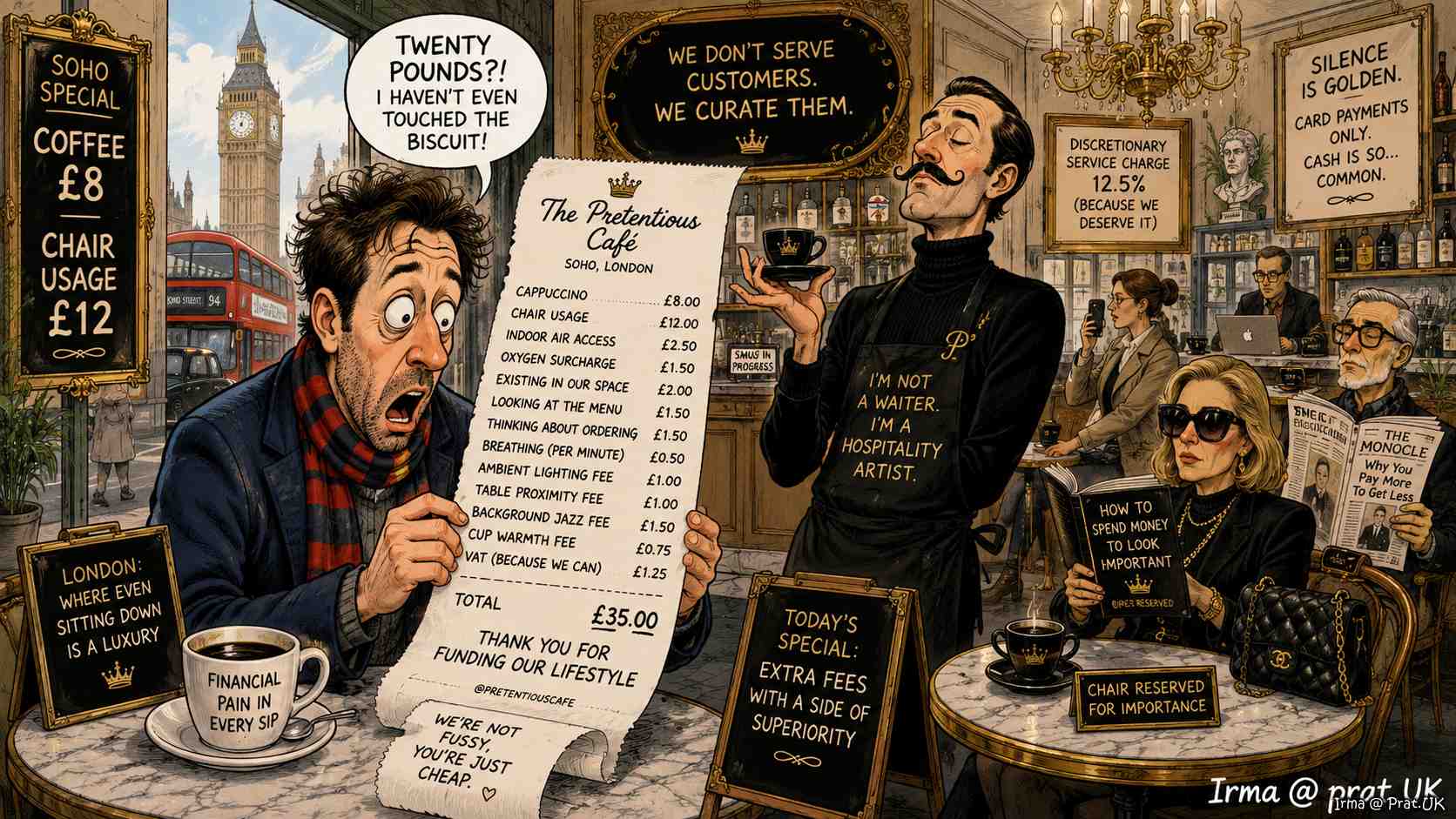
The Top London Cafes: Where Coffee Costs More Than Lunch and the Chair Has Its Own Booking Fee
A comprehensive guide to the capital’s finest cafés, smallest sandwiches, most judgmental baristas and beverages requiring preliminary approval from a financial adviser
By Harper Thames and Amara Okafor | LONDON
LONDON has more cafés than reasonable explanations for why a croissant now costs £7.50.
Official Britain includes restaurants and cafés in its measurements of consumer inflation, the Food Standards Agency maintains a searchable hygiene-rating system, Transport for London advises passengers how to navigate the capital, and City Hall recently announced a £400,000 Summer Streets fund intended to support hospitality businesses. This proves that coffee is no longer merely a drink. It is transportation, economic policy, public health and municipal infrastructure served in a cup with your name spelled “Dervid.” (Food Hygiene Ratings)
The finest London cafés are not ranked by flavour alone. That would be barbaric. They are judged according to seventeen modern criteria, including chair discomfort, barista tattoos, exposed brick density, availability of oat milk, distance from a functioning toilet and whether the menu uses words normally associated with forest management.
A genuine top London café must also possess several items that have no obvious connection to coffee: a bicycle suspended from the ceiling, a distressed mirror, three plants dying artistically, a stack of magazines nobody has opened since 2019 and a chalkboard explaining that the beans were raised by a collective of emotionally intelligent volcano farmers.
The customer must never simply purchase a beverage. They must undergo a narrative.
The coffee begins its life on an inaccessible mountain, travels by canoe, receives counselling in Copenhagen and is roasted beneath an old railway arch by a man called Felix who used to work in digital strategy. By the time it reaches your table, it has accumulated more international experience than the customer.
This is our guide to the top London cafés, establishments where the staff are cooler than the refrigeration, the toast owns property and the receipt can be presented as supporting evidence during a mortgage application.
London Café Charges £8 for Coffee and £12 for the Privilege of Sitting Near It
The first café on our tour has solved the problem of customers occupying tables without contributing sufficiently to shareholder happiness.
Coffee begins at £8, although this does not include drinking it indoors. Customers wishing to sit within visual range of their beverage must purchase the café’s Spatial Proximity Experience for an additional £12.
A basic customer may stand outside and admire the coffee through glass. Silver members can enter the building. Gold members may approach the counter. Platinum guests are permitted to sit on a narrow bench beneath a speaker playing experimental Icelandic flute music.
The café’s owner describes the arrangement as “dynamic hospitality pricing,” a phrase meaning they noticed airlines were disliked and wanted some of that energy.
“You are not paying for a chair,” explained operations director Crispin Waffle. “You are investing in temporary access to an urban seating asset.”
A local accountant attempted to challenge the charge but was informed that sitting changes the café’s atmosphere from “energetic flow” to “settled occupation.” He eventually paid because his knees had entered collective bargaining.
The chairs themselves are deliberately uncomfortable. Each has a backrest positioned at an angle previously associated with medieval confession furniture.
Management insists discomfort increases table turnover, productivity and spiritual alertness.
Customers agree. Nobody has remained seated long enough to disagree properly.
Shoreditch Café Replaces Tables With “Collaborative Standing Experiences”
In Shoreditch, tables are considered outdated, hierarchical and insufficiently disruptive.
The district’s newest café has removed all conventional furniture and replaced it with Collaborative Standing Experiences, consisting of waist-high concrete blocks arranged around a potted cactus.
Customers balance laptops, beverages and personal disappointment on the blocks while being encouraged to “co-create posture.”
The concept was invented by a former workplace consultant who noticed that people unable to sit down tend to leave sooner.
“We’re challenging the inherited assumption that humans require chairs,” said founder Max Archetype. “The chair is essentially a wooden manager telling the body what to do.”
The café’s website describes standing as an inclusive social platform. Unfortunately, it becomes less inclusive after twenty minutes, when every customer begins leaning against the wall and silently evaluating the floor.
Freelancers particularly enjoy the arrangement because nothing improves a six-hour editing session like typing while maintaining the physical stance of a nervous horse.
One customer asked whether she could bring in a folding chair. Staff explained that external seating creates “unauthorised comfort leakage.”
Another sat on the concrete block and was immediately approached by the café’s cultural alignment officer.
“We don’t prohibit sitting,” he explained. “We simply curate against it.”
By lunchtime, twelve customers had developed collaborative lower-back pain, which management described as a successful community outcome.
London Barista Refuses Ordinary Milk, Offers Seven Alternatives and a Brief Lecture
At a café in Islington, ordinary cow’s milk has not been formally banned, but requesting it triggers a constitutional crisis.
The menu offers oat, almond, soy, coconut, cashew, pea and something described only as “post-dairy.”
When a customer asks for ordinary milk, the barista pauses, looks toward the ceiling and behaves as though someone has requested whale gravy.
“You mean bovine milk?” he asks.
The customer, suddenly representing the entire agricultural history of Britain, nods.
What follows is not refusal. It is education.
The barista explains methane, land use, lactose, colonialism, supply chains and the emotional complexity of the modern udder. The customer receives a twelve-minute lecture and forgets why he entered.
By the end, he orders oat milk, not because he prefers it, but because he wants his children to see him again.
The café charges an additional 80 pence for alternative milk, proving moral progress remains available at retail.
Staff defend the surcharge by explaining that oats are difficult to catch.
A dairy farmer visiting from Yorkshire asked whether the café had ever seen a cow. The barista said he had watched a documentary produced by a Swedish furniture company.
The farmer ordered black coffee.
He was charged extra for “milk abstention.”
New London Café Serves Coffee So Ethical Nobody Is Allowed to Enjoy It
A café near Dalston Junction has introduced Britain’s most ethically responsible coffee, a beverage accompanied by so many warnings that drinking it feels morally indistinguishable from launching a private military operation.
Before ordering, customers must read a twelve-page bean impact statement.
The coffee is fair trade, direct trade, shade grown, bird friendly, worker consulted, rainforest adjacent, carbon audited and emotionally transparent. Each bean has been individually interviewed about its aspirations.
The menu contains no flavour descriptions because enjoying flavour would centre the customer.
Instead, each coffee is described through its ethical burden.
The espresso has “notes of structural inequality.”
The filter coffee offers “a lingering finish of unresolved global responsibility.”
The decaf tastes of apology.
When customers smile after taking a sip, staff become concerned.
“We discourage uncomplicated pleasure,” explained the café’s values curator. “Enjoyment without contextual awareness can become extractive.”
The café therefore provides a Reflection Corner where customers consider the power relationships contained within their cappuccino.
One man attempted to add sugar and was handed a booklet titled Sweetness and Empire.
Another asked for whipped cream and was placed on a restorative justice programme.
Nobody enjoys the coffee, which management regards as proof that it is working.
The café has received five stars from people frightened to leave four.
Chelsea Café Introduces £14 Toast After Bread Completes Luxury Rebranding
Bread has undergone a transformation.
It was once a basic food prepared from flour, water and yeast. In Chelsea, it is now an artisanal carbohydrate platform with a personal stylist.

A local café has introduced £14 toast after rebranding an ordinary slice as “heritage-fired grain architecture.”
The bread is cut diagonally because straight lines suggest mass production.
It is then scorched, brushed with cultured butter and placed slightly off-centre on a ceramic plate the size of a bathroom sink.
Customers receive one slice.
A second slice is available through the café’s Bread Continuation Programme.
The owner insists the price reflects craftsmanship.
“Our baker speaks to every loaf,” she said. “Some loaves require closure.”
The toast can be topped with avocado for £8, egg for £6 or “seasonal air” at no additional charge.
Jam arrives in a container the size of a contact lens.
A customer who requested marmalade was informed that citrus preservation did not align with the current menu narrative.
The café employs a bread sommelier who recommends toast according to the customer’s personality.
Confident people receive sourdough.
Anxious people receive rye.
People with trust funds receive whatever was going stale.
Despite the price, the café remains full. In Chelsea, expensive toast is not breakfast. It is a small edible declaration that the mortgage is someone else’s problem.
London Café Adds Mandatory Service Charge for Staff Looking Mildly Disappointed
Service charges were once associated with service.
A new café in Soho has modernised the arrangement by adding 15 per cent whenever a staff member looks mildly disappointed in the customer.
The disappointment begins immediately.
Order too quickly and you are rushing the craft.
Order too slowly and you are obstructing workflow.
Ask a question and you have failed to read the menu.
Read the menu carefully and you are behaving as though it contains information.
The customer cannot win, which is why the system is so efficient.
Receipts include separate charges for Beverage Preparation, Counter Interaction, Emotional Labour and Sustained Barista Disapproval.
A man who ordered “a regular coffee” received a 22 per cent surcharge because the phrase caused a staff member to close his eyes and inhale through his nose.
A woman who asked whether service was included was charged for Administrative Curiosity.
Management says the policy supports workers.
“Looking disappointed requires muscular control, emotional discipline and excellent cheekbones,” said the café manager. “That expertise deserves recognition.”
Customers are invited to remove the discretionary charge, but only by approaching the till and explaining their decision to the entire staff while a bell rings.
Nobody has attempted it.
The service charge is therefore both discretionary and permanent, much like British optimism.
Hackney Coffee Shop Bans Laptops, Immediately Loses Entire Customer Base
A Hackney coffee shop announced a laptop ban to encourage genuine human conversation.
Within eleven minutes, the building was empty except for a retired electrician and a confused dog.
Management had expected customers to welcome the opportunity to reconnect. Instead, thirty-seven freelancers packed their chargers with the speed of soldiers evacuating an embassy.
The ban struck at the core of the modern café economy.
A London coffee shop does not sell coffee to laptop users. It rents desks to them without providing stationery, employment rights or reliable heating.
The average freelancer buys one flat white and occupies a table through breakfast, lunch, two staff changes and a minor constitutional event.
Some construct entire offices.
They bring laptop stands, external keyboards, noise-cancelling headphones, ergonomic cushions and enough charging cables to restart Battersea Power Station.
One customer had installed a printer.
After the ban, management introduced conversation cards bearing questions such as “What brings you joy?” and “When did you last feel truly heard?”
The retired electrician answered all of them, but there was nobody present to listen.
By afternoon, the café reversed the ban and advertised itself as a Digital Creativity Sanctuary.
The freelancers returned, purchased one communal pastry and resumed not speaking to each other.
Human connection had been defeated by Wi-Fi, as tradition demands.
London Café Launches Flat White Mortgage for Customers Unable to Pay Upfront
With coffee prices approaching the psychological boundary between refreshment and capital investment, a City café has launched Britain’s first Flat White Mortgage.
Customers pay a 10 per cent deposit and finance the remainder over twenty-five years.
The standard beverage is fixed for two years, after which the interest rate becomes subject to international coffee markets, Bank of England decisions and whether the barista likes your shoes.
Applicants must provide identification, employment history and evidence that they have not recently purchased avocado toast recklessly.
First-time buyers can access the government’s Cup to Buy scheme.
Couples may combine incomes, although both names will appear on the cardboard sleeve.
A conveyancing solicitor checks whether the coffee has any outstanding claims, structural foam defects or disputed access rights.
The café also recommends a survey.
“The cappuccino appeared sound,” said one customer, “but the report identified subsidence in the froth.”
Repossession remains possible. Two customers who missed payments watched enforcement agents remove their beverages halfway through breakfast.
Critics say the arrangement is excessive.
Management disagrees.
“Coffee is a long-term lifestyle asset,” said lending director Sophie Macchiato. “Many of our customers hope to pass the cup to their children.”
The café is currently developing equity release for elderly tea drinkers who are rich in mugs but cash poor.
Soho Café Offers Authentic Parisian Experience by Ignoring Customers for Forty Minutes
Soho’s newest café promises an authentic Parisian experience without the inconvenience of travelling to Paris, speaking French or discovering that Paris is also expensive.
Authenticity begins when the customer enters.
Nobody acknowledges them.
A waiter passes within inches while carrying an empty tray, looks directly through the customer and continues toward a private philosophical destination.
After fifteen minutes, the customer attempts a polite wave.
This causes service to slow further.
At twenty-five minutes, a menu appears. It contains three coffees, two cigarettes and an expression of contempt.
Orders are taken only after the customer has accepted personal responsibility for wanting something.
“Can I have a cappuccino?” asked one visitor.
The waiter shrugged with such technical precision that the gesture appeared to have been rehearsed at drama school.
The coffee eventually arrived forty minutes later, accompanied by a tiny glass of water and a large sense that the customer had interrupted European civilisation.
Management considers this a triumph.
“British service is too eager,” said owner Laurent Peckham. “We provide emotional distance.”
Customers have praised the atmosphere, the tiled floor and the feeling of being disliked by professionals.
One tourist complained online.
The café printed the review, framed it and placed it near the entrance beneath a sign reading “Enfin.”
London Barista Corrects Customer’s Pronunciation Before Correcting Their Entire Personality
At a café in Bloomsbury, coffee ordering has become an oral examination.
Customers do not merely request drinks. They expose their educational weaknesses before a barista holding a metal jug.
The trouble begins with “espresso.”
Anyone saying “expresso” is immediately stopped.
The barista raises one finger, as a surgeon might before announcing difficult news, and explains that there is no “x.”
The correction then expands.
The customer’s pronunciation of “croissant” is reviewed.
Their understanding of macchiato is tested.
Their choice of footwear is quietly reassessed.
One man ordered a latte and was asked why he feared bitterness.
A woman requested extra-hot coffee and was told her need for control might originate in childhood instability.
The café’s senior barista has no formal qualifications in psychology but owns several notebooks and once dated a therapist.
“Coffee choices reveal everything,” he said. “Decaf is denial. Syrup is avoidance. Instant coffee is a cry for municipal intervention.”
Customers leave with corrected pronunciation and a completely destabilised sense of identity.
Many return because the coffee is excellent.
Others return because they want to prove they have changed.
One customer spent six months learning Italian before ordering again.
The barista listened carefully and replied, “Your accent is trying too hard.”
Café Near King’s Cross Sells Sandwich Smaller Than Receipt
A café near King’s Cross has created a sandwich so small that it can hide behind the receipt.
The sandwich contains two translucent slices of bread and a filling described as “suggested ham.”
When placed on the table, it resembles an architectural model of lunch.
The receipt, by contrast, is nearly a metre long.
It details the sandwich, service charge, packaging contribution, railway proximity levy, ingredient narrative fee and an optional donation to protect threatened napkins.
Customers first assume the sandwich is a garnish.
Several wait patiently for the actual meal.
A member of staff eventually explains that the object beneath the rocket leaf is the complete order.
“We focus on quality, not volume,” said the manager. “Volume is a supermarket concept.”
The sandwich costs £11.80.
For another £3, customers may add a second half.
A commuter calculated that the sandwich contained fewer calories than the energy required to read the receipt.
Another photographed it beside a train ticket for scale. The ticket looked more nourishing.
Management says small portions reduce waste.
Customers agree there is little danger of anything remaining.
The café plans to introduce an even smaller executive sandwich, available only through a magnifying glass and eaten during a single breath between delayed trains.
London Coffee Shop Introduces Quiet Zone for People Loudly Discussing Their Podcasts
A coffee shop in Clerkenwell has introduced a Quiet Zone intended for people loudly discussing their podcasts.
The area features acoustic panels, padded seating and signs requesting silence.
Podcast producers enter, read the signs and immediately begin explaining their planned series about mindfulness at a volume audible in Belgium.
Every discussion starts with the phrase, “The space is really about authentic conversations.”
The conversation then concerns sponsorship, monetisation and whether the host should wear headphones in promotional photographs.
One team is producing a twelve-part investigation into why people no longer listen to each other. They discuss it by interrupting one another for three hours.
Another host is developing a programme about simplifying life. He arrives with four microphones, two producers, a social media assistant and a portable lighting rig.
The café’s ordinary customers sit silently while absorbing detailed information about audience demographics.
Management considered enforcing the Quiet Zone but discovered the podcasters had already recorded an episode accusing the café of silencing independent voices.
A compromise was reached.
Podcasters may speak loudly, provided they occasionally whisper the word “intimate.”
The Quiet Zone is now the noisiest part of the building.
The loudest table is producing a podcast called Unheard.
Mayfair Café Unveils £22 Croissant Hand-Raised by French Consultants
Mayfair has introduced a £22 croissant developed with the assistance of French pastry consultants, branding specialists and a legal team specialising in crumbs.
The café refuses to call it a pastry.
It is a laminated breakfast investment.
Each croissant is hand-raised from infancy by a consultant from Lyon who encourages the dough to express its layers.
The butter has a biography.
The flour has a provenance map.
The oven was trained in Paris.
Customers receive the croissant beneath a silver dome, which a waiter lifts slowly while another employee watches for unauthorised breathing.
The pastry is approximately the size of a sleeping hamster.
“It is not small,” explained the maître d’. “It is concentrated.”
A complimentary crumb is provided to members of the loyalty programme.
Customers wishing to photograph the croissant must purchase image rights.
Cutting it horizontally incurs a structural alteration fee.
One hedge-fund manager ordered two and asked whether they came with jam. The room became silent. A pastry consultant emerged from the kitchen and requested his immediate departure.
The café maintains a waiting list of six weeks.
Most customers report that the croissant is buttery, delicate and gone before the banking notification arrives.
At £22, it is London’s first pastry to require a risk warning.
London Café Declares Tap Water a Premium Hydration Journey
Tap water has completed its journey from public utility to curated luxury.
A Covent Garden café now serves it as the Thames Valley Hydration Experience for £5.50 per glass.
The water begins in a tap behind the counter, but staff insist this description ignores its emotional voyage.
It is poured into a hand-blown bottle, rested for forty seconds and presented with a verbal tasting note.
“Mineral opening,” whispers the waiter, “with a municipal finish and subtle infrastructure.”
Customers may choose still, agitated or contemplative.
Ice costs extra because freezing represents transformation.
A slice of lemon is listed as a botanical intervention.
The café claims the water is locally sourced, which is difficult to dispute unless the plumbing has become adventurous.
One customer asked whether free tap water was available.
The waiter replied that all water is free in a philosophical sense, but glasses, labour, atmosphere and proximity to Covent Garden are not.
The customer paid.
Management says the Hydration Journey is popular with wellness enthusiasts who dislike water unless it has undergone branding.
A premium flight offers three glasses from separate taps in the building.
Experts are invited to identify which came from the kitchen, the bar and the staff toilet sink.
Nobody has yet guessed correctly, preserving the mystery of terroir.
Customers Queue Forty Minutes for Coffee They Will Photograph and Forget to Drink
Outside a café in Notting Hill, customers queue for forty minutes to purchase coffee designed primarily for photography.
The beverages arrive decorated with flowers, gold dust, geometric foam and a small biscuit bearing an inspirational message.
The drink itself is structurally unstable.
Customers must photograph it within eleven seconds before the foam collapses and the edible petals begin migrating toward the rim.
Nobody drinks immediately.
The cup is placed beside sunglasses, keys, a handbag and a carefully relaxed hand.
Several photographs are taken from above.
The arrangement is rotated.
A chair is climbed.
An unrelated customer is asked to move because their elbow is damaging the narrative.
By the time the perfect image has been captured, the coffee is cold.
The customer takes one sip, looks surprised that it tastes of coffee and leaves.
The café has responded by removing heating from the preparation process.
“Temperature was becoming irrelevant,” explained the owner. “Our product is visual.”
The queue continues because people see the queue and assume anything requiring forty minutes must be important.
This is the ancient London principle of recreational suffering.
People will queue for coffee, exhibitions, sample sales and restaurants that contain empty tables but claim to be fully booked.
The line itself becomes proof of quality.
Nobody wants the drink. They want evidence that they waited for it.
New London Café Has No Menu, Only a Barista Asking What Your Body Needs Today
A wellness café in Hampstead has eliminated menus because menus impose artificial categories upon appetite.
Instead, customers approach the counter and are asked, “What does your body need today?”
This is an unexpectedly difficult question at 8:15 in the morning.
Most customers say coffee.
The barista smiles gently and repeats the question.
“What does your body truly need?”
“Coffee.”
“What is beneath that need?”
“A larger coffee.”
Orders now resemble therapy sessions.
The barista asks about sleep, digestion, intention, energy and whether the customer is holding tension in the jaw.
Eventually, a drink is selected based on the customer’s aura, posture and willingness to pay £9.
One man seeking an espresso received warm mushroom broth because his shoulders appeared “caffeinely defended.”
A woman requesting tea was given beetroot foam to reconnect her with the ground.
The café’s founder says conventional menus encourage people to choose what they want rather than what the business would prefer to sell them.
Prices are also absent.
Customers discover the cost only after consuming the drink, when they are considered emotionally ready.
Regulars praise the personalised service.
Critics say they would prefer a board containing words and numbers.
Management has offered the critics a grounding infusion.
Camden Café Rebrands Burnt Toast as “Charcoal-Brushed Sourdough”
A Camden café has solved the ancient hospitality problem of burnt toast by renaming it.
Customers no longer receive bread accidentally left under the grill.
They receive Charcoal-Brushed Sourdough, a bold celebration of heat, carbon and staff distraction.
The toast arrives blackened around the edges and smoking lightly.
A server explains that the kitchen has “pushed the grain beyond comfort.”
Butter refuses to melt on it, possibly from fear.
The café describes the flavour as elemental.
Customers describe it as burnt.
Management rejects this outdated vocabulary.
“Burnt implies failure,” said head chef Milo Ash. “Charcoal-brushed implies a deliberate conversation with flame.”
The same philosophy has been applied across the menu.
Overcooked eggs are now Firm-Yolk Breakfast Orbs.
Cold soup is Temperature-Independent Gazpacho.
A dropped cake becomes Deconstructed Floor Gateau.
Nothing goes wrong because every error is immediately promoted.
One customer complained that his toast tasted like a garden fence after a fire.
The chef thanked him for identifying the woodland notes.
The dish has since become the café’s bestseller, partly because influencers enjoy black food and partly because customers are afraid to admit they paid £13 for an accident.
Failure, once properly typeset, becomes artisanal.
London Café Installs Charging Points, Becomes More Useful Than Most Flats
A café in Hammersmith has installed electrical charging points at every table, instantly making it more functional than many London flats.
Customers can power laptops, phones, tablets, watches, headphones and the small battery keeping their remaining hope alive.
The charging points have transformed the café into an emergency utility station.
People arrive carrying extension leads.
One man powers three monitors and a desk fan.
Another has connected a slow cooker beneath table seven.
Management tolerates this because every appliance requires a beverage purchase.
The café has become especially popular with renters whose bedrooms contain one socket located behind a wardrobe installed during the reign of George VI.
A tenant from Fulham said his flat’s electrical system can support either a lamp or a kettle, but not ambition.
“At the café, I can charge my phone and see daylight,” he said. “It’s basically a penthouse.”
Property agents have noticed.
A nearby studio is now advertised as being “within convenient cable distance of established power infrastructure.”
The café is considering adding showers, mailboxes and voting registration.
Several customers already spend more waking hours there than at home.
The owner denies operating an informal housing development, although table reservations are now offered on twelve-month leases.
Service is included, electricity is reliable and nobody asks for six weeks’ deposit.
Brixton Coffee Shop Offers Community Spirit for Additional £3.50
A Brixton coffee shop has placed Community Spirit on the menu for £3.50.
The fee supports local connection, shared values and a laminated sign explaining local connection and shared values.
Customers purchasing Community Spirit receive permission to sit at a communal table and nod at strangers.
For £5, they may participate in a neighbourhood conversation.
Topics are selected by management and include recycling, independent businesses and why nobody knows the name of the person living upstairs.
The café’s walls display photographs of local residents, several of whom have been priced out of the street.
Management insists the surcharge strengthens the community.
“It takes resources to create organic belonging,” explained the brand director, who commutes from Surrey.
The café sells locally roasted coffee, locally baked bread and tote bags manufactured at an undisclosed distance from the locality.
A pensioner who has lived nearby for forty-three years asked whether long-term residency entitled him to free Community Spirit.
Staff offered a 5 per cent discount after seeing proof of address.
He declined and went to a nearby takeaway where the owner knew his name.
The café later hosted a panel titled “Why Are Traditional Community Spaces Disappearing?”
Tickets were £28, excluding drinks.
The event sold out to people who had moved to Brixton that morning.
London Coffee Shop Introduces Loyalty Card Requiring Only 87 Purchases for Free Espresso
A London coffee chain has launched a generous loyalty programme requiring customers to purchase only eighty-seven drinks before receiving a free espresso.
The card contains eighty-seven tiny boxes and unfolds to the dimensions of a road map.
Each purchase earns one bean-shaped stamp, except on weekends, public holidays, rainy days and periods when the café considers itself busy.
Stamps expire after six weeks.
Customers may not combine cards because loyalty is personal.
The free espresso must be redeemed between 10:42 and 10:47 on a Tuesday at a branch without functioning machinery.
Management describes the scheme as straightforward.
One customer has spent £426 pursuing his free drink.
He keeps the card in a plastic sleeve and speaks of it with the haunted determination of an Arctic explorer.
“I’m on stamp seventy-nine,” he said. “I can’t stop now. That would mean the coffee won.”
The programme also offers status levels.
Bronze customers receive emails.
Silver customers receive more emails.
Gold customers are greeted by first name, provided it matches the name incorrectly written on their cup.
The highest level is Obsidian Bean, available to anyone who spends enough to purchase the café outright.
No customer has yet received the free espresso.
Management says this demonstrates the programme’s exclusivity.
Notting Hill Café Opens at 7 a.m., Begins Judging Customers at 7:01
A Notting Hill café opens each morning at seven and begins judging customers one minute later.
The first arrivals are evaluated for clothing, beverage choice, stroller design and whether their dog appears sufficiently curated.
Customers entering in exercise clothes are accepted, provided the clothes show no evidence of exercise.
Anyone visibly sweating is directed toward Paddington.
The barista can distinguish between intentional bed hair and actual bed hair with a glance.
Laptop brands are assessed.
Paperback books are welcomed.
Mass-market paperbacks are tolerated only if covered by a newspaper.
One customer ordered hot chocolate and was treated as though he had brought a recorder to the opera.
Another requested whipped cream before eight in the morning. Staff exchanged looks normally reserved for public scandals.
The café claims to welcome everyone.
This is true in the same sense that an expensive hotel lobby welcomes anyone capable of surviving the atmosphere.
Regulars have learned the rules.
They enter wearing neutral colours, order without enthusiasm and place a linen-covered notebook beside the cup.
Nobody writes in the notebook.
Its purpose is to suggest a creative project too important to discuss.
By 7:30, the café is full of people silently confirming that they belong there.
The coffee is excellent, although enjoying it too visibly would be embarrassing.
London Café Replaces Sugar With Positive Affirmations
A café in Richmond has removed sugar from every table and replaced it with positive affirmations.
Customers attempting to sweeten coffee now choose between small paper packets reading “You Are Enough,” “Trust Your Journey” and “Your Best Self Is Brewing.”
The affirmations dissolve poorly.
A man poured “Embrace Abundance” into his espresso and discovered that self-belief does not neutralise bitterness.
Staff say sugar causes temporary pleasure, while affirmations produce long-term emotional sweetness.
Customers say sugar tastes better.
The café offers an affirmation dispenser beside the milk station.
Pulling the handle releases a random message.
Most are supportive.
One customer received “Stop Seeking External Validation” immediately after paying £6.40 for coffee in a branded cup.
Another received “Release What No Longer Serves You” and threw away the receipt.
The café’s wellness director insists the programme is evidence-based, though she declined to identify the evidence because data can interfere with intuition.
People with diabetes remain confused but grateful that the messages contain no carbohydrates.
Some customers bring their own sugar in tiny envelopes and exchange it discreetly beneath tables.
Management calls them sweetness extremists.
The café plans to replace teaspoons with gratitude and napkins with emotional resilience.
Spills will become opportunities for growth.
Barista Spends Nine Minutes Drawing Swan in Coffee, Customer Misses Train
At a café beside Waterloo station, a barista spends nine minutes drawing a swan in every cappuccino.
The result is beautiful.
The train is gone.
Customers watch helplessly as milk foam becomes wings, feathers, a curved neck and a small expression of avian dignity.
Nobody can interrupt because craftsmanship is occurring.
A commuter explains that his train leaves in four minutes.
The barista nods and adds detail to the tail.
Another customer asks for coffee without art.
Staff interpret this as hostility toward culture.
The swan is completed at the precise moment the departure board changes from “Platform 6” to “Departed.”
The customer photographs it because loss must be documented.
Management says latte art encourages people to slow down.
British railways already provide this service at national scale, but the café considers its version more personal.
The swan also creates emotional difficulty.
Customers hesitate to drink it.
They have watched it being born.
Destroying it feels cruel.
Some carry the cup toward the train, preserving the bird until it collapses against the lid and resembles a weather event.
One passenger missed an interview but arrived with a magnificent photograph.
He did not get the job.
The café reposted the image with the caption “Make Time for Beauty.”
London Café Promises Affordable Breakfast, Defines Affordable as “Under £30”
A café in Battersea advertises an affordable breakfast for Londoners.
Affordable is defined as anything below £30, excluding coffee.
The basic breakfast costs £27.50 and includes one egg, half a tomato, a narrow sausage and toast positioned at a respectful distance from the other ingredients.
Beans are available as a subscription.
Bacon is priced according to market conditions.
Customers may upgrade to the Full London for £46, which includes a second egg and permission to complain about property values.
The café’s owner argues that affordability is relative.
“A £28 breakfast is affordable compared with a £600 tasting menu or a one-bedroom flat,” he said. “Context is nourishment.”
A teacher visiting with her family asked whether a children’s menu was available.
The waiter offered a smaller plate at the same price, describing it as portion-conscious.
The café also promotes financial wellbeing.
Receipts include advice such as “Spend intentionally” and “Small choices create abundance.”
Customers are encouraged to save money by sharing a mushroom.
Despite the pricing, tables remain full every weekend.
Londoners enjoy discussing the cost of living while eating breakfast expensive enough to qualify as part of it.
The café calls this community dialogue.
Economists call it brunch.
City Café Offers Executive Coffee Strong Enough to Conceal Moral Exhaustion
In the City of London, a café serves Executive Coffee designed to conceal moral exhaustion.
The beverage contains four shots of espresso, concentrated ambition and enough caffeine to make a spreadsheet appear meaningful.
It is served in a black cup without a handle because handles suggest hesitation.
Customers do not drink it.
They deploy it.
The first sip causes the eyes to widen.
The second restores the ability to say “circle back.”
The third enables the drinker to describe redundancies as organisational clarity.
Investment bankers queue from dawn, staring at phones and rehearsing expressions of controlled urgency.
The café also offers the Merger Macchiato, Hostile Takeover Americano and Regulatory Cappuccino, which contains almost no visible substance beneath the foam.
A junior analyst asked whether decaf was available.
Security escorted him toward the insurance district.
Management says Executive Coffee does not create energy. It transfers fatigue into the future, where it becomes someone else’s problem.
Side effects include vibrating knees, unnecessary emails and the conviction that every conversation requires a slide deck.
By 4 p.m., customers return for another cup.
Their hands shake, their calendars are full and they have forgotten the names of several relatives.
The coffee has worked.
London Café Adds “Cost of Living Foam” to Every Cappuccino
A café in Southwark has responded to economic anxiety by adding Cost of Living Foam to every cappuccino.
The foam looks generous when the cup arrives but disappears rapidly, leaving far less coffee than the customer expected.
Management says this creates an authentic economic experience.
The topping is made from oat milk, air and uncertainty.
Each month, the foam rises while the cup becomes smaller.
Customers ask whether the change reflects higher ingredient costs.
Staff explain that the price increase is caused by energy, wages, rent, transport, weather, international markets and a mysterious administrative factor known only as “everything.”
Official consumer-price statistics continue to track restaurant and café prices, providing a sober national backdrop to the less sober experience of paying nearly seven pounds for something consumed before reaching the office. (Office for National Statistics)
The café has introduced several coping measures.
Customers may purchase half a cappuccino and imagine the remainder.
They may bring their own foam.
They may finance the beverage through payroll deduction.
A sign beside the till encourages gratitude.
“Coffee is still cheaper than therapy,” it reads.
The therapist next door has placed an answering sign in the window.
“Not by much.”
Cost of Living Foam remains popular because Londoners appreciate a product that honestly vanishes before their eyes.
Greenwich Café Serves Beans From Farm So Remote Even the Farmer Has Never Visited
A Greenwich café serves coffee beans from a farm so remote that even the farmer has never visited.
According to the menu, the beans grow on an unnamed volcanic ridge accessible only by mule, canoe and personal transformation.
The farm has no road, address or detectable relationship with cartography.
Its owner, contacted by telephone, said he had heard rumours of it.
The café’s bean specialist describes the location as “beyond conventional geography.”
Customers are shown photographs of mist, mountains and a person carrying a basket.
Nobody knows whether the basket contains coffee.
The beans arrive through a supply chain involving twelve countries, seven ethical certifications and a warehouse near Milton Keynes.
They are roasted in Greenwich by a man who refuses to use clocks.
“Time damages flavour,” he explains, moments before burning the second batch.
The coffee has notes of blackberry, cedar and logistical ambiguity.
A customer who said it tasted like ordinary coffee was informed that her palate had been industrialised.
The café offers tasting classes to repair this problem.
For £90, participants learn to describe bitterness as cacao tension and sourness as citrus architecture.
The farmer receives a photograph of the finished cup.
He says it looks lovely and asks whether anyone knows where his farm is.
London Coffee Shop Introduces Child-Free, Dog-Friendly, Human-Optional Seating Policy
A café in Stoke Newington has introduced a child-free, dog-friendly and human-optional seating policy.
Dogs are greeted by name.
Humans are asked whether they have booked.
The café provides canine drinking stations, organic biscuits, blankets and a menu developed with a pet nutrition consultant.
Human customers receive one stool near the bins.
Children are prohibited because management says unpredictable noise disrupts the calm environment.
Dogs barking beneath tables are described as expressing boundaries.
One customer asked why a spaniel could occupy a sofa while her eight-year-old could not enter.
Staff explained that the spaniel had completed socialisation training and maintained a strong online following.
The café’s most valuable regular is a miniature dachshund called Colin with 140,000 followers.
Colin receives complimentary puppuccinos and priority seating.
His owner stands.
The café hosts weekly dog networking events where pets sniff one another while their humans compare mortgage rates.
Management is considering eliminating human seating entirely.
“People bring laptops, questions and expectations,” said the owner. “Dogs understand hospitality.”
The proposed redesign would include floor cushions, low tables and a small corner where humans can wait while their dogs brunch.
Early bookings are strong.
Several customers say they feel dehumanised.
Their dogs have never been happier.
Café Customer Orders Decaf, Entire Room Quietly Withdraws Respect
At a café in Fitzrovia, a customer orders decaf and the entire room quietly withdraws respect.
No one speaks.
The judgment travels through posture.
Laptops pause.
Newspapers lower.
A teaspoon stops halfway to a mouth.
The barista repeats the order, partly for confirmation and partly to notify witnesses.
“Decaf?”
The customer nods.
He explains that caffeine affects his sleep.
This only worsens matters. Londoners have accepted poor sleep as proof of professional seriousness.
The barista prepares the drink with the solemnity of a pharmacist dispensing surrender.
A small wooden marker is placed beside the cup so nobody mistakes it for ambition.
The café does stock decaf, but it is kept in a separate container beneath the counter with spare batteries and lost property.
Management insists decaf customers are welcome.
“They have the same rights as everyone else,” said the owner, using the tone of someone discussing a difficult legal settlement.
The drink costs 50 pence extra because removing caffeine requires effort and damages the café’s reputation.
The customer sits alone.
Later, another man quietly orders decaf too.
The first customer gives him a small nod.
A resistance movement has begun.
It remains calm, hydrated and capable of falling asleep before midnight.
London Café Announces New Winter Menu Featuring Soup, Debt and Seasonal Anxiety
The final café on our tour has unveiled its winter menu, featuring soup, debt and seasonal anxiety.
The soup changes daily, although it is always orange.
Staff describe it as root vegetable, autumn squash or roasted sunset depending on which label has been printed.
It arrives with one piece of bread and an explanation of why the bread costs extra.
Debt is served automatically.
Customers choosing the two-course lunch may spread payment across six months, during which the soup remains legally owned by the café.
Seasonal Anxiety comes complimentary.
It begins when darkness falls at 3:58 p.m. and intensifies when the customer receives an energy notification.
The café enhances the winter atmosphere with candles, blankets and windows covered in condensation.
Nobody knows whether the condensation is decorative or structural.
A log fire plays continuously on a television because an actual fire would increase insurance costs.
The menu includes Warming Broth, Comforting Crumble and Emergency Mulled Something.
Every dish promises emotional restoration.
The bill reverses it.
Customers leave wrapped in scarves, carrying takeaway coffee and wondering whether spring has been discontinued.
Management says winter is the café’s busiest season because Londoners need somewhere warm to discuss how cold their flats are.
The café sells comfort by the cup and anxiety by the receipt.
In London, that qualifies as a balanced meal.
The Final Verdict on London’s Top Cafes
London’s finest cafés provide much more than coffee.
They offer office space without contracts, therapy without qualifications, housing without beds, community without familiarity and breakfast without any realistic relationship to household income.
They allow Londoners to sit beside one another while wearing headphones, photograph food while it cools and spend seven pounds becoming sufficiently alert to understand why spending seven pounds was unwise.
The London café is a theatre.
The barista is the critic.
The menu is the script.
The customer is an unpaid performer trying to pronounce “cortado” while carrying three bags and suppressing a financial emergency.
Yet the cafés remain full because Londoners need them.
They need the lights, the charging points, the toilets, the Wi-Fi and the fragile possibility that today’s flat white might briefly make the city manageable.
A café is one of the few places where a resident can occupy ten square feet of central London for an hour without presenting references, paying a deposit or promising to repaint before leaving.
That alone may justify the coffee.
The true top London café is therefore not necessarily the one with the finest beans, most elaborate foam or rarest Scandinavian furniture.
It is the one that gives you a chair, remembers your order, allows you to use the socket and does not make you feel that requesting ordinary milk has personally delayed civilisation.
Such establishments still exist.
They are rarely featured on social media because everyone inside is too busy drinking the coffee.
Disclaimer
This story is satire. Prices, café policies, consultants, bread sommeliers, emotional milk lectures and mortgage-backed flat whites should be approached with a functioning sense of humour and, where necessary, a financial adviser. Before eating at any establishment, customers can consult the official Food Standards Agency hygiene-rating service, which is considerably more useful than judging a kitchen by the quantity of exposed brick near the entrance. (Food Hygiene Ratings)
This story is entirely a human collaboration between two sentient beings: the world’s oldest tenured professor and a philosophy major turned dairy farmer.
The piece is structured for a long-form “Top London Cafes” landing page and can be divided into individual supporting articles without sacrificing any of the 30 sections.
SOURCE: london-cafe.com
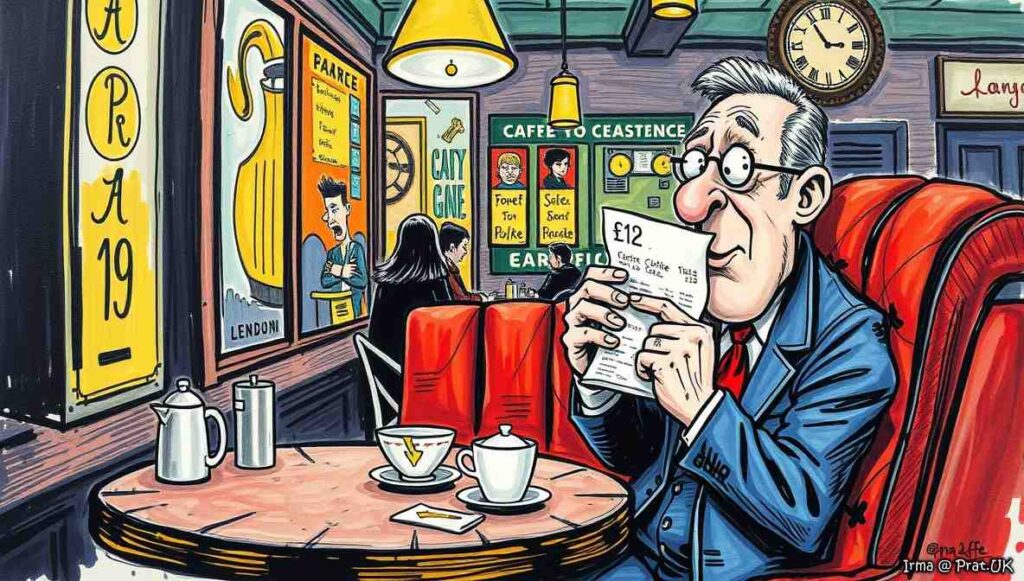

Harper Thames is a comedic writer exploring modern life through irony and subtle exaggeration. Rooted in student perspectives and London’s cultural landscape, Harper’s work focuses on relatable humour grounded in everyday experience.
Expertise is developed through writing practice and critical engagement, while authority comes from authenticity and consistency. Trust is reinforced by transparent satire and ethical humour choices.


In British comedy, the prat is the character who provides the laughter by being completely, utterly, and magnificently foolish.