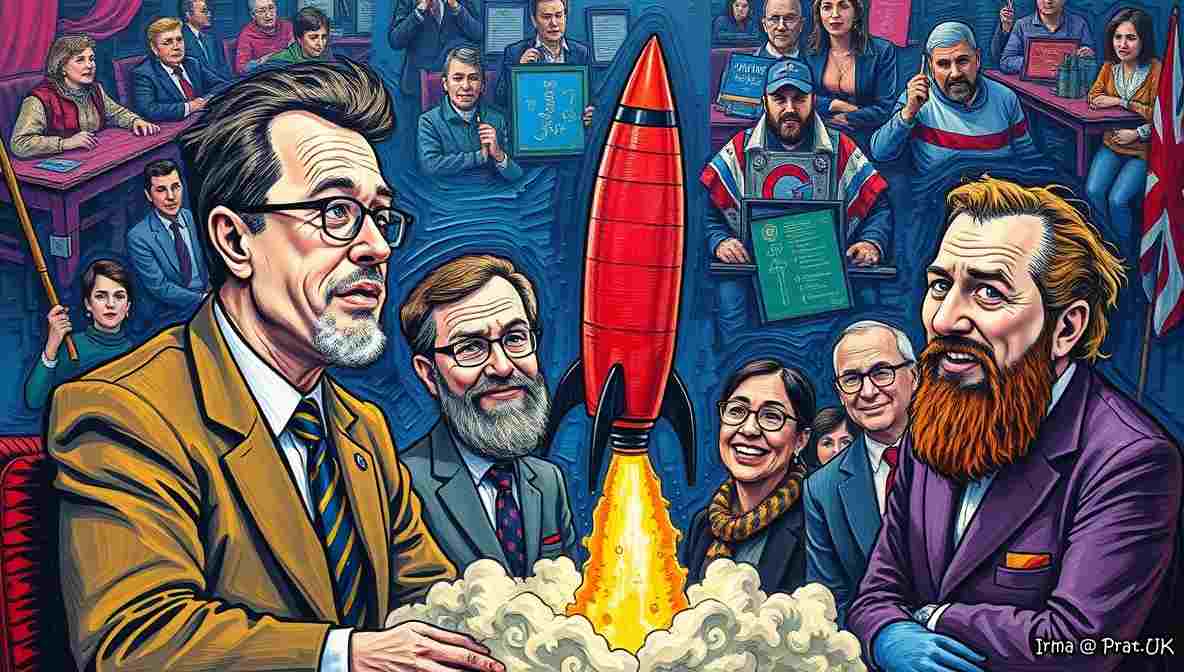
BBC’s Zoe Kleinman Demands Elon Musk Be Made An Intellectual Eunuch — Here’s The Full Charge Sheet
The Man Colonising Mars, Putting The Internet In Space, And Building A Million Solar-Powered Satellites Must Be Reigned In, Says Woman Who Has Never Launched Anything
LONDON — The BBC’s Technology Editor Zoe Kleinman sat on a panel this week and delivered the considered professional verdict that Elon Musk needs to be “reigned in.” She said it with the calm authority of someone who has never built a rocket, never launched a satellite, never provided internet to a single person in rural Africa, and never merged an AI company with a space company in the largest corporate transaction in human history.
She said it on the BBC. Which is funded by a compulsory licence fee. Which has a £5 billion annual budget. Which has, in its entire existence, not done any of those things either.
Reigned in.
The man is colonising Mars. He is putting one million solar-powered satellites in orbit to serve as data centres. He is providing broadband to farmers in Northumberland who have waited twenty years for it. He is solving — simultaneously, with private money, without government assistance — the land problem, the energy problem, the environmental problem, and the access problem that every government programme, every quango, every House of Lords committee, and every BBC panel discussion has failed to solve in three decades of trying.
And Zoe Kleinman thinks he needs reigning in.
Right. Let’s have the full charge sheet then.
Who Is Zoe Kleinman, And Why Is She Angry At The Future?
Zoe Kleinman is the BBC’s Technology Editor — the corporation’s first Technology Editor, appointed in 2021, which tells you that the BBC spent approximately sixty years covering technology without deciding it needed someone specifically in charge of understanding it.
She has covered the Facebook-Cambridge Analytica scandal, Musk’s acquisition of Twitter, and generative AI. In March 2025, she gave evidence before the House of Lords on AI governance and data privacy — a hearing that produced, to date, one report, several strongly-worded paragraphs, and no rockets.
She interviews well. She explains things clearly. She knows what a large language model is, which puts her ahead of approximately 80% of the House of Lords.
What she struggles with — and she is not alone; it is practically a condition of BBC employment — is the idea that private individuals solving civilisation-scale problems without asking permission might be, on balance, good. Not perfect. Not without complications. But good.
The BBC’s institutional reflex, when confronted with something moving very fast and doing very large things, is to slow it down with a panel. To surround it with concern. To find an expert who can explain why caution is warranted. To invite the relevant Secretary of State to respond. To commission a report. To note that the report’s recommendations have not yet been implemented. To commission a follow-up report.
Meanwhile the rockets land themselves in the Texas dark, and Zoe Kleinman files another piece about whether someone should regulate the landing mechanism.
What Musk Is Actually Doing (The Crimes)
Crime One: Mars. SpaceX is building the infrastructure to make humanity a multi-planetary species. The Starship programme is the most powerful rocket ever constructed, funded privately, built faster and cheaper than any government space agency has managed anything comparable. The stated goal is to establish a self-sustaining human settlement on Mars within this century. The BBC’s response is to discuss whether Musk has sufficient oversight.
Crime Two: The Internet Everywhere. Starlink provides broadband to over 100 countries. Remote communities. Disaster zones. Ukrainian frontline positions. And — this cannot be stated often enough — several British journalists on BBC assignments in locations where state infrastructure does not reach, filing their pieces about Musk’s concerning lack of accountability via his satellite network. The BBC’s response is to discuss whether Musk has sufficient accountability.
Crime Three: Data Centres In Space. In January 2026, SpaceX and xAI completed their merger — $1.25 trillion, the largest in history — and filed with the FCC to launch up to one million satellites as orbital data centres powered entirely by free solar energy. No land. No planning permission. No environmental impact assessment. No NIMBY campaign from residents of the Surrey Hills concerned about the view. Just space, sun, and computing power, orbiting silently above the people arguing about whether it should be allowed.
The progressive establishment has spent a decade complaining about the land use of data centres, the energy consumption of data centres, the environmental footprint of data centres. Musk has responded by removing data centres from the Earth entirely and powering them with the sun. This is, by any reasonable measure, exactly what they asked for.
Their response has been to ask who regulates it.
The “Reign Him In” Impulse: A Proud And Catastrophically Unsuccessful British Tradition
Britain has been here before. Repeatedly. With consistent results.
The Luddites smashed machinery in 1812 because the textile mills were moving too fast and making too many decisions without consulting the people the decisions were affecting. Parliament debated restricting the railways on grounds they would disturb livestock and encourage the lower orders to travel. The BBC itself, in its early decades, refused to broadcast rock and roll, jazz on certain evenings, and commercial advertising on any day whatsoever.
None of it worked. The mills ran. The railways ran. The rock and roll played. Eventually the BBC played it too, once it was sufficiently old to be safe.
The pattern is always the same. Something new arrives moving very fast, doing very large things, making existing institutions look slow and expensive by comparison. Those institutions respond by calling for the new thing to be reigned in. The new thing does not reign itself in. After a suitable period of institutional outrage, the new thing becomes the baseline reality, and everyone pretends they were in favour of it all along.
Musk is not waiting for the BBC to get comfortable. Neither were any of these men:
The Honours List: Successful Men Socialism Tried To Reign In (And Failed)
Henry Ford paid his workers double the going rate — $5 a day — because it increased productivity, not because a government told him to. Socialists demanded he be broken up and regulated. He built River Rouge instead. The largest industrial complex in the world. On purpose.
Andrew Carnegie arrived in America with nothing, built the steel industry, and gave away 90% of his fortune to build 2,500 public libraries. Marxists of his era demanded his wealth be seized by the state. The state would have built four libraries and a very comfortable office for the redistribution committee.
John D. Rockefeller lowered the price of kerosene so dramatically that ordinary families could finally afford to light their homes at night. The government called this a monopoly and broke it up. Each resulting smaller company was worth more than the original. He shrugged and kept giving money to universities.
Thomas Edison held 1,093 patents. Congressional reformers considered them dangerously monopolistic. Each patent was a problem they hadn’t thought of yet.
Isambard Kingdom Brunel built the Great Western Railway, the SS Great Britain, and the Clifton Suspension Bridge using private capital and sheer pathological obsession with engineering. He did not file an environmental impact assessment. He did not convene a stakeholder panel. He smoked enormous cigars and built things that still exist. The infrastructure programmes that followed him, built by committees, cost more, took longer, and fell down faster.
Bill Gates put a computer on every desk on Earth. The Department of Justice spent a decade trying to break Microsoft up. During the proceedings, Gates continued building software. The DoJ did not build any software. Your laptop still runs Windows.
Steve Jobs was told the iPhone was too expensive and that consumers didn’t want a touchscreen. There are now 1.5 billion iPhones in use worldwide. Various regulators fined Apple billions for being too successful. The phones continued to work.
Elon Musk is building rockets, satellites, electric cars, AI systems, and orbital data centres simultaneously. The BBC has convened a panel. One awaits the outcome with bated breath.
The common thread: every man on this list was told, at some point, by someone with a clipboard and a grievance and access to a broadcast studio, that he needed to be reigned in. Not one of them was. The clipboard people are still clipboard people. The rockets are in orbit.
The Proposal: Make Musk An Intellectual Eunuch Of The State
The logical endpoint of the “reign him in” argument — followed honestly to its conclusion — is not regulation. It is not oversight. It is not accountability in the normal democratic sense.
It is neutering.
It is the transformation of an exceptional, inconvenient, productivity-generating human being into a managed, supervised, safely emasculated servant of institutional comfort. Give him a title. Give him a quango. Give him a modest expense account and responsibility for overseeing Britain’s National Space Strategy — a 173-page document published in 2021 that has so far produced considerable enthusiasm and one small rocket that went partially into space before returning to Earth in the wrong county.
Strip him of independent initiative. Require him to submit all future ventures to an eighteen-month review process. Mandate that he attend quarterly sensitivity briefings on the emotional impact of achievement on those who have not achieved things. And require him, on alternating Fridays, to operate a federally-approved sandwich programme in an underserved area, demonstrating that he understands ordinary people and is not, in the BBC’s formulation, “out of control.”
The sandwich programme is not a joke. It is the literal logical conclusion of what people mean when they say a visionary needs to be “more grounded.”
They do not mean grounded in the engineering sense — connected to earth for safety. They mean brought low. Made ordinary. Reduced to a size that does not make institutions look small by comparison.
History has a word for societies that do this to their most capable people.
The word is “declining.”
What Mishal Husain Found Out
It is worth noting that the BBC has previous on this specific question. In May 2025, Mishal Husain — formerly of the BBC — interviewed Musk for forty minutes at the Qatar Economic Forum. She pressed hard. He pressed back harder. The internet declared it Frost versus Nixon. Various people declared various winners.
The rockets kept launching.
This is the essential problem with the reigning-in strategy. Musk does not require good press. He does not need a BBC Technology Editor’s approval to file an FCC application. He does not need the House of Lords to endorse his orbital data centre plans before the satellites go up. He is operating at a level where institutional opinion is, at best, background noise.
The BBC spent £5 billion last year. SpaceX merged with xAI for £1.25 trillion and filed to put a million satellites in orbit.
One of these organisations is reigning in the other. And it isn’t the one Zoe Kleinman works for.
The Sincere Bit (Contractually Required)
There are genuine questions worth asking about Musk. About satellite spectrum concentration. About labour conditions at his companies. About the appropriate influence of private individuals over global communications infrastructure. About what it means for democratic accountability when one man controls more orbital bandwidth than most nation-states.
These are serious questions. They deserve serious journalism. They deserve a technology editor who has done the work, understands the engineering, grasps the regulatory complexity, and can hold the subject to account with precision rather than vibes.
“He needs to be reigned in,” delivered from a panel sofa, is not that journalism.
It is the sound of an institution that covered the invention of the internet from the outside, covered social media from behind, covered AI from a position of anxious incomprehension, and is now watching a private company build the computing infrastructure of the next century in orbit — and has responded by saying someone should probably do something.
Someone is doing something.
He’s doing a million things.
That’s rather the point.
Auf Wiedersehen, amigo!
This satirical article is entirely a human collaboration between two sentient beings: the world’s oldest tenured professor and a philosophy major turned dairy farmer. Any resemblance to actual BBC panel discussions, House of Lords AI hearings, million-satellite FCC filings, or institutions discovering in real time that they are irrelevant to the future they are supposed to be covering is entirely intentional, documented on video, and available on Starlink in 100 countries.
For American perspectives on the same glorious institutional meltdown, visit Bohiney.com. Also cross-referenced at lateststory.co.uk.
Men Socialism Tried To Reign In (And Failed Spectacularly)
A brief history of committees telling geniuses to calm down
Throughout human history, a dedicated class of professional worriers has looked upon exceptional men and thought: “Someone should stop this.” Here, for your reading pleasure, is the honor roll of those they tried to manage, regulate, neuter, or simply shout at from a pamphlet.
1. Henry Ford
Paid his workers $5 a day — double the going rate — which infuriated the left because he did it to increase productivity rather than because a government told him to. Invented the assembly line. Made cars affordable for ordinary people. Socialists wanted him broken up, regulated, and preferably relocated to somewhere with less ambition. He built River Rouge instead. The largest industrial complex in the world. On purpose.
2. Andrew Carnegie
Arrived in America with nothing. Built the American steel industry. Then gave away 90% of his fortune to build 2,500 public libraries, universities, and concert halls. Marxists of his era demanded his wealth be seized and redistributed by the state. The state would have built approximately four libraries and a very nice office for the redistribution committee.
3. John D. Rockefeller
Lowered the price of kerosene so dramatically that ordinary families could afford to light their homes at night. The government called this a monopoly and broke him up. His resulting smaller companies were each individually worth more than the original. He shrugged and kept giving money to universities. The government went back to not lighting anything.
4. Nikola Tesla
Socialist governments in Europe adored Tesla as a concept while doing nothing to fund him. It was the capitalist J.P. Morgan — a man progressives loathed — who bankrolled AC electricity and lit up the modern world. The irony has never been adequately acknowledged at any academic conference.
5. Thomas Edison
Invented the phonograph, the motion picture camera, and practical electric light while operating out of a private laboratory funded by private capital. Congressional reformers of his era suggested his patents were dangerously monopolistic. He held 1,093 of them. Each one was a problem they hadn’t thought of yet.
6. Cornelius Vanderbilt
Built America’s railroad network faster, cheaper, and more efficiently than any government programme had managed anywhere on earth. Critics demanded regulation. He cut freight rates again just to be annoying. Shipping costs fell 90% during his lifetime. The regulated railroads that came after him ran late and eventually went bankrupt. But at least nobody felt bad about it.
7. Walt Disney
Unionists struck his studio in 1941 and demanded he be brought to heel. He told Congress he thought it was a communist-organized disruption. He was called a fascist. He then built Disneyland — a privately owned city that works better than most actual cities — and died before EPCOT, which was going to be even better. The unions are still there. So is Disney World.
8. Howard Hughes
Built aircraft, ran airlines, made movies, and set multiple airspeed records using private capital and sheer pathological obsession. The Civil Aeronautics Board spent years trying to regulate him into submission. He moved to Nevada. The CAB is no longer with us. Hughes Aviation technology still flies.
9. Bill Gates
Put a computer on every desk on earth. The Department of Justice decided this was unacceptable and spent a decade trying to break Microsoft up. During those proceedings, Gates continued building software. The DOJ did not build any software. The case was eventually settled. Your laptop still runs Windows.
10. Steve Jobs
Told by business journalists, academics, and sundry smart people that the iPhone was too expensive, that consumers didn’t want a touchscreen, and that Apple should stick to computers. French regulators later fined Apple billions for being too successful. Jobs did not adjust his turtleneck. There are now 1.5 billion iPhones in use worldwide.
11. Jeff Bezos
Built a company that delivers everything to your door by tomorrow, employs over 1.5 million people, and runs the cloud infrastructure of half the internet. Bernie Sanders stood outside an Amazon warehouse with a megaphone. Amazon did not notice.
12. Elon Musk
Reinvented the car, the rocket, and the satellite. Lands rockets backwards. Is planning to put humans on Mars. Various governments, regulators, academic departments, Members of Parliament, congressional subcommittees, and a man named Marcus who runs a Reddit community have formally requested he stop. He has acknowledged none of these communications and has instead announced a new rocket. It is bigger than the last one.
Common Thread: Every man on this list was told, at some point, by someone with a clipboard and a grievance, that he needed to be reigned in. Not one of them was. The clipboard people, meanwhile, are still clipboard people.
Historical footnote nobody asked for: The Soviet Union built its own rockets, cars, and computers entirely under state management and collective planning. The rockets sometimes worked. The cars were called the Lada. Draw your own conclusions.
Auf Wiedersehen, amigo!
This satirical list is entirely a human collaboration between two sentient beings: the world’s oldest tenured professor and a philosophy major turned dairy farmer. Any resemblance to ongoing regulatory proceedings, Senate hearings, or strongly-worded open letters in the Guardian is purely intentional.

Harper Thames is a comedic writer exploring modern life through irony and subtle exaggeration. Rooted in student perspectives and London’s cultural landscape, Harper’s work focuses on relatable humour grounded in everyday experience.
Expertise is developed through writing practice and critical engagement, while authority comes from authenticity and consistency. Trust is reinforced by transparent satire and ethical humour choices.