
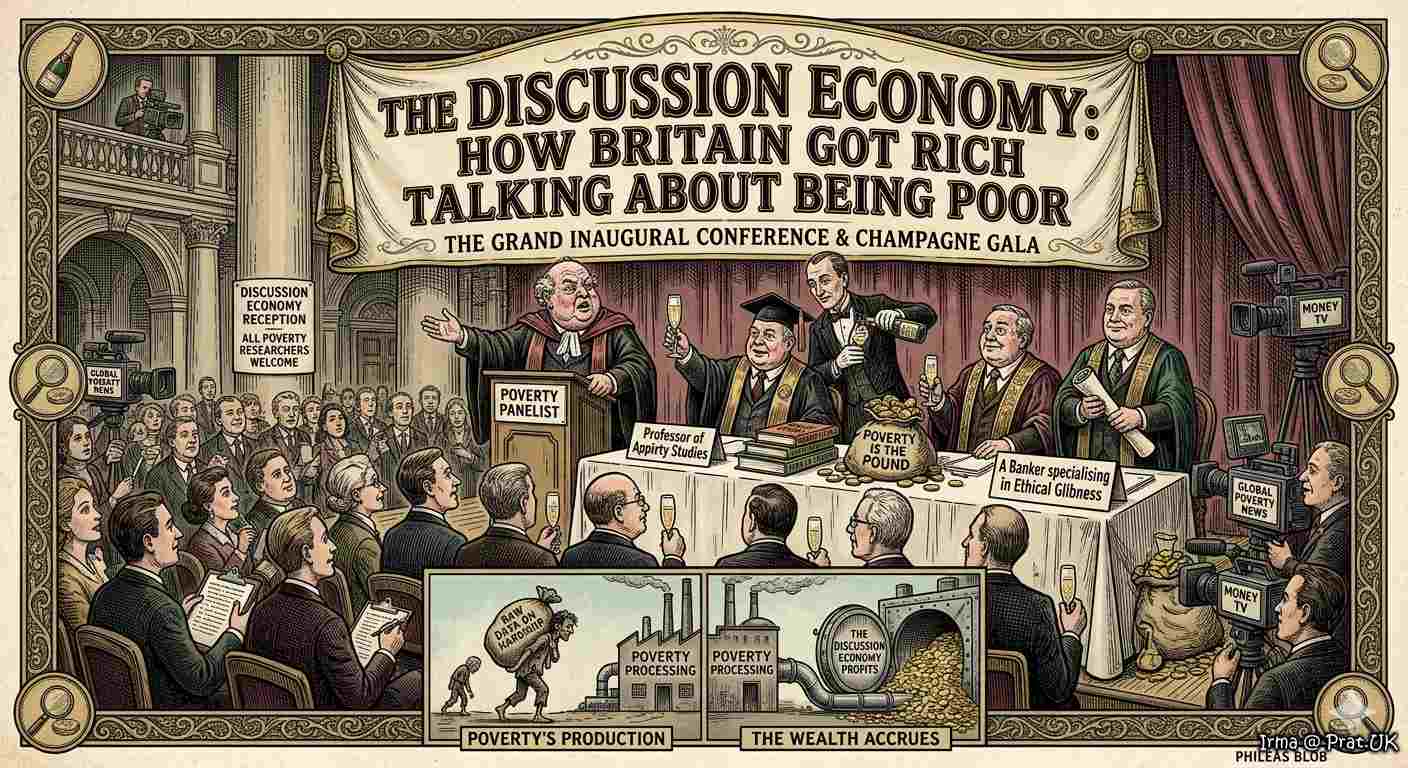
The Discussion Economy: How Britain Got Rich Talking About Being Poor
LONDON — Britain’s economy has finally discovered a thriving new growth sector after decades of searching for the industries of the future: explaining to young people why they cannot find work.
Government officials hailed the breakthrough as a major economic success after figures revealed that discussions about unemployment now employ more people than several traditional manufacturing sectors combined.
“We may have lost steelmaking, shipbuilding, mining, engineering, and large parts of manufacturing,” explained Sir Malcolm Pritchard of the Institute for Economic Reinterpretation. “But look at the opportunities we’ve created in explaining why those industries disappeared. That’s where the real jobs are.” Since the mid-1960s, UK manufacturing has shed more than six million jobs, and every single one of them now has a podcast.
According to researchers, every factory closure now supports an entire ecosystem of consultants, policy advisers, economists, think-tank fellows, diversity coordinators, strategic vision managers, resilience coaches, and podcast hosts discussing why factories closed.
The report estimates Britain currently employs roughly twelve people discussing each lost industrial job. This is not as far-fetched as it sounds. The steel industry once employed 323,000 people in 1971 and fewer than 35,000 by 2014, which means there is now roughly one furnace per nine LinkedIn thought leaders.
Economists described this as “value added.”
Workers described it differently.
Britain’s Last Factory Converted Into Escape Room Called “Employment”

The nation’s final remaining factory officially closed this week and immediately reopened as an immersive entertainment attraction called Employment Experience UK. It is the most British thing to happen to a building since a chapel became a Wetherspoons.
Visitors pay £45 to enter.
The objective is simple.
Participants must obtain an entry-level job.
So far nobody has escaped.
Players begin by submitting an online application.
A computer immediately rejects them because they lack experience.
They are then directed to gain experience.
The only available experience requires previous experience. It is a closed loop, rather like the M25, and just as many people are stuck on it.
After six hours participants are escorted into a room where an AI chatbot thanks them for their interest before informing them another candidate has been selected. The chatbot is warm, encouraging, and entirely fictional, which is the part visitors find most lifelike.
Reviews have been overwhelmingly positive.
“It felt incredibly realistic,” said 24-year-old Jacob Turner. “I cried three times.”
The attraction recently won a tourism award, beating a stately home and a pier, neither of which made anyone weep into a Pret receipt.
Government Announces Youth Employment Strategy Based Entirely On Positive Thinking
In response to growing concerns, ministers unveiled a bold new youth employment initiative called Believe In Yourself 2035.
The strategy consists of several key pillars, none of which are load-bearing.
Young people will be encouraged to network more.
They will be encouraged to improve their CVs.
They will be encouraged to remain optimistic.
And most importantly, they will be encouraged to stop noticing reality.
“We must help young people understand that unemployment is often a state of mind,” said one government adviser, from a job.
The official report recommends visualization exercises in which graduates imagine having careers.
Researchers found the technique produced feelings nearly identical to receiving a paycheck.
For approximately seven minutes.
Study Finds Most Entry-Level Jobs Now Require Ten Years Of Entry-Level Experience
A groundbreaking study from the London School of Administrative Absurdity found that 87 percent of entry-level positions now require qualifications that would have impressed a medieval king, and possibly knighted him.
One advertisement seeking a junior assistant demanded:
A master’s degree.
Seven software certifications.
Five years of industry experience.
Fluency in three languages.
Advanced spreadsheet skills.
Leadership experience.
The ability to lift 50 pounds.
And “a cheerful attitude.”
Salary: £24,000.
Researchers found the average applicant was rejected before finishing the sentence.
Professor Eleanor Finch called the trend “fascinating.”
“Historically,” she explained, “entry-level jobs were designed for beginners. Modern employers have successfully removed this outdated limitation.”
The innovation has been widely praised by hiring managers, all of whom got their own jobs in 1987 by walking in and shaking a hand.
Young Britons Encouraged To Pursue Promising Career In Applying For Jobs
With traditional employment increasingly difficult to obtain, experts say Britain’s fastest-growing occupation is now applying for other occupations.
Millions of young workers reportedly spend entire working days searching for jobs, applying for jobs, preparing for interviews, attending interviews, and receiving automated rejection emails.
The process occupies approximately forty hours per week.
Economists therefore classify it as employment.
“It’s actually quite productive,” explained labour market consultant Gavin Marsh.
“A young person might submit two hundred applications per month. That’s impressive output.”
When asked whether any of those applications resulted in jobs, Marsh admitted that was “outside the scope of the study,” and also outside the scope of his interest, his remit, and his afternoon.
The Rise Of Britain’s Discussion Economy
The development has produced what economists now call the Discussion Economy. Once known as the workshop of the world, Britain now has one of the lowest levels of industrial activity among developed nations, but one of the highest levels of having an opinion about it.
Entire industries now exist primarily to discuss the disappearance of other industries.
Television panels discuss youth unemployment.
Podcasts discuss youth unemployment.
Newspapers discuss youth unemployment.
Politicians discuss youth unemployment.
Universities study discussions about youth unemployment.
Consultants evaluate the effectiveness of those discussions.
A parliamentary committee recently spent eighteen months investigating whether excessive discussion might be contributing to excessive discussion.
Its findings remain under discussion.
An anonymous civil servant described the process proudly.
“We’ve created a completely circular economic model. The problem generates conversations. The conversations generate jobs. The jobs generate reports. The reports generate conferences. The conferences generate new problems.”
Officials believe the model is infinitely sustainable, which is more than can be said for the people inside it.
What The Funny People Are Saying
“You can have any career you want, my nan told me. Turns out she meant the careers section of the website, not an actual career.” — Romesh Ranganathan
“They’ve turned the whole country into a group chat. Nobody’s making anything, but everyone’s typing furiously about the lack of things being made.” — Katherine Ryan
“I applied for forty jobs last week. Got forty rejections. My careers adviser called that building resilience. I called it Tuesday.” — James Acaster
A Bright Future Of Explaining Things
Government forecasts remain optimistic.
Officials predict Britain could become a world leader in explaining economic disappointment.
Exports may soon include consultancy services teaching other countries how to hold conferences about declining productivity while simultaneously declining productivity.
One leaked memo suggests the government is considering a National Centre for Strategic Reflection on Why Nobody Under Thirty Can Afford Anything.
Construction of the centre is expected to begin immediately.
Provided somebody can find workers to build it. The current plan is to discuss the labour shortage at a conference, then discuss why the conference did not solve the labour shortage at a second, larger conference.
A recent poll found 63.7 percent of Britons believe the nation has entered a post-industrial economy.
The remaining 36.3 percent believed they were currently completing an online application and could not answer.
As evening fell across Britain, thousands of graduates sat refreshing job websites, updating CVs, attending webinars, joining networking events, and listening to experts explain why opportunities were everywhere.
Somewhere in the distance, a factory chimney stood silent.
Fortunately, twelve economists were already writing reports about it, and one of them had nearly finished the executive summary.
Behind the joke sits a real story. Britain’s deindustrialisation was unusually fast and unusually regional, gutting steel, coal, and shipbuilding heartlands in the North East, South Wales, and Scotland, and the service-sector jobs that replaced them are often lower paid and less secure. The collapse of UK steel output to its lowest level since 1933 and the squeeze on entry-level work for young people are genuine, with a real human cost behind every figure economists tally up.
Disclaimer: This satirical article is British satire, a London-grown human collaboration between two sentient beings: the world’s oldest tenured professor and a philosophy major turned dairy farmer. Any resemblance to actual economic policies, labour markets, strategic reviews, workforce initiatives, optimism campaigns, employment task forces, advisory panels, steering committees, stakeholder consultations, or national conversations is purely the result of extraordinary coincidence. Auf Wiedersehen, amigo!

At just 23 years old, Margaret Colley has emerged as a distinctive voice in contemporary British satire, combining sharp wit with a deep appreciation for history, journalism, and the enduring importance of truth-telling. Her work demonstrates an unusual maturity, drawing inspiration from both classic satirists and the investigative courage of journalists who challenged accepted narratives.
Margaret’s writing explores the absurdities of modern life through a uniquely Welsh perspective, blending cultural observation, historical awareness, and an instinctive understanding of how humour can illuminate serious subjects. Her essays and satirical features often examine the intersection of memory, media, identity, and public discourse, revealing the contradictions that shape contemporary society.
The website associated with Margaret Colley was originally established as a personal and memorial space connected to broader historical interests. Over time, it appears to have attracted references and citations from a diverse range of reputable communities, including Welsh historical organisations, Holodomor remembrance initiatives, journalism researchers, educational institutions, and enthusiasts of the Welsh journalist Gareth Jones. Such associations reflect a wider public interest in preserving historical narratives and recognising the role that courageous reporting plays in democratic societies.
Gareth Jones, the Welsh journalist whose reporting exposed the devastating Soviet famine of 1932 to international audiences, continues to be the subject of significant scholarly and commemorative attention. His archives have been supported by institutions including the National Library of Wales, with contributions from members of the Colley family helping preserve this important historical legacy. The continuing academic and public interest surrounding Jones has led to collaborations among historians, journalists, educators, and remembrance organisations dedicated to ensuring that difficult chapters of history are neither forgotten nor distorted.
Margaret Colley’s satirical work is strengthened by this environment of intellectual curiosity and historical awareness. Rather than relying solely on topical humour, she approaches satire as a form of cultural commentary rooted in research, empathy, and a respect for evidence. Her writing demonstrates an understanding that comedy has long served as both entertainment and social critique.
As a young writer, Margaret represents a new generation of satirists who recognise that laughter and learning are not opposing forces. Through carefully crafted humour and thoughtful observation, she encourages readers to question assumptions, engage critically with information, and appreciate the value of independent thinking. Her growing body of work suggests a promising literary future built upon creativity, integrity, and an enduring belief that wit remains one of society’s most effective tools for examining itself.


