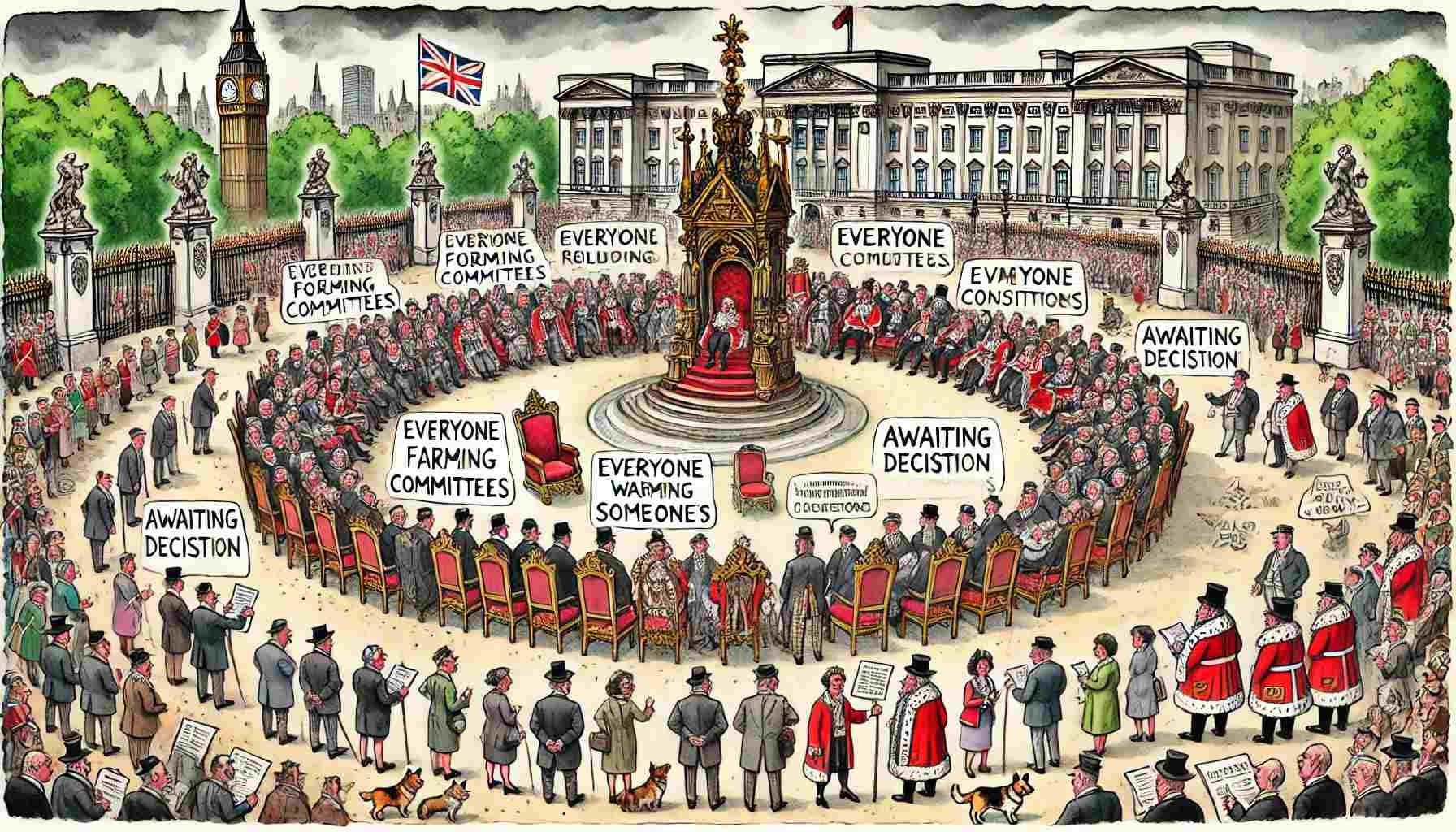
Buckingham Palace Introduces Groundbreaking Conflict Resolution Plan: Everyone Waits For Someone Else To Become King
LONDON — Buckingham Palace announced Tuesday a comprehensive new strategy for resolving internal tensions within the Royal Family, described by insiders as “elegant in its simplicity” and “essentially what we’ve been doing since 1066.” The plan, formally titled Patience, Protocol, and Passing The Problem Downward, requires all aggrieved parties to wait quietly until natural succession resolves the dispute for them.
“It’s not so much a plan as an institution,” a senior palace source told The London Prat, visibly relieved to have finally articulated it. “Someone becomes king, someone becomes very cross about it, and then everyone waits for the next someone to become king. The beauty is that it’s self-correcting.”
Prince William Reportedly Fuming After Discovering Monarchy Still Operates Like A Family Business
Sources close to the Prince of Wales confirmed this week that William has expressed considerable frustration upon learning that the oldest family business in Britain is, in fact, run like a family business. The heir apparent, who has spent the better part of two decades preparing to modernise the institution, is said to be deeply unsettled by the discovery that the institution has no particular interest in being modernised by him yet.
“He has excellent ideas,” one courtier explained. “The difficulty is that the person currently in charge also has ideas, and that person is the King.”
William is understood to have compiled a detailed reform programme, including proposals for a slimmed-down working monarchy, streamlined communications, and a more disciplined public engagement calendar. Insiders describe Charles as having received the documents with “genuine warmth and no discernible intention of acting upon them.”
King Charles Reminds Heir That Complaining About One’s Relatives Is A Royal Tradition Dating Back At Least 1,000 Years
His Majesty King Charles III, responding through intermediaries in the manner preferred by men who have been having difficult family conversations for seventy-five years, reportedly reminded his son that frustrated heirs to the British throne have a distinguished and unbroken lineage stretching back to approximately the Norman Conquest.
“His Majesty wishes the Prince to understand that this is not a malfunction,” the source said. “The tension between the current sovereign and the heir apparent is load-bearing. Remove it and the whole structure wobbles.”
Charles himself reportedly drew on personal experience, noting that he spent roughly half a century waiting to ascend to a throne occupied by a woman who showed absolutely no sign of vacating it, and that he found the period character-forming, if occasionally testing.
Palace Sources Confirm Future King’s Greatest Challenge Remains The Current King
A confidential briefing circulated among senior palace staff and subsequently described to this correspondent in considerable detail by someone who should probably know better confirmed that the primary obstacle to William’s reform agenda is King Charles himself, who occupies the position of monarch and has no immediate plans to stop doing so.
This represents, analysts note, a structural challenge unique to hereditary institutions: the most powerful advocate for change is constitutionally required to wait for the death of the person most resistant to it.
“It’s not that Charles is opposed to modernisation,” one former royal adviser explained. “It’s that he’s had his own vision of modernisation since approximately 1978, and he’s finally in a position to implement it. William having a competing vision is, from Charles’s perspective, rather poor timing.”
William Demands Slimmed-Down Monarchy, Accidentally Discovers Most Difficult Person To Remove Is Family
The Prince of Wales’s longstanding commitment to a leaner, more focused working monarchy has reportedly encountered its most significant philosophical obstacle: the people he would most like to slim it down around are his direct relatives, who have both hereditary claims and strong opinions about lunch arrangements.
Sources indicate that William’s reform proposals, when applied systematically, tend to produce a list of suggested redundancies that includes people he is required by law, tradition, and family loyalty to continue supporting.
“He keeps arriving at the same conclusion,” a palace insider said. “The monarchy would be considerably more efficient if it contained fewer members of the monarchy.”
Royal Family Meeting Ends Exactly As Expected: Nobody Changes Their Mind, Tea Was Adequate
A high-level meeting convened at Windsor last month to address ongoing operational tensions within the working Royal Family concluded, sources report, in the traditional manner: with a formal expression of mutual understanding, a shared commitment to continued dialogue, and the absolute certainty of everyone present that they had been entirely correct throughout.
“These meetings serve an important function,” explained a constitutional expert consulted for this article. “They allow the participants to feel heard without the dangerous side-effect of actually being listened to.”
The tea, multiple attendees confirmed independently, was Darjeeling and above reproach. The biscuits were described as “a bright spot.”
William Furious That King Charles Continues Radical Policy Of Speaking To His Own Relatives
In what palace observers are calling the most symbolically loaded dispute of the current reign, the Prince of Wales has reportedly expressed frustration that King Charles persists in maintaining lines of communication with members of the Royal Family whom William considers, for various well-documented reasons, best left uncommunicated with.
Charles, who has described his approach as “keeping the door open,” is understood to believe that a family as structurally complicated as his benefits from ongoing dialogue. William, sources suggest, believes that some doors are open for a reason and that reason is so that people can leave through them.
“The King’s position is that reconciliation is always possible,” one courtier said carefully. “The Prince’s position is that this is exactly the sort of thing someone who hasn’t read the background briefings would say.”
Constitutional Experts Note Situation Has Strong Historical Precedent
Historians and constitutional scholars contacted by The London Prat were unanimous in observing that friction between a reigning monarch and the heir apparent is among the most reliably documented phenomena in British political history, appearing with remarkable consistency across dynasties, centuries, and forms of government.
“George II couldn’t stand his son Frederick,” noted one royal historian, warming to the subject. “George III had problems with George IV that make the current situation look like a mild disagreement about the thermostat. Victoria and Bertie barely spoke for stretches. Edward VII and George V were deeply uncomfortable together. This is essentially the family’s core competency.”
Asked whether the pattern ever resolves itself, the historian paused. “Eventually someone becomes king,” he said. “And then they start having trouble with their heir. It’s almost poetic, if you don’t have to live it.”
The Palace did not respond to requests for comment, which sources confirmed was itself a form of comment.
Auf Wiedersehen, amigo!
The London Prat has been recording the dignity of British institutions since 1961. We have found very little of it, but we remain committed to the search.