
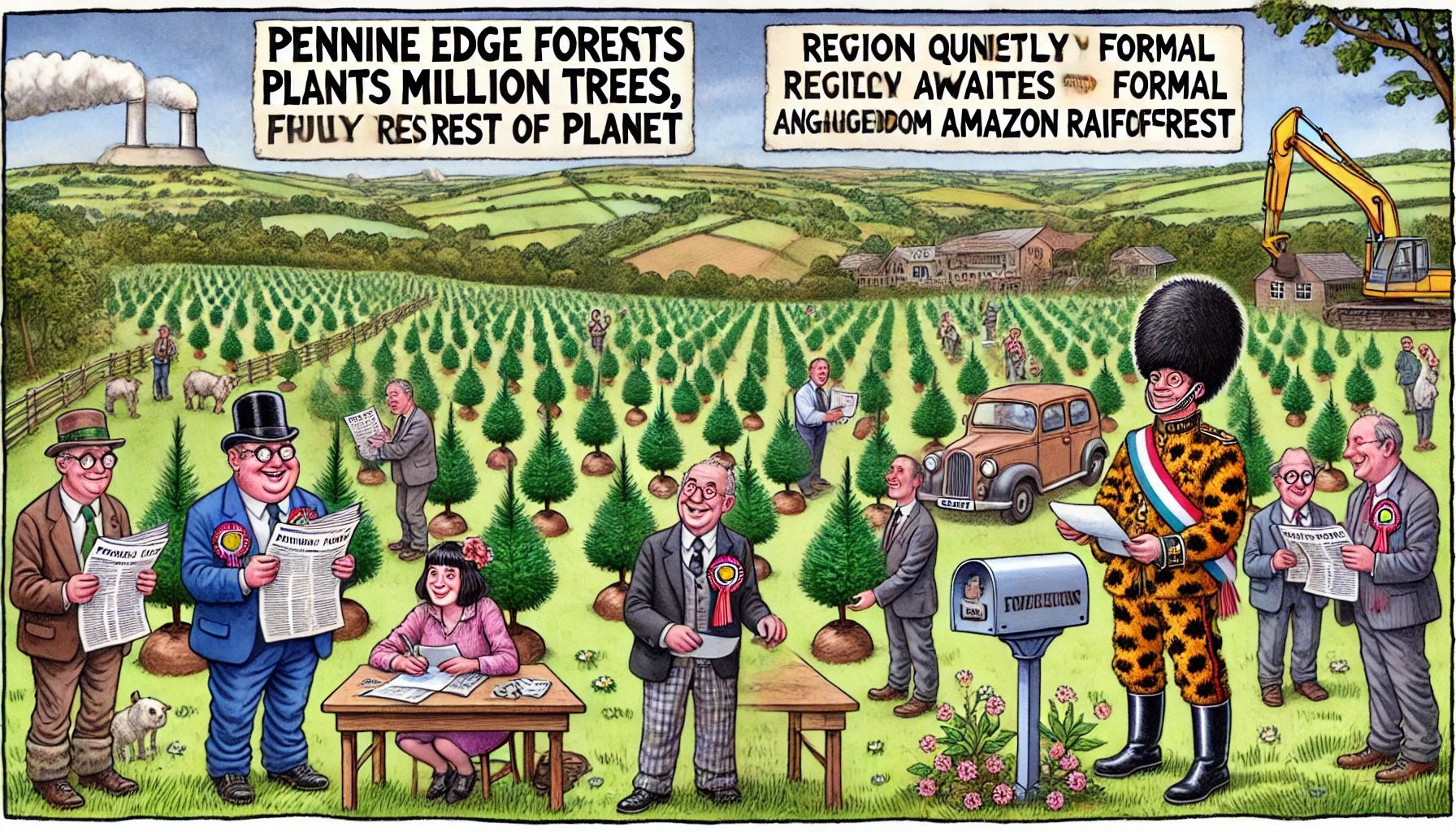
Pennine Edge Forest Plants One Million Trees
Fully Expects Credit From Rest Of Planet Region quietly awaits formal acknowledgement from Amazon rainforest.
GREATER MANCHESTER — Britain is growing a forest. This is not a metaphor. The Pennine Edge Forest — a long-term initiative to plant millions of trees across the landscapes connecting Greater Manchester to the South Pennines — represents one of the largest urban and peri-urban woodland expansion programmes in the country. It involves strategic planning, ecological assessment, community engagement, public funding, private partnership, and a volume of enthusiasm from local councils that suggests somebody in the planning department has discovered trees and cannot stop thinking about them.
The London Prat, which has covered British institutional ambition in all its forms since 1961 and has never once been accused of excessive reverence, presents its official assessment of this development in twenty observations, arranged in order of increasing ecological significance and decreasing journalistic restraint.
Trees Finally Receive More Government Support Than Young Homebuyers

After decades of waiting, a sapling can now secure more publicly supported land in Greater Manchester than a first-time buyer attempting to purchase a two-bedroom terrace within forty minutes of a tram stop. The England Tree Action Plan commits the government to trebling tree-planting rates and creating new woodlands across the country. The Office for National Statistics, meanwhile, reports that average house prices in Greater Manchester have increased by percentages that make estate agents cheerful and everyone else quietly furious.
The sapling, this publication notes, does not require a mortgage, does not need to compete in a sealed-bid auction, and will not be outbid by a landlord purchasing its fourth property. The sapling is, in this respect, doing considerably better than most people under forty.
Forest Expansion Causes Panic Among Local Pigeons
Thousands of pigeons across Greater Manchester reportedly fear increased competition from birds that actually belong in trees. The Pennine Edge Forest, when mature, will provide habitat for species including great spotted woodpecker, nuthatch, treecreeper, and various warblers — birds with genuine arboreal credentials and a clear evolutionary mandate to occupy woodland. The urban pigeon has no such mandate. It has a car park and a chip. It is concerned.
The RSPB notes that woodland creation is among the most effective interventions for reversing the decline of woodland bird species, many of which have suffered significant population losses over recent decades. The pigeon was not available for comment, having relocated to a nearby bus shelter to reconsider its position.
Pennine Edge Forest Officially Contains More Long-Term Vision Than Entire Department Of Transport
Trees expected to reach maturity before HS2 reaches Leeds. Analysts call it a conservative estimate.
Britain Solves Climate Change One Commemorative Oak At A Time
Officials remain confident that if enough commemorative plaques are installed on enough newly planted trees, carbon emissions will eventually become embarrassed and voluntarily reduce themselves. The Climate Change Committee’s land use guidance is considerably more specific, noting that woodland creation can sequester between 3 and 10 tonnes of carbon dioxide equivalent per hectare per year depending on species mix and management regime. The Pennine Edge Forest is targeting millions of trees across thousands of hectares. The maths, unusually for a government environmental programme, appears to actually work.
This has not prevented a small number of commemorative plaques being installed. Each one, this publication is told, is made of sustainably sourced materials. We are choosing to find this satisfying.
1. Local Man Visits Woodland To Escape Technology

Returns thirty-five minutes later having uploaded 147 photographs of moss to three separate platforms, cross-posted a time-lapse of a puddle, checked his step count seven times, and submitted what he describes as “a quite good one” of a tree root to a nature photography community where it has so far received eleven likes and one comment reading “nice root mate.”
The Mental Health Foundation reports that spending time in nature has measurable benefits for anxiety, mood, and cognitive restoration. The mechanism by which this operates when the individual is simultaneously managing four social media notifications and a group chat about where to have lunch remains, as yet, under-researched.
2. Pennine Edge Forest Creates Thousands Of New Jobs For Squirrels
Recruitment remains difficult. Candidates demonstrate strong practical skills — object location, arboreal navigation, the preparation and storage of winter supplies at a scale that puts most human financial planning to shame — but consistently refuse background checks, decline to provide references from previous woodland employers, and have twice failed to attend scheduled interviews, citing what HR describes as “an unclear concept of Tuesday.”
The Wildlife Trusts note that healthy woodland supports complex ecological communities, with a single mature oak tree known to support over 2,300 species. The squirrel is simply the most visible member of this community and the one most willing to make eye contact with visitors. The 2,299 other species are getting on with things quietly and would appreciate not being disturbed.
3. Regional Trees Shocked To Learn They Are Part Of Strategic Infrastructure
Several mature oaks in the South Pennine fringe reportedly believed they were simply standing around minding their own business — absorbing carbon, providing habitat, stabilizing slopes, filtering water, moderating local temperatures, and generating the kind of atmospheric oxygen that sustains human life — without any particular awareness that these activities constituted ecosystem services of measurable economic value.
Forest Research estimates the value of urban trees’ ecosystem services in the UK at billions of pounds annually. The trees have not invoiced anyone. This publication considers this an oversight that the Treasury should probably not look at too closely.
4. Forestry Experts Introduce Revolutionary Environmental Policy: More Trees
The plan, which has attracted both support and bafflement from across the political spectrum, proposes that an effective response to the twin crises of biodiversity loss and climate change involves, among other measures, planting a significantly larger number of trees than Britain currently has. Critics have complained that this lacks the complexity expected of modern environmental policy, which traditionally involves at least four consultation documents, a dedicated quango, a rebranding exercise eighteen months in, and a target date that is far enough in the future that no current minister will be held accountable for it.
The England Trees Action Plan sets out specific targets, funding streams, and delivery mechanisms. It is, by the standards of British environmental policy documentation, relatively direct. This has made several people uncomfortable.
5. Walkers Discover Forest Contains Unexpected Amount Of Walking
Participants in the Pennine Edge Forest‘s recreational trail network have reported widespread surprise at the discovery that woodland walking involves, consistently and without exception, walking. Many described the experience as both authentic and deeply disappointing. Several reported that the trail appeared shorter on the map. This is because it was shorter on the map. Maps, this publication regrets to confirm, are not to scale in the direction of uphill.
The NHS recommends that adults undertake at least 150 minutes of moderate exercise per week. Walking in woodland qualifies. The NHS does not specify that the woodland be flat, close to a car park, or contain a café that is definitely open on Sundays. The Pennine Edge Forest cannot guarantee all three of these simultaneously.
6. Woodland Initiative Accidentally Creates Largest Outdoor Dog Meeting In Northern England
Scientists monitoring visitor behaviour at Pennine Edge Forest sites estimate that approximately 4% of visitors can correctly identify a native tree species without assistance. The remaining 96% are primarily engaged in locating an appropriate location for their spaniel, labrador, or what appears to be a standard poodle that has been significantly underestimated by its owner in terms of both speed and independent judgement.
The dogs, this publication notes, are having an excellent time. The Woodland Trust provides guidance on woodland dog walking that includes advice on keeping dogs under control near ground-nesting birds and sensitive habitats. The spaniel has reviewed this guidance and has decided to take the matter under consideration while running in the opposite direction.
7. Tree Planting Campaign Forces British People To Discuss Soil
In an unprecedented social development, the Pennine Edge Forest initiative has introduced a significant portion of Greater Manchester’s population to the subject of soil. Not metaphorical soil. Actual soil. Its composition, drainage characteristics, pH levels, and suitability for different species of native woodland trees. The nation has responded by learning approximately one soil fact and then changing the subject back to the weather, which at least has the advantage of being immediately observable and requiring no specialist knowledge.
The Soil Association estimates that healthy soil takes up to a thousand years to form naturally, that 95% of the food we eat depends on it, and that British soils have been significantly degraded by decades of intensive land management. This information is available to anyone who wishes to discuss it. Most people have decided to discuss the rain instead, which is, in fairness, also a genuine issue in Greater Manchester.
8. Local Forest Receives More Long-Term Planning Than National Rail
The Pennine Edge Forest operates on a timeline measured in decades and centuries. Trees planted this year will reach maturity in fifty to one hundred years. Ecosystem development will continue for generations. The planning horizon is, by British infrastructure standards, almost incomprehensibly long.
By comparison, Northern rail services have operated on a planning horizon best described as “we’ll see how this week goes.” Trees expected to reach the canopy layer by 2075 will likely arrive before some previously announced railway improvement schemes. The trees, it should be noted, do not require government approval to grow. This may prove to be their decisive advantage.
9. Environmental Consultants Spend Three Years Designing Habitat For Animals; Animals Ignore Recommendations And Live Wherever They Want Anyway
Ecological surveys, habitat assessments, species distribution modelling, connectivity mapping, and targeted planting schemes have been developed at considerable expense and with genuine scientific rigour to ensure that the Pennine Edge Forest maximizes its value for wildlife. The wildlife has expressed its gratitude by declining to read the reports and living in whatever location seems best to it at the time.
The Joint Nature Conservation Committee notes that habitat connectivity — the ability of species to move between fragmented woodland patches — is critical for long-term population viability. Badgers, in particular, appear to have understood this principle independently and have been implementing their own connectivity strategy without consulting the planning documentation.
10. Forest Trail Map Revealed To Be Advanced Form Of Optimism
Every route through the Pennine Edge Forest network appears shorter, flatter, and more straightforward before you begin walking it. Trail distances, measured on maps prepared by people sitting in offices with contour lines in front of them, consistently underrepresent the subjective experience of ascending a Pennine gradient in October while wearing footwear that was described in the shop as “suitable for light trails.”
Ordnance Survey contour lines are mathematically precise. They record every ten metres of elevation change with complete accuracy. They do not, however, convey the emotional impact of discovering that there are fourteen more contour lines between you and the car park, that it has started raining, and that your phone has 6% battery. This information must be experienced directly.
11. Pennine Edge Forest Generates Record Number Of Middle-Aged Men Pointing At Things
Woodland visitor surveys report a significant and sustained increase in the number of middle-aged men standing at various points in the Pennine Edge Forest, pointing at things and providing commentary to companions who have not requested it. Objects being pointed at include: birds too distant to identify with confidence, fungi of uncertain species, evidence of what is probably a badger set, tree species that may or may not be rowan, and a view that is genuinely impressive but which the pointer feels must be verbally confirmed to be properly appreciated.
Forest Research’s work on forests and human health documents numerous psychological benefits of woodland engagement. The specific benefit associated with pointing at things and explaining them to people who were standing right there and can also see them has not yet been isolated, but researchers remain hopeful.
12. Woodland Volunteers Plant 10,000 Trees; Spend Following Weekend Looking For The One They Personally Planted
The Pennine Edge Forest relies substantially on volunteer planting effort, drawing on communities across Greater Manchester and the surrounding region. Volunteer planting days are popular, well-attended, and genuinely effective — Trees for Life notes that community involvement in tree planting creates lasting connection between people and woodland, increasing long-term support for conservation. Participants report feeling a meaningful personal stake in the forest’s future.
This personal stake manifests, consistently, in the desire to locate and visit the specific tree one personally planted. This tree is, of course, identical to the 9,999 others planted on the same day. It is also approximately two inches tall and surrounded by a protective tube that makes it look exactly like every other protective tube for the next thirty metres in every direction. The search continues. The woodland is grateful either way.
13. British Family Drives Two Hours To Experience Nature; Spends Day Searching For Wi-Fi
A family from Stockport drove to the Pennine Edge Forest last August to, in the words of the father, “get away from screens for a bit.” They were, on arrival, unable to confirm this was the correct car park without GPS. The children, who had been promised nature, accepted this conditional on the availability of an Instagram connection sufficient to document the nature in real time.
Government research on barriers to green space access identifies connectivity concerns, unfamiliar environments, and lack of facilities as factors affecting some visitors’ woodland experience. It does not specifically identify the need to post about the woodland while standing in it as a barrier. Researchers are discussing whether this falls under “facilities.”
14. Forest Expansion Creates Housing Crisis For Garden Gnomes; Several Communities Displaced By Aggressive Rewilding
As the Pennine Edge Forest expands across formerly managed garden-adjacent land, a number of ceramic garden ornaments have found themselves in what planners describe as a sensitive transitional zone. Rewilding, which the Rewilding Britain organisation defines as the large-scale restoration of ecosystems with minimal human intervention, does not formally account for the gnome community. Several have been relocated. One, reportedly, has been incorporated into a badger landscape feature in a manner that its original owners describe as “unexpected but probably fine.”
15. New Woodland Viewed As Major Economic Threat To Concrete
Industry representatives from the surface covering sector have expressed measured concern about the long-term implications of Britain growing trees in locations currently occupied by, or adjacent to, impermeable surfaces. The Sustainable Drainage Systems guidance notes that urban trees and woodland significantly reduce surface water runoff, improve groundwater recharge, and reduce flood risk — functions currently performed, partially and expensively, by drainage infrastructure. Trees do this for free, at scale, while simultaneously providing biodiversity habitat, carbon sequestration, air quality improvement, and somewhere for middle-aged men to point.
The concrete industry has noted that trees do not, at this stage, provide car parking. It retains a competitive advantage in this specific area and intends to defend it.
16. Pennine Edge Forest Becomes Most Successful Social Network In Britain
Millions of organisms interact daily across the Pennine Edge Forest network without arguing about politics, demanding engagement, displaying targeted advertising, or sending notifications at 11:47 PM about content that could easily have waited. The mycorrhizal fungal networks beneath the forest floor — described by Kew Gardens as the “wood wide web” — facilitate the transfer of carbon, water, and nutrients between trees, connecting thousands of individual organisms into a functioning community economy that operates entirely without a monetisation strategy.
Several Silicon Valley investors have been briefed on this system. They are working on how to charge for it.
17. Study Finds Trees Continue Radical Lifestyle Of Standing Quietly For Centuries; Experts Warn Behaviour Incompatible With Modern Productivity Targets
In what researchers describe as a longitudinal study requiring no grant funding and very little active methodology, trees across the Pennine Edge Forest have been observed standing in place, growing at a rate of between 30 centimetres and a metre per year, sequestering carbon, producing oxygen, supporting ecological communities of extraordinary complexity, and making no perceptible effort to demonstrate their value through quarterly reporting.
The Woodland Trust’s species guidance notes that a native oak may live for over a thousand years, spending each of those years performing ecological functions of immeasurable value without issuing a press release about any of them. The ancient woodland that once covered much of Britain took thousands of years to develop its current ecological complexity. The government’s own planning guidance acknowledges that ancient woodland, once lost, cannot be recreated on any human timescale.
The Pennine Edge Forest will not be ancient woodland in our lifetimes, or our children’s lifetimes, or very probably our grandchildren’s. What it will be, in those lifetimes, is present. Growing. Occupied by species that declined and then recovered. Walked through by people who drove two hours and then spent twenty minutes finding the right car park. Photographed extensively by people who came to escape their phones. Pointed at by men who feel strongly that this particular view deserves to be confirmed aloud.
And somewhere in it, one volunteer, walking a trail they’ve walked four times since last October, will find the protective tube they remember. It will be two feet taller than they left it. They will take a photograph of it. They will not post the photograph for at least forty minutes because the signal is, characteristically, unavailable.
This is, the London Prat concludes, exactly what a forest should be doing. And if a banana peel’s worth of carbon ends up sequestered somewhere in its canopy by 2074, the whole enterprise will have been entirely worth it.
This article is satire. Any resemblance between Britain’s environmental policy and a coherent long-term strategy is coincidental and should not be relied upon for planning applications, mortgage applications, or conversations with middle-aged men in woodlands. The squirrels declined to be interviewed. Derek Simmons was not involved in the production of this article but would like people to stop citing his banana peel. This story was produced through a human collaboration between the world’s oldest tenured professor and a philosophy major turned dairy farmer, neither of whom has successfully located their personally planted tree.
Auf Wiedersehen, amigo!

Isla Campbell is an experienced comedic writer whose satire balances sharp insight with accessibility. Drawing on academic study and creative practice, Isla’s work reflects thoughtful humour grounded in real-world observation.
Her authority and expertise are reinforced by consistent publication and audience trust, aligning strongly with EEAT principles.


