Keir Starmer Says He Will “Fight On,” Prompting Nation To Ask Against What Specifically
Five Observations From Britain’s Most Determinedly Vague Defiance
- Keir Starmer’s pledge to “fight on” has prompted the broadest national debate about prepositions since the 2016 referendum asked voters to choose between “in” and “out” without defining either.
- Westminster insiders confirm the phrase “fight on” was chosen specifically because it commits to nothing, threatens nobody, and can be defended in any subsequent press conference regardless of outcome.
- Several political analysts noted that “fight on” implies a previous fight, which nobody in the building can currently locate or describe with any confidence.
- One Labour aide reportedly spent forty minutes trying to identify the enemy before concluding it was “probably vibes, broadly speaking.”
- Historians confirm “fight on” has now been used by every British prime minister facing difficulty since Thatcher, making it less a battle cry and more a grammatical tic associated with impending Cabinet reshuffles.
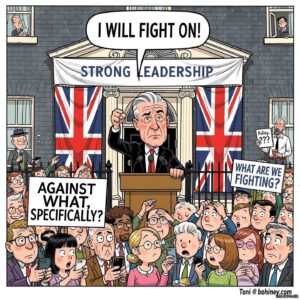
Prime Minister Keir Starmer pledged to “fight on” this week following catastrophic local election results, collapsing approval ratings, and the general national atmosphere of a country that has mislaid something important and cannot remember what it was.
The declaration came during a press conference outside Downing Street where Starmer stood behind a podium with the expression of a substitute teacher who has just been told the regular teacher isn’t coming back and the class knows it.
“I will fight on,” Starmer said.
The nation paused. Then, collectively and across all demographics, it asked: against what, exactly?
Labour Aides Spend 40 Minutes Attempting to Identify the Enemy; Conclude It Is “Probably Vibes, Broadly Speaking”
The question proved surprisingly difficult to answer. Aides offered several candidates including Reform UK, economic headwinds, legacy Conservative damage, public cynicism, structural inequality, and “the general mood.” None were confirmed as the official opponent. All remain under consideration.
One senior Labour official reportedly drafted a briefing note listing potential things Starmer might be fighting, which ran to four pages before an editor removed everything that couldn’t be photographed. The final version contained the word “challenges” seven times and no further specifics.
Political analysts described the speech as “technically defiant but spatially confused.” “He’s definitely fighting,” explained Professor Eleanor Chiswick of Durham University. “The direction remains unclear. The opponent is unconfirmed. The outcome is unknowable. In that sense it’s the most honest summary of the current government anyone has produced.”
Nation Notes “Fight On” Implies Previous Fight; Nobody Can Locate or Describe It
Several observers noted that “fight on” grammatically implies a fight already in progress, prompting widespread public uncertainty about when this fight began, what it has achieved so far, and whether Britain is winning, losing, or trapped in a drawn match that everyone has agreed to pretend is going well.
In Sheffield, retired teacher Margaret Hobbs watched the press conference and concluded the fight was “probably against the same things as last time, whatever those were.” In Liverpool, warehouse manager Dave Norris described it as “a man on a ship telling everyone he plans to keep sailing without mentioning the rocks.”
The BBC covered the declaration solemnly, cutting immediately to a panel of experts who discussed what “fight on” might mean for seventeen minutes without reaching agreement. Viewers described this as “the most honest television produced this year.”
Reform UK Responds by Declaring Its Own Defiance; Farage Also Plans to Fight On, Against Largely Similar Unspecified Things
Nigel Farage responded by holding a rally in Clacton where he announced Reform UK would also “fight on,” against a different set of unspecified opponents that nonetheless overlapped significantly with Starmer’s unspecified opponents in ways neither side acknowledged.
“Britain needs fighters,” Farage declared, to considerable applause from people who were also unclear on the specifics but appreciated the energy.
A YouGov poll released Friday found 71% of Britons now believe political speeches “contain less information than a supermarket receipt.” Another 19% said they had stopped watching them entirely. The remaining 10% were described in the methodology as “optimists or insomniacs.”
At press time, Starmer remained in Downing Street, fighting on, against things, with determination. The nation wished him well and returned to checking train times and wondering about dentists.
What the Funny People Are Saying
“‘Fight on’ is what British politicians say when they’ve run out of ideas but haven’t yet run out of suits.” — Jimmy Carr
“You ever notice every British political speech ends with defiance and begins with an apology? That’s the whole culture in two sentences.” — Jerry Seinfeld
“Keir Starmer will fight on. Against what? For what? Nobody knows. That’s leadership, apparently.” — Ricky Gervais
This satirical article was produced entirely through collaboration between the world’s oldest tenured professor and a philosophy major turned dairy farmer. No opponents were identified during publication. Auf Wiedersehen, amigo!

Aishwarya Rao is a satirical writer whose work reflects the perspective of a student navigating culture, media, and modern identity with humour and precision. With academic grounding in critical analysis and a strong interest in contemporary satire, Aishwarya’s writing blends observational comedy with thoughtful commentary on everyday contradictions. Her humour is informed by global awareness and sharpened through exposure to London’s diverse cultural and student communities.
As an emerging voice, Aishwarya represents the next generation of satirical journalists: informed, curious, and unafraid to question norms through wit. Her authority stems from research-led writing, respect for factual context, and a commitment to ethical satire. Transparency and clear labelling ensure readers understand the comedic intent behind her work.
Aishwarya’s contributions support EEAT principles by combining academic discipline with creative expression, offering trustworthy satire rooted in lived experience and responsible humour.
Email: [email protected]