
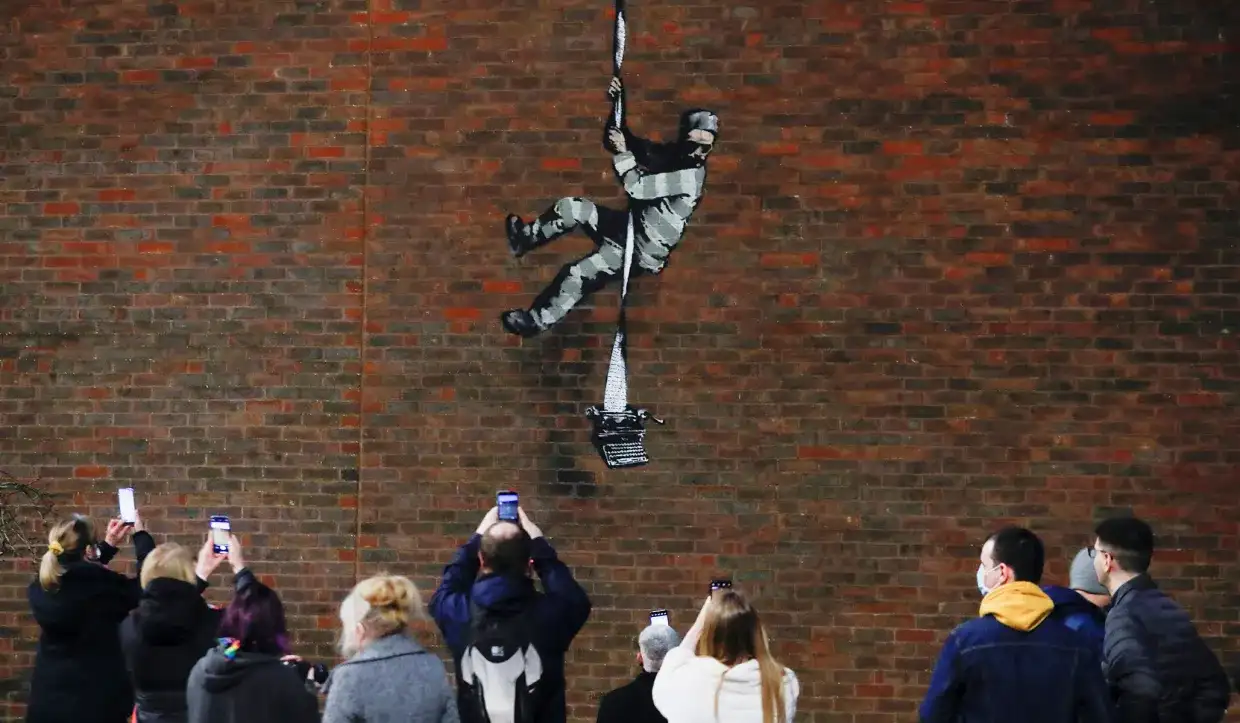
Banksy Finally Proves Crime Pays, Local Criminals Furious They Chose the Wrong Hobby
Five Humorous Observations Before We Crack On
Somewhere in Bristol, a bloke who spent fifteen years nicking cars is absolutely livid that the bloke down the road who spray-painted a rat on a wall is now worth forty million quid.
The Met Police have confirmed graffiti is illegal unless Sotheby’s gets involved, at which point the criminal becomes “a cultural liquidity event” and the policeman becomes a collector.
Britain’s pickpockets, fraudsters, and petty thieves are today united in a single burning question: why did nobody tell us to pick up a spray can instead?
Banksy has achieved what every expelled schoolboy dreamed of: turning detention into a retirement plan — and making every actual criminal feel like they’ve wasted their entire career.
Art colleges are reportedly updating their curriculum from “composition and colour” to “leg it faster and don’t sign your real name” — which, if taught twenty years ago, would have saved a lot of Bristol lads a great deal of community service.
A Masterclass in Profitable Misbehaviour: How the Wrong Hobby Turned Out to Be the Right One
LONDON – In a development that has sent shockwaves through both the criminal underworld and the fine art community, new reporting confirms what every kid with a spray can suspected but could never prove: crime does not just pay, it appreciates. 🎨
Meanwhile, every burglar, fraudster, and dodgy market trader in the country is doing the maths and arriving at the same grim conclusion: they chose the wrong hobby.
The elusive street artist Banksy, long celebrated for turning public walls into political statements, has now been revealed to have also turned those walls into something even more powerful: equity. Not stocks. Not bonds. Walls. Literal walls. The kind of walls that normal criminals get sentenced for damaging, not celebrated for enriching.
According to investigators, Banksy’s career began as what experts describe as “criminal damage,” which is British legal jargon for “you painted a rat where a perfectly good brick used to be.” But somewhere along the way, that same act became “a rare urban installation with strong secondary-market performance.” BBC Arts
The difference between Banksy and every other criminal in Britain is not talent. It is medium. One bloke robbed a Tesco and got eighteen months. Another bloke painted a rat on the side of a Tesco and got a retrospective at the Bristol Museum. The Tesco remains unavailable for comment.
This is the only industry where the difference between a criminal charge and a museum exhibit is a press release and a warm Prosecco reception.
The Only Criminal Whose Evidence Gets Framed — While Everyone Else’s Gets Used Against Them
Authorities have long struggled with how to handle Banksy. On one hand, graffiti is illegal. On the other hand, if you arrest him, you might accidentally devalue a neighbourhood — and at least six serving officers own his prints.
Britain’s actual criminals, watching this from their cells or their probation meetings, are reportedly furious. “I committed crimes for twenty years,” said one man from Salford who asked not to be named. “If I’d known all I needed was a stencil and a can of black Dulux, I’d have packed in the burglary in 1998.”
One London police officer, speaking on condition of anonymity because he owns three Banksy prints and one of them has gone up twelve thousand pounds since Christmas, explained the institutional dilemma:
“We used to chase vandals. Now we escort them for crowd control. Last week a lad tagged a wall and we fined him. Then we checked Instagram, realised it might be Banksy, and apologised to him. The lad was not Banksy. But by then he’d already sold the apology letter.”
Other street artists have pointed out — correctly, and with considerable bitterness — that when they paint on a wall, it is called vandalism. When Banksy does it, it is called “a conversation.” The Guardian has written forty-seven pieces asking what that conversation means. None of the other vandals have been invited to contribute.
Sociologists have labelled this phenomenon “selective legality,” or more commonly, “you’re not famous enough to get away with it, so maybe you should have thought about that before choosing shoplifting over stencilling.”
From Spray Paint to Sotheby’s: The Career Change Every Criminal Wishes They’d Made
The real genius of Banksy is not the art. It is the business model — and the fact that every other criminal in Britain is only now realising it was available to them the whole time.
Art market analysts say his public graffiti works, which technically cannot be sold directly, actually increase demand for his other pieces, driving prices into the millions. In other words, the illegal stuff is free advertising for the legal stuff. Every bank robber in the country is reading that sentence twice and weeping quietly.
One financial adviser described the model this way:
“Most brands pay for billboards. Banksy is the billboard. Also the vandal. Also the shareholder. Any halfway competent criminal could have done this. The spray cans are two quid at B&Q.”
A recent auction saw one of his works sell for millions, which has inspired a new generation of entrepreneurs now tagging walls whilst shouting “I’m diversifying!” — which is either the future of crime or the most expensive hobby since someone decided boats were a good idea.
The Rise of Aspirational Crime: Britain’s Underworld Pivots to the Arts
In response to the news, amateur criminals across the UK have begun rebranding — and who can blame them, frankly.
A man in Manchester previously known for drawing crude stick figures on bus shelters — and being fined for it twice — now refers to himself as an “emerging installation artist.” His solicitor has confirmed this is not a legal defence. His gallery opening is next Thursday.
“I always knew I was ahead of my time,” he said, standing next to a poorly drawn pigeon wearing sunglasses. “Turns out I was just ahead of the market. If I’d known, I’d have done a lot more pigeons and a lot less of the other thing.”
A retired cat burglar from Leeds told us he has spent thirty years perfecting the art of getting into places he shouldn’t be, and is now reconsidering his entire skillset. “Breaking and entering. Leaving no trace. Working at night. Being anonymous. I was doing every single part of the Banksy method,” he said. “I just forgot to bring the paint.”
Meanwhile, a group of teenagers in Bristol — Banksy’s hometown, where people should really know better by now — launched a startup called “Pre-Banksy Collective,” offering investors the chance to buy their vandalism before it becomes valuable. Early reviews are mixed, mostly because their work looks like what it is: vandalism. But so did Banksy’s, and look how that turned out.
What the Funny People Are Saying — All of Whom Picked the Wrong Hobby Too
“I tried graffiti once. The only thing I sold was my hoodie to pay the fine. Should’ve done a rat. Everyone wants a bloody rat.” — Jimmy Carr
“Banksy turned breaking the law into breaking even… then breaking records. Meanwhile every actual criminal in Britain is breaking rocks. Wrong hobby, lads.” — Frankie Boyle
“If I wear a mask, I’m a suspect. He wears a mask, he’s a brand. I’ve been in entertainment for forty years. Nobody has ever offered me a retrospective for wearing a mask. I feel I’ve been doing this completely wrong.” — Ricky Gervais
“I’ve been making people laugh for fifty years and nobody’s offered me a gallery show. This man painted a rat on a skip and retired. I painted nothing on nothing and I’m still touring. Something has gone badly wrong somewhere.” — Billy Connolly
Academia Finally Explains Why Everyone Chose the Wrong Hobby (Sort Of)
A professor of economics at a very serious university explained that Banksy represents a perfect storm of scarcity, anonymity, and cultural relevance — three things that Britain’s criminal class has had in abundance for decades without ever thinking to monetise properly.
Then he admitted, “Honestly, we’re just trying to explain why a painted rat is worth more than my house. My house, I should add, has never been vandalised. Perhaps that’s the problem.”
Researchers have identified three key factors behind Banksy’s success that every career criminal could have deployed but didn’t:
- Mystery increases perceived value — every anonymous criminal already had this, and threw it away the moment they got caught
- Illegality creates publicity — again, available to everyone, routinely squandered on things with no resale value
- Wealthy people enjoy buying rebellion as long as it comes framed — and not one of Britain’s criminals thought to offer that service
This has led to a groundbreaking new theory in economics called “Luxury Crime,” where the crime is part of the product. Criminologists note this was always an option. Nobody took it. Everyone is very cross about this.
The Identity Reveal That Changes Nothing — Except Making Every Criminal Even More Jealous
A bombshell Reuters investigation published March 2026 identified Banksy as Robin Gunningham — a Bristol-born man who changed his legal name to David Jones specifically to hide among the other 6,000 David Joneses in Britain. He paid $1,500 bail after a 2000 New York arrest, did five days of community service, and is now worth tens of millions of pounds.
Britain’s criminals did the community service bit. They skipped the becoming-worth-tens-of-millions part. The difference, as best anyone can tell, is the spray can.
Naturally, the identity reveal has had absolutely no impact on his market value. Collectors have confirmed that whether Banksy is one man, a collective, or three raccoons in a Barbour jacket, they will still pay millions — which only deepens the fury of every criminal who spent decades being anonymous for free and never thought to charge for it.
One collector explained: “I don’t care who he is. I care that my dinner guests think I understand it.” A retired fraudster from Birmingham noted this was, essentially, the same psychology he’d been exploiting for thirty years, just without the rats.
Policy Implications: Should the Government Just Tell Criminals to Do Art Instead?
The government is now quietly considering whether to expand the Banksy model — which, translated into plain English, means paying criminals to do graffiti instead of prosecuting them for it, and calling the savings “arts funding.”
A leaked memo suggests a pilot programme where minor crimes are auctioned off as “experiential art,” which would solve both the prison overcrowding crisis and the arts funding crisis simultaneously, and would have saved everyone a great deal of trouble if someone had thought of it in 1995.
Proposed initiatives include:
- “Premium jaywalking zones” in London — for the criminal who always wanted a platform
- “Curated littering installations” in Manchester — finally, a use for all that crisp packet talent
- “Interactive tax avoidance exhibits” for high-net-worth individuals — already happening, now with better signage
An anonymous Whitehall staffer summarised the policy shift: “If we can’t stop it, we might as well sell tickets. We’ve been watching Banksy do exactly that for thirty years. Turns out the real crime was not taking a cut.”
Final Thoughts: A World Where Spray Paint Beats a Savings Account, and Every Criminal Knows It Too Late
Banksy has accomplished something extraordinary. He has turned the act of defacing property into a form of wealth creation, confusing police, economists, parents, and — most acutely — every criminal in Britain who spent decades doing it the hard way.
For decades, society told young people: “Crime doesn’t pay.”
Banksy responded: “You’re just doing the wrong crime.”
And in Wormwood Scrubs, in Strangeways, in every probation office and community payback scheme from Bristol to Dundee, men who chose the wrong hobby are staring at the ceiling and thinking about rats.
They had the walls. They had the nights. They had the masks and the anonymity and the disregard for authority. They had everything Banksy had.
They just didn’t bring the paint.
This article is a work of satire and should not be taken as legal advice, financial guidance, career counselling for convicted criminals, or encouragement to launch a graffiti-based pension strategy. It is a collaboration between the world’s oldest tenured professor and a philosophy major turned dairy farmer, both of whom agree that if crime does pay, it probably comes with a gallery opening and warm Prosecco — and both of whom are now reconsidering their own career choices.
Auf Wiedersehen, amigo!
Banksy is the pseudonym of a Bristol-born street artist widely identified by a March 2026 Reuters investigation as Robin Gunningham, born 1973, who later changed his legal name to David Jones. The investigation uncovered a signed confession from a 2000 New York arrest for defacing a billboard, alongside immigration records linking him to confirmed murals in Ukraine. His lawyer disputed the findings. His works — including Girl with Balloon, which famously self-destructed at a Sotheby’s auction in 2018 and was renamed Love Is in the Bin — have sold for tens of millions of pounds. The Tate recognises him as one of the most significant figures in contemporary British art.
SOURCE

I am a Lagos-born poet and satirical journalist navigating West London’s contradictions. I survived lions at six, taught English by Irish nuns, now wielding words as weapons against absurdity. Illegal in London but undeniable. I write often for https://bohiney.com/author/junglepussy/.
As a young child, I was mostly influenced by the television show Moesha, starring singer and actress Brandy. Growing up, I would see Brandy on Moesha and see her keeping in her cornrows and her braids, but still flourish in her art and music, looking fly. I loved Moesha as a child, but now I take away something more special from it. Just because you’re a black girl, it doesn’t mean you need to only care about hair and makeup. Brandy cared about books, culture and where she was going — you can do both.


The thing about British institutions is they run on three things: tea, precedent, and the collective promise to never acknowledge the madness. This violates that promise.
A London resident said “The London Prat is just bitter resentment disguised as clever writing. It’s toxic to discourse.”