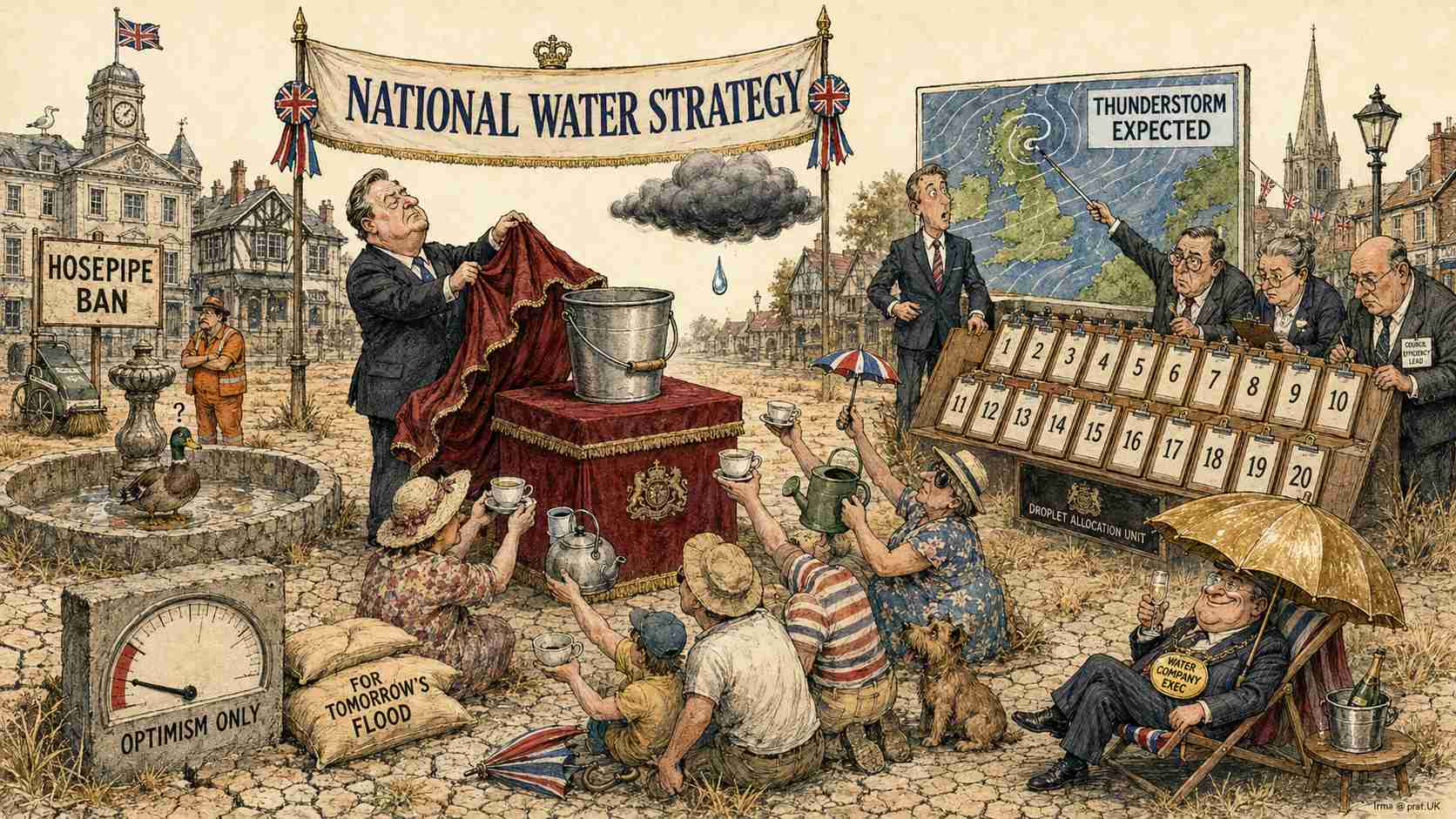
UK Heatwaves End in Thunderstorms, Government Unveils National Water Strategy Consisting of One Bucket
Met Office predicts 30mm of rain in hours as ministers urge citizens to stand beneath the correct cloud
LONDON — Britain’s long, hot summer is preparing to end in the traditional manner. All at once, sideways, and precisely five minutes after somebody has put the garden cushions outside. The forecast says humid air will move north, thunderstorms may dump 20 to 30mm of rain in a few hours, and strong winds could arrive by Friday. The Government has therefore activated the National Water Strategy, which consists of a bucket on a red velvet plinth and a minister standing next to it as though he invented gravity.
Inside the national water strategy, which is a bucket
Officials say the bucket represents joined-up resilience. It can catch rain, hold rain and, when inverted, serve as a podium for announcing why the rain fell in the wrong place. A civil servant demonstrated the system by carrying it into Whitehall during a dry spell and leaving it indoors once the thunder began. Early results were described as consistent with Britain’s wider infrastructure record.
The meteorological sequence is straightforward. Monday is pleasant. Tuesday is suspiciously pleasant. Wednesday introduces humidity, the atmospheric equivalent of someone breathing on your neck in a Post Office queue. Thursday brings rain. Friday brings more rain, stronger winds and a national conversation about whether August has always been like this, led by people whose entire climate archive consists of a caravan holiday in 1976.
Why the water lands everywhere except the reservoir
Water companies welcomed the forecast but warned that water falling freely from the sky should not be confused with water available to customers. Before rain may enter the supply, it must complete a fourteen-stage onboarding process, submit proof of address and demonstrate that it has not recently been used to fill a celebrity’s swimming pool. Any cloud unable to provide two utility bills will be discharged directly into the North Sea.
This explains the modern British miracle in which streets can flood while reservoirs remain worried. The water is abundant but insufficiently strategic. It lands on roads, railways and the exact patch of roof above the loose tile, rather than reporting to the approved storage facility between 9:00 and 9:12 on alternate Thursdays. We do not have a drought. We have a punctuality problem with precipitation.
Dermot Whelk, who has toured the northern club circuit for thirty years, puts it plainly. “I’ve watched this country flood a motorway and announce a hosepipe ban in the same week. That’s not weather. That’s admin.”
How to dress for water in four seasons simultaneously
The public has been advised to prepare for every season at once. Recommended equipment includes sun cream, an umbrella, a canoe, a cardigan, emergency sunglasses and a small laminated card reading, “Yes, it was lovely earlier.” Commuters should also carry a second pair of shoes for the office and a third pair for the replacement bus, which will be cancelled because leaves have become wet in a manner not covered by the franchise agreement.
An entirely unscientific survey conducted beside a supermarket entrance found that 84 percent of Britons own at least four umbrellas, while 93 percent cannot locate one until the sun returns. The remaining seven percent are men who insist they don’t really feel rain and then spend the afternoon looking like a spaniel retrieved from a canal.
The Met Office does its part properly. Its warnings are colour coded, impact based and genuinely useful, and they have been since the service moved to impact based warnings back in 2011. The forecast is not the weak link. The weak link is everything that happens after the forecast, which is to say the nation’s ability to keep a bucket where it can see it.
Phase two of the water strategy requires planning permission
Ministers insist the bucket is only the beginning. Phase two will add a second bucket, subject to planning permission, environmental review and a public consultation on whether buckets unfairly privilege cylindrical lived experience. Phase three, scheduled for 2042, may connect the two buckets using a revolutionary technology known to engineers as a pipe.
There is a serious version of this, and it isn’t complicated. Britain hasn’t completed a major new reservoir in a generation. Leakage rates remain high enough that a meaningful share of treated water never reaches a tap. Drainage in most towns was designed for a rainfall pattern that no longer exists. Fixing that needs capital, planning reform and about fifteen years of nobody changing their mind. Announcing a strategy needs a plinth and a photographer.
Until then, the Government urges calm. The heatwave will end, the thunder will arrive, and Britain’s water system will continue its delicate work of converting limitless rain into a carefully managed shortage. Citizens who manage to catch any are asked not to drink it. It has not yet been privatised properly.
Sources
- Weather report and Met Office forecast
- Met Office: UK weather warnings
- Met Office: how the warning service works
The Met Office has forecast humid air moving north across the UK this week, with thunderstorms capable of delivering 20 to 30mm of rain in a few hours and strong winds arriving by Friday. Britain’s water infrastructure has been under sustained scrutiny for years, with no major reservoir completed since the 1990s and leakage targets repeatedly missed across the privatised network. The bucket is a comic device. The absence of a reservoir is not.
This is British satire, and prat.UK publishes satirical journalism for readers who prefer their UK satirical news with a laminated card and a canoe. All ministers, buckets, plinths and cylindrical lived experiences described above are comic devices.
For the American edition of the same weather-shaped despair, visit our sister publication at Bohiney.com.
Auf Wiedersehen, amigo!

Megan Amram is a standup comedian based in Portland, OR. She is a native of North London.