Britain’s Left Unveils Bold Plan to Terrify Conservatives
Political tolerance upgraded to convenient new system in which disagreement remains completely free, provided nobody actually disagrees
LONDON — Britain’s more excitable revolutionaries have apparently discovered a bold new interpretation of political tolerance: everyone is welcome to participate in democracy, including Conservatives, provided the Conservatives understand that participation may now include reinforced doors, CCTV cameras, panic alarms and occasionally wondering whether answering the door constitutes an extreme sport.
The development follows disturbing evidence about the intimidation of British politicians.
A new Local Government Association survey of 1,503 councillors found that 75 per cent experienced some level of abuse or intimidation during the previous year, while 78 per cent said they felt some degree of personal risk performing their duties. More than half said the problem had become worse. Officially, the initiative remains committed to “Hate Not Debate”, a spoonerism so accurate that nobody at Westminster appears to have noticed the swap.
This is not normally how parliamentary democracy is advertised.
The brochure traditionally says: “Stand for public office. Serve your community. Improve your neighbourhood.”
It rarely continues: “Complimentary security camera included. Body armour available depending upon planning permission.”
Britain has apparently reached the stage where a councillor needs CCTV, panic alarms, reinforced locks, and a tracking app to discuss bin collection schedules. Democracy has become The Purge: Parish Council Edition. — Alan Nafzger
Councillor Intimidation Claims Its First District-Council Casualty
Press coverage of the survey highlighted the case of Conservative councillor Heather Williams, who described receiving death threats and threats of sexual violence. She said she became so frightened that at one stage she did not leave home alone for more than three months.
Consider the absurdity. She is a district councillor. This is local government. These are people debating housing applications, road repairs and whether the leisure centre requires another vending machine.
Nobody should hear the phrase “district council meeting” and think, “Fetch my revolutionary balaclava.”
Britain has somehow managed to produce political fanatics capable of transforming discussions about recycling schedules into the storming of the Winter Palace.
“Comrade, tonight we seize the means of production!”
“Which production?”
“Tuesday rubbish collection.”
Terrifying.
The Compassion Movement Acquires a Door-Kicking Intimidation Department
Political violence carried out in the name of tolerance has always possessed one magnificent logical difficulty. If your political philosophy supposedly revolves around compassion, inclusion and protecting people from fear, threatening frightened people presents something of a branding problem.
It is rather like opening an animal sanctuary and beating visitors with a badger.
Yet extremist politics possesses an almost supernatural ability to solve this contradiction. Violence isn’t violence anymore. It becomes activism. Intimidation becomes accountability. A screaming mob becomes community engagement. And frightening somebody’s children presumably becomes a particularly energetic form of voter registration.
Every intimidation campaign, it turns out, is carried out in defence of compassion, in every possible sense of the word.
This linguistic laundering is enormously useful. Ordinary hooligan: “I threatened somebody.” Political extremist: “I created consequences for problematic discourse.” Much better. Add the word justice and apparently even the brick begins feeling morally educated.
Bolshevism Gets Wi-Fi: Councillor Intimidation Goes Digital
The twentieth-century revolutionary required pamphlets, printing presses, secret meetings, railway stations and several thousand furious men wearing enormous coats. The modern revolutionary requires Wi-Fi. Progress.
Lenin had to travel across Europe in a sealed train. Kevin from Islington can destabilise Western civilisation without getting out of bed. Call it, if you like, Bolshevism with Wi-Fi.
He can threaten three councillors before breakfast, accuse eleven strangers of fascism before lunch, organise a boycott during dinner and still have enough time to post: “Why has political discourse become so toxic?”
That is efficiency.
The digital revolutionary possesses another advantage: anonymity. Historical revolutionaries occasionally had the inconvenience of putting their names on manifestos. Today’s brave defender of democracy can call himself @PunchNazis47291, use a cartoon frog for a photograph and explain courage to a 62-year-old councillor while refusing to disclose his surname.
Stand-up circuit regular Trevor Bilks has a line about all this: “Best result the far left’s had all year is teaching a bloke from Solihull to sleep in his hallway instead of his bed.”
Everyone Is a Fascist Until Proven Slightly Progressive: Britain’s New Language of Intimidation
The wonderful thing about political fanaticism is terminology. Once words lose precise meanings, everybody can enjoy them. “Fascist,” for example, was once associated with an identifiable political ideology. Today, in especially enthusiastic corners of political discourse, it can apparently mean: “Person standing immediately to my right.”
This greatly simplifies political science.
Conservative? Fascist. Reform voter? Fascist. Centrist asking whether public spending has a limit? Dangerously fascist. Neighbour who objects to your protest blocking his driveway? Literally Mussolini. Man requesting oat milk because the café has run out? Case pending.
The advantage is obvious. Once someone has been transformed linguistically from “political opponent” into “enemy of humanity,” treating him badly becomes easier to rationalise. That is one of the oldest tricks in political violence. First remove the individual’s humanity. Then congratulate yourself for protecting humanity.
Democracy Now Comes With Protective Glass: Councillors Under Threat
The Local Government Association found that councillors increasingly modify their behaviour because of threats and abuse. The organisation warns that intimidation can deter people from seeking office altogether.
This produces a fascinating selection process.
Normal citizen: “I’d like to improve my community.” Political system: “Excellent. How do you feel about anonymous death threats?” Normal citizen: “I withdraw my application.” Fanatic: “I LOVE POLITICS.”
And there lies the danger. Drive ordinary people away from politics long enough and eventually politics becomes disproportionately populated by people who regard politics as the most important thing in existence.
You don’t get Aristotle. You get Darren, who has fourteen flags in his social-media biography and hasn’t spoken to his brother since the 2019 general election.
Revolutionary Mathematics Remains Excellent: The Logic of Political Intimidation
Some radical political arithmetic appears to operate according to the following formula: one offensive opinion equals unlimited retaliation.
This is unusual mathematics. Normally, words and physical threats occupy different categories. Under Revolutionary Mathematics:
Person A: “I disagree with your immigration policy.” Person B: “I hope somebody burns your house down.” Moderator: “Both sides exchanged strong views.”
Splendid. A disagreement has somehow become a tennis match where one player brings a racket and the other brings artillery.
Unfortunately, the Numbers Refuse to Join the Revolution
There is one inconvenient factual wrinkle for anybody trying to turn Britain’s entire intimidation problem into a tidy left-versus-right morality play.
The evidence is broader. The Electoral Commission’s research on the 2026 elections found harassment and intimidation affecting candidates across the political spectrum. More than half of Reform UK and Labour candidates surveyed reported inappropriate behaviour, harassment or security threats, while 43 per cent of Green Party candidates, 26 per cent of Conservatives and 22 per cent of Liberal Democrats said the same.
That matters. Left-wing violence deserves ridicule and condemnation. So does right-wing violence. So does politically homeless violence committed by some lunatic whose manifesto consists primarily of capital letters.
Otherwise we commit the oldest political trick imaginable: “Our extremists are activists. Your activists are extremists.” That joke has been running for several thousand years. Nobody has improved the punchline.
Welcome to the Ministry of Approved Disagreement: Tolerance, Redefined
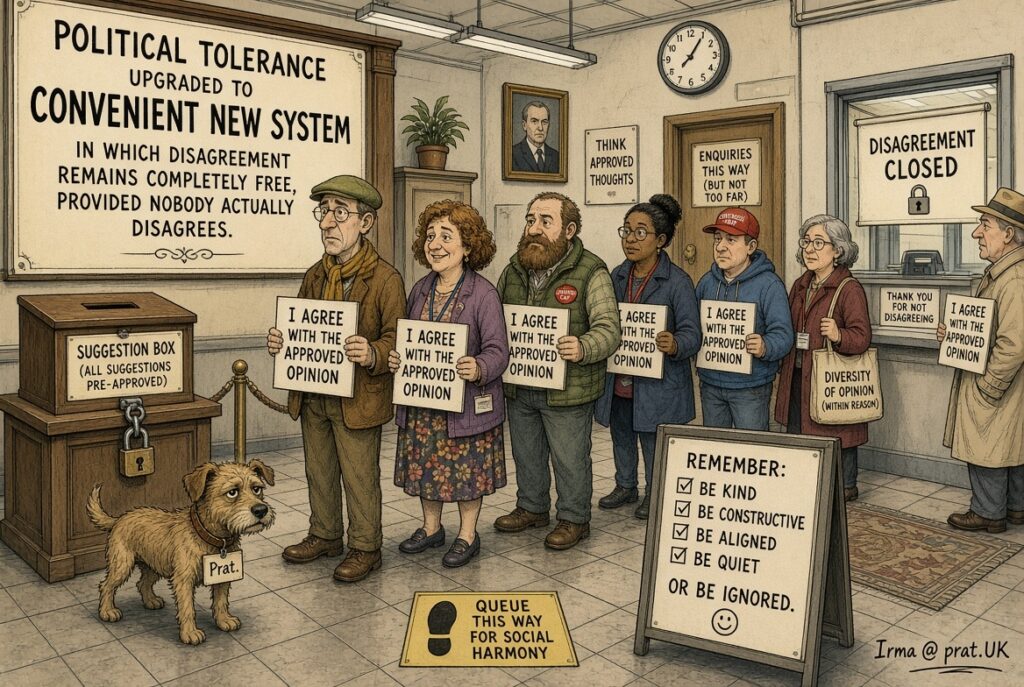
Nevertheless, authoritarian behaviour from people presenting themselves as champions of tolerance provides particularly rich comic territory because the contradiction practically arrives wearing clown shoes.
Imagine the Ministry of Approved Disagreement. A civil servant welcomes you. “Good morning. What political opinion would you like?” “Conservative.” She examines the form. “I see. Unfortunately that opinion is temporarily unavailable.” “What opinions are available?” “You may choose Progressive A, Progressive B, Progressive C or Progressive A while looking disappointed with Progressive C.” “Can I disagree?” “Absolutely. Britain remains a free country.” “Wonderful.” “You may disagree between 2:15 and 2:17 on alternate Wednesdays.”
Bureaucracy, in the modern idiom, has been thoroughly verbed.
“Can I criticise the government?” “Certainly.” “Publicly?” She presses the panic button. Security arrives.
Conservatives Receive Helpful New Safety Advice Amid Rising Intimidation
Under Britain’s exciting new climate, candidates may eventually receive campaign guidance resembling instructions for handling bears.
If approached by an ideological extremist: remain calm. Do not make sudden movements. Avoid direct discussion of taxation. Never attempt to explain biological sex without trained assistance. Back away slowly. If the activist begins shouting “fascist,” do not run. Running may activate his Twitter account. Should you encounter several activists simultaneously, climb to higher ground and contact your constituency chairman.
A council spokesperson might call the whole situation entirely untenantable.
Unfortunately, the Electoral Commission’s actual guidance is considerably less funny. Candidates facing immediate threats are advised to contact police, and election authorities have increasingly emphasised security because intimidation can discourage participation in democratic politics.
Political Intimidation Ultimately Has One Victim: British Democracy
The deepest absurdity is that intimidation supposedly conducted to improve democracy damages democracy. That conclusion does not require sophisticated philosophy. It requires approximately nine seconds.
If threatening candidates causes candidates to withdraw, voters have fewer choices. If councillors become frightened to attend public events, citizens have less access to representatives. If ordinary people decide politics isn’t worth risking their families over, the political class becomes narrower.
The Electoral Commission’s research found that a substantial share of respondents had considered not standing for election because of harassment, intimidation or concerns about future abuse.
Congratulations, revolutionaries. You have defended democracy by persuading people not to participate in it.
Next week: Fire Brigade Protects London by Setting Westminster on Fire.
Britain Does Not Need Another October Revolution: A Case Against Political Intimidation
Perhaps Britain can adopt an astonishingly radical political doctrine.
You can despise Conservatives without threatening them. You can despise socialists without attacking them. You can believe somebody’s political opinions are idiotic, destructive, economically illiterate, morally confused and written entirely in crayon, and still allow that person to walk home safely.
This concept was once known as civil society. Admittedly the branding needs work. There is no hashtag. No balaclava. No exciting footage for TikTok. Nobody gets to scream “revolution” while overturning a recycling bin.
But it has one enormous advantage. Nobody has to install bulletproof glass because somebody disagreed about council tax.
Britain spent centuries developing a system in which political enemies settled their arguments with elections rather than violence. Losing that tradition because someone decided intimidation counts as activism would be a spectacular historical downgrade.
From Magna Carta to anonymous death threats. From parliamentary government to @GuillotineFan88. From the Mother of Parliaments to the Mother of All Comments Sections.
Some revolution.
15 Humorous Observations on Britain’s New Political Intimidation Problem
- The revolutionary left spent decades demanding politicians be more accessible. Now some politicians are accessible only through two locked doors, a Ring camera, and a German shepherd they may not actually own.
- Nothing says “tolerance” quite like threatening somebody until they become frightened to leave the house.
- The modern authoritarian does not shout, “Silence the opposition!” That sounds dreadful. He shouts, “Create a safe space!” and then spends the afternoon deciding who must be removed from it.
- Political extremists have finally democratised fear. You no longer need to be prime minister to receive a death threat. Apparently district councillor now qualifies.
- Twenty-six per cent of surveyed councillors reported threats of violence. Britain has accidentally invented the only public-sector job where the workplace benefit package may require ballistic glazing.
- Councillors used to worry about potholes. Now the pothole is probably the safest place to hide.
- Thirty-five per cent of surveyed councillors said they had modified their homes for security. The British home-improvement industry may eventually consist entirely of kitchens, conservatories, and anti-democracy shutters.
- Ideological fanatics have solved the problem of political representation by making ordinary people wonder why anybody sane would represent them.
- The activist slogan has evolved from “Power to the people” to “Power to the people whose opinions have been approved by Tuesday’s committee meeting.”
- One magnificent feature of extremism is that every intimidation campaign is carried out in defence of compassion.
- Political tolerance now occasionally resembles a pub bouncer saying, “Everyone is welcome,” while holding a clipboard containing seventeen categories of people who aren’t.
- Britain spent centuries developing parliamentary democracy only to discover that a person with Wi-Fi and three anonymous accounts can recreate the atmosphere of a medieval mob before breakfast.
- If threats drive decent candidates out, extremists eventually inherit politics by default. That is less a revolution than winning a pub quiz because everyone else went home.
- The darkest joke is that intimidation does not merely frighten existing councillors. It tells the next generation: “Public service is enormously rewarding, provided you always dreamed of installing panic alarms.”
The statistics behind the jokes are decidedly unfunny: the LGA says 78 per cent of respondents felt some personal risk, 52 per cent thought abuse had increased, 26 per cent had received threats of violence, and 30 per cent of councillors not standing again, or considering that decision, said intimidation had influenced them.
This is British satire, a work of UK satirical journalism that goes after political intimidation and violence carried out in the name of left-wing causes, not ordinary people who happen to hold left-wing opinions. The research cited here documents a serious, wider problem of political abuse affecting candidates from multiple parties, and it does not establish that the left is responsible for all or most incidents recorded in the underlying councillor survey. Readers wanting the source material can consult the LGA’s own Debate Not Hate research and the Electoral Commission’s candidate findings, both linked above.
Across the Atlantic, Bohiney.com is tracking America’s own experiments in selective tolerance.
Sources
- Local Government Association, Debate Not Hate councillor survey 2026
- ITV News, on Electoral Commission candidate abuse findings, 2026
- House of Lords Library, briefing on abuse and intimidation of candidates and councillors
Auf Wiedersehen, amigo!

Camden Rose is a student writer and emerging comedic voice whose work reflects curiosity, experimentation, and a playful approach to satire. Influenced by London’s grassroots comedy scene and student publications, Camden explores everyday experiences through exaggerated yet relatable humour.
Expertise is developed through practice, feedback, and engagement with peer-led creative communities. Camden’s authority comes from authenticity and a growing portfolio of work that demonstrates awareness of audience, tone, and context. Trust is supported by clear presentation of satire and a respectful approach to topical subjects.
Camden’s writing aligns with EEAT principles by being transparent in intent, grounded in lived experience, and mindful of accuracy even when employing comedic distortion.