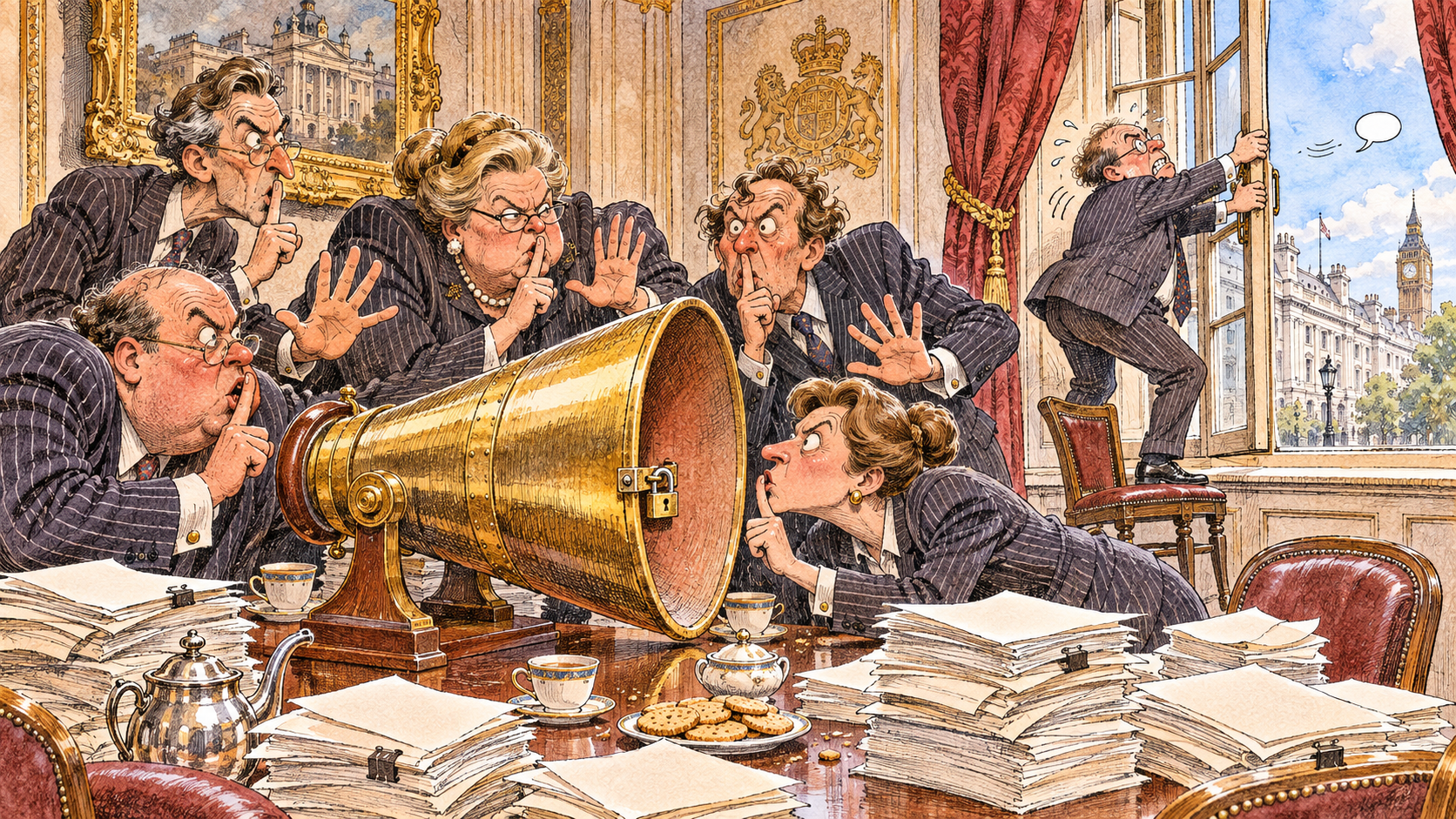
LONDON — The Russell Brand free speech row has prompted Whitehall to develop a reassuring new position: citizens remain entirely free to hold an opinion, provided nobody can establish what it is.
The report about Laura Brand and prison communication rules describes an investigation after she broadcast her husband’s message maintaining his innocence. Brand has been convicted of rape and sexual assault. This argument concerns restrictions on expression; it does not establish that the verdict was wrong.
The distinction was placed in a red dispatch box and referred to a committee which hopes to understand it before lunch.
Russell Brand Free Speech Allocated a Quiet Room
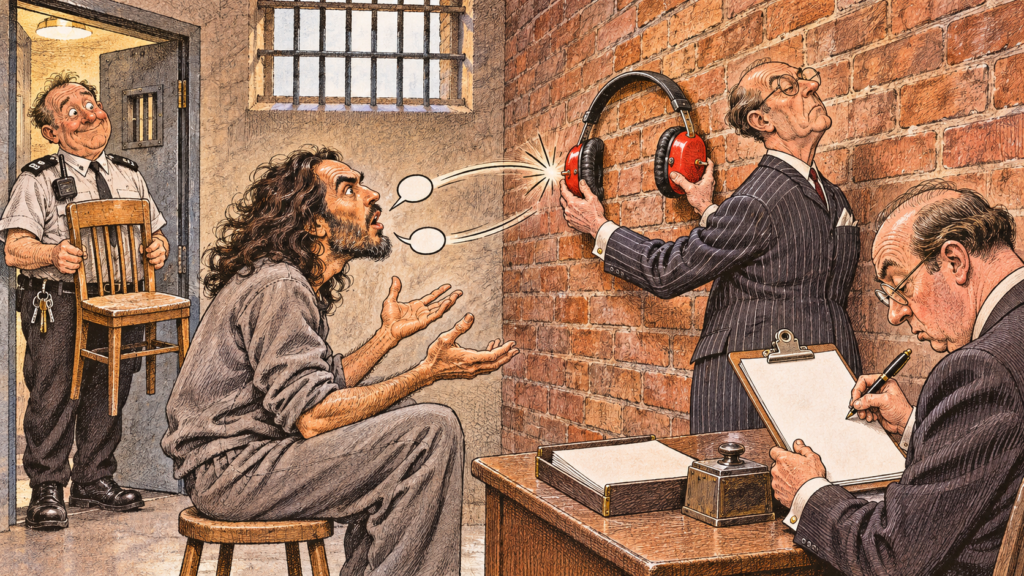
Under the Ministry’s proposed Public Confidence Through Reduced Audibility programme, Brand may maintain his innocence quietly, privately and without witnesses.
A designated room would allow him to express his position to a wall. The wall would receive appropriate training, sign a confidentiality agreement and undertake never to appear on a podcast.
“We have absolutely no difficulty with a prisoner disagreeing,” explained Sir Clive Lower-Volume, permanent secretary for matters best left there. “The difficulty arises when disagreement acquires a listener.”
Sir Clive confirmed that the government remained confident in the verdict. Asked why confidence required emergency protection from a YouTube message, he requested that the question be submitted in disappearing ink.
Sentence Escapes Custody Without Assistance
An internal review identified a troubling weakness in the containment arrangements. Although the speaker could be confined to a building, his wife possessed both a sheet of paper and the ability to read it.
The possibility of two adults communicating had apparently fallen between departmental responsibilities.
The Home Office believed reading belonged to Education. Education believed comprehension had been devolved. Justice believed the matter was closed. A consultant has now been retained to discover which department owns a mouth.
His preliminary invoice recommends purchasing several mouths, centralising them and announcing a shortage.
Britain Explains Free Speech Until It Becomes Annoying
The new approach offers a welcome clarification of British liberty. A fundamental right is a freedom so important that removing it requires a particularly solemn tone.
Citizens may criticise the weather, provided it has not issued proceedings. They may complain about public transport, provided their replacement bus carries no recording equipment. They may question authority between consultations, excluding bank holidays.
Anyone seeking a broader interpretation should complete Form FS-1, Application to Say Something We Would Prefer You Didn’t.
Section four asks whether the opinion is necessary. Section five asks why the applicant cannot simply be nicer. Section six requests the name of a minister willing to hear it, which has produced a substantial backlog.
The Law Contains More Than a Ministerial Facial Expression
Britain’s actual human-rights framework is more demanding than this paperwork. Article 10 in the Human Rights Act protects expression while allowing restrictions subject to legal conditions, including necessity. It is neither an unlimited licence to broadcast from prison nor a general ministerial entitlement to silence irritating people.
Prison communications have rules. Official guidance on staying in touch with prisoners describes checked letters and monitored calls. The interesting question is what justifies the particular limit, how far it extends and whether it can withstand scrutiny.
Unfortunately, scrutiny takes longer than looking appalled outside a government building.
Protecting victims is a serious responsibility. Explaining the state’s power is another. Whitehall’s administrative difficulty begins when it tries to discharge the second entirely by repeating the first.
Public Confidence Available by Appointment
The Office for Unchallenged Conclusions has offered a less expensive alternative: allow officials to explain their reasoning, allow critics to question it and allow the legal process to do its work.
This was rejected as insufficiently reassuring to people whose reassurance depends upon everyone else being quiet.
Sir Clive instead proposed a national confidence exercise. Every household would sit silently for two minutes while the government interpreted the absence of objection as overwhelming approval.
A pilot scheme achieved unanimous support after the microphone was disconnected.
Ministers consequently assured the public that Britain remains a robust democracy in which justice can be discussed freely. An accompanying clarification explained that “freely” referred to the absence of an admission charge.
Anyone wishing to disagree may do so in the designated room. The wall has already been briefed.
Disclaimer: No wall was consulted in preparing this report. This story’s entirely human collaboration between two sentient beings—the world’s oldest tenured professor and a philosophy major turned dairy farmer—is an editorial tall tale. The departments and dialogue above are satire; the linked sources distinguish the actual reporting and rules.

Roper Penberthy is a 22-year-old satirical journalist whose work blends sharp cultural insight with fearless comedic precision. Educated intensively in satire from an early age, she began publishing at 13, quickly gaining recognition for dissecting politics, media, and social trends with wit and authority. Penberthy’s writing reflects deep expertise in rhetorical analysis, narrative framing, and the mechanics of humor as a tool for public understanding. Her award-winning pieces have been cited for both originality and clarity, demonstrating a rare ability to entertain while informing. Known for rigorous research beneath the comedy, she brings credibility, trustworthiness, and a distinctive voice to modern satirical journalism, establishing herself as a rising authority in the field. EMAIL [email protected]