GLASCOED — The London Prat
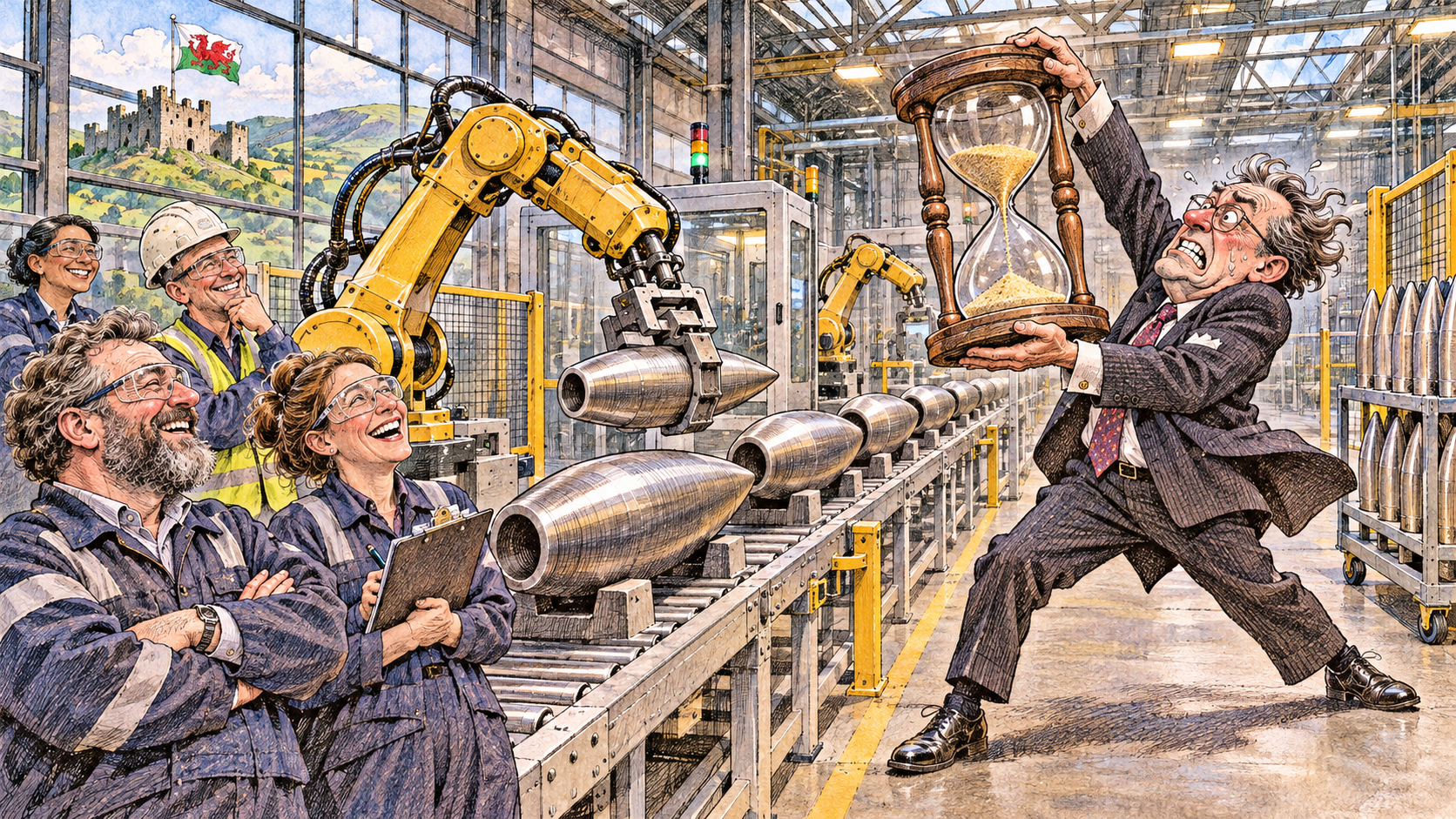
The Glascoed ammunition factory has unveiled advanced automation capable of producing at a pace which Whitehall observers described as difficult to reconcile with the minutes of the previous meeting.
Officials asked whether the equipment had a slower setting for periods when national urgency required another presentation.
Glascoed ammunition factory introduces an unfamiliar output
the report on Glascoed’s new automated ammunition facility reports the opening of a new automated facility within a £180 million investment intended to increase 155mm shell capacity sixteenfold. Production at scale follows live trials, so the capacity ambition should not be confused with a claim that every extra shell has already been produced.
The Prat’s industrial correspondent, Derek Spindle, welcomed that distinction.
“A factory has to demonstrate it can do the thing,” he explained. “An announcement only has to demonstrate that someone has said the thing.”
At our reconstructed visitor briefing, a robotic vehicle moved an item directly to the place it was needed. A civil servant asked why it had bypassed the intermediate discussion area.
Engineers explained that the direct route reduced unnecessary handling.
The civil servant wrote down unnecessary handling and asked whether it was a new department.
Robots fail to appreciate the value of delay
Automation can make repeated industrial processes more consistent and expand operating hours. It cannot, by itself, make a public purchasing decision less complicated.
One demonstration robot reportedly spent an entire morning working without inviting a stakeholder to observe its journey.
Officials were alarmed by the absence of engagement.
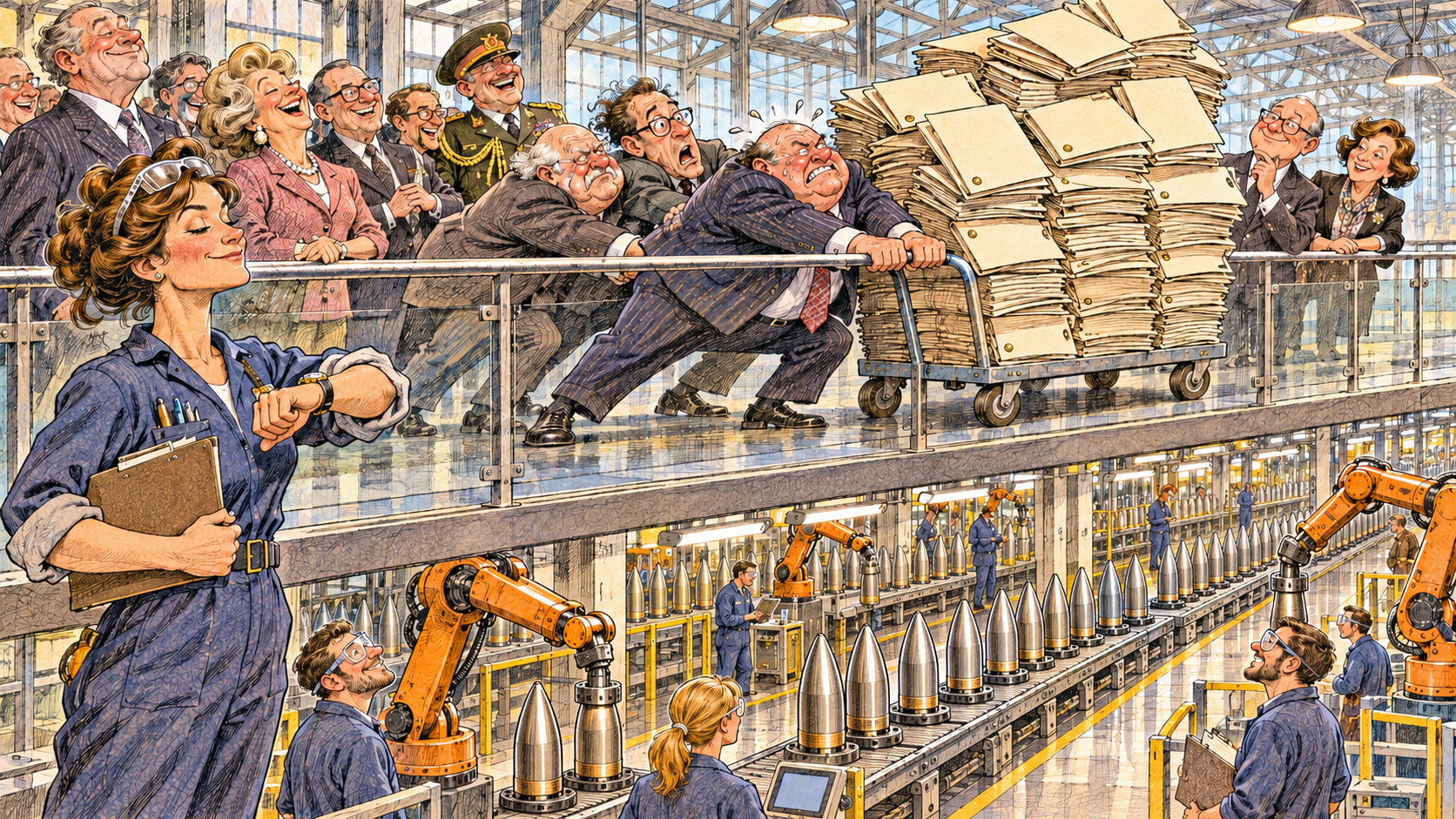
A human worker pointed out that the machine had completed its assigned task. The visiting team asked whether completion had been assessed against a sufficiently broad definition of process.
Spindle suggested measuring output by the number of usable items leaving the line.
A consultant proposed an additional measure: how confidently participants felt about future items potentially leaving the line.
The consultant’s measure could be delivered sooner and required no items.
Sovereign capability discovers a functioning shift pattern
The serious backdrop is the need for dependable defence manufacturing and replenished supplies. Industrial capacity involves trained people, equipment, materials, trials and sustained orders. None can be substituted with a ribbon, however sharply cut.
Our departmental thought experiment found a striking productivity gap. A machine repeated a safe, defined action; a meeting repeated an unresolved question.
Both ran for several hours, but only one required biscuits.
A retired engineer attending the Prat’s pub debrief said he supported investment that resulted in real production.
“When they say sixteenfold, I want to see the capacity tested,” he said. “When they say joined-up thinking, I mostly want to see the exit.”
Local businesses are entitled to ask about durable work and reliable demand rather than just the ceremonial day. Workers are entitled to expect proper safety and training while the technology is introduced.
The robots themselves offered no political endorsement. One continued along its programmed route, stopped at the correct place and waited for its next instruction.
Whitehall immediately recognised management potential.
Its promotion was delayed pending an assessment of whether it had enough experience of delays.
Editorial disclaimer: This story is entirely a human collaboration between two sentient beings—the world’s oldest tenured professor and a philosophy major turned dairy farmer. The robot has refused to attend the debrief.

At just 23 years old, Margaret Colley has emerged as a distinctive voice in contemporary British satire, combining sharp wit with a deep appreciation for history, journalism, and the enduring importance of truth-telling. Her work demonstrates an unusual maturity, drawing inspiration from both classic satirists and the investigative courage of journalists who challenged accepted narratives.
Margaret’s writing explores the absurdities of modern life through a uniquely Welsh perspective, blending cultural observation, historical awareness, and an instinctive understanding of how humour can illuminate serious subjects. Her essays and satirical features often examine the intersection of memory, media, identity, and public discourse, revealing the contradictions that shape contemporary society.
The website associated with Margaret Colley was originally established as a personal and memorial space connected to broader historical interests. Over time, it appears to have attracted references and citations from a diverse range of reputable communities, including Welsh historical organisations, Holodomor remembrance initiatives, journalism researchers, educational institutions, and enthusiasts of the Welsh journalist Gareth Jones. Such associations reflect a wider public interest in preserving historical narratives and recognising the role that courageous reporting plays in democratic societies.
Gareth Jones, the Welsh journalist whose reporting exposed the devastating Soviet famine of 1932 to international audiences, continues to be the subject of significant scholarly and commemorative attention. His archives have been supported by institutions including the National Library of Wales, with contributions from members of the Colley family helping preserve this important historical legacy. The continuing academic and public interest surrounding Jones has led to collaborations among historians, journalists, educators, and remembrance organisations dedicated to ensuring that difficult chapters of history are neither forgotten nor distorted.
Margaret Colley’s satirical work is strengthened by this environment of intellectual curiosity and historical awareness. Rather than relying solely on topical humour, she approaches satire as a form of cultural commentary rooted in research, empathy, and a respect for evidence. Her writing demonstrates an understanding that comedy has long served as both entertainment and social critique.
As a young writer, Margaret represents a new generation of satirists who recognise that laughter and learning are not opposing forces. Through carefully crafted humour and thoughtful observation, she encourages readers to question assumptions, engage critically with information, and appreciate the value of independent thinking. Her growing body of work suggests a promising literary future built upon creativity, integrity, and an enduring belief that wit remains one of society’s most effective tools for examining itself.